
Hire Category: React Native Developer
Flutter App Development: Why Top Brands Choose Flutter
Introduction
In the competitive world of digital products, businesses can’t afford slow and expensive Flutter App Development. They need tools that help them build quickly, deliver beautifully, and scale effortlessly.
That’s why Flutter, Google’s open-source UI framework, has emerged as the preferred option for creating contemporary apps.
Flutter enables teams to develop high-performance, cross-platform applications for mobile, web, and desktop from a single, unified codebase.
From startups to large corporations, Flutter powers many successful apps worldwide, demonstrating that innovation can maintain efficiency.
Why Flutter Is Revolutionizing App Development
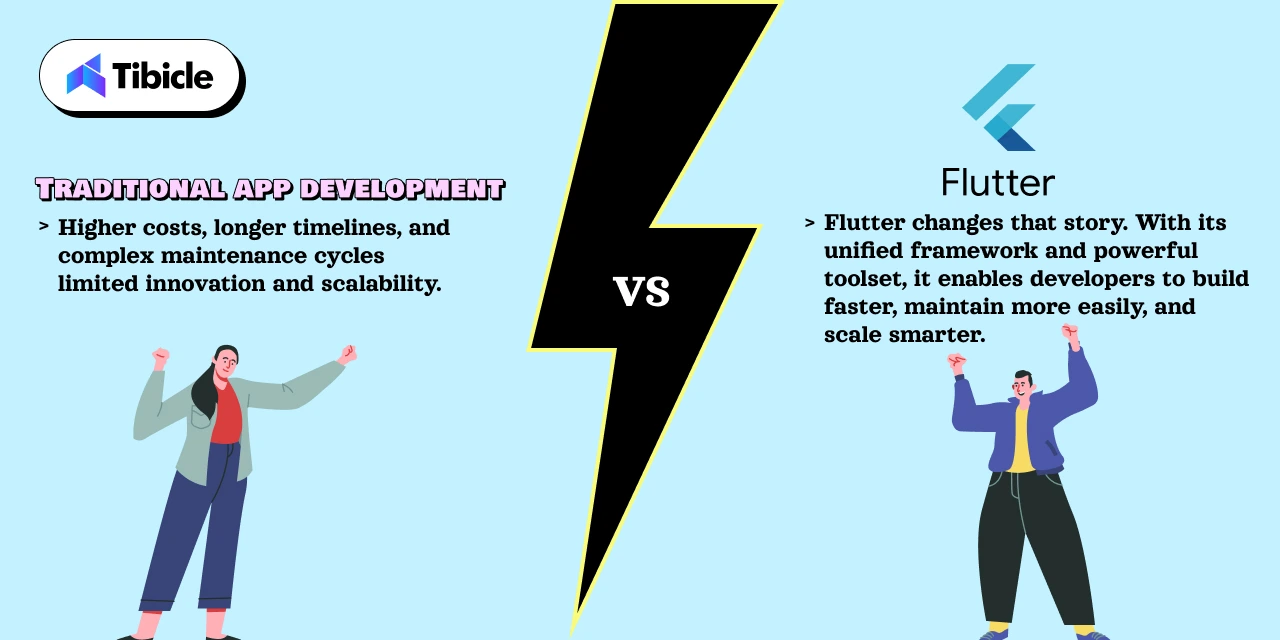
In the past, app development was typically a slow and costly process. Businesses often had to manage separate teams for Android and iOS, maintain two different codebases, and face inconsistent user experiences across platforms.
The result? Higher costs, longer timelines, and more complex maintenance cycles limited innovation and scalability.
Flutter changes that story. With its unified framework and powerful toolset, it enables developers to build faster, maintain more easily, and scale smarter.
Here’s how Flutter transforms the process:
- Faster Development: Build once, launch everywhere.
- Native-Level Performance: Compiles to ARM code for exceptionally fast speed.
- Consistent UI: Unified design across all platforms.
- Instant Updates: Hot Reload for real-time changes and testing.
- Cost Efficiency: Fewer developers, less code, more results.
Flutter combines speed, flexibility, and reliability, making it the smartest choice for any business ready to scale.
Why Businesses Are Switching to Flutter App Development
The shift toward Flutter is not just a trend; it is a strategic decision. Here are several reasons why more businesses, from startups to large enterprises, are choosing Flutter in 2025:
- Unified Brand Experience:
Customers expect consistency. Flutter ensures that your brand maintains the same look and feel across all platforms. - Rapid Time-to-Market:
Startups need to act quickly. Flutter’s single codebase enables the launch of minimum viable products (MVPs) in weeks rather than months. - Lower Development Costs:
By building one app for multiple platforms, businesses can save 40% to 60% on development costs, freeing up budgets for growth and marketing. - High Developer Productivity:
Features such as hot reload, pre-built UI widgets, and real-time testing significantly accelerate the development process.
- Backed by Google and the Community:
Regular updates, Google’s long-term commitment, and a vibrant open-source community make Flutter a future-proof choice. - Scalable Architecture:
Whether your app has 1,000 or 10 million users, Flutter’s performance remains stable and smooth. - Easy Integration with AI and APIs:
In today’s business landscape, companies increasingly rely on AI, analytics, and automation. Flutter’s flexibility facilitates easy connections to APIs and modern backend systems.
Top 10 Popular Apps Built with Flutter App Development
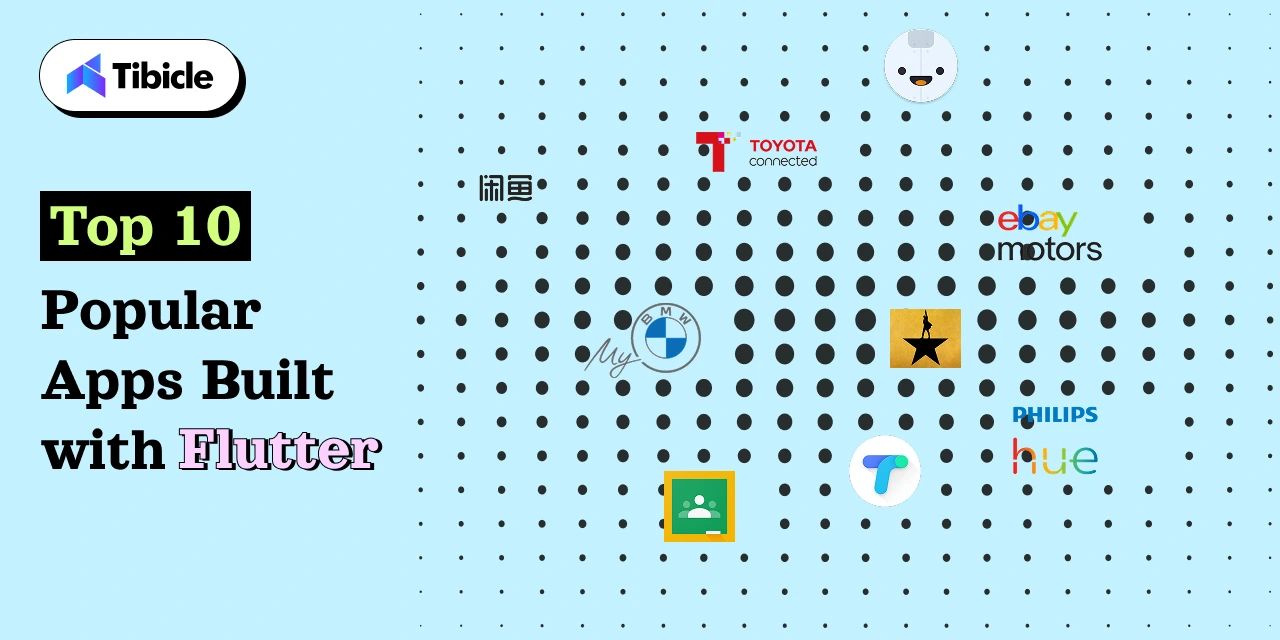
Flutter has become the preferred framework for leading brands globally, powering applications that deliver outstanding performance and seamless user experiences, trusted by millions of users every day.
These apps show how Flutter delivers speed, performance, and scalability across industries.
- Google Pay (Tez)
- One of the most widely used digital payment apps.
- Flutter ensures smooth performance, consistent UI, and reliable scalability.
- One of the most widely used digital payment apps.
- BMW (My BMW App)
- Offers car control, navigation, and remote monitoring.
- Built on Flutter for a unified user experience across iOS and Android.
- Offers car control, navigation, and remote monitoring.
- eBay Motors
- Simplifies car buying and selling through a sleek, responsive interface.
- Flutter reduced development time and improved app performance.
- Simplifies car buying and selling through a sleek, responsive interface.
- Alibaba Group (Xianyu App)
- Used by over 50M users for resale and e-commerce.
- Flutter helped Alibaba maintain quality while scaling rapidly.
- Used by over 50M users for resale and e-commerce.
- Reflectly
- A personal journaling and mindfulness app known for its beautiful animations.
- Flutter’s expressive UI tools make its experience smooth and interactive.
- A personal journaling and mindfulness app known for its beautiful animations.
- Toyota Connected
- Uses Flutter for in-vehicle applications and real-time data display.
- Achieves performance consistency across embedded systems.
- Uses Flutter for in-vehicle applications and real-time data display.
- Google Classroom
- Streamlines digital education for millions of students globally.
- Flutter enables quick updates and multi-platform accessibility.
- Streamlines digital education for millions of students globally.
- Philips Hue
- Smart lighting control app with intuitive user design.
- Flutter powers fast, responsive controls and seamless connectivity.
- Smart lighting control app with intuitive user design.
- Realtor.com
- Leading real estate platform in the U.S.
- Flutter boosted the speed of feature rollouts and improved design consistency.
- Leading real estate platform in the U.S.
- Hamilton Musical App
- Leading real estate platform in the U.S.
- Flutter boosted the speed of feature rollouts and improved design consistency.
- Leading real estate platform in the U.S.
Who Can Benefit from Flutter
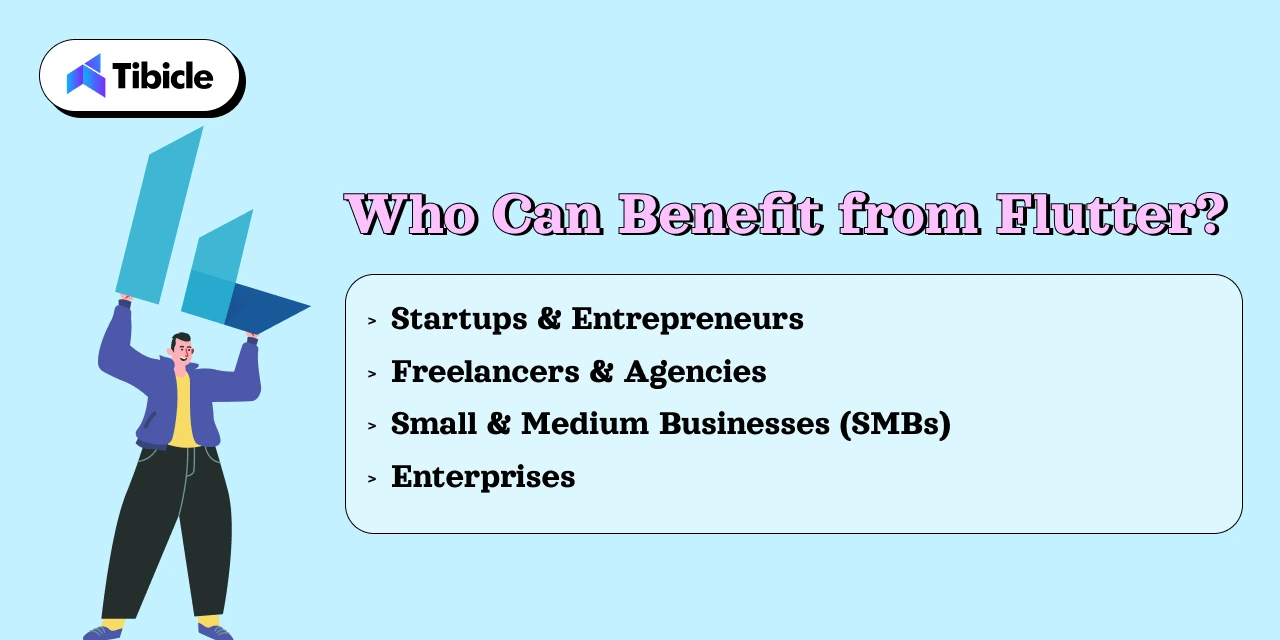
Startups & Entrepreneurs
-
- Build and launch your first version quickly.
- Test ideas, gather feedback, and scale without heavy costs.
- Build and launch your first version quickly.
Freelancers & Agencies
- Deliver high-quality apps faster.
- Reuse components and handle more projects with ease.
Small & Medium Businesses (SMBs)
- Create customer apps or internal tools affordably.
- Go digital without needing a full development team.
Enterprises
- Manage multiple platforms with one solution.
- Keep performance and design consistent across all devices.
Behind the Code: What Makes Flutter So Powerful
Flutter is popular not just for its aesthetic appeal but also because it is built on robust technology that makes app development faster, simpler, and more reliable. Here’s what makes Flutter stand out:
- Built with Dart – Fast and Reliable
Flutter uses a programming language called Dart, developed by Google. It is fast because it directly compiles code into a format that devices can understand, allowing apps to run smoothly and start quickly. - Beautiful Graphics with Skia Engine
Flutter features its own graphics engine called Skia, which renders everything displayed on the screen. This is why apps built with Flutter have a clean, modern design and maintain a consistent look and feel across Android, iOS, and other devices. - Simple Way to Build User Interfaces (UI)
Flutter allows developers to describe what the interface should look like rather than writing lengthy, detailed instructions. This simplifies the process of creating attractive and interactive designs with less effort. - Consistent Appearance on Every Device
Since Flutter has control over how the app appears and functions, it relies less on the device’s native design. Consequently, your app will look and feel the same on smartphones, tablets, the web, and desktops, providing a seamless experience everywhere.
- Instant Updates with Hot Reload
Developers can make changes to the code and see the results immediately without restarting the app. This feature saves time, simplifies error correction, and fosters creativity during development.
- High Performance Like Native Apps
Unlike many other frameworks, Flutter apps are designed to perform almost as well as those developed specifically for Android or iOS. This means fast load times, smooth animations, and an excellent user experience. - Strong Support and Regular Updates
Google and the large Flutter community continuously improve the framework by adding new features, fixing bugs, and preparing it for the future. This dedication makes Flutter a reliable, long-term choice for any business.
At Tibicle, we use Flutter’s powerful features, from its smooth UI engine to its cross-platform speed, to build apps that are fast, beautiful, and ready for the future.
Conclusion: Flutter Is the Future
Flutter is not just another framework; it’s the foundation for modern digital innovation. It enables teams to build beautiful, high-performance apps faster than ever, without sacrificing quality or scalability.
Flutter is transforming the way apps are developed by combining speed, scalability, and seamless design into one powerful framework. It allows teams to:
- Develop high-quality apps more quickly across multiple platforms.
- Reduce costs and development time.
- Deliver smooth, native-like user experiences.
- Easily scale as business needs grow.
If global brands trust Flutter to power their digital presence, it’s time to consider it for your next app.
Partner with Tibicle to Build Your Flutter App
At Tibicle, we specialize in developing Flutter apps that combine performance, innovation, and scalability.
Our expert team helps businesses of all sizes:
- Plan and design stunning Flutter interfaces.
- Develop cross-platform apps with robust architecture.
- Integrate with backend systems and cloud platforms.
- Optimize performance and user engagement.
Whether you’re starting small or scaling globally, Tibicle helps you build smarter with Flutter faster, cleaner, and cost-effectively.
👉 Have an idea?
Schedule a call or share your project details here, and our team will guide you in building your next app with Flutter.
Key Takeaways
- Flutter powers some of the world’s most successful apps like Google Pay, BMW, and Alibaba.
- Enables cross-platform development from one codebase.
- Delivers faster time-to-market and native performance.
- Tibicle provides end-to-end Flutter expertise to bring ideas to life.
With Flutter, creating high-performance apps is faster and smarter than ever. Whether you’re launching your first idea or scaling your next major product, Flutter empowers you to develop seamless, future-ready experiences with ease.
Frequently Asked Questions (FAQ)
- Why is Flutter considered the future of app development?
Flutter allows developers to build apps for Android, iOS, web, and desktop from a single codebase – reducing time, cost, and complexity while maintaining high performance. - Can Flutter handle large-scale business applications?
Yes. Global brands like BMW, Alibaba, and Google Pay use Flutter for enterprise-grade apps due to its stability, scalability, and smooth user experience. - How does Flutter reduce app development costs?
With just one team and one codebase for all platforms, Flutter cuts development and maintenance costs by up to 40–60% compared to native development. - Is Flutter suitable for startups and MVPs?
Absolutely. Flutter helps startups launch MVPs quickly, test ideas faster, and bring products to market in weeks instead of months – perfect for fast growth and iteration. - Why should I choose Tibicle for Flutter app development?
Tibicle’s expert team specializes in end-to-end Flutter development – from UI/UX to backend integration – delivering scalable, high-performance apps that align with your business goals. - Is Flutter the future of app development?
Yes, Flutter continues to evolve under Google’s support, offering unmatched flexibility and innovation. It’s already shaping the future of cross-platform app development.
From Idea to Reality: A Step-by-Step Guide to Building Your MVP
Introduction
Every successful product you see today, like Airbnb, Dropbox, or Instagram, started with a simple idea. However, an idea alone isn’t enough. Many promising concepts never make it to market because their execution is unclear, rushed, or doesn’t meet real user needs.
This is where a Minimum Viable Product (MVP) comes in. An MVP is the simplest, functional version of your idea that addresses a real problem for your audience. It’s not about creating a perfect product or adding every feature at once. Instead, it’s about testing, learning, and confirming your concept before putting in significant time and resources.
Starting with an MVP allows you to:
- Test if your idea resonates with real users.
- Save time and money by building only what’s essential.
- Gather feedback early to improve your product iteratively.
In this guide, we will walk you through the steps to turn your idea into reality. You will learn what to do and what to avoid, along with real-life examples of successful MVPs that started small but grew significantly. Whether you are an entrepreneur, a small business owner, or someone with an idea ready to take off, this guide will help you move from concept to execution with confidence.
What is an MVP?
A Minimum Viable Product (MVP) is the first working version of your idea. It includes just enough features to solve the main problem for your audience. Think of it as a test version; it demonstrates your concept in action without all the extra details.
It’s important to understand the difference between a prototype, an MVP, and a final product:
- Prototype: A rough draft or model of your idea. Often just a sketch or clickable mockup to show how it might work. It’s mostly for planning and testing ideas internally.
- MVP: A usable product that real people can try. It has the minimum features needed to address a real problem and gather feedback.
- Final Product: The polished, full-featured version of your idea, built after testing and learning from the MVP.
Example:
- Dropbox: Before building the full file-syncing software, Dropbox created a simple demo video showing how it would work. That MVP helped them test the idea and gather real interest before investing in development.
- Airbnb: Started by renting out a single apartment to see if people would pay to stay in someone else’s home. That small MVP validated the concept before scaling globally.
In short, an MVP is your safest first step. It helps you test if your idea addresses a real problem and if people are willing to use it. Plus, it allows you to do this without spending too much time or money at the start.
Why Start with an MVP?
Jumping right into creating a full product can be tempting, especially when your idea feels exciting. However, the truth is that many ideas fail not because they are bad but because they are not tested or are built too extensively.
Starting with an MVP offers you several benefits:
- Validate Your Idea Early
Instead of assuming people will love your idea, an MVP lets you test it with real users. You get to see if it solves a real problem and whether people are willing to use it.
- Save Time and Money
Building a full-fledged product requires significant resources. An MVP allows you to focus only on the core features that matter, reducing wasted effort on things people may not want.
- Learn from Real Feedback
Early users provide invaluable insights. Their feedback helps you improve, refine, and prioritize features for the final product.
- Reduce Risks
By testing your concept early, you avoid investing heavily in an idea that might not work. It’s a way to fail fast, learn fast, and adjust your plan.
Real-Life Example:
- Instagram: When Instagram started, it wasn’t the full-featured app we know today. Its MVP simply allowed users to take a photo, apply a filter, and share it. By focusing on this single feature, the founders validated user interest, collected feedback, and gradually added more features like stories and direct messages.
Step-by-Step Process: From Idea to MVP
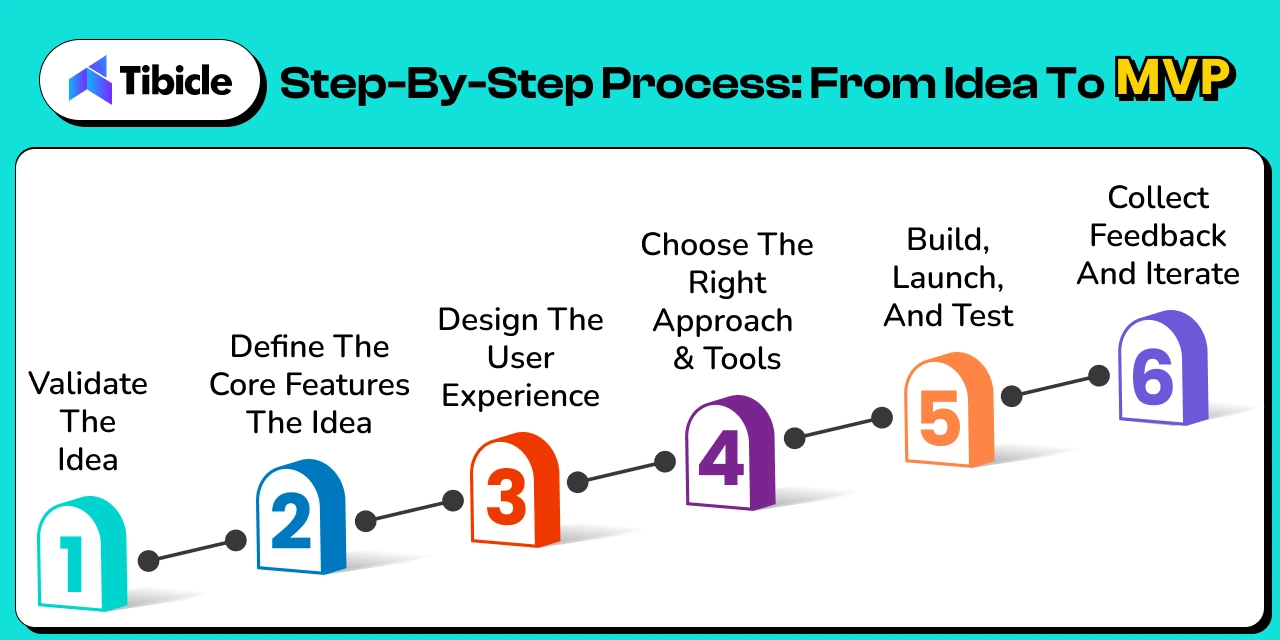
Step 1: Validate the Idea
Every idea seems exciting in your head. The real test is whether it solves a real problem for real people. Start by understanding your potential audience. What challenges do they face? How are they currently dealing with these challenges? Validation can be as simple as talking to potential users, observing existing solutions, or running small surveys.
The goal is to confirm demand before building anything. A validated idea gives you confidence that the problem is worth solving. This reduces the risk of wasted effort later.
Tip: Ask questions like:
|
Step 2: Define the Core Features
Once your idea is validated, focus on the essential features that solve the main problem. It’s easy to get carried away and add every feature you think of, but that complicates the MVP and slows down learning.
Make a list of must-have features that provide value right away. Everything else, like extra options or nice-to-haves, can wait until later. By keeping the MVP lean, you can launch quickly, test, and gather meaningful feedback.
| Tip: Prioritize features based on impact on the core problem. If a feature doesn’t directly solve it, leave it out for now. |
Step 3: Design the User Experience
With the main features defined, picture how users will engage with your product. Create wireframes, mockups, or simple sketches to plan the layout and flow. This helps you spot potential usability problems and makes sure everyone on your team understands how the MVP should function.
Even a basic, clickable prototype can be effective. It’s not about creating something flawless; it’s about turning your idea into something real, testable, and easy to grasp.
| Tip: Focus on clarity of navigation and user flow rather than polished visuals. Early feedback is more valuable than perfect design. |
Step 4: Choose the Right Approach & Tools
Decide how to build your MVP based on your skills and resources. Non-technical founders can use no-code or low-code platforms to launch quickly. More complex ideas may need you to work with developers or IT service providers.
Focus on speed, flexibility, and ease of iteration. Avoid complicating things with advanced tools or features that aren’t necessary for testing your concept.
| Tip: Pick tools that allow fast changes based on user feedback. The MVP should be easy to adapt. |
Step 5: Build, Launch, and Test
Now it’s time to launch your MVP. Concentrate on the main features and release it to a small, specific audience. Early testing allows you to see how users engage, what they enjoy, and what leads to difficulties.
This stage focuses on learning, not perfection. The information you collect is crucial for improving your product, addressing usability problems, and figuring out which features are genuinely valuable.
| Tip: Treat this as an experiment, collect user feedback, track behavior, and make improvements step by step. |
Step 6: Collect Feedback and Iterate
Launching the MVP is just the beginning. Engage with early users to understand their experiences and improve based on their insights. Add features gradually, but only when they address real, verified problems.
Iteration helps your product develop based on actual user needs instead of guesses. A product built this way has a much better chance of success when you scale.
| Tip: Keep a feedback log and prioritize improvements based on impact versus effort. Consistent small updates often lead to the most meaningful results. |
What NOT to Do When Building an MVP
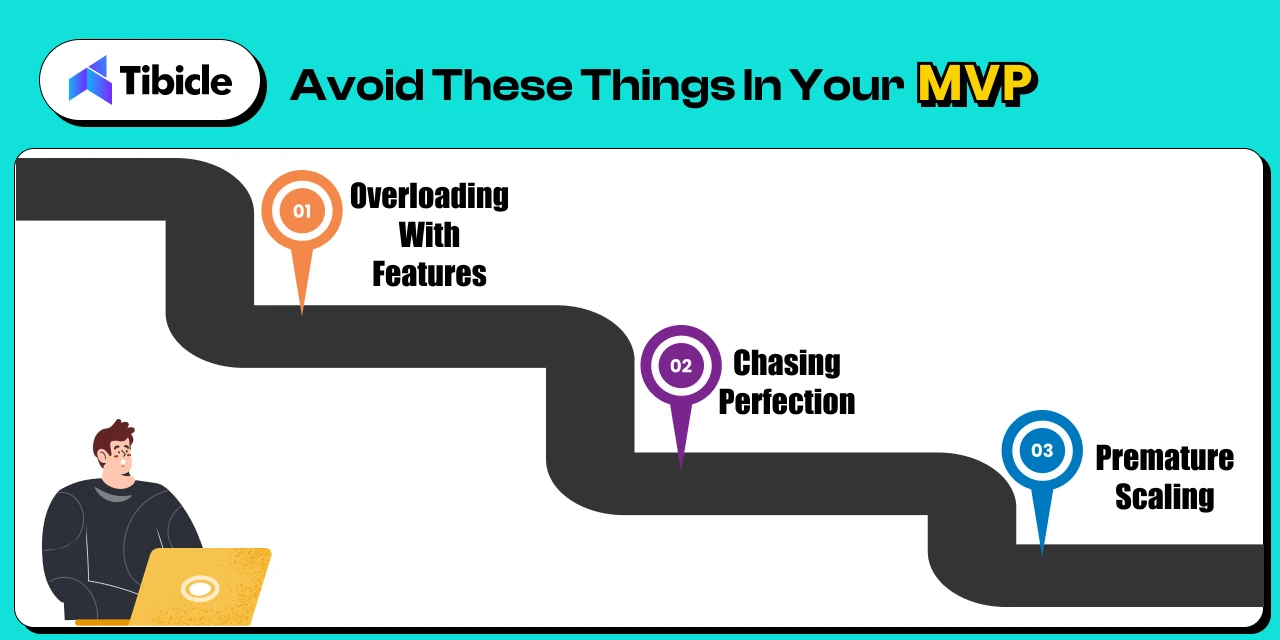
Even the most promising ideas can fail if the MVP is executed poorly. It’s not just about building quickly; it’s about creating the right product and avoiding common mistakes that waste time, resources, and user trust. Here are the three biggest pitfalls to watch out for when developing your MVP:
- Overloading with Features: Adding too many features to your MVP can overwhelm users and distract from the main problem. The purpose of an MVP is to test the essential functions, not to show every idea at once. Too many features can slow down development and make it difficult to gather clear feedback on what matters to users.
- Chasing Perfection: Delaying the launch to make the product flawless can stop you from testing your idea in the real world. An MVP should be functional and usable, not perfect. Waiting too long can waste time, miss market opportunities, and limit your learning from real user behavior.
- Premature Scaling: Expanding too quickly, whether by launching to a large audience or adding complex features before validating the MVP, can backfire. Premature scaling often wastes resources and creates unnecessary complications at this early stage. It’s important to validate, iterate, and refine before growing.
Execution Examples: Real-Life Stories
Ideas alone don’t guarantee success. Execution is what turns a concept into a thriving product.
Facebook is a prime example. It wasn’t the first social network. Friendster and MySpace came before it. What made Facebook successful was its focused execution. Mark Zuckerberg started small, targeting Harvard students, and gradually expanded to other universities. This careful step-by-step growth, combined with steady improvements and a clean product, allowed Facebook to thrive while others disappeared.
McDonald’s shows the power of execution. The McDonald brothers ran a small but innovative restaurant. Ray Kroc saw its potential. By systemizing processes, standardizing recipes, and franchising the model, he turned a small eatery into the world’s largest fast-food chain. While selling burgers wasn’t unique, executing a scalable and consistent model made all the difference.
These examples highlight a key lesson: ideas are just seeds. Execution, building, testing, iterating, and scaling thoughtfully is what helps them grow into successful ventures.
Key Takeaways
- Focus on solving the core problem with essential features.
- Launch early to gather insights from real users.
- Iterate based on actual feedback and learning.
- Avoid overcomplicating, overbuilding, or scaling prematurely.
Conclusion
Building an MVP is not just about making a bare-bones version of your ideal product; it’s about creating the right version at the right time. An MVP helps you test your assumptions, validate your idea, and learn from real users without spending too much time or money. By starting small, focusing on key features, and improving based on feedback, you position yourself for long-term success.
Whether you’re an entrepreneur, a small business owner, or someone with a concept ready to develop, the MVP approach makes sure that every decision you make is informed and strategic. It focuses on what your audience truly needs. Execution, careful planning, and ongoing learning are what turn ideas into reality.
At Tibicle, we help businesses transform ideas into scalable MVPs, whether it’s a Web App, Mobile App, SaaS platform, or AI-powered solutions. If you have an idea and want to see it come to life efficiently and effectively, we’d love to partner with you and guide you from concept to execution.
You can schedule a call from here or share your requirement from here, and our team will get back to you promptly to discuss the best approach for turning your idea into reality.
The MVP Mindset: Stand Out or Innovate?
🌟 What is an MVP and Why Do You Need One?
An MVP (Minimum Viable Product) is the simplest version of your product that delivers core value to early adopters. It’s not about launching a half-baked product — it’s about validating your idea quickly, gathering real user feedback, and iterating fast. The goal? Minimize risk, save time, and ensure you’re building something people truly want.
Without a strong MVP strategy, you risk building features no one needs or over-engineering a product before finding product-market fit. That’s why it’s crucial to define your approach early on.
🛠️ Choosing the Right Team for Your MVP
The success of your MVP doesn’t rely on the idea alone — it’s about execution. And for that, you need the right team. Here’s what to prioritize:
- Visionaries: You need people who understand the market and the problem you’re solving.
- Product Managers: To keep the team aligned and prioritize features.
- Developers: Lean, multi-skilled developers who can build fast without sacrificing quality.
- UI/UX Designers: A clean, intuitive experience is a must — even for the first version.
- Marketers: Someone to build early buzz and attract first users.
Pro Tip: A small, agile, cross-functional team often works better than a large one in MVP stages.
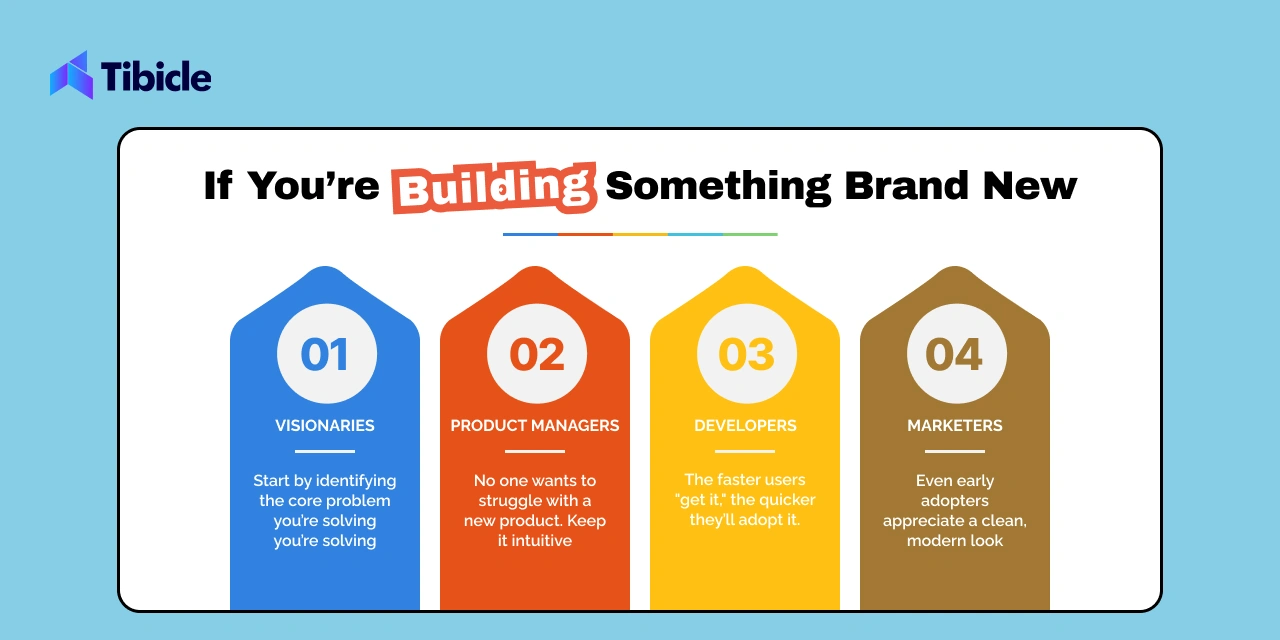
🚀 If You’re Building Something Brand New
When creating a brand-new MVP for startups, your focus should revolve around these four pillars:
- Features: Start by identifying the core problem you’re solving. Focus only on essential, high-impact features. Every feature should directly address a pain point or create undeniable value.
- Ease of Use: No one wants to struggle with a new product. Keep it intuitive. The fewer the clicks, the better.
- Ease of Understanding: The faster users “get it,” the quicker they’ll adopt it. Your messaging and functionality must be crystal clear.
- UI/UX: Even early adopters appreciate a clean, modern look. A polished UI enhances credibility, while a smooth UX keeps them engaged.
💡 Pro Tip: Test small. Validate the core concept before you expand.
🔥 If You’re Competing in an Existing Market
For MVPs in spaces like dating apps or fitness trackers — where giants already rule — you need an edge. Focus on these essentials:
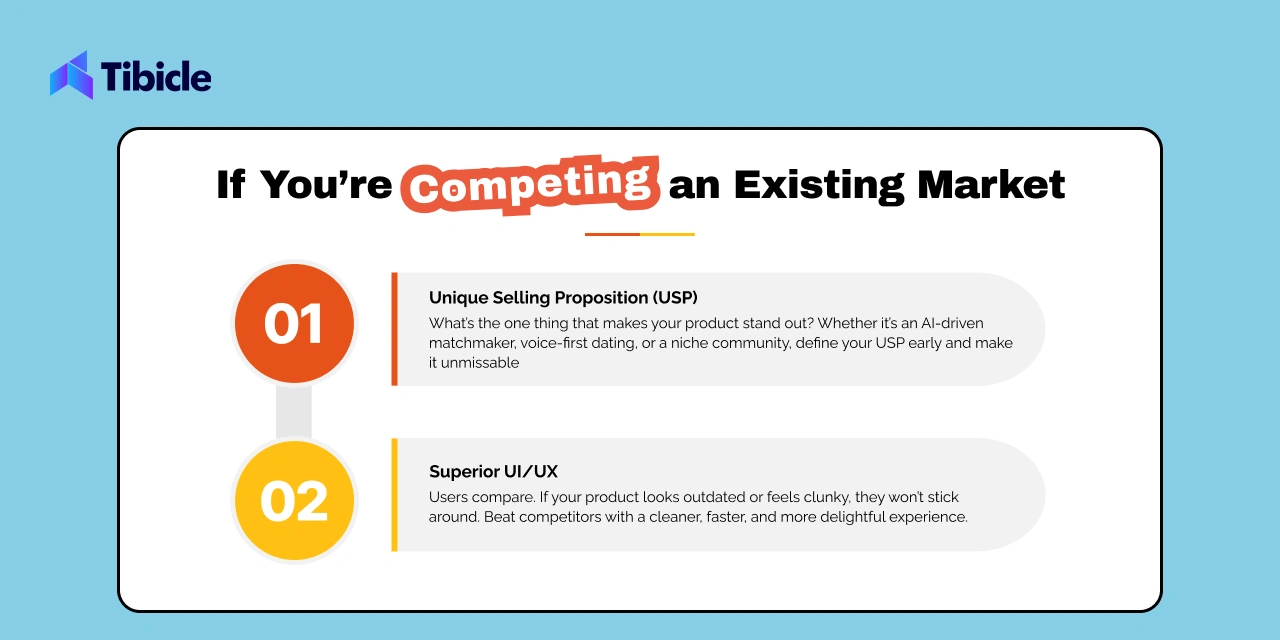
- Unique Selling Proposition (USP): What’s the one thing that makes your product stand out? Whether it’s an AI-driven matchmaker, voice-first dating, or a niche community, define your USP early and make it unmissable.
- Superior UI/UX: Users compare. If your product looks outdated or feels clunky, they won’t stick around. Beat competitors with a cleaner, faster, and more delightful experience.
💡 Pro Tip: Study user complaints on existing apps. Solve those pains.
🔧 Bonus Tips (For Any MVP!)
- Scalability: Build with future growth in mind — but don’t over-engineer.
- Feedback Loop: Build, measure, learn. Quickly.
- Monetization: Plan early. Will it be freemium? Subscription? Ads?
🎯 Final Thoughts
Whether you’re blazing a new trail or taking on a crowded market, the MVP’s goal is the same: get to market fast, learn fast, and adapt fast.