
When to Hire an AI Software Development Consulting Firm.

Sep 29, 2026

Read in 7 Minutes
Table of Contents
- What This Guide Covers
- Introduction
- The Warning Signs a Workflow Needs Rescuing, Not More Internal Effort
- Common Root Causes Behind Failed AI Workflows
- What an AI Software Development Consulting Firm Actually Diagnoses
- Scoping an AI Software Development Consulting Firm Engagement Without Repeating the Same Mistakes
- When to Hire an AI Consulting Firm vs Fix It Internally
- What an AI Consulting Engagement Costs and How Long It Takes
- How Tibicle Rescues and Optimizes Failed AI Software Development Consulting Firm Workflows
- Key Takeaways for Teams With a Stalled AI software development consulting firm Workflow
- Frequently Asked Questions
What This Guide Covers
Who this is for
Engineering leaders, technology executives, and AI teams often struggle to turn completed initiatives into measurable results. This guide helps organisations address stalled pilots, failed AI implementations, rising costs, poor data quality, and workflows that function technically but fail to deliver measurable business value. An AI software development consulting firm can help these teams identify underlying challenges, improve existing AI systems, optimise workflows, and align technology with measurable business outcomes.
Search intent
Readers searching for an AI software development consulting firm are often past the initial experimentation stage. They want to understand why an AI project stalled, whether it can be rescued or should be retired, what a consulting audit examines, and what it will cost to get the workflow back on track.
What you will walk away with
- The warning signs that indicate an AI workflow needs rescue rather than another internal sprint
- The most common causes of failed AI projects, including poor data quality, unclear budgets, infrastructure limitations, and missing business metrics
- How an AI project audit evaluates architecture, data pipelines, model selection, cost, and ROI
- How to determine whether a stalled AI workflow should be rebuilt, optimized, or retired
- How to scope a rescue engagement around one workflow, one measurable metric, and a defined first milestone
- When to fix an AI initiative internally, when to replace a specific component, and when a full consulting audit makes more sense
- Typical timelines and cost ranges for diagnostic audits and full AI rescue/rebuild projects
- How ongoing monitoring, optimization, cost controls, and feedback loops can prevent an AI workflow from becoming technical debt again
- How Tibicle approaches AI workflow rescue and optimization, from diagnostic audit through rebuild and ongoing monitoring.
Introduction
The global AI consulting services market was valued at USD 9.65 billion in 2025 and is projected to grow from USD 11.91 billion in 2026 to USD 73.89 billion by 2034, a CAGR of 25.6% over the forecast period, according to Fortune Business Insights. A large and growing share of that spend is not funding new builds. It is funding repair work.
Companies that shipped an AI pilot in the last eighteen months are now sitting on workflows that technically run but never reached production, never produced a number finance accepts, or quietly stopped improving after launch. That reframes what hiring an ai software development consulting firm means today. The brief is rarely “help us start.” It is far more often “tell us why this stalled, and what is worth saving.”
That makes it a diagnostic problem before it is an engineering problem — an honest AI project audit, disciplined root cause analysis for AI failure, and a clear decision about what to rebuild versus retire. This guide covers the warning signs, the root causes, what a consulting engagement actually reviews, how to scope a rescue so it does not repeat the original failure, and what the work costs.
The Warning Signs a Workflow Needs Rescuing, Not More Internal Effort
Most teams do not decide to stop. They drift. These signals separate a project that needs another sprint from one that has become a sunk-cost problem.
Stalled Pilots That Never Reach Production
The clearest sign of a stalled AI initiative is a demo that still impresses in a meeting but has never processed real production volume. Look for the pattern, not the excuse: the launch date has moved three times, no single owner can name the metric the workflow is supposed to move, scope gets re-litigated every cycle, and each delay is explained by “one more sprint.” When the proof of concept to production gap has stayed open for two or more quarters, the blocker is usually structural, not effort.
Rising Abandonment Rates Across the Industry
The industry data confirms this is not a local problem. S&P Global Market Intelligence’s Voice of the Enterprise: AI & Machine Learning research found that 42% of businesses scrapped most of their AI initiatives in 2025, up sharply from 17% the year before. The same survey of more than 1,000 respondents across North America and Europe found that the average organization abandoned 46% of its AI proofs of concept before they ever reached production.
A jump from 17% to 42% in a single year is not a signal that AI stopped working. It is a signal that the easy pilots were built first, and the second wave hit real integration, data, and cost constraints that the pilot phase never tested. If your workflow is stuck at exactly that boundary, you are in the majority and the fix usually requires a different lens than the one that built it.
Common Root Causes Behind Failed AI Workflows
Failures cluster. In practice, three patterns explain the overwhelming majority of AI technical debt we see in stalled projects.
Why Most AI software development consulting firm Pilots Never Deliver Measurable Value
MIT NANDA’s “The GenAI Divide: State of AI in Business 2025” report found that roughly 95% of organizations are getting zero return on an estimated USD 30–40 billion of enterprise generative AI investment. Only about 5% of integrated pilots were extracting real value; the rest remained stuck with no measurable P&L impact. The gap was rarely model quality. It was that pilots were scoped around what the technology could demonstrate rather than around a workflow the business already measures — which is why an impressive demo and a stalled initiative so often describe the same project.
Data Quality and Budget: The Two Leading Causes of Abandonment
The second pattern is less glamorous and more common. S&P Global Market Intelligence’s outlook report found that data quality ties with budget issues as the leading cause of AI project abandonment, followed by infrastructure performance. That ordering matters when you are deciding where to spend rescue money. Teams instinctively blame the model and go shopping for a better one, when the actual defect sits upstream in inconsistent, unlabelled, or undocumented data — or downstream in a cost model nobody projected past the pilot.
Optimization Deficits: When the System Works but Never Improves
The third failure is quieter and often more expensive. The workflow shipped, it runs, and it has not improved since the week it launched. No one is reviewing output quality, token or inference spend is climbing without a ceiling, prompts and thresholds set during the pilot were never revisited, and there is no feedback loop from user corrections back into the system. This is a legacy AI system optimization problem, not a failure but left alone for a year, it produces the same outcome as one. An AI software development consulting firm can help organisations continuously monitor, optimise, and improve these systems so they remain cost-efficient, reliable, and aligned with business goals. Our guide to the key fundamentals of AI development covers the monitoring foundations most pilots skip.
What an AI Software Development Consulting Firm Actually Diagnoses
A competent engagement does not open with a recommendation. It opens with an AI implementation review that separates symptoms from causes, across three layers.
Architecture Review: Where the Workflow Actually Breaks
An AI architecture review traces a real request end to end and identifies where it degrades: orchestration logic, retry and fallback behaviour, latency at each hop, integration points with existing systems, and error handling under load. The finding is often that the AI component is sound while the surrounding system is not — brittle integrations, no queueing, or a synchronous call where an asynchronous one belonged. That distinction decides whether you are looking at a rewrite or a targeted AI integration and automation fix.
Data Pipeline and Model Selection Review
Next comes the input layer: where the data originates, how it is cleaned and validated, how freshness is maintained, and whether the retrieval or context strategy actually surfaces the right records. Only after that does model selection get examined — task fit, context window, latency budget, and cost per call, benchmarked against current alternatives from our review of the tools reshaping digital workflows. Reviewing in this order matters, because swapping models on top of a broken pipeline reliably produces a more expensive version of the same failure.
Cost and ROI Reconstruction
The last layer is financial. AI ROI diagnosis means rebuilding the unit economics honestly: cost per transaction at current volume, projected cost at target volume, engineering hours consumed to date, and the specific business metric the workflow was meant to move. Many rescues end here, because the reconstructed model shows the workflow can never clear its own cost at scale. Knowing that in week three is far cheaper than discovering it in month nine. Independent technology consulting is usually what makes that conclusion sayable.
Three approaches to fixing a failing AI workflow:
| Approach | What It Involves | Best Fit |
| Internal fix attempt | The existing team tries to patch the workflow with limited outside input | Narrow, well-understood problems where in-house expertise is available |
| Point vendor swap | Replace one component, such as the model provider, without a broader review | A workflow that is architecturally sound but using the wrong model |
| Full consulting audit | An outside AI software development consulting firm reviews architecture, data, and cost end to end | Workflows with unclear root causes or repeated failed fix attempts |
Scoping an AI Software Development Consulting Firm Engagement Without Repeating the Same Mistakes
The uncomfortable truth about AI project turnaround work is that rescue projects fail at roughly the same rate as the originals and usually for the same reasons.
Why Rescue Projects Fail the Same Way Original Projects Did
Gartner predicts that over 40% of agentic AI projects will be canceled by the end of 2027, due to escalating costs, unclear business value, or inadequate risk controls. Those are the same three failure modes that kill first attempts, and they apply just as much to the agent-based workflows teams are now betting on. A rescue inherits them by default: the original ambition survives into the new statement of work, the cost ceiling is left undefined again, and success is described in adjectives rather than numbers. Scoped as broadly as the first attempt, the second is simply a more expensive repeat.
Setting a Narrower, Measurable Scope for the First 90 Days
The correction is to make the first phase almost uncomfortably small. Pick one workflow, one user group, one metric with a current baseline, and one number that phase one has to hit. Ninety days should end with production traffic on a narrow slice, not a relaunch of everything the original project promised. A smaller scope is not a lack of ambition it is the only way to generate evidence that the remaining scope is worth funding.
Deciding What to Rebuild vs What to Retire
Some components should not survive the rescue. Anything without a named owner, without documentation, or without a measurable contribution is a liability being carried forward. Retiring it is a decision, and it should be made explicitly at the start rather than by neglect six months in:
- Define one measurable outcome for the first 90 days, not a full workflow relaunch
- Separate the model problem from the data problem before proposing a fix
- Retire components that never had a clear owner, rather than inheriting them into the new scope
- Set a kill criterion in writing before the engagement starts, not after it stalls again
When to Hire an AI Consulting Firm vs Fix It Internally
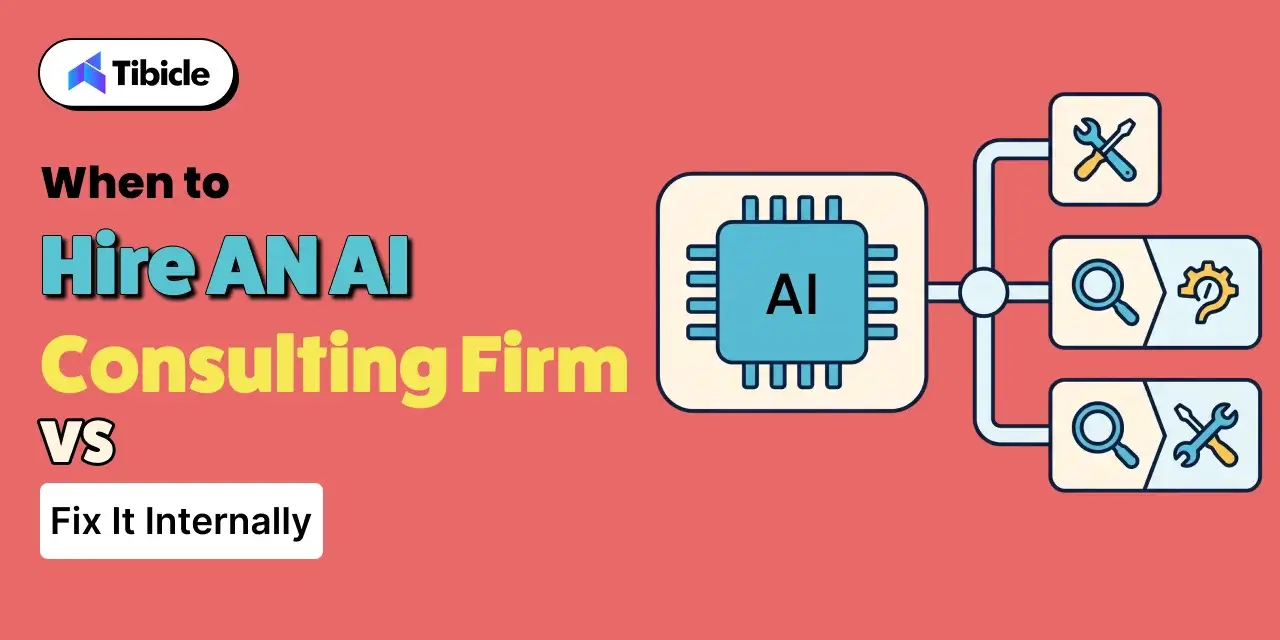
Outside help is not automatically the right call. The decision comes down to whether your team is short on capacity or short on diagnosis.
Signals That Point to an Internal Fix
Keep it in-house when the failure is understood and narrow: a known bottleneck, a documented data gap, or a single integration that needs rework. If your team can state the root cause in one sentence, has done this class of work before, and the fix is measured in weeks rather than quarters, an outside audit mostly adds coordination overhead. Adding a dedicated technical resource is often the cheaper answer.
Signals That Point to Bringing in Outside Help
Bring in outside help when the same fix has been attempted more than once and failed the same way, when nobody can agree on the root cause, when the people who built the workflow have left, or when the internal recommendation is politically constrained. A stalled AI initiative that has consumed two quarters without a production milestone has stopped being a technical question and become an organisational one, and that is precisely where an independent AI and automation consulting engagement earns its fee.
Hybrid Engagements: Audit Now, Build Later
The most common AI consulting engagement model sits between the two. An outside firm runs a fixed-scope diagnostic typically two to four weeks and delivers a root cause report, a rebuild-versus-retire recommendation, and a costed phase one. Your team then executes the build with the firm advising, or hands over a defined slice. This keeps institutional knowledge in-house, caps initial spend, and gives leadership a decision point before committing a rebuild budget. Where it is unclear whether the problem is technical or strategic, product consulting alongside the audit resolves it faster than either alone.
What an AI Consulting Engagement Costs and How Long It Takes
Pricing varies widely by region, complexity, and firm size. The ranges below reflect what mid-market rescue engagements typically look like and should be treated as planning figures, not quotes.
Diagnostic Audit Cost and Timeline
A focused diagnostic audit usually takes two to four weeks. Costs typically range from USD 8,000 to USD 30,000. System complexity and existing documentation determine the final cost. The audit includes an architecture review, data pipeline assessment, reconstructed cost model, and written recommendation. It also defines a scoped first phase. Offshore and hybrid delivery models usually cost less. Clean documentation can also help teams complete the engagement faster. The audit is deliberately small its job is to make the next decision cheaply, not to start building.
Full Rescue and Rebuild Cost and Timeline
A full rescue and rebuild usually takes three to six months. Costs range from roughly USD 50,000 to USD 250,000 or more. Integration surface area usually drives the cost more than AI complexity. Teams can often deliver a narrow first milestone within six to ten weeks. This approach requires only a fraction of the full budget. Teams can fund the remaining work after the first metric improves. Teams using SaaS and startup stacks usually fall near the lower end of this range. These projects often involve fewer legacy systems and require less integration work.
What Extends an Engagement Beyond the Original Estimate
Three factors drive most budget overruns. Data access delays can take weeks to resolve. Undocumented legacy systems may require teams to reverse-engineer them before making changes. Scope can also expand when early results show promise. Compliance reviews, security approvals, and stakeholder availability often create scheduling constraints. Delivery teams cannot always control these factors. A well-written statement of work identifies these constraints upfront. It assigns an owner to each dependency and defines a clear kill criterion. This approach ensures that an overrun triggers a decision instead of another quiet extension.
How Tibicle Rescues and Optimizes Failed AI Software Development Consulting Firm Workflows
Tibicle works with teams whose AI workflow already exists and is not delivering. The process is deliberately sequenced so no rebuild work is quoted before the root cause is established.
Diagnostic Audit and Root Cause Review With an AI Software Development Consulting Firm
Engagements start with a fixed-scope audit rather than a proposal. We trace a live request end to end, review the data pipeline and model selection against the actual task, and reconstruct the cost and ROI model at current and target volume. You receive a written root cause report, a rebuild-versus-retire recommendation for each component, and a costed first milestone. If the honest answer is that the workflow should be retired, that is what the report says. See how we approach this in our AI and automation consulting practice.
Rebuild With an AI Software Development Consulting Firm and a Narrow, Measurable First Milestone
Build work begins only against a single measurable outcome with a documented baseline and a written kill criterion. The first milestone targets production traffic on a narrow slice of the workflow, typically within six to ten weeks, so value is proven before the wider scope is funded. Integration into your existing web, mobile, or SaaS systems is handled as part of that milestone rather than deferred the AI integration and automation work is usually where stalled projects actually broke.
Ongoing Optimization and Monitoring with an AI Software Development Consulting Firm
Teams can prevent optimization deficits by assigning someone explicit responsibility for improvement after launch. That person should review output quality on a fixed schedule. They should track inference and infrastructure costs against an agreed ceiling. They should also tune prompts and thresholds as usage patterns change. A feedback loop should turn user corrections into system improvements instead of adding them to a backlog. Teams should revisit model and tooling choices regularly. A stack that works well at launch may not remain optimal throughout the year. Our 24/7 monitoring and support and annual maintenance services provide this ongoing support. Our project portfolio showcases comparable delivery work.
Key Takeaways for Teams With a Stalled AI software development consulting firm Workflow
- Hiring an ai software development consulting firm makes sense once internal fix attempts have repeated the same failure pattern more than once. One failed attempt is information; two identical ones mean the diagnosis is wrong.
- Data quality and unclear budgeting cause more AI project abandonment than weak models do, so a model swap is rarely the fix it appears to be.
- A rescue engagement needs a narrower, measurable first scope one workflow, one metric, one 90-day number or it becomes a second failed project with a larger invoice.
- A diagnostic audit before any rebuild is almost always cheaper than a second failed attempt, and it is the only reliable way to tell a rebuild from a retirement.
- Optimization does not end at launch. Workflows nobody owns after go-live decay into the same outcome as the ones that never shipped.
If your AI workflow has stalled and the internal fixes have stopped working, book a 30-minute call with Tibicle and we will tell you what the audit would look at.
Frequently Asked Questions
What are the warning signs that an AI software development consulting firm workflow needs outside help rather than more internal effort?
The strongest signal is repetition: the same fix attempted twice with the same result. Others include a launch date that keeps moving, no owner who can name the metric the workflow should move, and a pilot that has never handled production volume.
What does an AI software development consulting firm actually review during a diagnostic audit?
Three layers. Architecture tracing a live request end to end to find where it degrades. Data origin, validation, freshness, and retrieval strategy, examined before model selection. Cost cost per transaction now, projected cost at target volume, and the business metric the workflow was meant to move.
Can a failed AI software development consulting firm pilot be rescued, or does it need to be rebuilt from scratch?
Both happen, and the audit tells them apart. Pilots whose AI component works but whose surrounding system is brittle are usually salvageable. Pilots built on a broken data foundation, or whose unit economics never clear at scale, are better retired and rescoped.
How do we scope a rescue engagement so it doesn’t fail the same way the original project did?
Make phase one uncomfortably small: one workflow, one user group, one metric with a baseline, one 90-day target. Separate the model problem from the data problem before proposing a fix, retire components that never had an owner, and put a kill criterion in writing before work starts.
How much does an AI software development consulting firm engagement typically cost?
A fixed-scope diagnostic audit usually runs two to four weeks at roughly USD 8,000 to USD 30,000. A full rescue and rebuild typically runs three to six months at USD 50,000 to USD 250,000 or more, driven mainly by integration surface area rather than AI complexity.
Does Tibicle offer AI software development consulting firm to rescue and optimize failed AI workflows?
Yes. Tibicle runs fixed-scope diagnostic audits, rebuilds against a narrow measurable first milestone, and provides ongoing optimization and monitoring. Review the AI and automation consulting service, or get in touch about a stalled workflow.
Schedule A Developer Interview And Get 15 Days Risk-Free Trial
Schedule a Call

Relevant Blog
Enterprise LLM Integration Services

Prejin Nadar

Building Private local AI Desktop App Development
Prejin Nadar
3 Best Restaurant Management App for 2026
Prejin Nadar
Written by
Recent Blogs
Enterprise LLM Integration Services
What This Guide Covers Who this is for Enterprise LLM integration services help engineering leaders, platform teams, and technology executives turn existing model access into working production workflows. This guide is for organisations connecting OpenAI, Claude, or both to systems that support real business processes, including CRM platforms, ticketing systems, document pipelines, and internal tools. […]
When to Hire an AI Software Development Consulting Firm.
What This Guide Covers Who this is for Engineering leaders, technology executives, and AI teams often struggle to turn completed initiatives into measurable results. This guide helps organisations address stalled pilots, failed AI implementations, rising costs, poor data quality, and workflows that function technically but fail to deliver measurable business value. An AI software development […]
Building Private local AI Desktop App Development
What This Guide Covers Who this is for: US tech firms, SaaS companies, startups, CTOs, engineering managers, and product teams looking for experienced Electron.js developers for ongoing private local AI desktop app development and custom desktop application development. Search intent: Hiring and decision. This guide covers where to find Electron.js developers, how to evaluate their […]
Got an Idea? Get FREE Consultation
In our world, there's no such thing as having too many clients

