
Enterprise LLM Integration Services

Sep 29, 2026

Read in 7 Minutes
Table of Contents
- What This Guide Covers
- Introduction
- Why Enterprises Are Buying Integration Services Instead of Building In-House
- Connecting OpenAI and Claude to Existing Business Workflows
- Why Enterprise LLM Integration Services Projects Stall
- Security and Governance for Enterprise LLM Integrations
- Avoiding Vendor Lock-In With Enterprise LLM Integration Services
- What Enterprise LLM Integration Services Actually Cost
- How Tibicle Delivers Enterprise LLM Integration Services
- Key Takeaways From Enterprise LLM Integration Services
- Frequently Asked Questions
What This Guide Covers
Who this is for
Search intent
Readers looking for enterprise llm integration services are past the evaluation stage. They want to know where the integration points sit, whether to standardise on one provider or route across several, what security and data handling terms have to be settled first, and what the build and run costs look like before scoping a project.
What you will walk away with
- Why enterprise buying has swung sharply from building AI capability in-house to buying it, and what that means for your integration decision
- The three integration architectures — single-provider, multi-model routing, and an abstracted middleware layer — and which workflows each one fits
- Why integration projects stall between a working demo and production, and how to scope a proof of concept that tests the right things
- The data handling, access control, and retention terms to settle with every model provider before production traffic flows
- Architecture choices that keep a workflow portable as provider pricing, capability, and model availability shift
- Cost ranges by workflow complexity, the ongoing costs an integration carries after launch, and how to measure whether it is working
Introduction
enterprise llm integration services help enterprises turn model access into reliable production workflows. Teams can connect OpenAI, Claude, or both to existing business systems such as CRM platforms, ticketing systems, document pipelines, and internal tools. The goal is to create workflows that deliver measurable business value, not simply connect an API to an application.
Access is the easy part. Any team can obtain an OpenAI or Anthropic API key in an afternoon. Most enterprises lack a workflow that reliably calls the right model with the right context and access controls. The workflow must also keep working when a provider changes pricing or deprecates a version. That gap is what enterprise llm integration services help close.
This guide covers where LLM calls actually plug into existing business workflows, how multi-model routing between OpenAI and Claude works in practice, why so many integration projects stall between demo and production, the security and governance an enterprise integration needs before traffic flows, and what the work costs to build and to run.
Why Enterprises Are Buying Integration Services Instead of Building In-House
Two years ago, the default assumption was that serious AI capability had to be built internally. That assumption has collapsed faster than almost any recent enterprise technology trend.
The Shift From Building AI Capability to Buying It
The build case focused on differentiation. If AI became core to the product, teams believed they should own the capability. The differentiating layer has since moved. Models now serve as commodity inputs. Durable advantages come from workflow design, proprietary data, and integration quality. Rebuilding infrastructure that vendors already operate adds unnecessary work. Building a routing layer, evaluation harness, and monitoring stack from scratch can consume several quarters. Buying those capabilities gives that time back to the roadmap.
What Changed in Enterprise Buying Behavior Between 2024 and 2025
The data on this shift is unusually stark. Menlo Ventures found that 47% of enterprise AI solutions were built internally in 2024. Companies purchased the remaining 53%. By 2025, internal builds had fallen to roughly 24%. Purchased solutions had risen to 76%. This marked a near-reversal in a single year.
The research does not suggest that internal teams got worse. Ready-made solutions simply reached production faster and demonstrated value sooner. Internal builds still had to solve the same infrastructure problems as other teams. For most enterprises, the question is no longer, “Can we build this?” Instead, they ask, “Is eighteen months of platform work the fastest route to the outcome we want?” Bringing in AI integration and automation expertise can help teams keep internal engineering focused on differentiated work.
Connecting OpenAI and Claude to Existing Business Workflows
An LLM integration is rarely a new system. It is a new step inside a process that already runs.
Where LLM Calls Actually Plug Into a Workflow
The insertion points are more predictable than they look: intake, where unstructured input is classified, extracted, or normalised before it enters a system of record; enrichment, where an existing record is summarised or supplemented mid-process; drafting, where a human receives a prepared output to approve or edit; and review, where a completed item is checked against policy before it moves on. Existing RPA to LLM integration usually happens at exactly these points — the rules-based step stays, and the LLM handles the input variance the rules could never absorb.
Multi-Model Routing: Using OpenAI and Claude for Different Tasks
Multi-model LLM workflow integration means treating model choice as a per-task decision rather than a company-wide standard. Long-context document analysis, code generation, structured extraction, and high-volume classification have genuinely different price-performance profiles, and the leader on each changes with almost every release cycle. Prompt routing sends each task type to whichever model performs best for it, with the routing rules held in configuration rather than in application code — so a benchmark shift becomes a config update instead of a release. Our rundown of the tools reshaping digital workflows covers how quickly that landscape moves.
Fallback and Redundancy Across Providers
Every major provider has had outages, rate-limit events, and capacity constraints during peak demand. An LLM fallback architecture treats that as expected behaviour rather than an incident: primary and secondary providers are configured per task, failover is automatic on timeout or error, and prompts are written to work acceptably on either. The design cost is real prompts must be portable and output schemas provider-neutral but the alternative is a business workflow whose availability is capped by a single vendor’s status page.
Three integration architectures for connecting LLMs to workflows:
| Architecture | What It Involves | Best Fit |
| Single-provider integration | Direct calls to one vendor’s API from the application code | A single well-defined task with low switching risk |
| Multi-model routing | Route different task types to whichever model performs best for that task | Workflows spanning several task types, like coding, writing, and analysis |
| Abstracted middleware layer | A provider-agnostic layer that business logic calls, with models swappable behind it | Long-lived workflows where vendor lock-in is a real risk |
Why Enterprise LLM Integration Services Projects Stall
Integration projects rarely fail at the API call. They fail at everything surrounding it — the inputs, the permissions, the cost model, and the scope nobody wrote down.
The Gap Between a Working Demo and a Production Workflow
MIT NANDA’s “The GenAI Divide: State of AI in Business 2025” report found that roughly 95% of organisations were getting zero return on an estimated USD 30–40 billion of enterprise generative AI investment, with only about 5% of integrated pilots extracting real value. The demo works because it runs on clean inputs, one happy path, and a forgiving audience. Production adds malformed inputs, concurrency, latency budgets, permissions, audit requirements, and edge cases nobody scripted. Most of the integration work lives in that difference — which is also why so many AI workflows stall short of production.
Scoping an Integration Project So It Doesn’t Become a Cancellation Statistic
Gartner predicts that over 40% of agentic AI projects will be canceled by the end of 2027, citing escalating costs, unclear business value, or inadequate risk controls. All three are scoping failures rather than engineering ones. Scope one workflow with an owner, a current baseline, and a cost ceiling defined before the first call is made. Write down what result would justify expanding, and what result would end it. A project that cannot name its own kill criterion has already accepted an indefinite runway, and indefinite runways are what the cancellation figures are actually measuring.
What a Realistic Proof of Concept Actually Tests
A useful proof of concept is deliberately unglamorous. It runs on real production data, including malformed records, and measures cost per transaction at realistic volumes. The proof of concept also tests failure behaviour by taking the provider offline during a run and checks latency against the workflow’s actual tolerance. It also puts the output in front of the people who will own the result. A proof of concept that only tests good output on good input has not tested the real risks.
Security and Governance for Enterprise LLM Integrations
The moment a workflow calls a third-party model, enterprise data crosses an organisational boundary. Governance has to be settled before that happens, not audited afterwards.
Data Handling When a Workflow Calls a Third-Party Model
IBM’s Cost of a Data Breach Report 2026 found that security incidents involving shadow AI — employees using unapproved AI tools — more than doubled to 43% of breached organisations, up from 20% the year before, with those incidents averaging USD 5.39 million. More pointedly for integration teams: among organisations that experienced an AI-related breach, 92% lacked proper AI access controls. A sanctioned, governed integration is itself a shadow AI control, because it removes the reason employees paste sensitive data into consumer tools. Where data cannot leave the perimeter at all, a locally hosted model is the alternative worth costing.
Access Control and Prompt/Response Logging
Enterprise API security for LLM workflows requires the model call to inherit the caller’s permissions. It should not run through a privileged service account with access to everything. Filter retrieval results by the requesting user’s entitlements before assembling the context. Every call should also include enough logging detail to reconstruct it later. Record the model and version, prompt template, workflow step, user, and response. Without these records, incident response and quality regression analysis become guesswork.
Vendor Data Retention and Training Opt-Out Terms
Retention and training terms differ by provider, by plan tier, and by API endpoint, and they change. Settle them in writing before production traffic flows:
- Confirm in writing that prompts and completions are not used to train the vendor’s models by default
- Log which model, prompt version, and workflow step produced each output
- Strip or mask sensitive fields before they leave internal systems, not after the model responds
- Set a data retention window with each provider and confirm it is enforced, not just documented
Avoiding Vendor Lock-In With Enterprise LLM Integration Services
Model pricing, capability, and availability have all moved substantially within single quarters. Portability is an architectural decision, cheapest at the start.
Abstracting the Model Layer From Business Logic
Business logic should call an internal interface such as summarise this document or classify this ticket. It should not depend on a vendor SDK scattered throughout the codebase. Custom LLM middleware can manage prompt templates, routing rules, retries, token accounting, and provider credentials behind this interface. This design makes model changes a configuration update instead of a code change across multiple services. The abstraction may take a few days to implement. It can save weeks of work when pricing or model capabilities change.
Version Pinning and Model Deprecation Risk
Never point production at a floating model alias. Pin an explicit version so behaviour cannot change underneath a workflow that has already been validated against it, then treat every provider deprecation notice as scheduled work with a named owner and a date rather than as a notification to file. Keep a small regression set of real inputs and expected output characteristics, so a version upgrade can be evaluated in hours instead of being discovered in production.
Cost Monitoring Across Multiple Providers
Multi-provider setups fragment spend across separate billing surfaces, which is how token costs quietly triple before anyone notices. Track cost per workflow and per transaction in one place rather than per vendor invoice, tag every call with its workflow and environment, and alert on rate of change rather than on absolute totals. Set per-workflow ceilings that throttle or degrade gracefully rather than fail, and review the routing table quarterly — a task routed to a premium model six months ago is often served just as well by a cheaper one now. Ongoing technology consulting support is what keeps that review from slipping.
What Enterprise LLM Integration Services Actually Cost
Pricing varies by region, delivery model, and compliance burden. The ranges below reflect typical mid-market engagements and are planning figures, not quotes.
Integration Cost for Enterprise LLM Integration Services
A single, well-defined workflow connected to one provider classification, extraction, or drafting inside an existing system generally runs USD 15,000 to USD 40,000 over four to eight weeks. Multi-model routing across several workflows with a middleware layer, evaluation harness, and monitoring typically lands between USD 60,000 and USD 150,000. Enterprise-wide programmes carrying formal security review, compliance sign-off, and multiple system integrations move past USD 200,000. Integration surface area drives the number far more than model complexity does: the same classification task costs three times as much when it has to write into a legacy system with no usable API, and offshore or hybrid delivery models shift the whole band downward without changing that ratio.
Ongoing Costs of Enterprise LLM Integration Services: Token Usage, Monitoring, and Model Updates
The build is not the whole cost. Token spend scales with volume and needs a modelled ceiling before launch, not a monthly surprise. Monitoring, evaluation runs, prompt maintenance, and provider version migrations typically add 15% to 25% of the original build cost per year. Teams that skip this line item usually discover it as an unplanned engineering diversion two quarters in, when a provider deprecation lands in the same sprint as a roadmap commitment. That is why annual maintenance and 24/7 monitoring are worth costing at the same time as the build rather than after it.
Measuring the Performance of Enterprise LLM Integration Services
Workflow automation ROI needs a baseline before launch. Measure current handling time, error or rework rate, throughput per person, and cost per transaction. After launch, track these four metrics alongside model cost per transaction and human override rate. The override rate provides a clear signal of workflow performance. If reviewers rewrite most outputs, the workflow creates more work instead of removing it. Review all six metrics with the business owner who owns the baseline. The team that built the integration should not be the only group evaluating its performance.
How Tibicle Delivers Enterprise LLM Integration Services
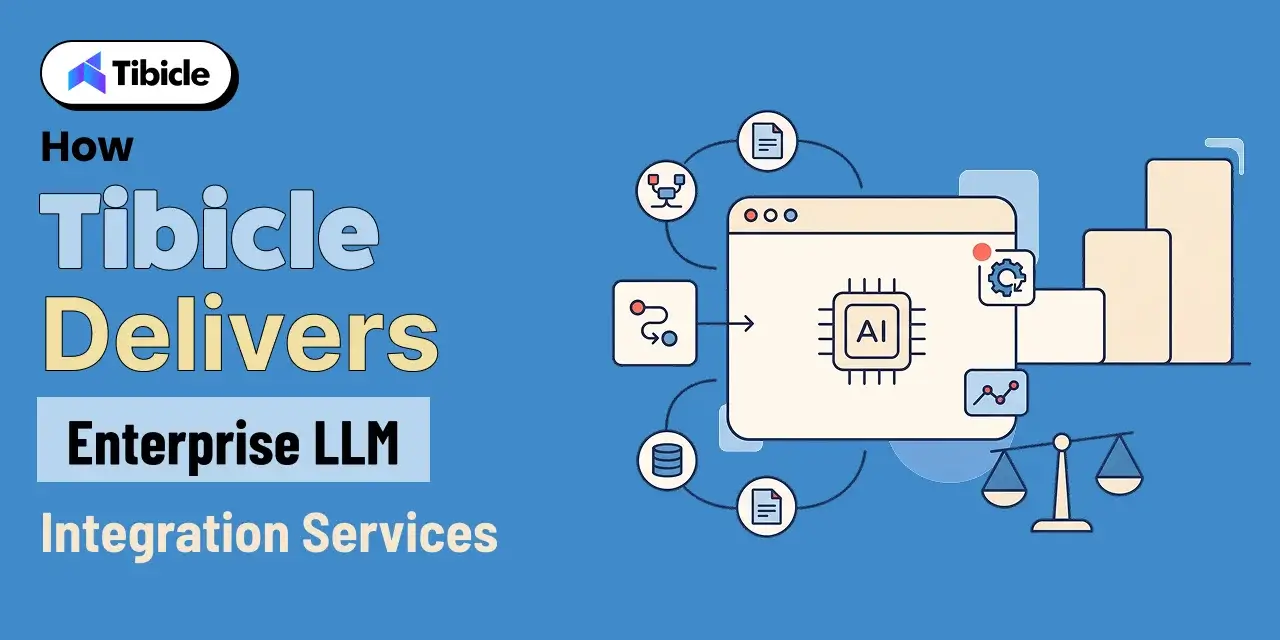
Tibicle builds LLM integrations into systems that are already running, with routing, security, and monitoring treated as part of the build rather than as a later phase.
Workflow Assessment and Integration Architecture Planning
Engagements start with the workflow, not the model.We map the process end to end, identify the steps where an LLM call can change the outcome, and assess each step for data sensitivity, latency tolerance, and volume. This process defines the integration architecture, whether single-provider, multi-model routing, or an abstracted middleware layer. We also define the first workflow, model its token ceiling, and document security requirements before writing any code. Our AI and automation consulting practice runs this assessment as a fixed-scope phase.
Implementation With Multi-Model Routing and Security Built In
Implementation puts business logic behind a provider-agnostic interface from the first commit, with prompt templates versioned, model versions pinned, and routing rules held in configuration. Fallback across providers, permission-aware retrieval, field masking before egress, and full prompt and response logging are part of the initial build rather than hardening bolted on before a security review. Every workflow ships with a modelled cost ceiling and an evaluation set drawn from real inputs. The work integrates into existing web, mobile, and SaaS systems as AI integration and automation, and comparable delivery is visible in our project portfolio.
Ongoing Monitoring and Model Management for Enterprise LLM Integration Services
After launch, someone has to own the integration. That means cost tracked per workflow against an agreed ceiling, output quality sampled on a fixed cadence, override rates reviewed with the business owner, provider deprecation notices handled as scheduled work, and the routing table revisited as pricing and capability shift. Teams that want that capacity in-house can add a dedicated technical resource; teams that would rather not staff it can run the whole thing as a managed engagement. Either way the aim is the same — an integration that keeps getting cheaper and more accurate after launch, instead of one that quietly decays until someone notices the bill.
Key Takeaways From Enterprise LLM Integration Services
- Enterprise llm integration services succeed or fail on workflow scoping, not on whether OpenAI or Claude powers the integration. Model choice is the most reversible decision in the project.
- Most enterprises now buy AI capability rather than build it — roughly 76% purchased in 2025 against 53% a year earlier — because bought solutions reach production faster.
- An abstracted model layer protects a workflow from vendor pricing changes, deprecations, and outages, and costs days upfront rather than weeks later.
- Retention, training opt-out, and access control terms need settling with every provider before production traffic flows, not after.
- Budget for the run, not just the build — monitoring and version migrations typically add 15% to 25% of build cost per year.
If you have model access but no working production workflow, book a 30-minute call with Tibicle and we will map where the integration points actually sit.
Frequently Asked Questions
What do enterprise LLM integration services actually include beyond connecting an API key?
The API call is a small fraction of the work. Integration services cover workflow mapping, prompt design and versioning, permission-aware retrieval, routing and fallback logic, output validation, logging, cost controls, and monitoring — plus integration into the systems the workflow already runs on.
Should we integrate OpenAI, Claude, or both into our workflow?
Both, if the workflow spans several task types. Long-context analysis, code generation, extraction, and high-volume classification have different price-performance profiles, and the leader on each shifts every release cycle. Routing per task and keeping models swappable usually beats standardising on one provider.
How do we avoid vendor lock-in when integrating a large language model into a core workflow?
Put business logic behind an internal interface rather than a vendor SDK, keep prompt templates and routing rules in configuration, pin explicit model versions, and maintain a regression set of real inputs. Swapping providers then becomes a configuration change instead of a cross-service rewrite.
What happens to our data when a workflow sends it to a third-party model?
That depends on the provider, plan tier, and endpoint, which is why the terms have to be confirmed in writing first. Confirm training opt-out by default, set an explicit retention window, and mask sensitive fields before they leave internal systems rather than after the model responds.
How much does an enterprise LLM integration services project typically cost?
A single well-defined workflow with one provider generally runs USD 15,000 to USD 40,000 over four to eight weeks. Multi-model routing across several workflows with middleware and monitoring typically lands at USD 60,000 to USD 150,000. Ongoing costs add roughly 15% to 25% of build cost per year.
Does Tibicle provide enterprise LLM integration services connecting OpenAI and Claude to custom workflows?
Yes. Tibicle maps the workflow first, designs the integration architecture, and builds with multi-model routing, fallback, and security controls included from the start, then runs ongoing monitoring and model management. Review the AI integration and automation service, or get in touch to scope a workflow.
Schedule A Developer Interview And Get 15 Days Risk-Free Trial
Schedule a Call

Relevant Blog
Building Private local AI Desktop App Development

Prejin Nadar

3 Best Restaurant Management App for 2026
Prejin Nadar
Written by
Recent Blogs
Enterprise LLM Integration Services
What This Guide Covers Who this is for Enterprise LLM integration services help engineering leaders, platform teams, and technology executives turn existing model access into working production workflows. This guide is for organisations connecting OpenAI, Claude, or both to systems that support real business processes, including CRM platforms, ticketing systems, document pipelines, and internal tools. […]
When to Hire an AI Software Development Consulting Firm.
What This Guide Covers Who this is for Engineering leaders, technology executives, and AI teams often struggle to turn completed initiatives into measurable results. This guide helps organisations address stalled pilots, failed AI implementations, rising costs, poor data quality, and workflows that function technically but fail to deliver measurable business value. An AI software development […]
Building Private local AI Desktop App Development
What This Guide Covers Who this is for: US tech firms, SaaS companies, startups, CTOs, engineering managers, and product teams looking for experienced Electron.js developers for ongoing private local AI desktop app development and custom desktop application development. Search intent: Hiring and decision. This guide covers where to find Electron.js developers, how to evaluate their […]
Got an Idea? Get FREE Consultation
In our world, there's no such thing as having too many clients

