
Enterprise AI Automation Development Agency

Sep 18, 2026

Read in 4 Minutes
Table of Contents
- Introduction
- Why Enterprises Need an Enterprise AI Automation Development Agency, Not a Point Tool
- What End-to-End Process Automation Actually Requires
- Where Enterprise AI Automation Workflow Projects Break: The Data Behind the Failure Rate
- Process Bots vs Point-Solution RPA: Choosing the Right Scope
- Governance and Human Oversight for Enterprise AI Automation Process Bots
- Common Reasons Enterprise AI Automation Workflow Projects Never Reach Production
- How Tibicle Delivers Enterprise AI Automation Development Services
- Key Takeaways
- Conclusion
- Frequently Asked Questions
Who this is for: Operations leads, CTOs, and process owners evaluating an enterprise AI automation development agency for a full business process rather than a single bolted-on bot.
Search intent: Commercial evaluation with a technical backbone. The reader has moved past “what is workflow automation” and wants to know why point-solution RPA plateaus, what end-to-end automation actually requires, and how to scope a rollout that survives contact with a real process.
What you will walk away with: What end-to-end process automation requires beyond a single bot, current adoption and failure data from McKinsey, Gartner, EY, and a multi-agent systems study, a process-bots-vs-point-solution comparison table, and how Tibicle structures enterprise AI automation development around full processes, not isolated tasks.
Introduction
An enterprise AI automation development agency builds bots that carry a business process from start to finish. A single script that automates one step and hands the rest back to a person does not qualify. McKinsey’s Global Institute found that current technology could automate work occupying 45% of employee time. That number explains why automation budgets keep growing. It also explains why so many automation projects disappoint. Most of that 45% sits inside processes that cross five or six different systems. It doesn’t sit inside one screen a single bot can operate. Hiring an enterprise AI automation development agency only pays off when the engagement covers the whole process. Think invoice to payment, application to approval, ticket to resolution, not just the one step that looked easiest to automate first. This guide covers what end-to-end process automation requires, and why workflow automation projects fail at a predictable rate. It also covers how to choose between point-solution RPA and a custom process bot, and how Tibicle structures this work around full processes.
Why Enterprises Need an Enterprise AI Automation Development Agency, Not a Point Tool
From Single-Task Bots to End-to-End Process Automation
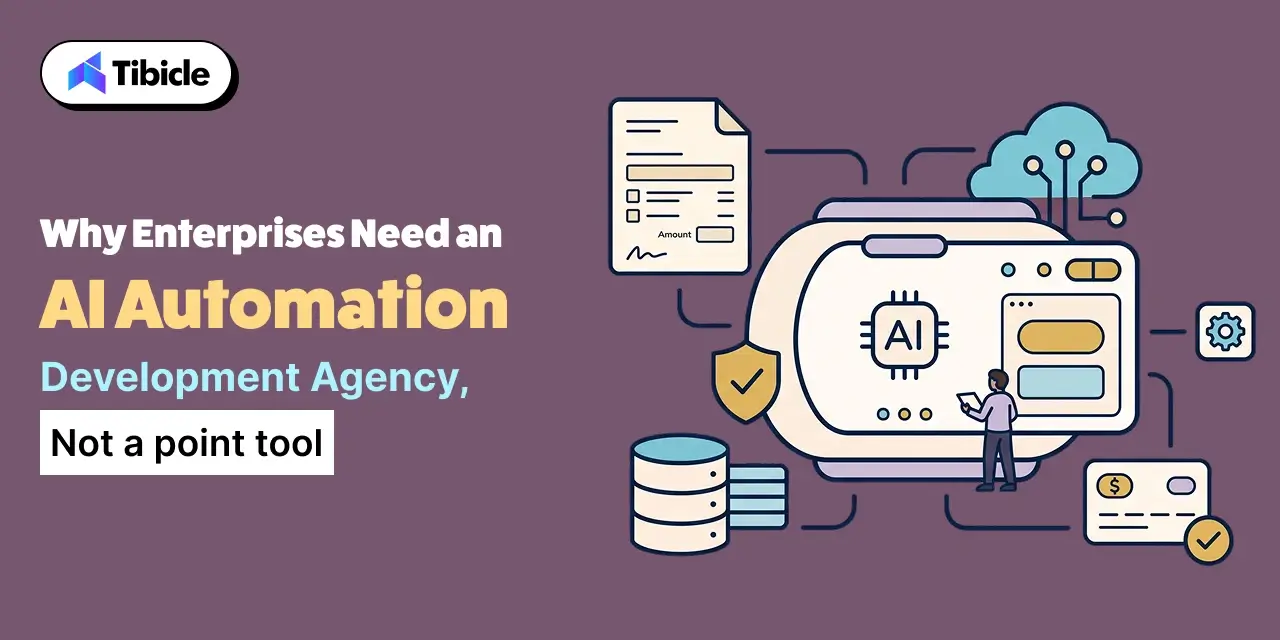
A single-task bot reads a form and copies data into a spreadsheet. End-to-end process automation follows that data through every subsequent step: validation, approval routing, exception handling, and the system update that closes the loop. Businesses hire an enterprise AI automation development agency specifically to own that full chain. A business rarely gets meaningful time back from automating only the easiest 20% of a process and leaving the rest manual.
The Market and Priority Behind This Shift
Gartner finds that 90% of large enterprises now name hyperautomation a stated priority. Fewer than 20% of organizations have actually mastered measuring what those initiatives deliver. The market reflects the same appetite. Fortune Business Insights values business process automation at $22.3 billion in 2026. The firm expects it to reach $56.68 billion by 2034, a 12.37% compound annual growth rate. The gap between stated priority and measured success is exactly where an enterprise AI automation development agency earns its fee.
What End-to-End Process Automation Actually Requires
Mapping the Full Process Before Automating Any Step
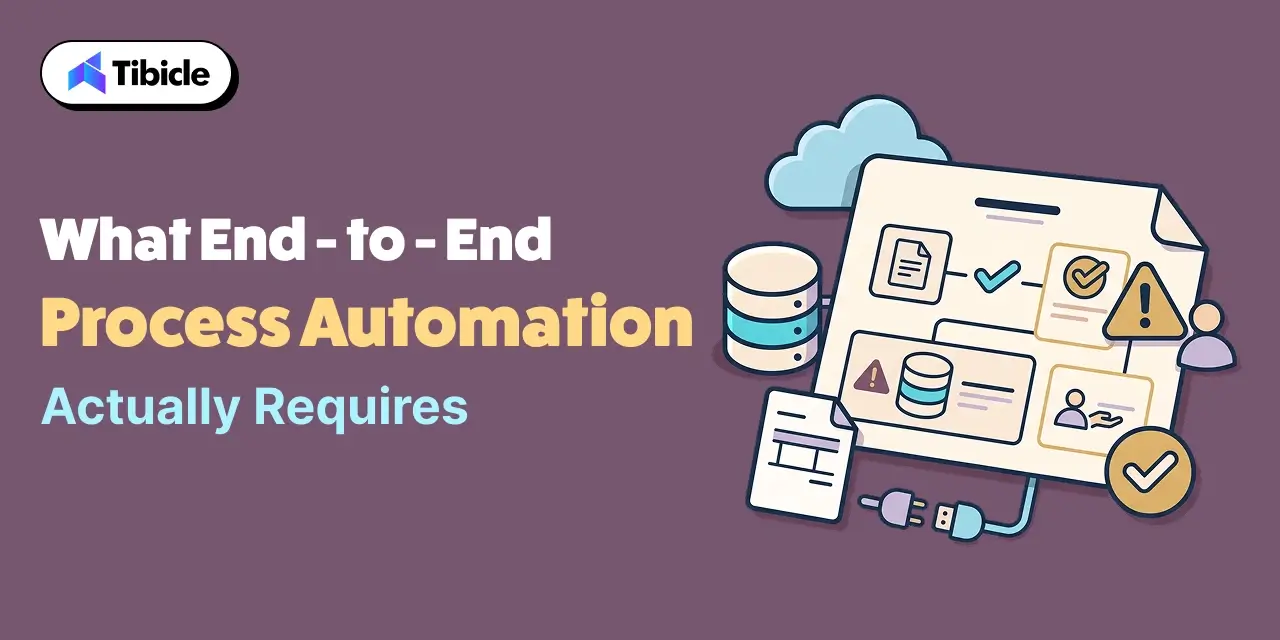
Before a team builds any bot, it needs to map the actual process end to end. That includes the exceptions and edge cases nobody documents, because everyone already knows about them. Skipping this step is the single most common reason a workflow automation project only ever covers the easy path.
Connecting Systems That Were Never Built to Talk to Each Other
Most enterprise processes span a CRM, an ERP, an email inbox, and at least one legacy internal tool that predates all of them. Custom workflow automation bots need integration work at every one of these boundaries. That is exactly the part a generic no-code automation template skips over.
Exception Handling for the Cases Enterprise AI Automation Alone Can’t Resolve
Every real process has a percentage of cases that do not fit the standard path. Examples include a mismatched invoice, an incomplete application, or a request that needs a judgment call. A process bot with no path for these cases either breaks silently or produces a wrong result with confidence. Both outcomes are worse than simply routing the case to a person.
Where Enterprise AI Automation Workflow Projects Break: The Data Behind the Failure Rate
The Classic RPA Failure Pattern
EY’s own consulting practice has observed that 30% to 50% of initial RPA projects fail. Most often, the team never scoped the process correctly before automation began. The technology itself was rarely the problem. That failure pattern has held for years, across a technology shift from rules-based bots to AI-driven ones.
Why Multi-Bot Orchestration Fails More Than Expected
When a process needs multiple bots coordinating with each other, the failure risk compounds. A UC Berkeley study analyzed over 1,600 execution traces across seven popular multi-agent frameworks. It found failure rates between 41% and 86.7%. The causes: issues in system design, coordination between agents, and output verification. Enterprise process bots that hand off work between multiple automated steps inherit this same risk. The fix: build the orchestration layer deliberately, rather than assembling it from default settings.
What Separates the Projects That Scale
The projects that avoid this pattern share a common trait. The team scoped, mapped, and tested the process against real edge cases before a single bot went live. A named owner stayed accountable for what happens when a step fails.
Process Bots vs Point-Solution RPA: Choosing the Right Scope
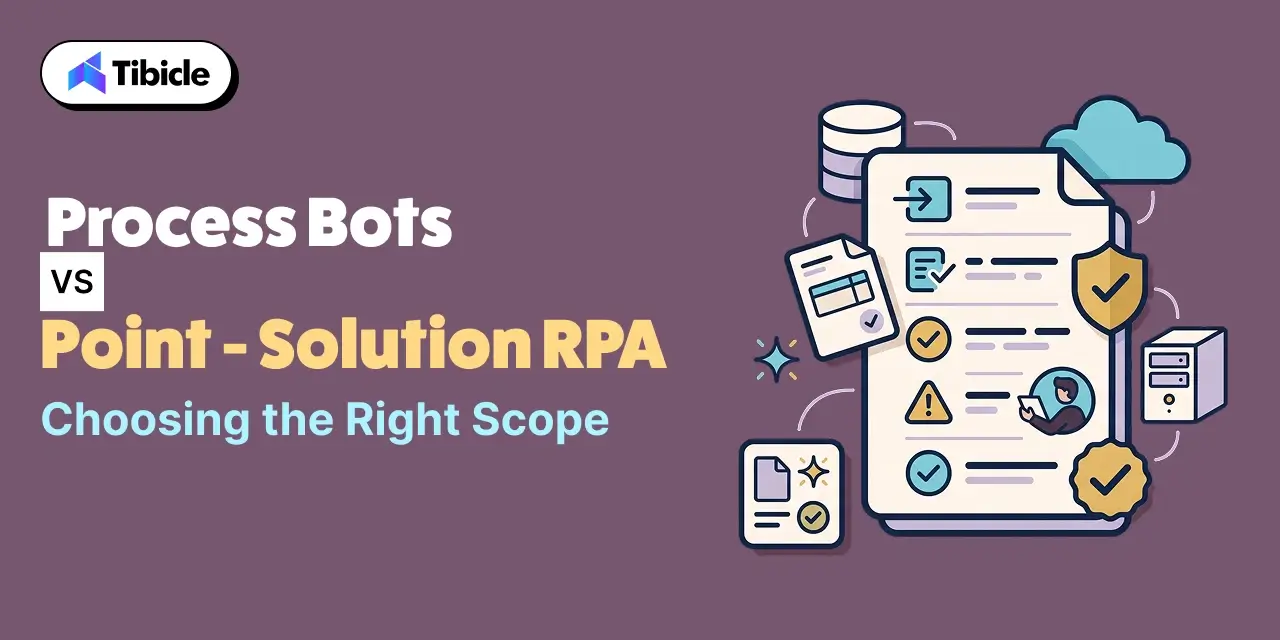
The right scope depends on how much of the process a bot needs to own end to end. It doesn’t depend on which tool looks most capable in a demo.
| Factor | Point-Solution RPA | Custom Enterprise Process Bots |
| Scope | Automates one step or screen | Owns a process from trigger to completion |
| System integration | Limited to pre-built connectors | Built for the enterprise’s actual systems, legacy included |
| Exception handling | Often absent or bolted on later | Designed in from the start, with a routing path to a person |
| Scaling pattern | Plateaus around a handful of bots | Scales with the process, not with bot count |
| Best fit | A single, well-defined, high-volume task | A cross-system business process with real exceptions |
Tibicle’s Enterprise & Internal Tools work applies this same end-to-end scoping to internal operations. Its Logistics & Supply Chain work applies the same approach to processes that span multiple external partners and internal systems.
Governance and Human Oversight for Enterprise AI Automation Process Bots
Role-Based Permissions Across Every System a Bot Touches
A process bot should hold the narrowest permission set needed for its specific step in every system it touches. It should not run on a shared service account with broad access, just because that’s convenient for the developer who set it up.
Exception Queues Instead of Silent Failures
Every automated step needs a defined path for what happens when it cannot complete. That means a queue a person actually monitors, not a log file nobody reads until something breaks downstream.
Audit Trails for Every Automated Decision
Enterprise process bots that touch financial, compliance, or customer-facing decisions need a record of what data drove each action. That record satisfies an audit and makes debugging a failed run possible in the first place.
Common Reasons Enterprise AI Automation Workflow Projects Never Reach Production
- Nobody mapped the process end to end, so the bot only ever covered the easy path
- No exception queue existed, so edge cases either broke the bot or produced silent wrong outputs
- The team chained multiple bots together without a deliberate orchestration layer to coordinate them
- Nobody owned the automation after launch, so it broke the first time an underlying system changed
- The team never defined success with a measurable target, so nobody could tell if the project actually worked
How Tibicle Delivers Enterprise AI Automation Development Services
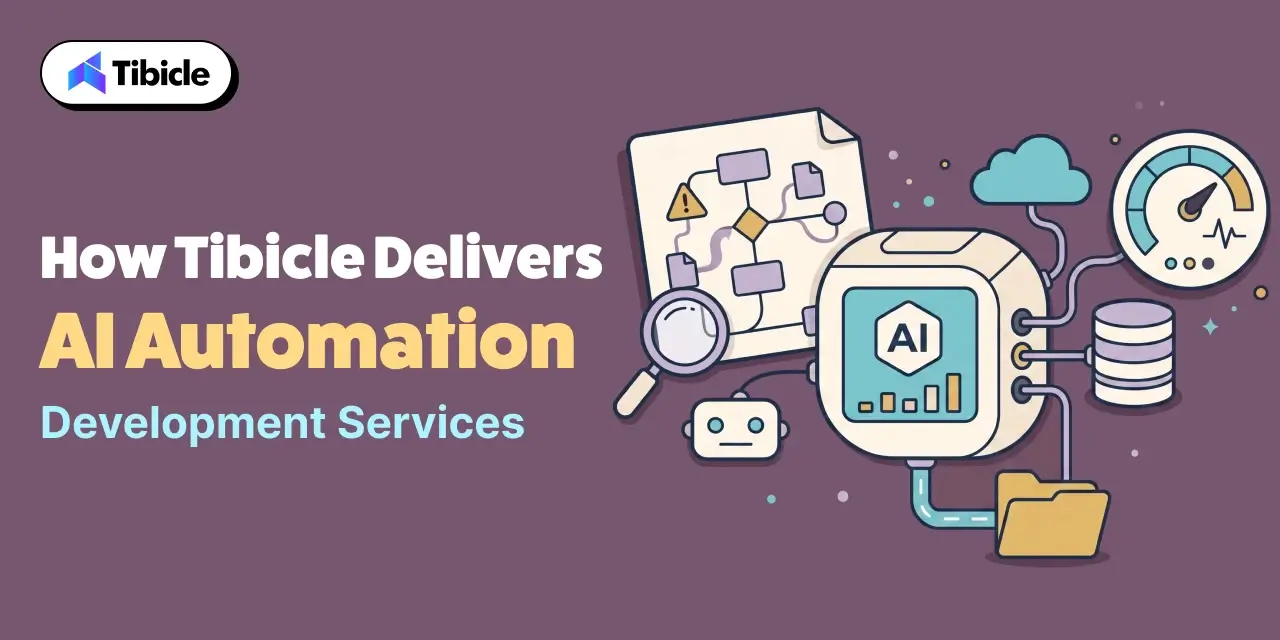
Process Audit and Automation Roadmap
Tibicle starts by mapping the actual process end to end, including the exceptions, before scoping which parts to automate first. This stage draws on Tibicle’s AI & Automation Consulting practice.
Build: Integration, Orchestration, and Exception Handling
The build phase connects every system the process touches, sequences the automated steps deliberately, and routes exceptions to a person by design. Tibicle delivers this through its AI Development and Integration services. Enterprises that want an embedded automation team can tap ongoing capacity through Tibicle’s Dedicated Tech Resource Allocation model.
Monitoring and Continuous Improvement
After launch, Tibicle monitors the automation through its 24/7 Monitoring & Support service. The team tracks exception rates and adjusts the process bot as the underlying systems change.
Key Takeaways
- An enterprise AI automation development agency scopes automation around a full process, not a single task. That’s what separates it from a point RPA tool
- 45% of employee time is technically automatable today, but most of that time sits inside multi-step processes, not single screens
- 30% to 50% of initial RPA projects fail, most often because nobody scoped the process correctly before automation began
- Chaining multiple bots together without deliberate orchestration carries documented failure rates as high as 41% to 86.7%
- Exception handling, audit trails, and a named process owner after launch are what separate automation that scales from automation that quietly breaks
Conclusion
End-to-end process automation earns its cost once a bot can carry a process through its exceptions, not just its easy path. That reliability comes from scoping and orchestration decisions made before a single bot goes live.
Have a business process that needs full end-to-end automation? Talk to the Tibicle team.
Frequently Asked Questions
What does an enterprise AI automation development agency actually build, compared to RPA software?
RPA software automates a single task or screen. An enterprise AI automation development agency builds and owns a full process across every system it touches. That includes exception handling and orchestration between automated steps.
Why do so many enterprise ai automation workflow projects fail?
EY has observed that 30% to 50% of initial RPA projects fail. Most often, the team never mapped and scoped the process correctly before automation began. The underlying technology was rarely the problem.
Do we need point-solution RPA or a custom process bot?
Point-solution RPA fits a single, well-defined, high-volume task. A custom process bot fits a process that spans multiple systems and has real exceptions. It needs to scale without adding a new bot for every variation.
What happens when an enterprise ai automation process hits a case it can’t handle?
A well-designed enterprise process bot routes that case to a monitored exception queue for a person to resolve. It doesn’t fail silently or produce an output with false confidence.
Is chaining multiple bots together riskier than a single bot in enterprise ai automation?
Yes. Research on multi-agent systems found failure rates between 41% and 86.7% when multiple automated agents coordinate without a deliberate, purpose-built orchestration layer.
Does Tibicle offer enterprise AI automation development services for full business processes?
Yes. Tibicle builds end-to-end enterprise process bots, covering process mapping, system integration, exception handling, and ongoing monitoring after launch.
Schedule A Developer Interview And Get 15 Days Risk-Free Trial
Schedule a Call

Relevant Blog
Legacy Application AI Modernization Services

Arjun Shinojiya

Custom Computer Vision Software Development Company
Arjun Shinojiya
Written by
Recent Blogs
Enterprise AI Automation Development Agency
Who this is for: Operations leads, CTOs, and process owners evaluating an enterprise AI automation development agency for a full business process rather than a single bolted-on bot. Search intent: Commercial evaluation with a technical backbone. The reader has moved past “what is workflow automation” and wants to know why point-solution RPA plateaus, what end-to-end […]
Legacy Application AI Modernization Services
Who this is for: Engineering leads, CTOs, and IT decision-makers responsible for a legacy web or desktop application who are evaluating AI modernization services for legacy applications rather than a full ground-up rebuild. Search intent: Commercial evaluation with a technical backbone. The reader has moved past “what is legacy modernization” and wants to know where […]
Custom Computer Vision Software Development Company
Who this is for: Engineering leads, product owners, and operations heads at B2B enterprises evaluating a custom computer vision software development company for a real visual-data workflow rather than a demo. Search intent: Commercial evaluation with a technical backbone. The reader has moved past “what is computer vision” and wants architecture choices, accuracy data, and […]
Got an Idea? Get FREE Consultation
In our world, there's no such thing as having too many clients

