
Legacy Application AI Modernization Services

Sep 17, 2026

Read in 4 Minutes
Table of Contents
- Introduction
- Why Legacy Application AI Modernization Services Now Mean More Than a Rewrite
- Where AI Actually Helps in a Legacy Application AI Modernization Services Project
- Where AI-Assisted Code Migration Still Falls Short
- Refactor, Re-Platform, or Rebuild: Choosing the Right Path for Web and Desktop Apps
- The Security Case for Modernizing Now, Not After an Incident
- What a Safe AI-Assisted Legacy Application AI Modernization Services Rollout Actually Looks Like
- Common Reasons Legacy Application AI Modernization Services Projects Stall
- How Tibicle Delivers Legacy Application AI Modernization Services
- Conclusion
- Frequently Asked Questions
Who this is for: Engineering leads, CTOs, and IT decision-makers responsible for a legacy web or desktop application who are evaluating AI modernization services for legacy applications rather than a full ground-up rebuild.
Search intent: Commercial evaluation with a technical backbone. The reader has moved past “what is legacy modernization” and wants to know where AI genuinely speeds up the work, where it still needs a human reviewer, and how to scope a safe rollout.
What you will walk away with: Where AI-assisted code migration actually helps versus where it still fails, current market and technical debt data from Gartner, Stripe, Grand View Research, and a code-migration benchmark study, a refactor-vs-rebuild comparison table, and how Tibicle structures legacy application AI modernization services for web and desktop apps.
Introduction
Legacy application AI modernization services now cover far more ground than a manual line-by-line rewrite. Gartner predicts that by 2030, AI-native development platforms will drive 80% of organizations to adopt smaller software engineering teams. AI will augment these teams directly. That shift changes what a business should expect when it hires a partner for legacy application AI modernization services. AI tools can now read an undocumented codebase, draft tests before a refactor, and translate large chunks of deprecated syntax. What they cannot yet do reliably is judge intent.
A model cannot tell whether a piece of business logic was a deliberate decision or an accidental bug. That judgment call is exactly where a modernization project goes wrong if nobody checks the model’s work.
This guide covers where AI genuinely speeds up legacy modernization, and where it still falls short. It also covers how to choose between refactoring, re-platforming, and a full rebuild for a web or desktop app, and how Tibicle structures legacy application AI modernization services around human review, not blind automation.
Why Legacy Application AI Modernization Services Now Mean More Than a Rewrite
From Manual Rewrites to AI-Assisted legacy application ai modernization services Refactoring
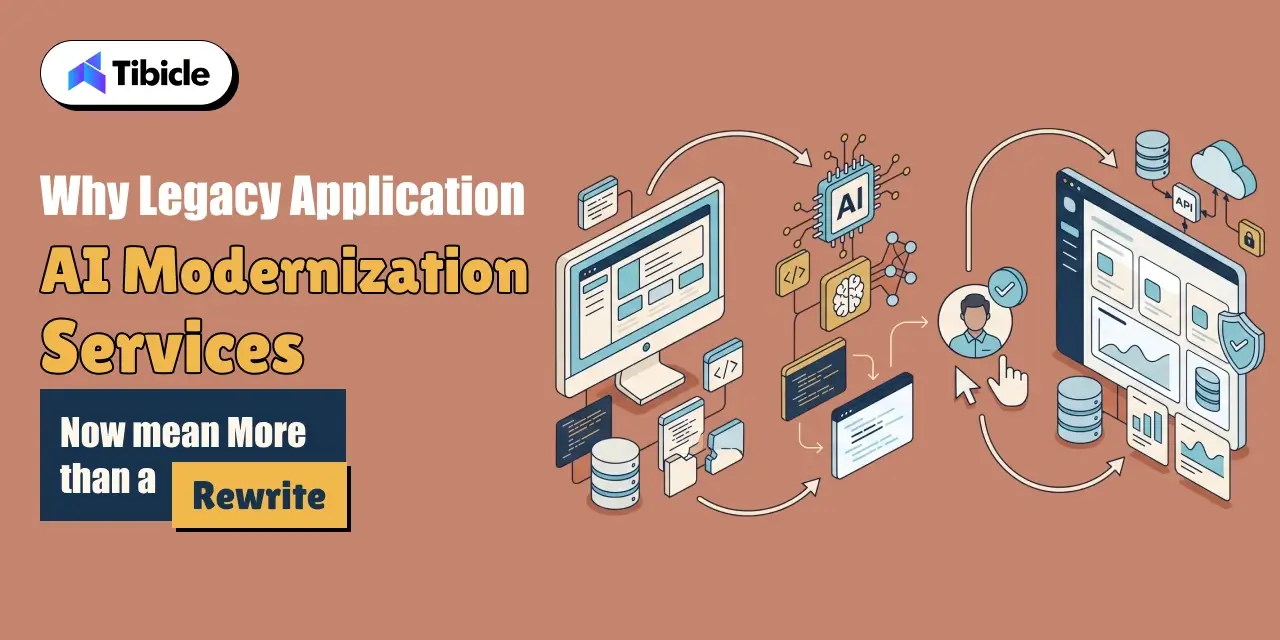
A manual legacy rewrite means a team reads old code, guesses at intent, and rebuilds it by hand. This process often takes months before anything ships. AI-assisted refactoring changes the shape of that work. A model can summarize what a function does, flag dead code, and draft a first-pass translation into a modern framework in minutes. Legacy application AI modernization services that use this workflow move faster. But the model’s draft is only a starting point for review, not a finished migration.
The Market and Cost Behind This Shift
The application modernization services market reflects how central this work has become. Grand View Research values it at $17.8 billion in 2023. The firm projects growth to $28.2 billion in 2026 and $52.5 billion by 2030, a 16.7% compound annual growth rate. The cost of standing still is just as concrete. Stripe’s Developer Coefficient survey polled over 1,000 developers. It found that engineers spend 17.3 hours of a 41.1-hour work week, roughly 42%, on technical debt and bad code rather than new development. Legacy application AI modernization services exist to claw back that time, not just to make old code look newer.
Where AI Actually Helps in a Legacy Application AI Modernization Services Project
Code Comprehension and Documentation for Undocumented Systems
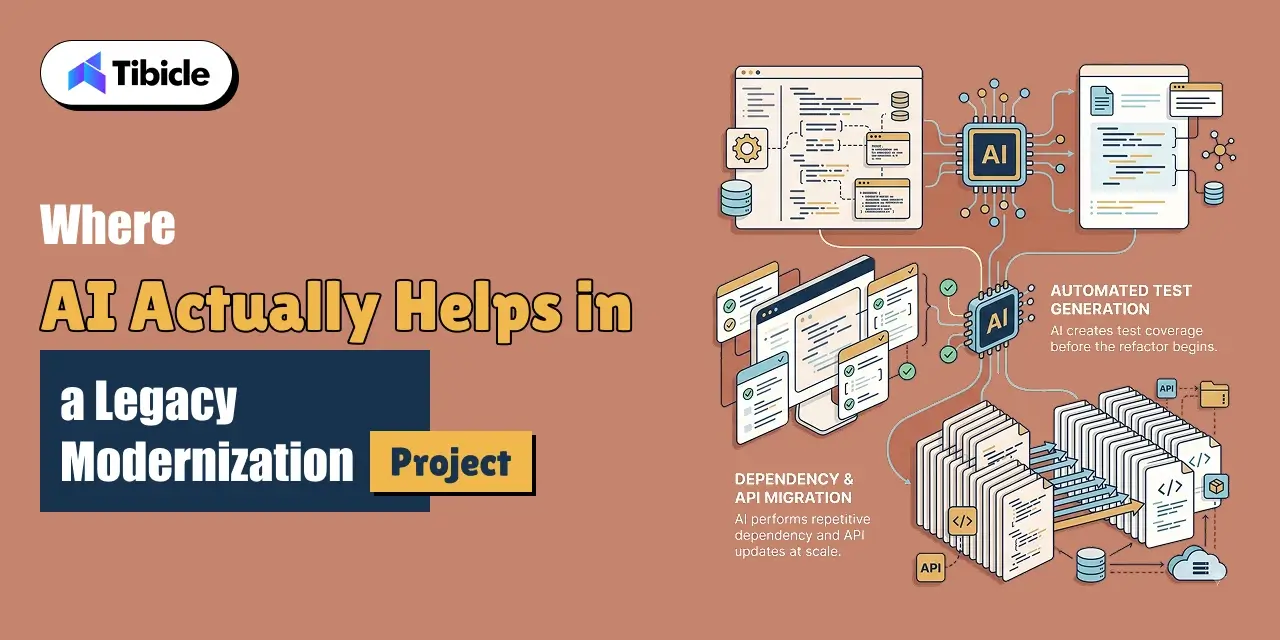
Most legacy systems outlive the developers who wrote them. AI models are genuinely strong at reading undocumented code. They produce a plain-language summary of what a module does. That summary cuts the weeks a team would otherwise spend just understanding the system before touching it.
Automated Test Generation Before Refactoring
Before any refactor, a team needs tests that capture current behavior, bugs included. These tests keep a migration from silently changing what the system does. AI-assisted test generation drafts this coverage far faster than writing it by hand. It gives a modernization project a safety net before the first line of legacy code changes.
Dependency and API Migration at Scale
Bulk, mechanical changes are exactly the kind of repetitive task AI tools handle well. Think upgrading a deprecated API call across hundreds of files, or updating a library’s import syntax. This is where legacy application AI modernization services save the most calendar time with the least risk.
Where AI-Assisted Code Migration Still Falls Short
The Accuracy Gap on Complex Migrations
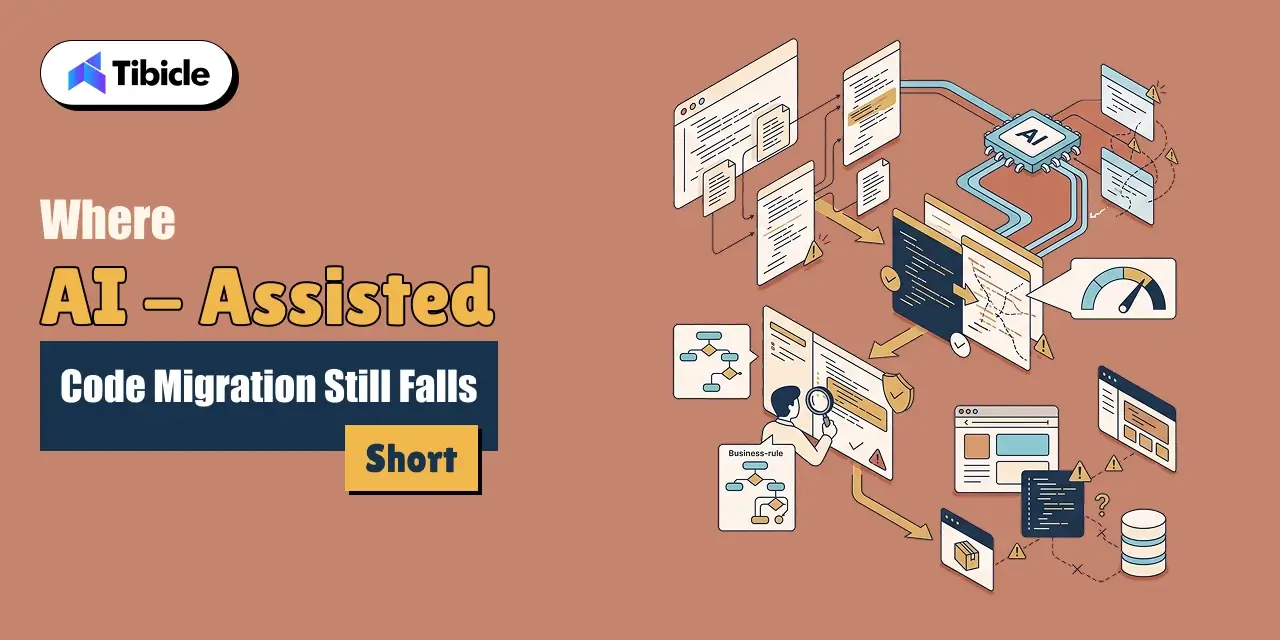
Complex, cross-file migrations are where AI-assisted code migration is still unreliable. CODEMENV is a benchmark built to test large language models on code migration across environments. It found an average pass rate of only 26.5% across seven models. The strongest model, GPT-4o, reached just 43.84%. That gap is the clearest argument against handing a legacy migration to a model unsupervised.
Why Business Logic Still Needs a Human Reviewer
A model cannot tell the difference between a rule the business requires and one that exists only because of a decade-old workaround nobody removed. Legacy application AI modernization services need a domain expert in the loop. That expert makes the call, migration by migration.
Legacy Frameworks AI Tools Handle Poorly
Niche or end-of-life frameworks give AI tools far less to work from. Think older desktop toolkits, uncommon enterprise Java frameworks, or proprietary internal libraries. Accuracy drops accordingly on these systems. They are the migrations that most need a team that has done this specific kind of work before.
Refactor, Re-Platform, or Rebuild: Choosing the Right Path for Web and Desktop Apps
The right modernization path depends on how much of the existing system is worth keeping. It does not depend on which approach sounds most thorough.
| Approach | What It Involves | Best Fit |
|---|---|---|
| Refactor in place | Clean up and modernize code within the existing architecture | Systems with sound architecture but outdated code or dependencies |
| Re-platform | Move the app to a new framework or runtime while keeping most business logic | Apps on a deprecated stack that still fits the business well |
| Rebuild | Redesign and rebuild the application from the ground up | Systems where the architecture itself blocks the product roadmap |
When Refactoring in Place Is Enough
Refactoring in place is the fastest and cheapest path when the architecture still fits the business. This applies when the problem is outdated syntax, unpatched dependencies, or missing tests. Tibicle’s Technology Consulting practice scopes this decision as the first step of any engagement, before any code changes.
When to Re-Platform Instead
A web application on a deprecated framework usually needs re-platforming even when the business logic is sound. The same applies to a desktop app tied to an unmaintained toolkit. Tibicle’s Website Development and Desktop App Development teams handle this kind of migration directly.
When a Full Rebuild Is Worth the Cost
A full rebuild earns its cost only when the current architecture blocks what the business needs next. It should not happen simply because the code looks old. Reserve this path for systems where refactoring or re-platforming would cost nearly as much as starting over.
The Security Case for Modernizing Now, Not After an Incident
For the first time in 19 years, exploiting a software vulnerability overtook stolen credentials as the leading attack method. Verizon’s 2026 Data Breach Investigations Report puts this at 31% of breaches. Legacy applications carry an outsized share of this risk. Unpatched frameworks, unsupported libraries, and years of accumulated workarounds give attackers more surface to work with than a current, actively maintained system. Legacy application AI modernization services that fold security hardening into the migration close this gap while a team already has the code open. Treating security as a separate project misses that window. Tibicle’s Annual Maintenance Contracts keep a modernized system patched after the migration ships.
What a Safe AI-Assisted Legacy Application AI Modernization Services Rollout Actually Looks Like
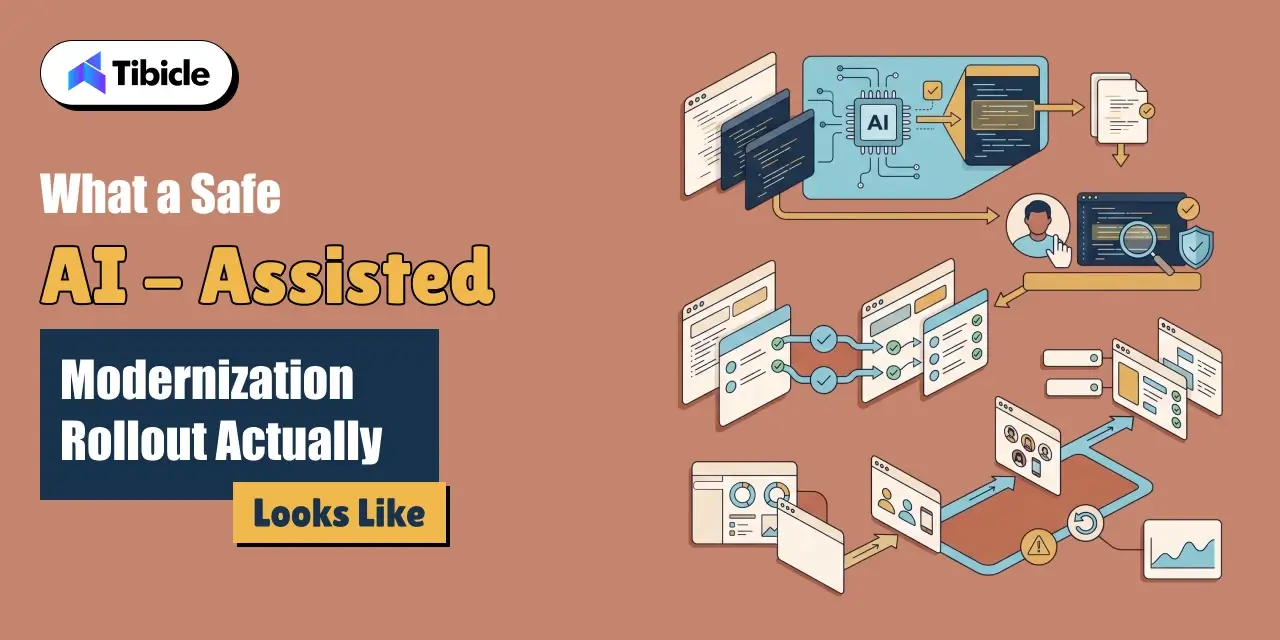
Human-in-the-Loop Review for AI-Generated Migrations
Every AI-generated migration needs a reviewer before it merges. That reviewer must understand the original system’s business context, not just its syntax. This single step separates a safe legacy application AI modernization services engagement from a risky one.
Test Coverage Before and After the Migration
A team should write tests against the legacy system’s actual behavior. Running those same tests against the migrated version confirms the refactor did not silently change what the system does.
Staged Rollout Instead of a Big-Bang Cutover
A staged rollout sends a modernized system to a small user group first. A fast rollback path backs this up. This approach catches problems a test suite misses before they reach every user at once.
Common Reasons Legacy Application AI Modernization Services Projects Stall
- The team let an AI tool migrate business-critical logic without a domain expert reviewing the output.
- No test suite existed to confirm the migrated system behaved the same way as the original.
- The project chose a full rebuild when a refactor or re-platform would have solved the actual problem.
- The team scoped security hardening as a separate project instead of folding it into the modernization work
- The rollout went live for every user at once, with no staged path or rollback plan.
How Tibicle Delivers Legacy Application AI Modernization Services
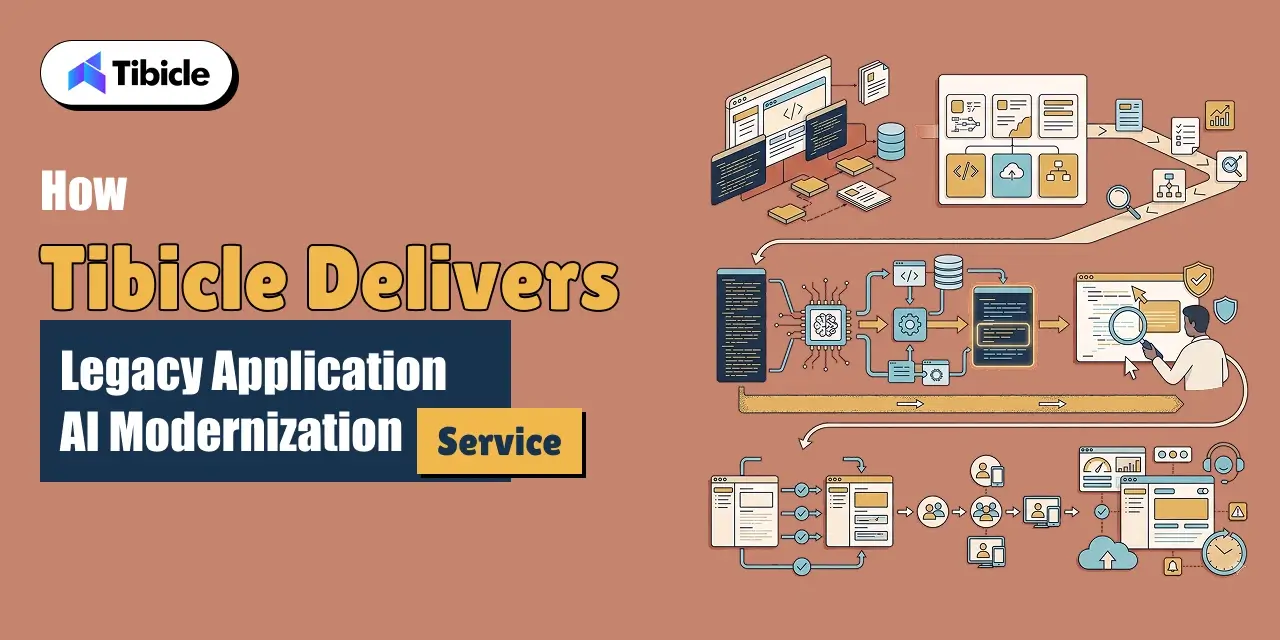
Legacy Application Audit and Modernization Roadmap
Tibicle starts with an audit of the existing system. The audit covers what still works, what is a genuine liability, and whether the right path is a refactor, a re-platform, or a rebuild. This scoping stage draws on Tibicle’s Technology Consulting practice.
AI-Assisted legacy Migration with Human Review
The build phase uses AI tools for the mechanical, high-volume parts of the migration. A developer reviews every change that touches business logic before it merges.
Testing and Ongoing Legacy Application AI Modernization Services Support
After migration, Tibicle stages the rollout and verifies behavior against the original system. The team keeps the modernized application maintained through its 24/7 Monitoring & Support service.
Conclusion
AI genuinely speeds up legacy application modernization for comprehension, test generation, and bulk migration work. It still needs a human reviewer for anything touching business logic. Getting that balance right is exactly what a business hires a modernization partner to do.
Have a legacy web or desktop application that needs modernizing? Talk to the Tibicle team.
Frequently Asked Questions
What do legacy application AI modernization services actually include?
They combine AI-assisted code comprehension, automated test generation, and bulk dependency migration with human review of business logic. Teams deliver this as a refactor, re-platform, or rebuild depending on the system.
How accurate is AI at migrating legacy application ai modernization services code on its own?
Benchmark research on code migration found an average pass rate of only 26.5% across tested models. The best model reached under 44%. That gap is why unsupervised AI migration is not reliable for complex systems.
Should we refactor, re-platform, or rebuild our legacy application ai modernization services?
Refactor if the architecture still fits the business and the code is just outdated. Re-platform if the stack itself is deprecated but the logic is sound. Rebuild only if the architecture blocks what the business needs next.
Why does legacy application AI modernization services matter for security, not just performance?
Vulnerability exploitation is now the leading cause of data breaches. Legacy systems carry a disproportionate share of unpatched, unsupported code, which gives attackers more to work with.
How long does a legacy application AI modernization services take?
It depends on scope. A focused refactor with AI-assisted comprehension and testing can take weeks. A full re-platform or rebuild of a business-critical system takes longer, and a team should stage it.
Does Tibicle offer legacy application AI modernization services for web and desktop apps?
Yes. Tibicle modernizes legacy web and desktop applications using AI-assisted migration with human review, covering refactoring, re-platforming, security hardening, and ongoing support after launch.
Schedule A Developer Interview And Get 15 Days Risk-Free Trial
Schedule a Call

Relevant Blog
Custom Computer Vision Software Development Company

Arjun Shinojiya

How to Hire Dedicated Electron.js Developers in 2026

Avni Kanabar
Written by
Recent Blogs
Legacy Application AI Modernization Services
Who this is for: Engineering leads, CTOs, and IT decision-makers responsible for a legacy web or desktop application who are evaluating AI modernization services for legacy applications rather than a full ground-up rebuild. Search intent: Commercial evaluation with a technical backbone. The reader has moved past “what is legacy modernization” and wants to know where […]
Custom Computer Vision Software Development Company
Who this is for: Engineering leads, product owners, and operations heads at B2B enterprises evaluating a custom computer vision software development company for a real visual-data workflow rather than a demo. Search intent: Commercial evaluation with a technical backbone. The reader has moved past “what is computer vision” and wants architecture choices, accuracy data, and […]
Custom Autonomous AI Agent Development Services: Building Task-Driven Workflow Bots
What This Guide Covers Who this is for: Engineering leads, product owners, and operations heads evaluating AI agent development services for a real internal workflow rather than a chatbot pilot. Search intent: Commercial evaluation with a technical backbone. The reader has moved past “what is an AI agent” and wants architecture choices, failure data, and […]
Got an Idea? Get FREE Consultation
In our world, there's no such thing as having too many clients

