
Custom Computer Vision Software Development Company

Sep 16, 2026

Read in 5 Minutes
Table of Contents
- Introduction
- Why B2B Enterprises Need a Custom Computer Vision Software Development Company, Not a Vision API
- What Custom Computer Vision Software Development and Multimodal AI Actually Requires
- Where Custom Computer Vision Software Development Creates Enterprise Value: Manufacturing, Healthcare, and Retail
- General-Purpose Multimodal APIs vs a Custom Computer Vision Software Development Company
- Data Privacy, Compliance, and Governance for Visual and Biometric Data
- Common Reasons Custom Computer Vision Software Development Projects Fail to Reach Production
- How Tibicle Delivers Custom Computer Vision Software Development and Multimodal AI Development
- Conclusion
- Frequently Asked Questions
Who this is for: Engineering leads, product owners, and operations heads at B2B enterprises evaluating a custom computer vision software development company for a real visual-data workflow rather than a demo.
Search intent: Commercial evaluation with a technical backbone. The reader has moved past “what is computer vision” and wants architecture choices, accuracy data, and a build-vs-buy comparison before briefing a vendor.
What you will walk away with: What a production computer vision and multimodal AI build actually requires, current market and accuracy data from Gartner, Grand View Research, and a UC-affiliated benchmark study, a build-vs-buy comparison table, and how Tibicle structures custom computer vision and multimodal AI application development for B2B enterprise.
Introduction
A custom computer vision software development company builds systems that read pixels and turn them into business decisions. It does not just label a photo and stop there. Gartner projects that 80% of enterprise software and applications will be multimodal by 2030, up from less than 10% in 2024. That shift changes what a B2B enterprise actually needs from a computer vision software development company.
A generic vision API can tag a photo. However, a production system has to do more. For example, it must catch a hairline defect on a moving line, read a document buried inside a video frame, or flag an anomaly in real time. In addition, it then has to route that decision to the right person or system, without a human reviewing every frame. The gap between a vision demo and a system an enterprise can run in production sits in the architecture, not the model.
Therefore, that means data pipelines, fusion across image, text, and sensor inputs, and a deployment plan that respects where the data can live. This guide covers what custom computer vision and multimodal AI development actually requires, and where it creates real enterprise value. It also covers why general-purpose vision APIs fall short on domain-specific data. And it covers how Tibicle structures custom computer vision and multimodal AI application development for B2B enterprise.
Why B2B Enterprises Need a Custom Computer Vision Software Development Company, Not a Vision API
From Single-Purpose Vision APIs to Multimodal Enterprise Systems
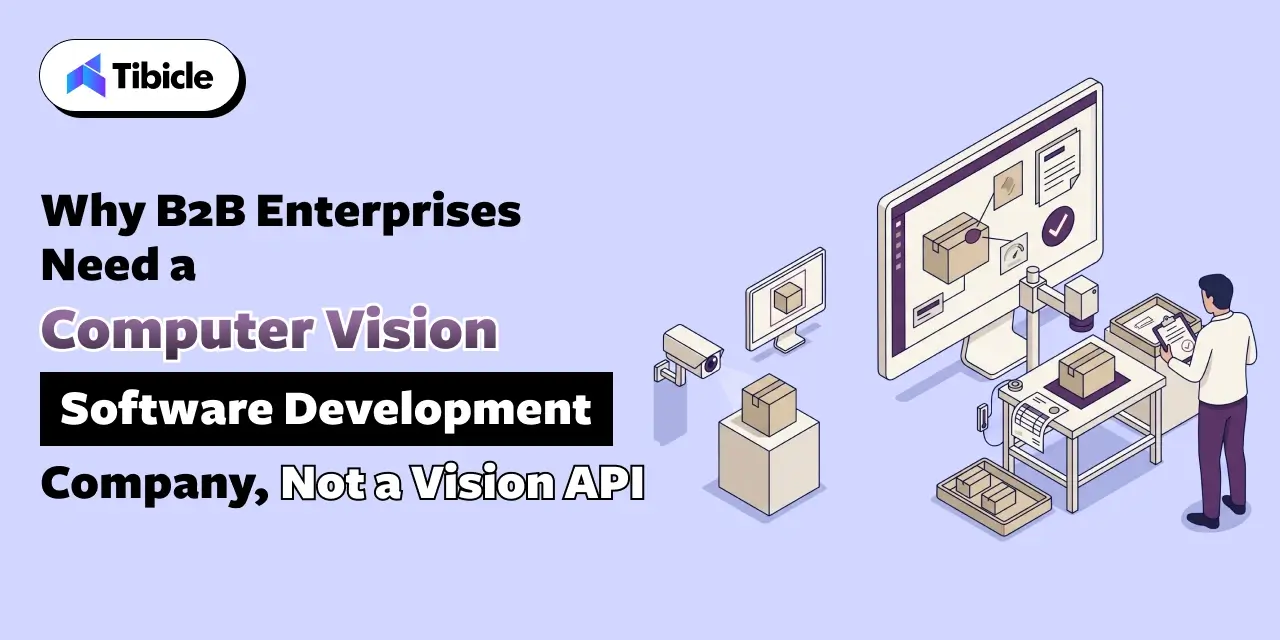
A stock vision API returns labels: this is a box, this is a face, this is a forklift. A B2B enterprise workflow needs more context than that. It needs to combine what a camera sees with what a sensor reports, what a document says, and what a business rule requires. It then acts on all three together. That combination is what multimodal AI application development actually means in practice. It is also why a computer vision software development company builds a pipeline, not a single model call.
The Market Shift Behind This Demand
Enterprise investment in visual AI is accelerating in a way that reflects this shift. Grand View Research values the global computer vision market at $23.6 billion in 2025. The firm projects growth to $28.2 billion in 2026 and $101.5 billion by 2033, a 20.1% compound annual growth rate. It attributes a meaningful share of that growth to the move toward multimodal AI models. These models combine visual, textual, and contextual data for more accurate analysis. A computer vision software development company sits right at that intersection. It builds the fusion layer generic tools do not provide out of the box.
What Custom Computer Vision Software Development and Multimodal AI Actually Requires
Data Pipelines: Capture, Labeling, and Model Training
A production vision system starts with a data pipeline, not a model. Cameras or sensors capture raw footage. A labeling process marks what matters for the specific task. A training loop then fine-tunes a model against that labeled set. Skipping the labeling step and relying on a general pretrained model instead is the single most common reason a computer vision pilot never reaches production.
Fusing Vision With Text, Sensor, and Structured Data
Multimodal AI application development means combining an image with the data around it. Think a timestamp, a sensor reading, a work order number, or a compliance rule stored as text. A system that flags a defect but cannot tie it to the right batch record only does half the job. The fusion layer, not the vision model alone, makes the output usable by another system or person.
Edge vs Cloud Custom Computer Vision Software Development Inference for Real-Time Decisions
A quality-control camera on a production line cannot wait on a round trip to a cloud API when the line moves faster than that latency allows. Edge inference keeps the decision local and fast. Cloud inference trades some latency for easier updates and more compute. A computer vision software development company picks this split based on the actual line speed and network reliability, not by default.
Where Custom Computer Vision Software Development Creates Enterprise Value: Manufacturing, Healthcare, and Retail
Manufacturing: Defect Detection and Quality Control
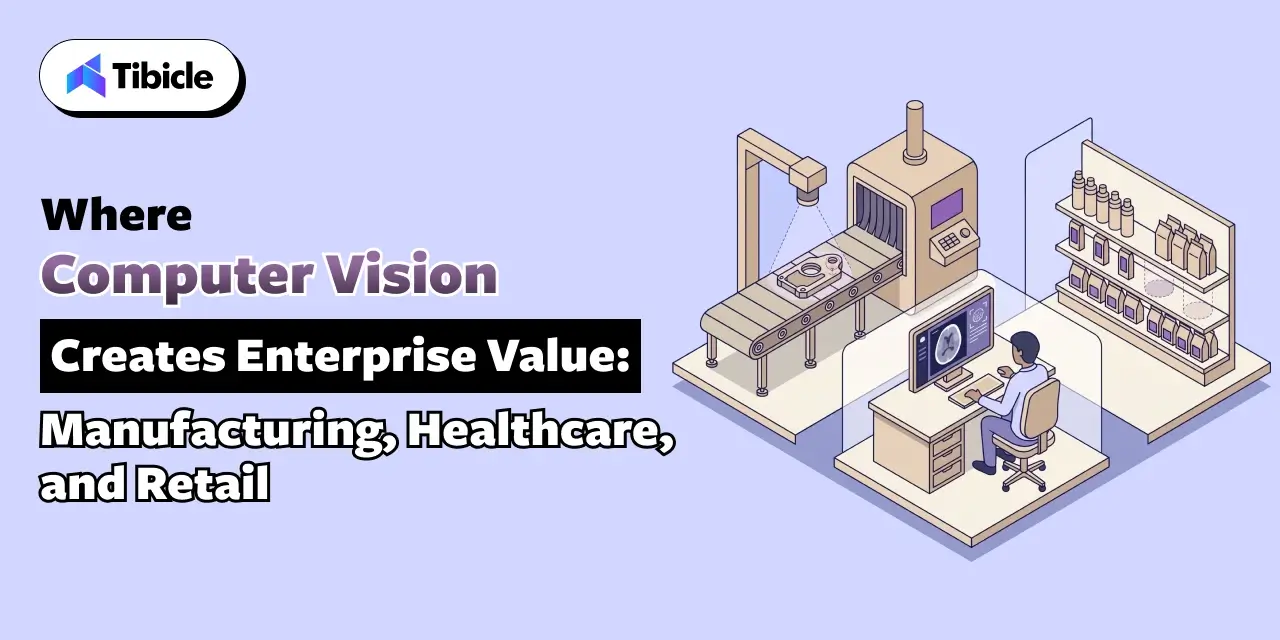
Manufacturing and IT functions report measurable cost benefits from AI use cases. Quality control and predictive maintenance are consistently among the strongest, according to McKinsey’s 2025 State of AI survey. A camera on the line that catches a surface defect before it reaches packaging replaces a manual inspection step. That manual step scales poorly and tires over an eight-hour shift. Tibicle’s IoT & Smart Solutions work covers the sensor and real-time monitoring layer this kind of inspection system depends on.
Healthcare: Medical Imaging and Diagnostic Support
Medical imaging is the single largest category of FDA-authorized AI and machine learning medical devices. A 2024 analysis found the agency cleared 168 machine-learning-enabled Class II devices that year. Radiology accounted for roughly 74% of them. That concentration reflects how mature computer vision has become for structured image analysis. It also reflects how much regulatory scrutiny a healthcare-facing build has to clear before launch. Tibicle’s HealthTech industry work covers this compliance layer directly.
Retail and Logistics: Shelf Monitoring and Inventory Accuracy
A camera that reads shelf gaps, verifies planogram compliance, or counts inventory at a dock door removes a manual audit step. That manual audit otherwise happens once a day at best. Tibicle’s Retail & E-Commerce work applies this same computer vision and multimodal AI pattern to shelf and inventory monitoring.
General-Purpose Multimodal APIs vs a Custom Computer Vision Software Development Company
Where General-Purpose Vision APIs Are the Right Call
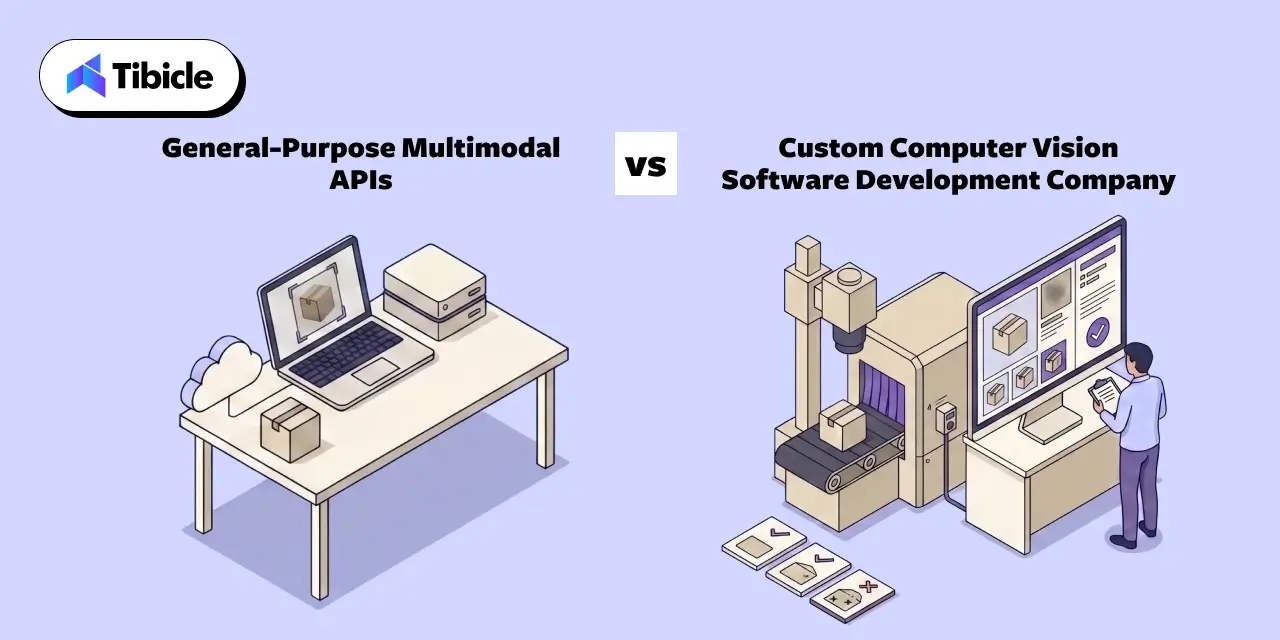
A general-purpose multimodal API handles common, well-represented tasks well: reading a receipt, tagging a product photo, moderating uploaded images. For those tasks, building custom is rarely worth the cost.
Why Accuracy Drops on Domain-Specific Visual Data
Accuracy drops fast once the task moves to specialized visual data the model never trained on. The MMAD benchmark tests multimodal large language models on industrial anomaly detection. Researchers built it specifically for that purpose. It found that GPT-4o, the strongest commercial model tested, reached only 74.9% average accuracy across defect and anomaly questions. The researchers note this falls far short of what industrial inspection actually requires. General-purpose models train on broad internet imagery, not the specific texture of a welded seam or a printed circuit board. That gap does not close on its own.
The Case for a Custom Computer Vision Software Development Build
A computer vision software development company closes that gap. It fine-tunes on the enterprise’s own visual data instead of relying on a general-purpose model’s out-of-the-box accuracy.
| Factor | General-Purpose Vision APIs | Custom Computer Vision Development |
|---|---|---|
| Setup speed | Live in days | Live in weeks, scoped to the specific visual task |
| Accuracy on domain data | Drops on specialized or unfamiliar imagery | Fine-tuned on the enterprise’s own labeled data |
| Data control | Images often processed through the vendor’s cloud | Data and models stay inside your infrastructure by design |
| Latency | Depends on network round trip | Can run at the edge for real-time decisions |
| Cost at scale | Per-call fees grow with image volume | Fixed build cost, no recurring per-call fee |
| Best fit | Common, well-represented visual tasks | Specialized, regulated, or high-volume visual workflows |
For workflow bots that need to run on a user’s own machine, the same architecture questions apply to a desktop shell rather than a browser tab. Tibicle’s guide on running local LLMs in Electron covers the process-model constraints that shape an on-device agent build.
Data Privacy, Compliance, and Governance for Visual and Biometric Data
When Visual Data Becomes Regulated Biometric Data
Not every image is ordinary personal data. Under GDPR, facial recognition footage at an access point counts as biometric data. This kind of footage falls under Article 9’s special category rules (ICO). Those rules carry a higher legal bar than standard personal data. A computer vision software development company needs to know which parts of a visual pipeline cross that line. That scoping has to happen before the first camera goes live, not after.
On-Prem and Edge Deployment for Sensitive Computer Vision Software Development Data
Keeping inference on-site or at the edge is often the simplest way to reduce this exposure. It beats routing every frame through a third-party cloud API. It also removes a dependency on an external vendor’s uptime for a workflow that cannot pause.
Human Review Checkpoints for High-Stakes Visual Decisions
Any visual decision with legal, safety, or diagnostic consequences needs a human checkpoint before it becomes final. A confidence score attached to an automated action is not enough on its own. Building that checkpoint into the workflow from day one costs far less than retrofitting it after an incorrect automated decision.
Common Reasons Custom Computer Vision Software Development Projects Fail to Reach Production
The pattern behind stalled computer vision projects repeats across industries:
- The pilot used a small, clean dataset that does not reflect real production conditions, lighting, or camera angles
- No labeling pipeline existed to keep the training data current as the visual task changed
- The team evaluated the model on accuracy alone, without a plan for what happens when confidence is low
- The team discovered edge or latency requirements only after building the cloud-based architecture
- The team identified biometric or regulated visual data only after the system had already started collecting it
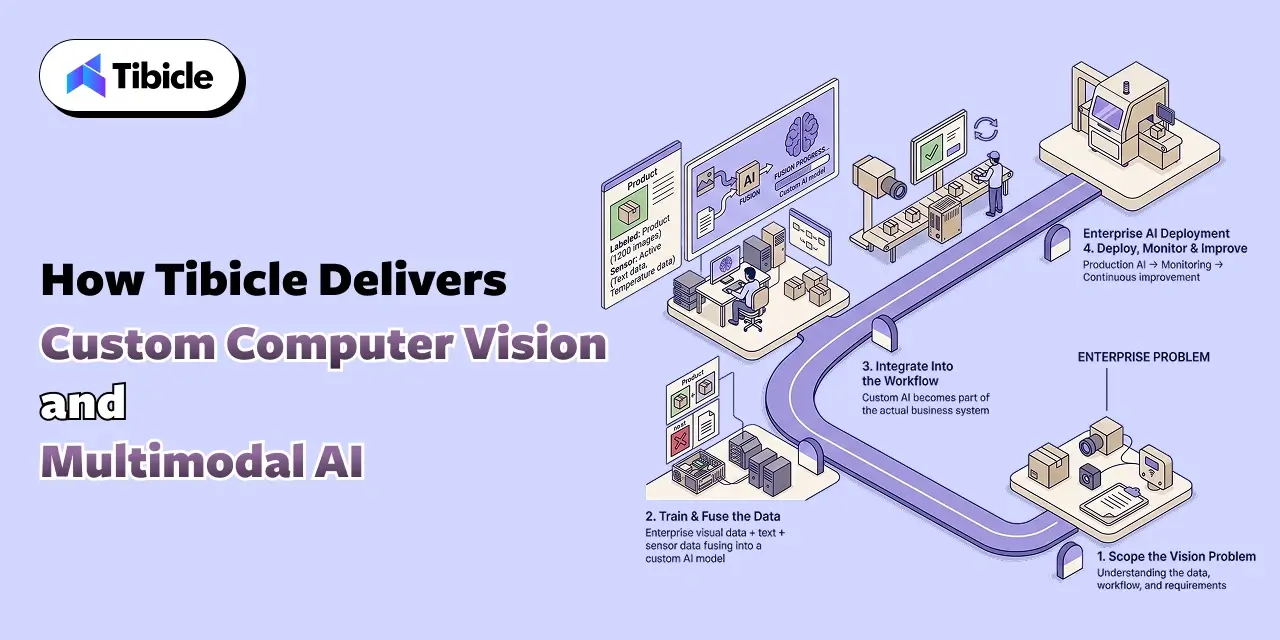
How Tibicle Delivers Custom Computer Vision Software Development and Multimodal AI Development
Data and Model Scoping
Tibicle starts by auditing the actual visual task. That includes what the camera or sensor captures today, and what a labeled dataset needs to include. It also covers whether the workflow needs edge inference or can run in the cloud. This scoping stage draws on Tibicle’s AI & Automation Consulting practice.
Build: Model Training, Fusion, and Integration
The build phase fine-tunes a vision model against the enterprise’s own data. It also fuses that model with the text, sensor, and structured inputs the workflow depends on. Tibicle delivers this through its AI Development and Integration services.
Deployment and Monitoring
After launch, Tibicle monitors accuracy against production data, not just the original test set. The team retrains the model as the visual task or environment drifts.
Conclusion
A custom computer vision and multimodal AI system earns its cost once three things start to matter more than demo speed. Those three things: accuracy on real production data, latency, and data governance. All three come down to architecture decisions a team makes before training starts. Building a computer vision system for a real enterprise workflow? Talk to the Tibicle team.
Frequently Asked Questions
What does a custom computer vision software development company actually build, compared to a vision API?
A vision API returns labels for a single image. A computer vision software development company builds the full pipeline instead. That pipeline covers data capture, labeling, model training, fusion with other data sources, and deployment tuned to the enterprise’s latency and compliance needs.
How accurate are general-purpose multimodal AI models on specialized enterprise visual tasks?
Benchmark research on industrial anomaly detection found the strongest commercial multimodal model reached only 74.9% accuracy. That falls well short of what industrial inspection requires. This gap is why domain-specific fine-tuning matters for specialized visual tasks.
Does custom computer vision software development need to run on-site instead of through a cloud API?
It depends on latency and data sensitivity. Real-time production-line decisions often need edge or on-prem deployment. So does regulated visual data, such as biometric identification, rather than a round trip to a cloud API.
What industries get the most value from custom computer vision software development?
Manufacturing, healthcare, and retail show the clearest documented value today, covering defect detection, medical imaging analysis, and shelf or inventory monitoring.
When does visual data become regulated biometric data for custom computer vision software development?
Under GDPR, facial recognition footage at an access point counts as biometric data. Article 9’s special category rules cover this kind of data. Those rules require a stronger legal basis than ordinary personal data.
Does Tibicle offer custom computer vision software development and multimodal AI development for B2B enterprises?
Yes. Tibicle builds custom computer vision and multimodal AI applications for enterprise clients, covering data pipeline design, model fine-tuning, fusion with existing systems, and post-launch monitoring.
Schedule A Developer Interview And Get 15 Days Risk-Free Trial
Schedule a Call



Written by

Recent Blogs
Custom Computer Vision Software Development Company
Who this is for: Engineering leads, product owners, and operations heads at B2B enterprises evaluating a custom computer vision software development company for a real visual-data workflow rather than a demo. Search intent: Commercial evaluation with a technical backbone. The reader has moved past “what is computer vision” and wants architecture choices, accuracy data, and […]
Custom Autonomous AI Agent Development Services: Building Task-Driven Workflow Bots
What This Guide Covers Who this is for: Engineering leads, product owners, and operations heads evaluating AI agent development services for a real internal workflow rather than a chatbot pilot. Search intent: Commercial evaluation with a technical backbone. The reader has moved past “what is an AI agent” and wants architecture choices, failure data, and […]
How to Hire Dedicated Electron.js Developers in 2026
What This Guide Covers Who this is for: US tech firms, SaaS companies, startups, CTOs, engineering managers, and product teams looking to hire dedicated Electron.js developers for ongoing desktop application development. Search intent: Hiring and decision. This guide covers where to find Electron.js developers, how to evaluate their technical skills, and how dedicated developers compare […]
Got an Idea? Get FREE Consultation
In our world, there's no such thing as having too many clients

