
Best Food Service Management Software in India (2026)

Jul 29, 2026

Read in 5 Minutes
Table of Contents
- What This Guide Covers
- Introduction
- What Food Service Management Software Actually Does (And What It Doesn’t)
- Types of Food Service Management Software: Which Model Fits Your Operation
- Key Capabilities That Separate High-ROI Platforms From Average Ones
- Top Food Service Management Software in India 2026 Comparison
- Pricing Breakdown: What Food Service Management Software Actually Costs in India
- ROI and Business Impact: What the Numbers Say
- Implementation Risks and Challenges No Vendor Will Tell You About
- Vendor Selection Checklist for Custom Food Service Management Software: Before You Sign Anything
- Why Tibicle LLP Is Worth Evaluating for Custom Food Service Management Software
- Conclusion
- FAQs
What This Guide Covers
Who this is for:
Restaurant owners, cloud kitchen operators, catering businesses, hotel F&B managers, multi-outlet restaurant chains, and operations leaders in India who are actively evaluating food service management software to improve operational efficiency, maintain FSSAI and GST compliance, reduce food costs, and support business growth.
Search intent:
Commercial investigation and software evaluation. This guide is designed for decision-makers who are not looking to understand what food service management software is. Instead, they are comparing platforms, evaluating pricing, understanding implementation costs, assessing compliance capabilities, and identifying the solution that best fits their operational requirements before investing.
What you will walk away with:
A comprehensive comparison of the leading food service management software platforms in India, including pricing tiers, deployment models, GST and FSSAI compliance capabilities, total cost of ownership, ROI benchmarks, implementation challenges, vendor evaluation criteria, and a practical decision framework to help you select the right software for your restaurant, cloud kitchen, catering business, or multi-location food operation with confidence.
Introduction
Running food operations on spreadsheets in 2026 costs more than it looks like on paper. Staff errors go uncaught until month-end, aggregator commissions quietly eat margin nobody is tracking, FSSAI audit failures show up without warning, and outlet-level visibility does not exist until the numbers are already wrong.
Decision-makers who have delayed adopting food service management software are now facing a compounding cost problem, not a technology problem.
This guide cuts through feature marketing to give ops leaders, CFOs, and CTOs a direct comparison of platforms, pricing structures, ROI benchmarks, and a vendor selection framework built specifically for Indian operations.
What Food Service Management Software Actually Does (And What It Doesn’t)
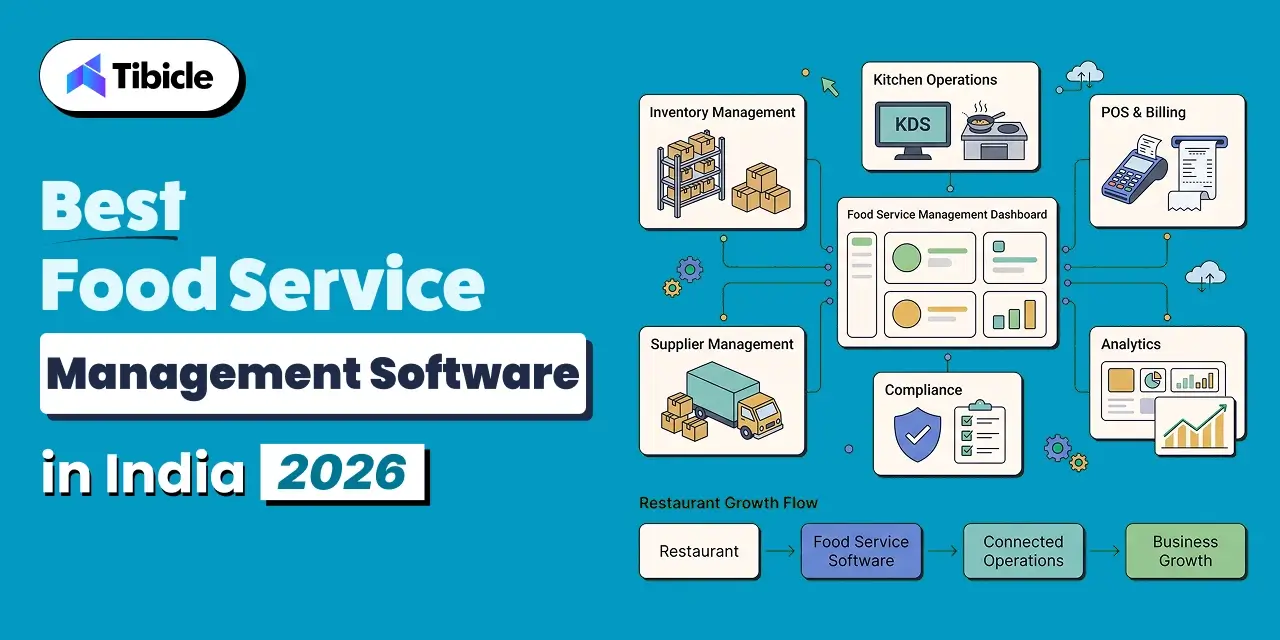
Food service management software integrates the kitchen, the counter, and the back office into a single system. It tracks inventory as it is depleted, prices out recipes against current ingredient costs, routes kitchen tickets to the right station, schedules staff based on actual demand, and bills correctly across dine-in, takeaway, and delivery.
Core Operational Functions
- Inventory tracking and auto-reorder triggers
- Recipe costing and menu margin analysis
- Kitchen order ticketing (KOT) and kitchen display system (KDS) integration
- Staff scheduling and shift management
- GST billing compliant across dine-in, takeaway, and delivery
Where Most Deployments Fall Short
Vendors market a single connected system. In most kitchens, that promise doesn’t hold up in practice.
- Systems sold as “all-in-one” that still need 4 to 5 third-party integrations to actually function
- Platforms without native Zomato or Swiggy order pulling, forcing manual re-entry at peak hours when a mistake is most likely
- No FSSAI compliance audit trail or temperature logging is built into the base product, leaving operators to bolt on a separate app
Types of Food Service Management Software: Which Model Fits Your Operation
Cloud-Based vs. On-Premise: The Right Call for Indian F&B
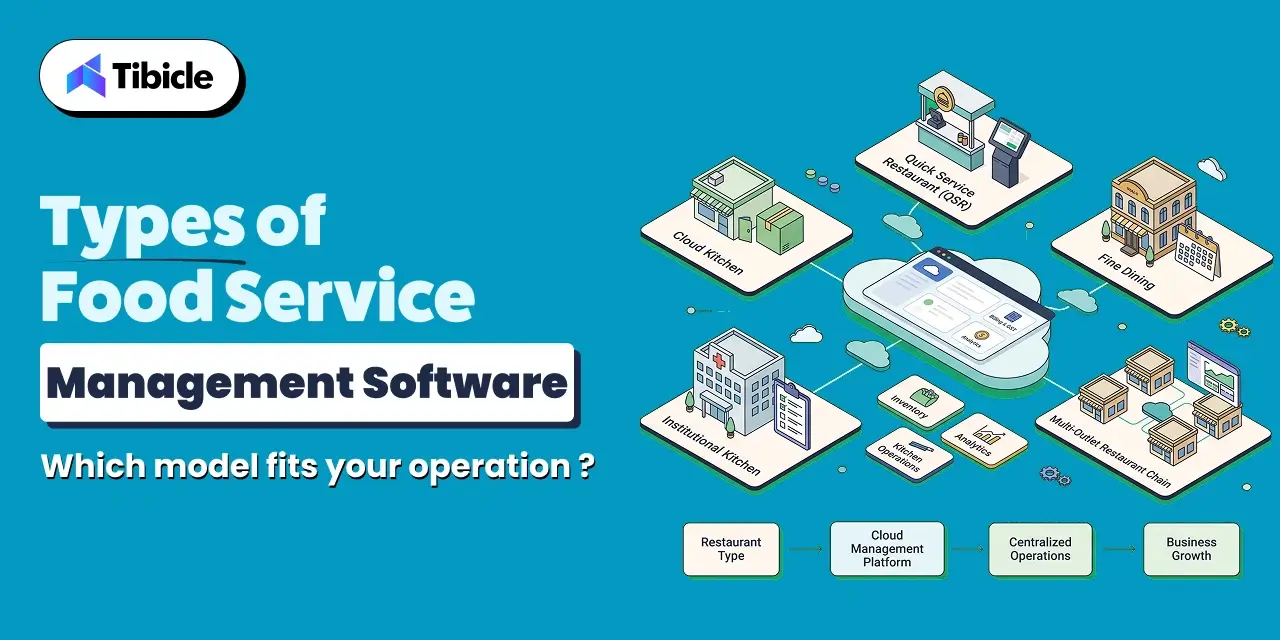
The cloud-versus-on-premise decision usually comes down to outlet count and internet reliability at each location. Cloud platforms cost less upfront, sync across outlets in real time, and pull GST and FSSAI updates automatically. On-premise systems cost more to set up but keep running without an internet connection, which matters for large institutional canteens where connectivity itself is a risk.
| Criteria | Cloud-Based | On-Premise |
| Upfront cost | Low (subscription) | High (license + hardware) |
| Internet dependency | High | None |
| Multi-outlet sync | Real-time | Manual/complex |
| GST/FSSAI update speed | Automatic | Manual patching |
| Best for | Chains, cloud kitchens | Large institutional canteens |
By Operational Format
- QSR chains and fast-casual: speed is the priority, so KDS and aggregator sync aren’t optional
- Fine dining: table management, reservation handling, and margin tracking on fewer, higher-value covers
- Cloud kitchens: zero front-of-house, built around order aggregation and cost-per-dish analytics
- Institutional catering (hospitals, corporates): compliance-first, HACCP-ready out of the box
- Multi-outlet chains: centralized dashboards with outlet-level P&L, so a regional manager sees a bleeding location without waiting for a monthly report
Key Capabilities That Separate High-ROI Platforms From Average Ones
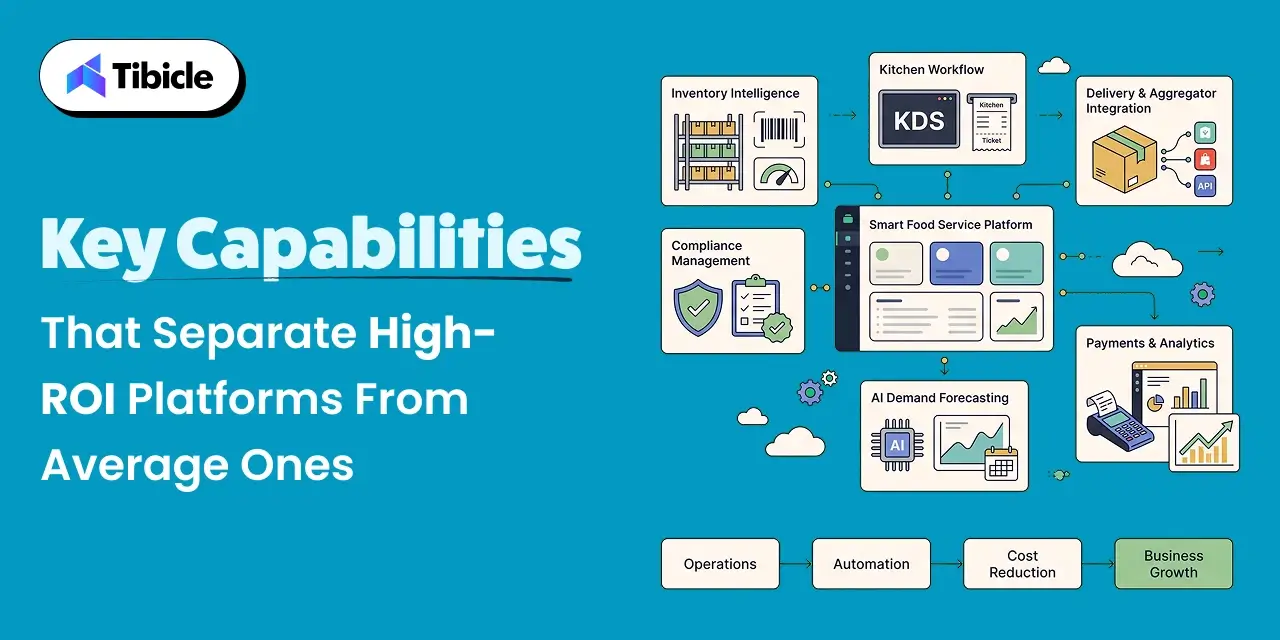
Every vendor claims inventory management, aggregator integration, compliance, and forecasting. The difference shows up in how deep those four capabilities actually go.
Inventory and Food Cost Control
- Real-time stock depletion versus theoretical usage comparison
- Wastage flagging with root-cause tagging (over-prep, spoilage, theft)
- Vendor rate benchmarking across purchase orders, which surfaces a supplier who quietly raised prices months ago
Aggregator and Payment Integration
- Direct order pull from Zomato, Swiggy, and ONDC, with no manual re-entry
- Commission breakdown visibility per order, per platform, since commission structures change often
- UPI, card, and wallet reconciliation inside the same dashboard
Compliance and Audit Readiness
- FSSAI digital logs covering temperature, hygiene, and supplier certifications
- HACCP checklist automation with mobile notifications, so a missed check gets flagged the same day
- GST billing return-ready reports, specifically GSTR-1 and GSTR-3B output, not just invoice generation
AI-Driven Demand Forecasting
- Sales pattern analysis to reduce over-prep by day of the week and hour
- Seasonal and event-based menu adjustment prompts
- Auto-indent to suppliers once stock hits the par level, closing the loop between forecasting and procurement
Recipe management depth is what actually decides whether the food cost number on a dashboard is accurate or just directional, so it’s worth testing specifically during a demo.
Top Food Service Management Software in India 2026 Comparison
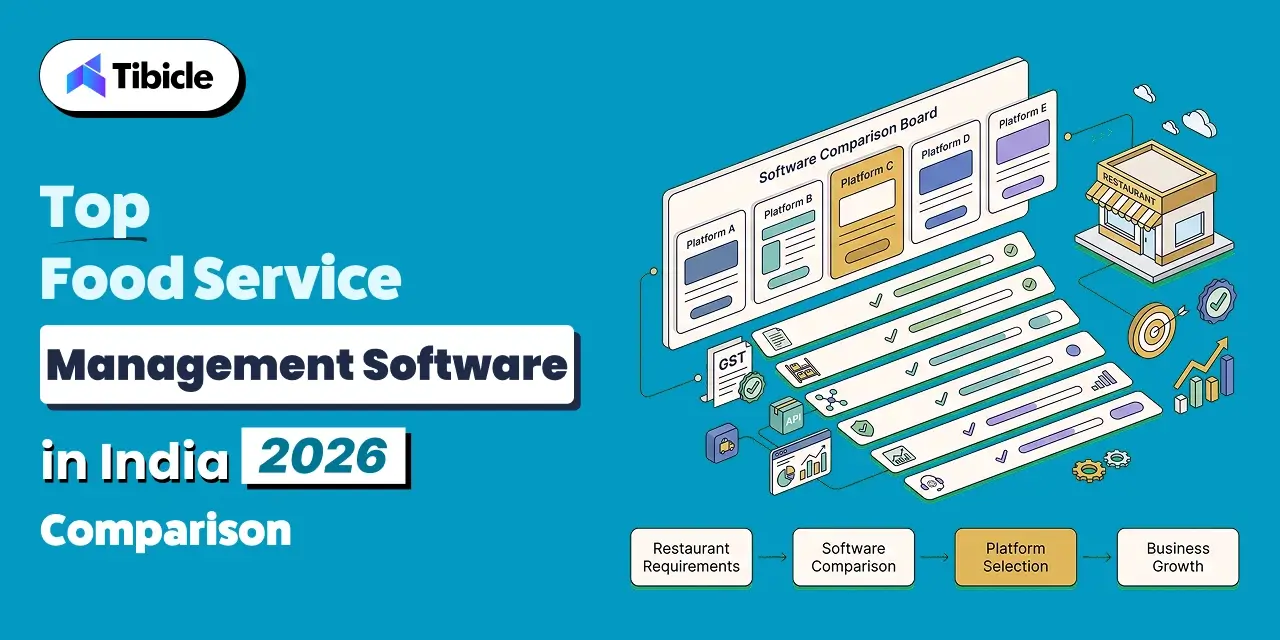
Seven platforms come up consistently in Indian F&B procurement conversations, each built for a different operational profile. Use the table below as a shortlist starting point, then verify scope directly with each vendor before signing.
Platform Comparison Table
| Platform | Best For | GST Ready | Aggregator Sync | FSSAI Compliance | Pricing (INR/month) | India Support |
| GOFRUGAL POS | Retail + Restaurant chains | Yes | Yes | Yes | ₹1,500–₹5,000/outlet | Strong |
| Petpooja | QSR, multi-outlet | Yes | Yes | Partial | ₹1,000–₹3,500/outlet | Strong |
| APICBASE | F&B enterprises, catering | Yes | No | Yes | Custom | Limited |
| MarketMan | Inventory-first operators | No | Partial | No | $127+/month | Limited |
| Oracle Simphony | Enterprise, hotels | Yes | Partial | Partial | Custom enterprise | Moderate |
| Lightspeed Restaurant | Fine dining | Yes | Partial | No | ₹4,000–₹8,000/outlet | Moderate |
| MealSuite | Institutional catering | Yes | No | Yes | Custom | Limited |
What the Table Doesn’t Tell You
- Platforms with strong India support often have shallower recipe costing depth
- Enterprise platforms (Oracle, APICBASE) require a 3- to 6-month implementation window
- “GST ready” often means GST invoice generation only, not full GSTR filing support, so confirm scope before signing
Custom-Built vs. Off-the-Shelf: When to Consider a Bespoke Solution
Off-the-shelf software works for standard formats: QSR, café, single-outlet restaurants. Custom development starts to make sense once operations span multiple states with different compliance rules, run proprietary supply chain workflows, or need POS, ERP, and warehouse management combined into one system. Build cost in India typically runs ₹3 to ₹30 lakhs, depending on scope.
Pricing Breakdown: What Food Service Management Software Actually Costs in India
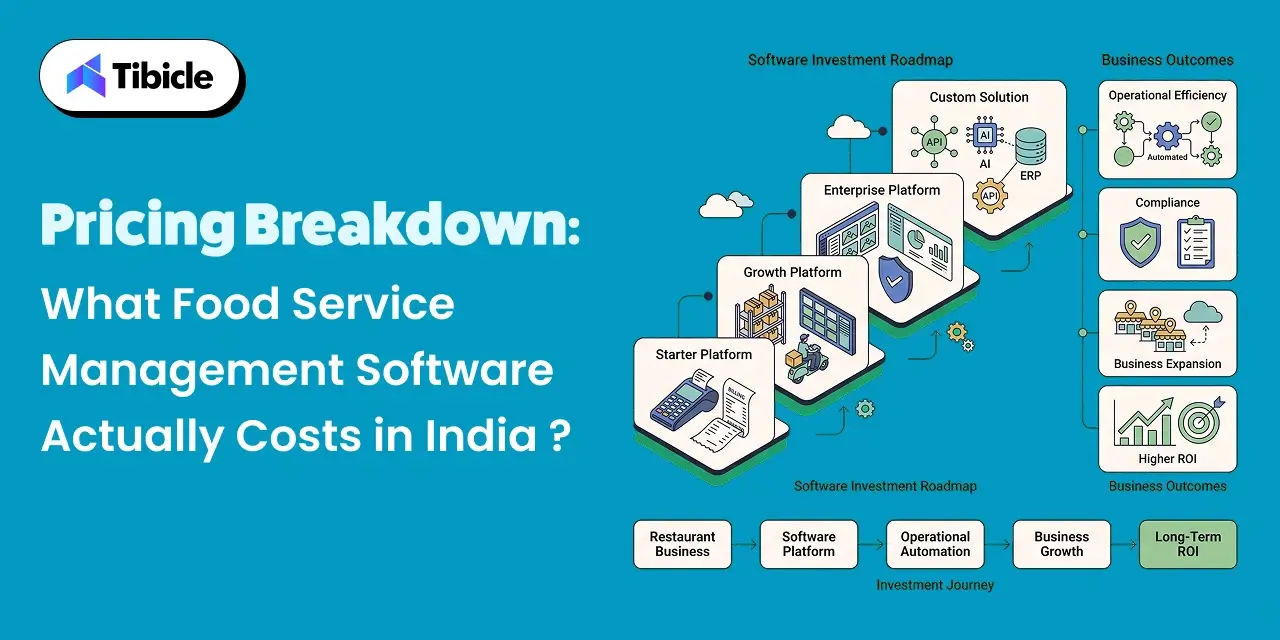
Subscription Tier Structure (Market Overview)
| Tier | Monthly Cost (INR) | Typical Inclusions | Limitations |
| Starter | ₹800–₹2,000/outlet | POS, billing, basic inventory | No aggregator sync, limited reports |
| Mid-Market | ₹2,500–₹6,000/outlet | KDS, Zomato/Swiggy, staff module | Single-brand only, no API access |
| Enterprise | ₹8,000–₹25,000+/outlet | Full suite, compliance, analytics | Setup fees + annual contract lock-in |
| Custom Build | ₹3L–₹30L (one-time) | Tailored workflows, full ownership | Higher upfront, longer timeline |
A Starter plan looks attractive on price but stops working the moment a business needs aggregator sync, which is usually within the first year of adding a second outlet.
Hidden Costs Most Vendors Don’t Disclose Upfront
- Onboarding and data migration: ₹10,000–₹50,000, rarely included in base pricing
- Annual maintenance contracts: 15 to 20% of license value
- Per-API-call charges for aggregator sync beyond threshold volumes
- Training and change management: underestimated by 40 to 60% in most budgets
Total Cost of Ownership (TCO): 3-Year Estimate
A mid-market SaaS platform for a 5-outlet chain runs approximately ₹18 to ₹35 lakhs over 3 years, including setup, subscription, and support. A custom-built platform for the same setup runs ₹12 to ₹25 lakhs upfront, with near-zero recurring cost beyond hosting. The TCO crossover point, where custom becomes cheaper than SaaS, typically lands between 18 and 24 months for high-volume operations.
ROI and Business Impact: What the Numbers Say
Where the Measurable Returns Come From
- Food cost reduction: operators using real-time inventory platforms report 8 to 15% reduction in food costs within 6 months, through wastage control and accurate par-level ordering
- Labour efficiency: automated scheduling and KDS reduce kitchen labour hours by 10 to 18% in high-volume QSR environments
- Aggregator margin recovery: direct order integration eliminates manual entry errors that cause 3 to 5% order cancellation rates. At ₹500 average order value across 500 daily orders, that recovers roughly ₹7,500 a day
- Audit cost avoidance: FSSAI non-compliance penalties range from ₹1 lakh to licence cancellation; automated compliance logs remove this exposure entirely
ROI Timeline Benchmarks by Operation Type
| Operation Type | Avg. Payback Period | Primary ROI Driver |
| QSR chain (5+ outlets) | 4–7 months | Inventory + aggregator efficiency |
| Fine dining (1–3 outlets) | 10–14 months | Labour + table turn improvement |
| Cloud kitchen (multi-brand) | 3–5 months | Order accuracy + food cost |
| Institutional catering | 12–18 months | Compliance cost avoidance |
Cloud kitchens see the fastest payback because order accuracy and food cost are the entire business model. Institutional catering takes the longest because its biggest return, avoiding a compliance failure, is a risk being priced out rather than an efficiency captured every month.
What a 1% Food Cost Reduction Means at Scale
For a restaurant chain doing ₹5 crore a month in revenue, a 1% food cost improvement equals ₹5 lakh a month, or ₹60 lakh annually. That alone funds a mid-market software subscription 6 to 8 times over.
Implementation Risks and Challenges No Vendor Will Tell You About
The 4 Most Common Failure Points in Deployments
- Data migration failures. Menu data, supplier records, and historical inventory often exist in Excel or legacy POS systems. Poor migration planning causes 4 to 8 weeks of parallel operations, doubling team workload.
- Staff adoption gaps. Kitchen and front-of-house teams resist new workflows. Most vendors provide generic training videos, not role-specific onboarding.
- Integration misfits. Many platforms claim Zomato or Swiggy integration but only support certain city-specific API versions. Test this in your specific market before signing.
- Contract lock-in without exit clauses. Annual contracts without data portability provisions create vendor dependency. Negotiate raw data export rights upfront.
India-Specific Compliance Risks
- GST slab misclassification across dine-in (5%) versus delivery (5%, no ITC), where poorly configured platforms generate incorrect GSTR-1 entries
- FSSAI licence linking requirements differ by state, and not all platforms support state-wise configuration
The Pilot-First Principle
Best-practice implementation deploys in one outlet for 4 to 6 weeks before a full chain rollout. This surfaces process gaps in a controlled environment and prevents company-wide disruption if the configuration is wrong.
Vendor Selection Checklist for Custom Food Service Management Software: Before You Sign Anything
Non-Negotiables for Indian F&B Operations
- GST-compliant billing with GSTR-1 and GSTR-3B output, not just GST invoice generation
- Native Zomato and Swiggy order integration, not routed through third-party middleware
- FSSAI digital compliance logs with a mobile audit trail
- Offline billing mode with auto-sync on reconnection, critical for Tier 2 and Tier 3 cities
- Multi-outlet dashboard with outlet-level P&L visibility
- UPI, card, and wallet reconciliation inside the platform
- Data export rights in standard formats (CSV/Excel), guaranteed contractually
Scalability and Support Criteria
- India-based support team with a defined SLA, response time under 4 hours for critical issues
- API access for custom integrations (ERP, loyalty, accounting)
- Configurable by outlet format, since QSR, fine dining, and cloud kitchen shouldn’t share one fixed workflow
- Pricing transparency: request a full TCO breakdown covering onboarding, training, maintenance, and API costs
Red Flags During Vendor Demos
- Vague answers on state-wise FSSAI configuration
- No references from similar-size Indian operations
- Feature roadmap locked behind an “enterprise tier” with no delivery timeline
Why Tibicle LLP Is Worth Evaluating for Custom Food Service Management Software
Off-the-shelf platforms work for standard formats. Custom development becomes the right call when operations span multiple states, run proprietary supply chain logic, or need POS, ERP, and warehouse management combined into one integrated system.
Tibicle’s track record building custom software with AI integration, covering chatbots, recommendation engines, and analytics dashboards, translates directly into food management use cases that need workflow automation and real-time reporting. An agile delivery model, an Ahmedabad-based team, and a project range typically under ₹50 lakhs make Tibicle viable for mid-market F&B operators who have outgrown SaaS limits but aren’t yet at Oracle-scale budgets.
If your operation has requirements that off-the-shelf platforms can’t meet, discuss your use case with Tibicle.
Conclusion
Choosing food service management software in India is not a technology choice; it is an operational infrastructure decision with direct P&L consequences.
- Standard format operations: evaluate Petpooja, GOFRUGAL, or Lightspeed
- Compliance-heavy or institutional operations: evaluate APICBASE or MealSuite
- Complex, multi-state, or deeply integrated operations: custom development is worth evaluating
FAQs
What is the best food service management software for multi-outlet restaurants in India?
Platforms like Petpooja and GOFRUGAL POS are purpose-built for multi-outlet Indian operations with GST compliance and aggregator integration. Enterprise chains with complex workflows should evaluate custom-built solutions.
How much does food service management software cost in India?
Subscription platforms range from ₹800 to ₹25,000+ per outlet per month, depending on features. Custom builds run ₹3 to ₹30 lakhs one-time. The total 3-year cost of ownership is the right metric to compare.
Is cloud-based food service management software reliable in Tier 2 cities?
Reliability depends on offline mode capability. Platforms without offline billing carry real risk in areas with intermittent connectivity. Always test offline functionality before deployment.
Do these platforms support FSSAI compliance?
Partially. Most generate digital logs, but few support state-wise licence configuration or HACCP-level audit trails. Verify scope explicitly with vendors before signing.
When should a restaurant chain build custom food service management software instead of buying off-the-shelf?
When integration requirements exceed 3 to 4 third-party systems, when multi-state compliance structures make standard configurations unworkable, or when TCO favours ownership over 2 to 3 years.
How long does implementation for food service management software typically take?
SaaS platforms: 2 to 6 weeks for a single outlet. Enterprise or custom builds: 3 to 9 months, depending on scope and data migration complexity.
Schedule A Developer Interview And Get 15 Days Risk-Free Trial
Schedule a Call

Relevant Blog
Custom AI Chatbot Development Services

Diya Koradiya

GraphRAG Implementation Services

Arjun Shinojiya
Enterprise AI Automation Development Agency
Arjun Shinojiya
Written by
Recent Blogs
Custom AI Chatbot Development Services
What This Guide Covers Who this is for: CIOs, CTOs, AI leaders, operations executives, customer support teams, and enterprise technology decision-makers evaluating custom AI chatbot development services for internal knowledge access, customer support, helpdesk automation, or other business-critical use cases. It is particularly relevant for organisations with proprietary knowledge bases, sensitive data, complex access controls, […]
GraphRAG Implementation Services
Who this is for: Engineering leads and product owners at enterprise SaaS companies evaluating GraphRAG implementation services for a knowledge base or retrieval system that vector search alone is not answering well. Search intent: Commercial evaluation with a technical backbone. The reader has moved past “what is GraphRAG” and wants to know when a knowledge […]
Enterprise AI Automation Development Agency
Who this is for: Operations leads, CTOs, and process owners evaluating an enterprise AI automation development agency for a full business process rather than a single bolted-on bot. Search intent: Commercial evaluation with a technical backbone. The reader has moved past “what is workflow automation” and wants to know why point-solution RPA plateaus, what end-to-end […]
Got an Idea? Get FREE Consultation
In our world, there's no such thing as having too many clients

