
Restaurant Management System: Complete Guide to Features, Cost, and ROI in 2026

Jul 20, 2026

Read in 5 Minutes
Table of Contents
- Introduction
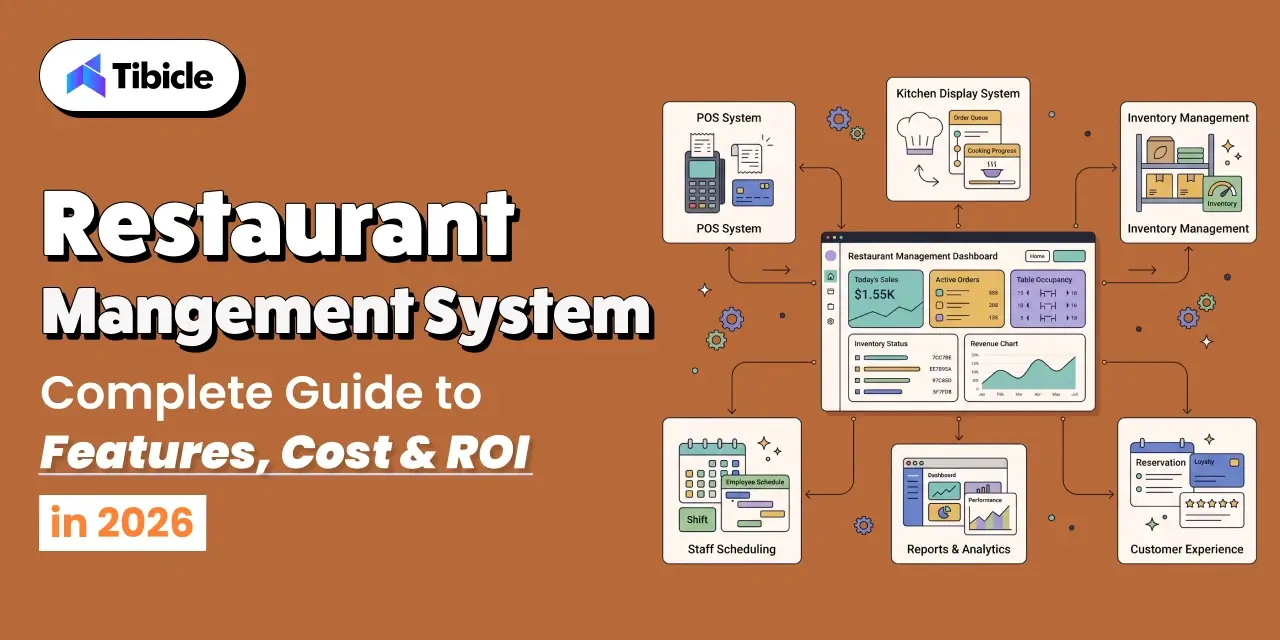
- What a Restaurant Management System Actually Includes
- Core Features That Decide Whether the Investment Pays Off
- Off-the-Shelf vs Custom: How to Read the Trade-Off
- What a Restaurant Management System Costs in 2026
- Restaurant Management System ROI: What the Numbers Say for 2026
- Risks Operators Underestimate Before They Sign
- Restaurant Management System Buyer Checklist: What to Verify Before You Commit
- When a Custom Restaurant Management System Makes More Sense Than a Platform
- Conclusion
- Frequently Asked Questions
Introduction
A restaurant management system has moved from a back-office convenience to the operational core of how restaurants run in 2026. The global restaurant management software market was valued at $5.79 billion in 2024. It is projected to reach $14.70 billion by 2030, growing at a 17.4% CAGR. That growth is not happening in a vacuum. It is a direct response to margin pressure: in 2025: 42% of operators reported that their restaurants were not profitable, and more than 9 in 10 cited food and labor as significant cost challenges.
The problem most operators run into is not whether to adopt a restaurant management system. It is choosing a system that removes cost instead of adding it. If it does not integrate with the restaurant POS system, cannot handle multi-location reporting, or gets abandoned by kitchen staff after two months does not protect margin; it erodes it. This guide breaks down what such system includes, what the core features do for the P&L, what such system costs in 2026, and how to calculate the return before signing anything.
What a Restaurant Management System Actually Includes
A restaurant management system is not a single tool. It is a connected set of modules that share data, with the restaurant POS system acting as the hub that every other component reads from. When operators evaluate, the distinction that matters is how tightly these modules talk to each other, not how many features appear on the vendor’s sheet. A strong restaurant POS system feeds clean data to every module downstream.
A typical restaurant management system covers the following operational layers:
- Point of sale: the restaurant POS system handles order entry, payment processing, and the transaction record that feeds every other module.
- Restaurant inventory management: restaurant inventory management ties stock depletion to sales, plus purchase orders, recipe costing, and waste tracking.
- Kitchen operations: order routing to a kitchen display system, ticket timing, and station-level coordination.
- Staff and scheduling: labor scheduling, time tracking, and labor-cost reporting against sales.
- Reporting and analytics: daily sales, food cost, and labor cost visibility, ideally by location and by day.
The value of a restaurant management system comes from these layers sharing one data source. When the restaurant POS system records a sale, restaurant inventory management should deplete stock in real time, and the reporting layer should reflect the margin impact without a manual export. Restaurant inventory management that runs on live POS data is the difference between control and guesswork. A collection of disconnected tools that each solve one problem is not a restaurant management system; it is a reconciliation burden.
Core Features That Decide Whether the Investment Pays Off
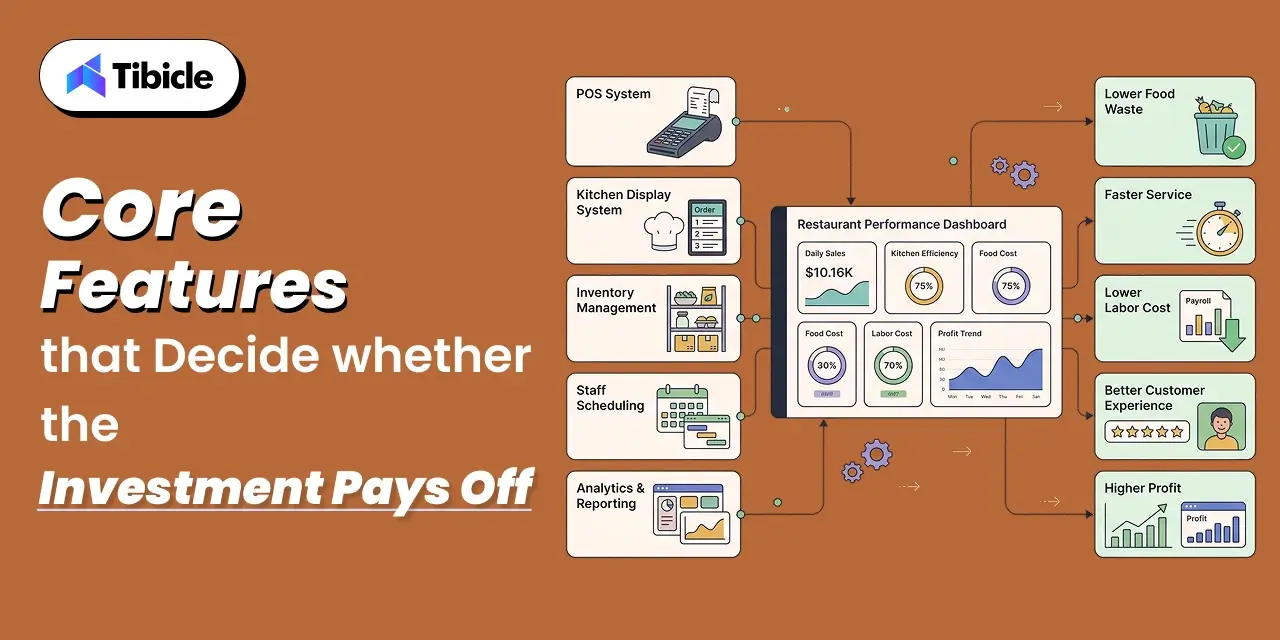
Not every feature in a restaurant management system moves the P&L. A short list does. These are the capabilities worth weighting heavily in any evaluation, because they map directly to cost recovery.
POS Integration Depth in a Restaurant Management System
The restaurant POS system is the center of the stack, so how the other modules connect to the restaurant POS system decides everything downstream. Real-time restaurant inventory management tied to POS sales is categorically different from an end-of-day sync. A restaurant management system that updates inventory once every 24 hours hands you yesterday’s problem. Ask vendors specifically about sync frequency and what happens when the restaurant POS system integration drops mid-service.
Recipe Costing and Food-Cost Visibility
Food and beverage costs run 28% to 35% of revenue for full-service restaurants, and most of the variance hides in the gap between theoretical and actual usage. A system with recipe costing that pulls live invoice pricing gives operators a real cost-per-plate number instead of a stale estimate. Without it, restaurant inventory management stays a counting exercise rather than a cost-control tool, and the restaurant management system never pays back what it promised.
Kitchen Display and Order Routing in a Restaurant Management System
A kitchen display system connected to the restaurant POS system replaces paper tickets with live, routed orders. Orders reach the correct station, get bumped when complete, and stay logged for reporting inside the restaurant management system. The operational payoff shows up during peak service, when missed or duplicated tickets cost more than the software does.
Labor Scheduling Against Sales
With labor consistently at 30% to 35% of revenue, a restaurant management system that schedules staff against forecast sales, not guesswork, directly affects margin. The scheduling module is only useful when it reads from the same sales data the restaurant POS system captures, the same source that drives restaurant inventory management.
Reporting That Is Current, Not Month-End
The operators who struggle most are the ones who learn their food cost was high when the month-end P&L arrives, weeks after the problem occurred. A system earns its cost when it surfaces daily food and labor cost by location, early enough to act on, with restaurant inventory management data feeding the numbers in real time.
Off-the-Shelf vs Custom: How to Read the Trade-Off
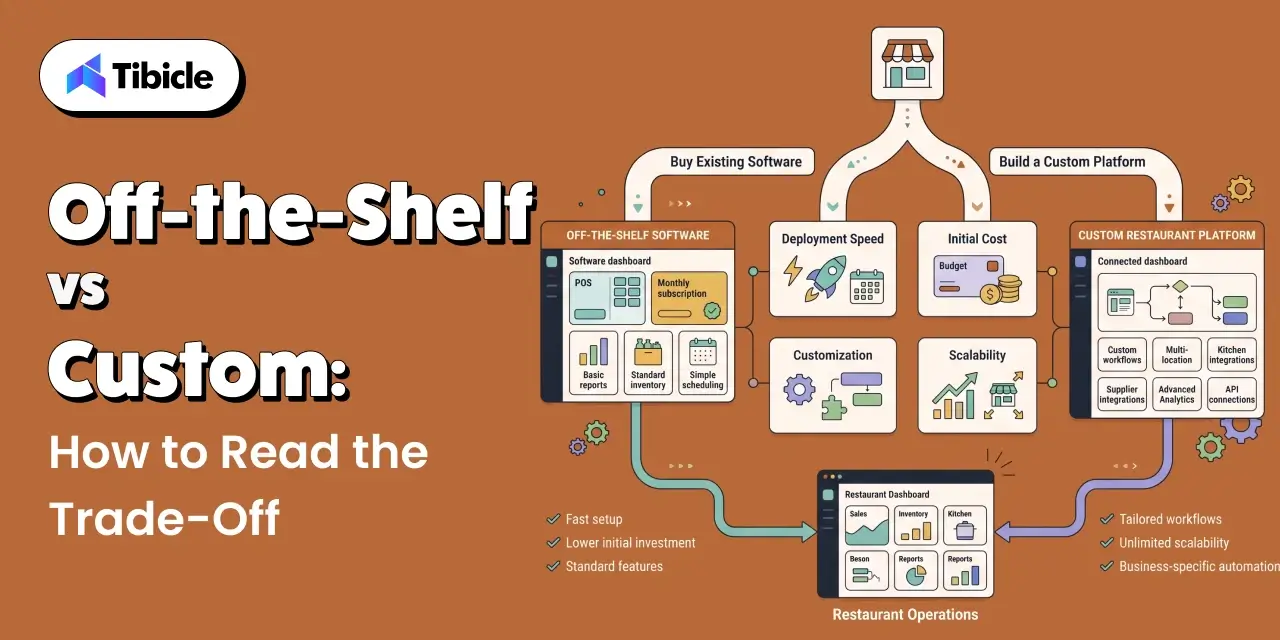
Most restaurants should start with an off-the-shelf system. Platforms like Toast, Square, and Lightspeed cover standard single-location and small-group operations well, deploy quickly, and spread cost across a predictable monthly fee. The decision gets harder when an operation has workflows a standard management system cannot model without expensive workarounds, or a restaurant POS system that resists third-party integration.
A practical way to read the trade-off:
- Stay off-the-shelf when: you run one location or a small group, your menu and pricing are standard, and you need to launch in weeks. The restaurant POS system and its native modules will cover you.
- Consider custom when: you run multiple concepts from one kitchen, carry proprietary supplier contracts, need tax logic across regions, or your restaurant inventory management has to behave in a way no off-the-shelf restaurant inventory management module supports.
The tipping point is cost-competitiveness. When the cost of customizing and maintaining workarounds on an off-the-shelf management systems approaches the cost of a purpose-built one, custom stops being the expensive option.
What a Restaurant Management System Costs in 2026
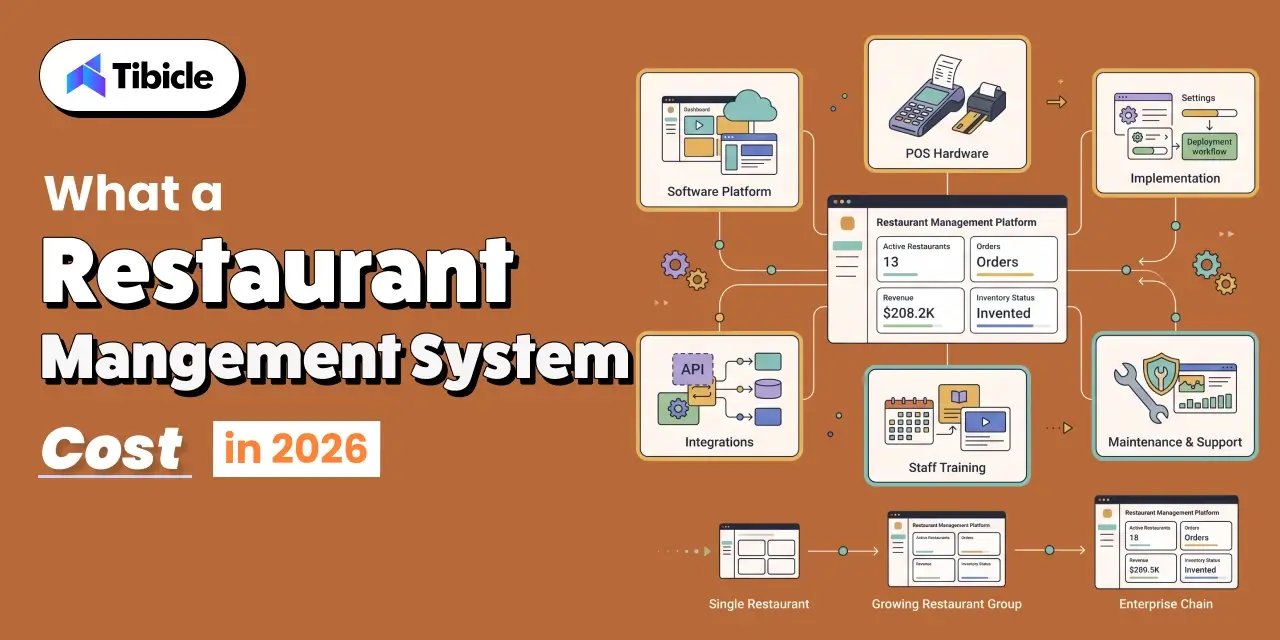
A restaurant management system is priced on published starting rates, but what vendors rarely publish is the total operators actually pay after setup, integration, training, and the tier upgrade that arrives when entry-level features fall short.
The ranges below reflect publicly available 2026 restaurant management system pricing and should anchor a budget conversation, not replace vendor quotes.
| Operation Size | Typical Monthly Cost | What Drives It |
| Single location | $150 to $400 / location | POS software, basic inventory, one terminal |
| Small group (3 to 10) | $800 to $2,500 / month | Multi-location reporting, deeper inventory, integrations |
| Enterprise (20+) | $5,000+ / month | Chain-wide control, forecasting, custom contracts |
| Custom build | Scoped per project | Higher upfront, no per-terminal license, full ownership |
Two cost lines operators consistently underestimate: onboarding and setup fees, which can run several hundred dollars per location, and the internal labor cost of integrating the restaurant POS system with restaurant inventory management and the rest of the stack. Budget an extra 15% to 20% on top of the subscription for the first year.
Restaurant Management System ROI: What the Numbers Say for 2026
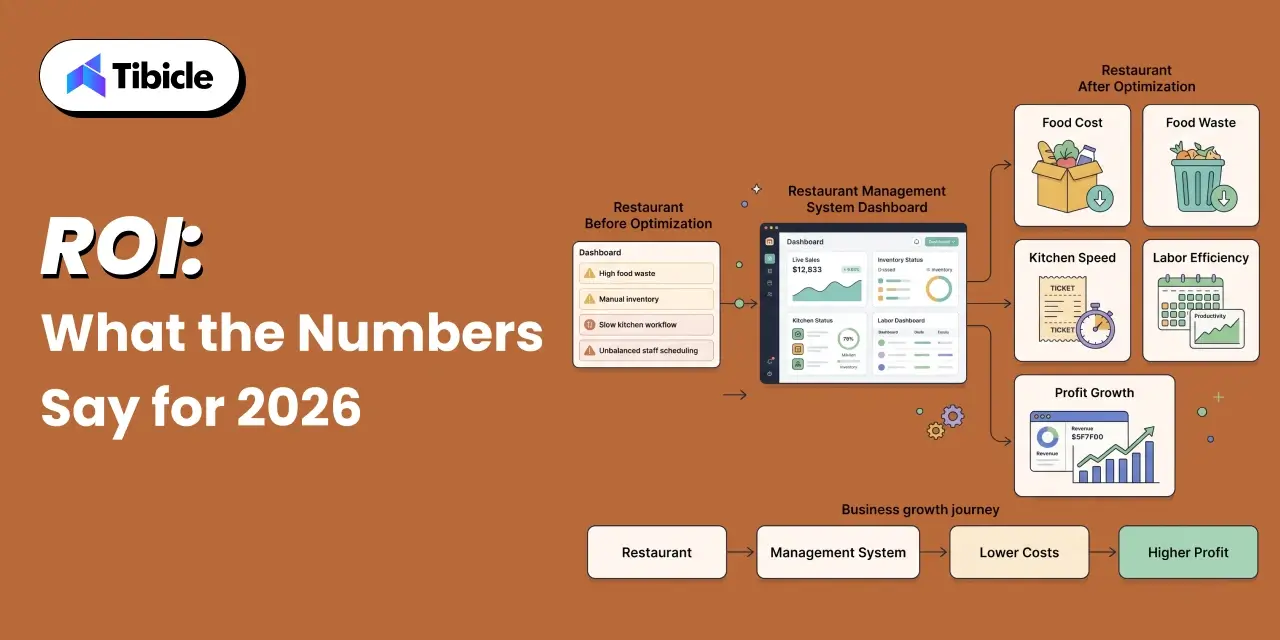
The return on a restaurant management system is a math problem with established inputs, not a leap of faith. Two levers do most of the work in any management system rollout: food cost and labor.
Food Cost Recovery
Restaurants using inventory software report roughly 35% less food waste and a 2% to 5% drop in food-cost percentage. For a restaurant generating $1 million in annual revenue at 32% food cost, cutting food cost by two points saves about $20,000 a year, often more than the software and the labor to run it. Disciplined restaurant inventory management inside a system is where that recovery comes from.
Labor Recovery
Manual stock counting eats management hours every week. Restaurants that move counting into software report an 80% reduction in counting time. Folding restaurant inventory management into a system recovers that management labor and improves accuracy over clipboard estimates at the same time. Most operations see measurable food-cost change within 30 to 60 days of going live.
Payback Timeline
- Independent restaurants (1 to 2 locations): 3 to 6 month payback is typical.
- Mid-market groups (3 to 10 locations): often under 90 days when food-cost variance is addressed directly.
- Enterprise chains: ROI compounds across waste reduction, restaurant inventory management gains, and purchasing efficiency at scale.
The efficiency case is backed at the industry level: among operators who increased technology investment over the past two to three years, 69% say it made operations more efficient and productive.
Risks Operators Underestimate Before They Sign
The system fails more often from implementation than from a bad product.
- Integration failure with the existing POS: not every restaurant POS system connects cleanly to every module. Verify API compatibility and sync frequency between the restaurant POS system and restaurant inventory management, and ask for a reference running your exact POS version.
- Data accuracy in the first 90 days: recipe libraries, unit-of-measure mismatches, and supplier catalog errors corrupt restaurant inventory management data early. Assign one internal owner for data hygiene before go-live.
- Kitchen staff adoption: the fastest-failing rollouts skip change management. If back-of-house staff do not trust the restaurant inventory management workflow, counts stop happening accurately and the restaurant POS system data loses its value.
- Outgrowing the platform: choosing a system built for your current size, not your 3-year plan, sets up an expensive migration to a bigger system later. Ask vendors about customers at your target scale.
Restaurant Management System Buyer Checklist: What to Verify Before You Commit
Use these questions to separate a good system demo from a good fit:
- Does the system integrate with your current restaurant POS system without custom development?
- Does restaurant inventory management update in real time, or on an end-of-day sync?
- Can you see daily food and labor cost by location, not just month-end totals, with restaurant inventory management feeding the food-cost number?
- Does restaurant POS system pricing scale predictably as you add locations?
- What is the onboarding timeline, and who owns setup and staff training?
- Does the vendor have reference customers at the scale you are planning for?
When a Custom Restaurant Management System Makes More Sense Than a Platform
Off-the-shelf platforms cover most restaurants well. They fall short for operations with non-standard workflows: dark kitchens running multiple brands from one facility, cloud-kitchen aggregators managing proprietary supplier contracts, and vertically integrated chains with custom procurement logic. For those, the customization required to force-fit a standard system often costs more than a purpose-built system that models the operation as it actually runs.
Tibicle LLP builds AI-powered web and mobile applications, custom POS software, and connected kitchen systems for restaurant operators in that category. Its restaurant tech, custom POS, and kitchen systems services run from a scoped MVP to a full restaurant management system partnership. For deeper context on controlling food cost through software, see Tibicle’s guide to the best restaurant accounting software in 2026.
Conclusion
Choosing a system is not about counting features. It is about selecting the system that removes the most cost from your structure with the least implementation risk. The restaurant POS system anchors the stack, restaurant inventory management protects the food-cost line, and the reporting layer turns both into decisions you can act on before month-end.
Single-location operators have a different right answer than growing groups, and growing groups a different answer than enterprise chains. The decision logic holds across all three: match the restaurant management systems to your cost structure and your growth plan, not to the demo that looked best in the room.
Ready to map the right restaurant management system to your operation, or scope a custom build? Talk to the Tibicle team.
Frequently Asked Questions
What is a restaurant management system?
A restaurant management system is a connected set of modules- POS, restaurant , kitchen display, inventory management, scheduling, and reporting- that share one data source. The restaurant POS system records sales, and the other modules in the system read from it to control cost and coordinate operations.
How is a restaurant management system different from a POS?
A restaurant POS system records transactions. A restaurant management system uses those transactions to run restaurant inventory management, cost recipes, schedule labor, and report margin. The restaurant POS system captures revenue; the wider system controls cost.
How much does a restaurant management system cost in 2026?
A system for a single location typically costs $150 to $400 per month. Groups of 3 to 10 locations budget $800 to $2,500 monthly. Enterprise system platforms start above $5,000 a month. Add 15% to 20% for setup, restaurant POS system integration, and training in year one.
How long before a restaurant management system pays for itself?
Most operators see measurable food-cost improvement within 30 to 60 days once restaurant inventory management is live. Full payback on such system is typically 3 to 6 months for independents, and often under 90 days for multi-unit groups with high food-cost variance.
When should a restaurant build custom instead of buying?
When workflows are non-standard, multiple kitchen formats, proprietary supplier contracts, or multi-brand aggregation, that a standard system cannot handle without costly workarounds. A custom system becomes cost-competitive above that complexity threshold, especially when restaurant inventory management has to follow rules no vendor supports.
Schedule A Developer Interview And Get 15 Days Risk-Free Trial
Schedule a Call

Relevant Blog

How to Hire Dedicated Electron.js Developers in 2026

Avni Kanabar


Electron vs Tauri 2026: Desktop Framework Guide

Diya Koradiya
Written by

Recent Blogs
Custom Autonomous AI Agent Development Services: Building Task-Driven Workflow Bots
What This Guide Covers Who this is for: Engineering leads, product owners, and operations heads evaluating AI agent development services for a real internal workflow rather than a chatbot pilot. Search intent: Commercial evaluation with a technical backbone. The reader has moved past “what is an AI agent” and wants architecture choices, failure data, and […]
How to Hire Dedicated Electron.js Developers in 2026
What This Guide Covers Who this is for: US tech firms, SaaS companies, startups, CTOs, engineering managers, and product teams looking to hire dedicated Electron.js developers for ongoing desktop application development. Search intent: Hiring and decision. This guide covers where to find Electron.js developers, how to evaluate their technical skills, and how dedicated developers compare […]
Cross-Platform Desktop Application Development: Electron
What This Guide Covers Who this is for: SaaS companies, enterprise product teams, CTOs, engineering leaders, and product managers evaluating cross platform desktop application development for Windows, macOS, and Linux. Search intent: Implementation and decision. This guide explains why Electron remains a practical cross-platform desktop Application Development for enterprise SaaS, where it fits against native […]
Got an Idea? Get FREE Consultation
In our world, there's no such thing as having too many clients

