
Enterprise AI Application Development Services: Building Custom LLM Solutions for B2B SaaS

Sep 30, 2026

Read in 9 Minutes
Table of Contents
- What this Guide Covers
- Introduction
- Why B2B SaaS Companies Are Turning to Enterprise AI Application Development Services
- Custom LLM Development vs Off-the-Shelf AI Tools
- Core Architecture for Custom LLM Solutions in B2B SaaS
- Data Security, Governance, and Compliance in Enterprise AI Application Development Services
- Why Agentic AI and Workflow Automation Inside B2B Saas Products
- Cost, Scalability, and Vendor Lock-In in Custom LLM Development for enterprise ai application development services
- How Tibicle Delivers Enterprise AI Application Development Services
- Key Takeaways for B2B SaaS Teams for enterprise ai application development services
- FAQ: Enterprise AI Application Development Services
What this Guide Covers
Who this is for
Product managers, CIOs, and engineering leaders at B2B SaaS companies evaluating custom AI features. Teams comparing build vs buy vs hybrid approaches for LLM integration. Companies that shipped AI pilots and need guidance on reaching production. Organizations ready to invest in enterprise ai application development services but unsure whether to build in-house or partner.
Search intent
Comparison and decision. This guide helps teams understand which approach—custom LLM development, off-the-shelf tools, or hybrid delivers the greatest value for their architecture, compliance posture, and budget. It explains the architectural decisions and governance frameworks that separate proof-of-concept AI from production systems.
What you will walk away with
A framework for choosing between custom LLM development, generic AI tools, and hybrid approaches. Understanding of retrieval-augmented generation, multi-tenant data isolation, and orchestration layers. Security and compliance requirements: SOC 2, GDPR, role-based access control, audit logging. Cost optimization strategies and decision criteria for building in-house vs partnering with a vendor. How Tibicle delivers enterprise AI application development services from architecture to production support.
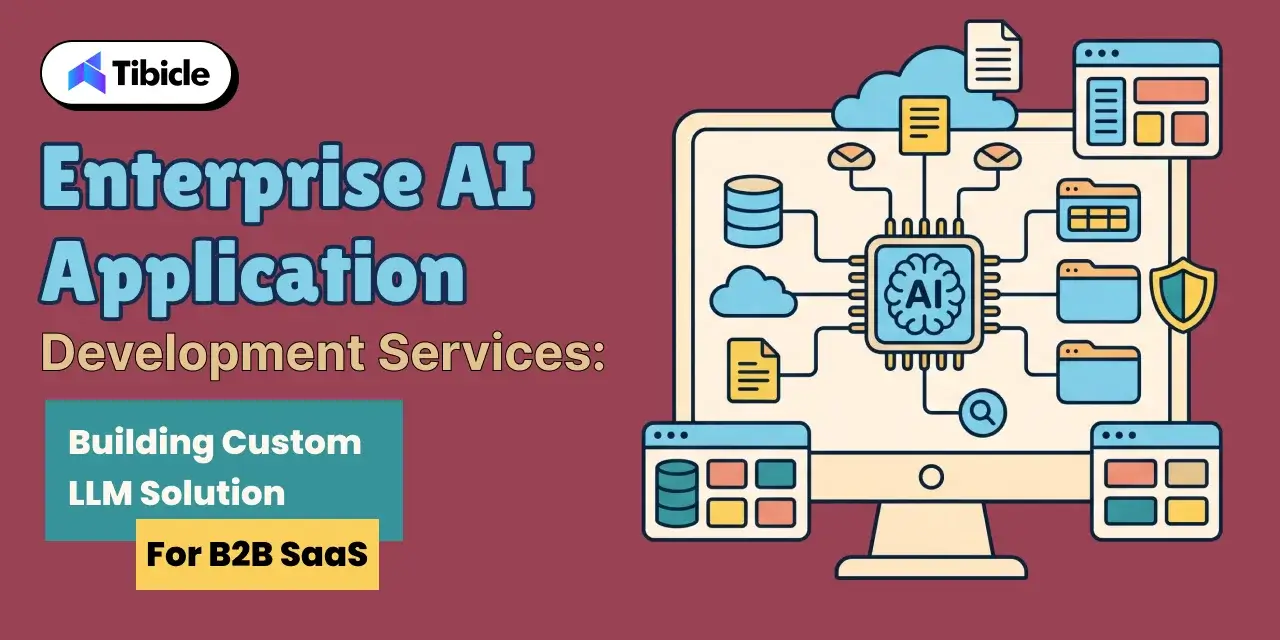
Introduction
The enterprise generative AI market is projected to reach $1.2 trillion by 2030, growing at a CAGR of 42% from 2024 to 2030, according to Grand View Research’s Enterprise Generative AI Market Report. Yet most B2B SaaS companies shipping AI today are not building enterprise AI application development services. Instead, they’re bolting on generic chatbots or wrapping third-party APIs without addressing the core problem: how to make AI reason over a customer’s own data inside a multi-tenant product.
The companies winning in this space are moving past chat widgets. They’re investing in enterprise AI application development services that embed retrieval-augmented generation, multi-tenant data isolation, and governance controls directly into their product architecture. This shift is not about having the latest model. It’s about building custom LLM development solutions that work at scale, stay secure, and don’t hallucinate.
This guide covers the architecture, governance, and operational decisions that separate proof-of-concept AI features from production systems that drive retention and pricing. We’ll examine why custom LLM solutions outperform generic tools, what a secure enterprise AI application development framework looks like, and how to avoid the vendor lock-in that catches most teams after launch.
Why B2B SaaS Companies Are Turning to Enterprise AI Application Development Services
The pressure is no longer whether to add AI. It’s whether to add it fast enough to keep up with competitors. B2B SaaS teams face a choice: embed generic AI wrappers and ship quickly, or invest in enterprise AI application development services that embed AI into core workflows. The companies choosing the latter are doing so because generic approaches stop working the moment they touch real customer data.
The Difference Between AI-Enabled and AI-Native SaaS Products
An AI-enabled product bolts on an LLM feature after the core product is built. A chatbot answers questions. A form suggests answers. The LLM runs in isolation, with no access to the customer’s data, the product’s logic, or any context beyond a user’s single message.
An AI-native product makes AI central to how the product solves problems. The LLM integrates into workflows: it classifies incoming support tickets, generates personalized recommendations, automates report generation, or prioritizes tasks. Enterprise AI application development services bridge this gap by embedding retrieval, orchestration, and governance into the product stack, not layering it on top.
The shift matters because AI-native features drive pricing models and retention. Companies charging for an AI feature see 15% to 30% higher churn in the segment where AI is optional versus where it’s core to what the product does. Custom LLM development for B2B SaaS requires architecture built for AI from the start, not retrofitted.
How Many B2B SaaS Companies Are Already Building Custom AI Features
A 2026 Benchmarkit report on B2B SaaS & AI-Native Metrics found that 68% of B2B SaaS companies added AI to their product in the past 12 months or plan to do so by the end of 2026. That same report shows only 34% have a documented AI strategy. The gap between shipping AI and managing AI is wide.
More important: most of those companies are using off-the-shelf tools or vendor APIs without investing in custom LLM development for B2B SaaS. The segment moving toward enterprise AI application development services companies building retrieval layers, orchestration logic, and governance controls is smaller but growing fastest. Those teams report 2.4x higher feature adoption and 40% lower churn in customers using the AI features versus those who don’t.
The competitive moat is thin. Generic AI wrappers can be copied in weeks. Custom LLM solutions tied to proprietary data pipelines and workflows take months to build and years to defend.
Custom LLM Development vs Off-the-Shelf AI Tools
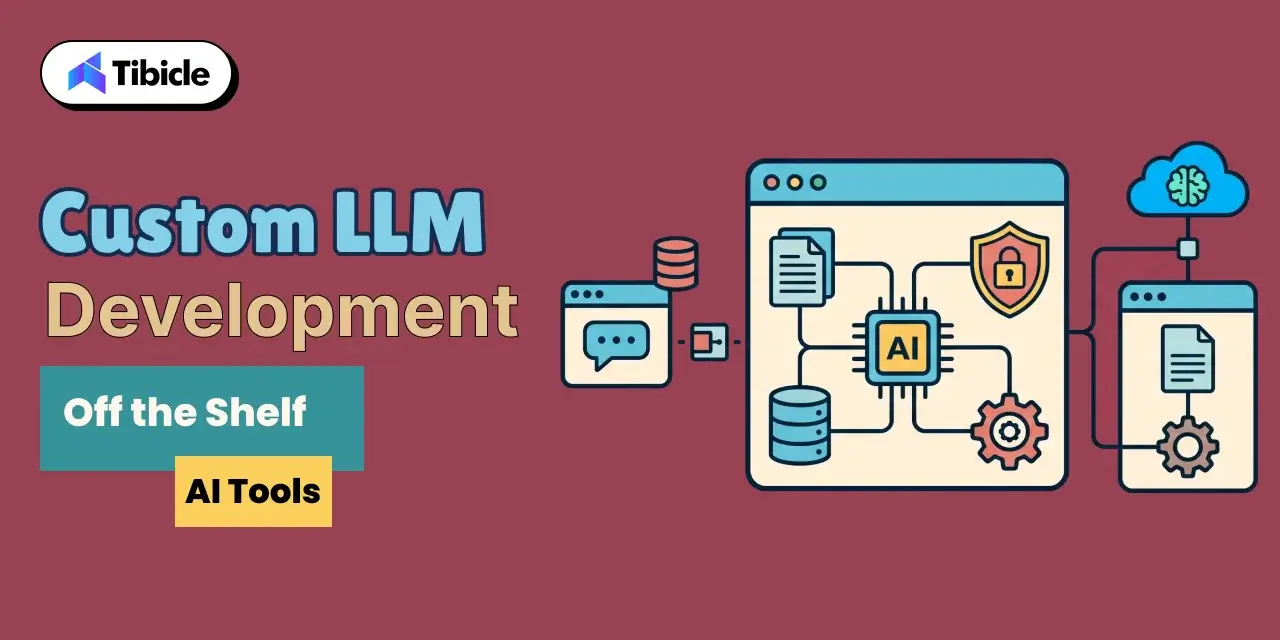
The build versus buy decision shapes everything that comes after. Off-the-shelf tools move fast. Custom LLM development for B2B SaaS moves slower but reaches production more often. Understanding why is essential before committing to either path.
Why Generic AI Tools Stall Inside a Real Product Workflow
Generic AI tools work well in controlled demos. A chatbot answers general questions. An API wrapper processes simple requests. But the moment a SaaS product asks the LLM to reason over customer data, answer questions unique to that customer’s context, or integrate with existing workflows, generic tools hit a wall.
The reason: generic tools have no connection to the customer’s data. They can’t retrieve relevant information. Enterprises call this “hallucination.”
A second problem emerges: compliance. Generic tools train on customer input. They store conversations. They may send data to third-party servers. SaaS companies adding AI realize too late that their generic approach violates data residency requirements, SOC 2 controls, or GDPR rules. Enterprise AI application development services address this upfront by designing data flows and access controls before a feature ships.
What Separates the Enterprise AI Projects That Reach Production
Research from MIT NANDA’s “The GenAI Divide” report shows 63% of enterprise generative AI pilots fail to move to production or deliver measurable business impact. The gap between prototype and production is not about model quality. It’s about architecture.
Projects that reach production share three traits:
First, they ground AI outputs in the customer’s own data. Retrieval-augmented generation (RAG) connects the LLM to a vector database of customer documents, so answers cite specific sources rather than guess.
Second, they build governance into the architecture. Role-based access controls are enforced in the orchestration layer, not the UI. Audit logs capture which data, model, and prompt produced each output. SOC 2 compliance is a design requirement, not a post-launch patch.
Third, they choose multi-model architecture. Teams designing for a single vendor (OpenAI, Anthropic, Google) lock themselves into that vendor’s pricing, availability, and roadmap. Projects that reach sustainable production build abstraction layers so switching models is a configuration change, not a rewrite.
Where a Hybrid Approach Fits Between Buying and Building
Most B2B SaaS teams don’t build custom LLM development entirely from scratch. The hybrid approach starts with a vendor API for the LLM inference OpenAI’s GPT, Anthropic’s Claude, or Google’s Gemini but wraps it with a custom retrieval and orchestration layer.
This approach captures the best of both worlds: vendor models handle inference cost and scaling, but enterprise AI application development services the retrieval, data isolation, and governance layers stay in-house. For teams with existing data platforms, this path is most common.
Comparison Table: Three Approaches to Adding AI to a SaaS Product
| Approach | What It Involves | Best Fit |
| Off-the-shelf AI tool | Embed a third-party chatbot or API wrapper with minimal customization | Fast validation, low engineering investment |
| Custom LLM application | Enterprise AI application development services build retrieval, orchestration, and data grounding around the product’s own data | Core product features tied to retention and pricing |
| Hybrid build | Start with a vendor model API, add a custom retrieval and orchestration layer on top | Most B2B SaaS teams with an existing data platform |
Core Architecture for Custom LLM Solutions in B2B SaaS
Three architectural decisions determine whether enterprise AI application development services actually work on customer data inside a multi-tenant product: retrieval, tenancy, and orchestration. Miss any one, and the feature either hallucinates or fails to scale.
Retrieval-Augmented Generation for Grounding Outputs in Customer Data
Retrieval-augmented generation (RAG) is the foundation of custom LLM development for B2B SaaS that works. Instead of asking an LLM to answer from its training data alone, RAG retrieves relevant documents or data points from the customer’s own repository, then passes those to the LLM as context.
Research by Bechard & Marquez Ayala in the NAACL 2024 Industry Track (published in ACL Anthology) demonstrated that RAG significantly reduces hallucination in enterprise applications compared to LLM-only approaches. The mechanism is straightforward: the LLM grounds its answer in retrieved sources, so it can cite them rather than invent them.
In practice, this means storing customer data documents, support tickets, transaction logs, product usage data in a vector database. When a customer asks a question, the system retrieves the top 5 to 10 most relevant chunks, passes them to the LLM, and asks it to answer based only on those chunks. The answer quality depends heavily on retrieval quality, not model size. This is why enterprise AI application development services prioritize retrieval optimization before model selection.
Multi-Tenant Data Isolation for Shared LLM Infrastructure
A single LLM instance serves hundreds or thousands of customers. Each customer’s data must remain isolated. This is not a UI problem; it’s an orchestration problem.
Data isolation in multi-tenant architecture happens at three levels. First, in the vector database: when Customer A’s data is indexed, it’s tagged with Customer A’s ID. When Customer A searches, the retrieval layer filters results to include only Customer A’s data before passing to the LLM.
Second, in the LLM call itself: the system sends only Customer A’s retrieved data, not any other customer’s information, so the model has no way to leak data even if prompted.
Third, in access logs and audit trails: which customer, which model, which data sources, which output. This creates accountability and allows teams to spot if the isolation broke.
The cost of getting this wrong is high. A single data isolation bug exposes all customers’ data to all other customers. This is why enterprise AI application development services make multi-tenant isolation a non-negotiable design requirement.
Orchestration and Fallback Across Multiple Model Providers
Enterprise AI application development services that rely on a single LLM provider create a single point of failure. If OpenAI’s API is down, your product feature is down. If pricing increases 50%, you’re locked in.
Orchestration layers abstract the model choice. The application calls an orchestration interface that routes to OpenAI’s GPT, Anthropic’s Claude, Google’s Gemini, or an open-source model depending on cost, availability, or performance requirements. If the primary model is unavailable, the orchestration layer automatically falls back to a secondary model.
Portability also enables cost optimization. As new models release, teams test them against performance benchmarks and switch if a cheaper or faster option emerges. This decision tree is made in configuration, not code.
Data Security, Governance, and Compliance in Enterprise AI Application Development Services
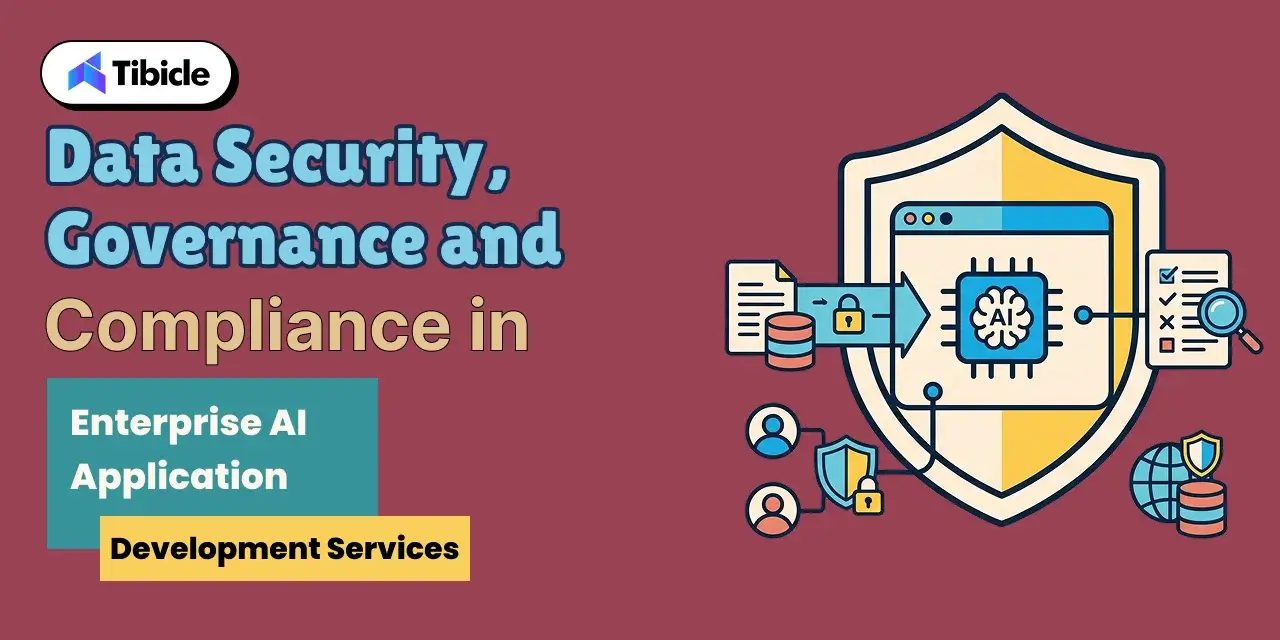
The moment an LLM touches customer data, governance becomes non-negotiable. Most SaaS companies lag here. Features ship fast, but access controls, audit logging, and compliance frameworks catch up slowly. Enterprise AI application development services put governance in place before launch, not after the first security audit.
Preventing Shadow AI Inside Your Own Product
Shadow AI describes AI features that ship without IT approval, governance oversight, or security review. A product team embeds an LLM integration, it works, users love it, and security finds out three months later.
IBM’s 2026 Cost of a Data Breach Report found that 41% of security incidents involving AI systems involved shadow AI deployments, and 68% of AI-related data breaches had missing or inadequate access controls. These breaches are not the result of LLM flaws; they’re the result of governance gaps.
Enterprise AI application development services prevent shadow AI by making governance a gating requirement. Before an LLM feature ships, IT approves the model provider. Security reviews the data flows. Compliance confirms that customer data stays where it should. This adds weeks to launch but eliminates the class of post-launch surprises that compromise customer trust.
Role-Based Access Control and Audit Logging for LLM Features
Role-based access control (RBAC) for enterprise AI application development services enforces permissions in the orchestration layer, not the UI. If a customer’s Support team member should not see financial data, the system refuses to retrieve financial data when that user queries the LLM, even if they know the field name.
Audit logs capture four details for every LLM call: which user, which model, which data sources retrieved, and which output was generated. This allows security teams to spot patterns (e.g., one user querying an unusual amount of customer data) and compliance teams to prove to auditors that access controls worked.
A critical detail: never log the full LLM prompt or output if it contains sensitive customer data. Log which templates and data categories were used instead. This protects privacy in logs while preserving audit visibility.
SOC 2, GDPR, and Data Residency Considerations for Enterprise Buyers
Enterprise buyers have compliance mandates. US companies may require SOC 2 Type II certification. EU companies require GDPR compliance. Others require data to stay within a specific geographic region.
Custom LLM development for B2B SaaS must accommodate these constraints from the start. If a customer requires data residency in Europe, the vector database, LLM inference, and all intermediate processing must happen in Europe. If a customer requires SOC 2 Type II, orchestration layers must enforce access controls and generate audit logs that satisfy SOC 2 requirements.
Enterprise AI application development services teams should ensure:
- Log which model, prompt, and data source produced each output, not just that a request happened
- Keep customer data out of any third-party model’s training pipeline by contract
- Enforce access permissions in the orchestration layer, not just in the UI
- Require IT-approved model providers before an AI feature ships
Why Agentic AI and Workflow Automation Inside B2B Saas Products
The next wave of enterprise AI application development services moves beyond single-turn chat to task-specific agents. An agent chains multiple LLM calls together, uses tools (APIs, databases, external services), makes decisions, and executes workflows. This is where AI moves from assistant to executor.
From Chat Interfaces to Task-Specific AI Agents
A chat interface is a single turn: user asks, LLM answers. An agent is multi-turn: the agent breaks a task into steps, executes each step (possibly using external tools), evaluates the result, and either completes the task or escalates to a human.
Gartner’s August 2025 press release on task-specific AI agents projects that 60% of enterprise applications will embed task-specific AI agents by the end of 2026. The shift reflects a maturity transition: enterprises are moving past experimental AI to production workflows powered by AI.
In B2B SaaS, this looks like: an agent ingests support tickets, classifies them, retrieves relevant articles or past tickets, drafts a response, and routes it to the appropriate team member. Or: an agent analyzes a customer’s usage data, identifies churn signals, recommends interventions, and logs the recommendation to the CRM. Enterprise AI application development services that ship agents move beyond LLM integration to task orchestration.
Human-in-the-Loop Design for High-Stakes Actions
Agents should never take high-stakes actions without human review. This is where custom LLM development for B2B SaaS makes hard tradeoffs.
If an agent is deleting a customer’s data, refunding a charge, or escalating a sensitive support ticket, a human approves the action before it runs. If an agent is categorizing a low-stakes ticket or retrieving documentation, it runs autonomously.
The design requires flagging high-stakes actions during orchestration, routing them to an approval queue, and waiting for human confirmation before execution. This slows high-stakes workflows but prevents autonomous mistakes.
Monitoring and Evaluating Agent Behavior in Production for enterprise ai application development services
An agent running in production is a black box without monitoring. Did it make the right decision?
Enterprise AI application development services include observability: logging each step the agent took, which data it retrieved, which decision it made, and which outcome it produced. Teams use this data to identify failure modes, retrain prompts, and adjust guardrails.
A common metric is task completion rate: what share of agent-started tasks finish successfully without human intervention? Early deployments typically see 60% to 75% autonomous completion. As teams refine prompts and adjust guardrails, completion rates climb to 85% to 95%. The tail 5% to 15% are genuinely ambiguous cases that require human review.
Cost, Scalability, and Vendor Lock-In in Custom LLM Development for enterprise ai application development services
Every LLM call costs money. When a SaaS product ships an AI feature to thousands of customers, those costs scale linearly. Architecture choices made at the start determine whether you can absorb those costs or whether they drain margin.
Managing Token Costs as Usage Scales Across Customers for enterprise ai application development services
Token cost optimization starts with prompt design. A poorly designed prompt retrieves unnecessary context, passes it all to the LLM, and wastes tokens. A well-designed prompt retrieves only essential context, prunes irrelevant information, and reuses the LLM’s output for multiple purposes.
In practice, this means: retrieval returns top 10 documents. Filtering logic removes irrelevant ones, leaving 3. Those 3 go to the LLM. The output answers the customer’s question and feeds downstream processes (CRM update, ticket classification) so multiple outcomes come from one LLM call.
A second lever: caching. If 100 customers ask similar questions, custom LLM development for B2B SaaS can cache the LLM’s response for the first query and reuse it for similar queries, saving 99 LLM calls. This requires identifying cacheable patterns and designing workflows around them.
At scale (10k+ daily LLM calls), token cost optimization becomes a full-time effort. Teams track cost per feature, cost per customer, and cost per outcome. They experiment with model switching (cheaper models for simple tasks, expensive models for complex ones). Enterprise AI application development services teams budget 20% to 30% of engineering time for cost optimization once a feature launches.
Designing for Multi-Model Portability Instead of a Single Vendor for enterprise ai application development services
Single-vendor lock-in is a long-tail risk that bites hard. OpenAI may raise prices. Anthropic may deprecate a model. A new competitor may release a faster or cheaper model. Enterprise AI application development services designed around one vendor get trapped.
Multi-model portability means building an abstraction layer so the LLM choice is a configuration, not architecture. The orchestration layer defines an interface: given a prompt, context, and temperature, return a completion. This interface can route to OpenAI, Anthropic, Google, or an open-source model like Llama.
The cost: extra abstraction and complexity. The benefit: when a new model emerges, testing and switching takes days, not months. This flexibility is worth the cost in production systems where LLM inference is a core feature.
When to Fine-Tune vs When to Rely on Prompting and RAG for enterprise ai application development services
Fine-tuning an LLM (retraining it on custom data) is expensive, slow, and usually unnecessary. Most custom LLM development for B2B SaaS solves the problem with prompting and RAG.
Fine-tuning makes sense when:
(1) your task requires domain language that base models don’t understand well,
(2) you need consistent output formatting that prompting alone doesn’t guarantee, or
(3) you have thousands of examples and want to reduce latency by using a smaller model.
Fine-tuning doesn’t make sense when:
(1) your task is straightforward (retrieval + prompting is enough),
(2) your data changes frequently (retraining every week is expensive), or
(3) you’re still learning what works (prototyping with prompting first is faster).
Most teams start with prompting and RAG, measure performance, and only fine-tune if those approaches plateau. Enterprise AI application development services teams treat fine-tuning as a phase-two optimization, not a day-one choice.
How Tibicle Delivers Enterprise AI Application Development Services
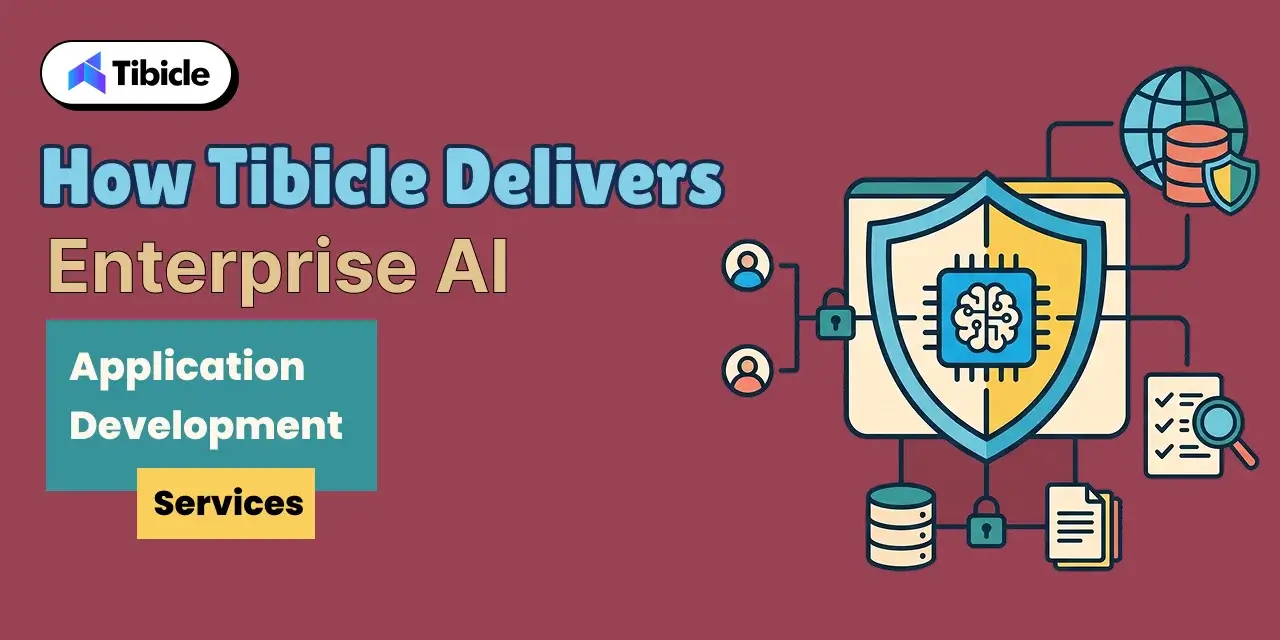
Custom LLM development for B2B SaaS requires both depth and speed. Tibicle’s enterprise AI application development services process moves from strategy through production without losing momentum.
AI Readiness Assessment and Architecture Planning
The first phase diagnoses readiness. Tibicle works with product and engineering teams to map existing data flows, identify which workflows could benefit from AI, and audit governance gaps.
This phase answers hard questions: Do you have structured customer data to retrieve from? Do your compliance requirements prohibit certain vendors? Do you have the engineering capacity to own an AI feature, or do you need help? What budget range makes the ROI case work?
From this assessment, Tibicle designs the architecture. Which data goes into the retrieval layer? Which model(s) and orchestration tools support your use case? Where do access controls live? The design document becomes the blueprint for implementation.
Implementation With RAG, Security, and Governance Built In for enterprise ai application development services
Implementation phase turns architecture into code. Tibicle builds the retrieval pipeline (vector database setup, data ingestion, chunking strategy), the orchestration layer (multi-model routing, fallback logic, cost tracking), and governance controls (RBAC, audit logging, data isolation).
Critically, security and governance are not afterthoughts. They’re wired in during implementation. By the time features ship to production, role-based access is enforced, audit logs are capturing the right data, and compliance requirements are met. This eliminates the post-launch scramble that catches most teams.
Custom LLM development for B2B SaaS at this stage also includes testing. Tibicle runs benchmarks against customer data to validate that retrieval quality is high enough, that outputs are accurate enough, and that latency is acceptable.
Ongoing Support, Monitoring, and Model Updates for enterprise ai application development services
Once a feature ships, enterprise AI application development services don’t end. Tibicle partners with teams to monitor performance in production, track token costs, identify failure modes, and update models as new ones release.
This phase includes: quarterly model evaluations (testing new models against benchmarks), prompt optimization based on real production failures, and cost optimization as usage patterns change. As customers use the AI feature, Tibicle helps teams refine guardrails and tune thresholds for when to escalate to human review.
Key Takeaways for B2B SaaS Teams for enterprise ai application development services
Enterprise AI application development services succeed or fail on data grounding, not on model selection. A smaller model with access to customer data outperforms a large model guessing from training data.
Generic AI wrappers rarely survive contact with a real product workflow. 63% of enterprise generative AI pilots fail to reach production. The gap is not creativity; it’s architecture and governance.
Multi-tenant data isolation and access control belong in the orchestration layer, not the interface. One isolation bug exposes all customers.
Token costs and model portability need architecture decisions made before launch, not after the first bill arrives. Lock-in is a long-tail risk that costs months to escape.
Agentic AI is the next wave, and human-in-the-loop design is the line between innovation and liability. Know which decisions stay with humans.
Ready to build enterprise AI that actually reaches production? Book a call with Tibicle to discuss your AI strategy and learn how enterprise AI application development services can deliver custom LLM solutions built for scale, security, and your customers.
FAQ: Enterprise AI Application Development Services
What are enterprise AI application development services, and how are they different from adding a chatbot to an app?
Enterprise AI application development services build custom LLM solutions integrated into product workflows, not bolted on. A bolted-on chatbot sits in isolation with no access to customer data. Custom LLM development for B2B SaaS connects the LLM to your data via retrieval, wires in governance and access controls, and makes the AI feature core to what the product does. The difference is between a widget and a system.
Does a B2B SaaS product need its own LLM, or can it call a vendor’s API?
Most teams call a vendor API (OpenAI, Anthropic, Google) for LLM inference. You don’t need to train your own model. What you do need is a custom orchestration layer that adds retrieval, data isolation, governance, and vendor-switching logic around the vendor API. This hybrid approach is how 70% of enterprise AI application development services projects are structured.
How does Retrieval-Augmented Generation work inside a multi-tenant SaaS product?
RAG retrieves relevant documents or data chunks from each customer’s repository, then passes only those chunks to the LLM as context. In multi-tenant systems, retrieval is filtered by customer ID, so Customer A only sees Customer A’s data. The LLM grounds its answer in retrieved sources rather than guessing, which eliminates most hallucinations. Custom LLM development for B2B SaaS that skips RAG fails at production scale.
What data security requirements apply to a custom LLM feature handling customer data?
Enterprise customers require role-based access control (users can’t query data they don’t have access to), audit logging (which user, which data, which model, which output), SOC 2 or GDPR compliance (depending on customer base), and data residency compliance (data stays in the required region). These are not optional. Enterprise AI application development services teams build these controls before shipping features.
Does Tibicle build custom LLM solutions and AI agents for B2B SaaS companies?
Yes. Tibicle specializes in custom LLM development for B2B SaaS, from architecture planning through production support. We design retrieval and orchestration layers, build multi-tenant data isolation and governance controls, and help teams avoid vendor lock-in.
Schedule A Developer Interview And Get 15 Days Risk-Free Trial
Schedule a Call

Relevant Blog
Enterprise LLM Integration Services

Prejin Nadar

Building Private local AI Desktop App Development
Prejin Nadar
Written by

Dhairya Dadhania
Business Development Executive
I'm Dhairya Dadhania, Business Development Executive at Tibicle LLP. I help businesses move beyond their current limitations by defining a clear and ambitious digital vision by focusing on identifying core opportunities and aligning them with purposeful, innovative digital solutions.
Related posts
Enterprise LLM Integration Services
What This Guide Covers Who this is for Enterprise LLM integration services help engineering leaders, platform teams, and technology executives turn existing model access into working production workflows. This guide is for organisations connecting OpenAI, Claude, or both to systems that support real business processes, including CRM platforms, ticketing systems, document pipelines, and internal tools. […]
29 Sep 2026 | Prejin Nadar
When to Hire an AI Software Development Consulting Firm.
What This Guide Covers Who this is for Engineering leaders, technology executives, and AI teams often struggle to turn completed initiatives into measurable results. This guide helps organisations address stalled pilots, failed AI implementations, rising costs, poor data quality, and workflows that function technically but fail to deliver measurable business value. An AI software development […]
29 Sep 2026 | Prejin Nadar
Building Private local AI Desktop App Development
What This Guide Covers Who this is for: US tech firms, SaaS companies, startups, CTOs, engineering managers, and product teams looking for experienced Electron.js developers for ongoing private local AI desktop app development and custom desktop application development. Search intent: Hiring and decision. This guide covers where to find Electron.js developers, how to evaluate their […]
28 Sep 2026 | Prejin Nadar
Got an Idea? Get FREE Consultation
In our world, there's no such thing as having too many clients

Email
tea@tibicle.com

Phone
+91 9724922880