
Building Private local AI Desktop App Development

Sep 28, 2026

Read in 6 Minutes
Table of Contents
- What This Guide Covers
- Introduction
- Why Enterprises Are Moving Toward Private Local AI Desktop App Development
- Architecting a Local-Only Electron App With No Cloud Fallback
- Model Selection for Fully Private, High-Quality Local Inference
- Data Sovereignty, Compliance, and Air-Gapped Deployment
- Hardware Budgeting for Private Local AI Desktop App Development With Zero-API-Reliance Deployment
- What Privacy-First Electron Development Actually Costs
- How Tibicle Builds Privacy-First Local AI Desktop Software
- Key Takeaways for Enterprise IT and Compliance Teams: Private Local AI Desktop App Development
- FAQ
What This Guide Covers
Search intent: Hiring and decision. This guide covers where to find Electron.js developers, how to evaluate their technical skills, and how dedicated developers compare with freelancers and in-house hires.
What you will walk away with: A practical hiring framework covering Electron architecture, native modules, cross-platform packaging, security, sourcing channels, technical screening, regional rates, onboarding, and long-term team management.
Introduction
The global edge AI market is projected to grow from $30.0 billion in 2026 to $118.7 billion by 2033. This represents a 21.7% compound annual growth rate. Data privacy is a key growth driver, alongside real-time processing and IoT expansion (Grand View Research ).This growth reflects a shift already underway in enterprises. Businesses are moving AI features from the cloud to local devices. This approach helps sensitive data stay within the organization.
Why Enterprises Are Moving Toward Private Local AI Desktop App Development
Enterprises evaluating AI features for desktop software increasingly rule out cloud APIs before comparing models. The reason is architectural, not preferential. Once a feature sends any user data to a third-party endpoint, that data falls under a vendor’s retention policy, breach history, and jurisdiction. For regulated industries or IP-sensitive workflows, that single dependency can disqualify an otherwise strong product.
What “No API Reliance” Actually Means in Practice
No API reliance means the AI feature runs entirely on the user’s machine, with no outbound network call required for it to function. The model, the inference runtime, and the data it processes stay local. This differs from “offline mode,” which usually means the app degrades gracefully without internet access. A fully local architecture has no degraded state to fall back from, because there was never a cloud dependency to lose.
The Cost of Getting Data Handling Wrong
The financial argument for local-only architecture has gotten harder to ignore. The global average cost of a data breach reached $4.99 million in 2026, up 12% year over year and the highest figure IBM’s Cost of a Data Breach Report has recorded (IBM). Every API call to a third-party AI provider is a potential point of exposure that this figure now prices in. A desktop app that never transmits user data to an external inference endpoint removes an entire category of breach vector, along with the vendor-risk assessments, data processing agreements, and downstream liability that come with sending data off-device in the first place. For compliance teams building a business case, that cost avoidance is often the argument that gets a fully local architecture funded over a cheaper hybrid build.
Architecting a Local-Only Electron App With No Cloud Fallback
A genuinely local-only Electron app is a design decision made before the first line of inference code is written, not a setting toggled later.
Designing for Zero Network Dependency From the Start
Where Local Inference Actually Runs in the Electron Process Model
Inference belongs in the main process or a dedicated utility process, not the renderer. Running a quantized model directly in the renderer blocks the UI thread and complicates memory management under Chromium’s sandboxing rules. A utility process, communicating over IPC, keeps inference isolated, restartable, and easier to profile for memory and CPU load without freezing the interface the user is looking at.
What Breaks When Teams Assume “Local-First” Means “Local-Sometimes”
The most common failure occurs when a feature works locally during development but quietly switches to a cloud endpoint in production. This often happens when certain tasks seem too complex to run on the device, such as long-context summarization, large embedding models, or translation.
These exceptions can reintroduce the data exposure that a local-first architecture is designed to prevent. They may also go unnoticed during an initial security review if the primary chat feature genuinely runs locally. Every AI feature and fallback path must be tested to ensure the application maintains its zero-API requirement in production.
| Approach | Network Dependency | Best Fit |
| Cloud-dependent | Requires a live connection for every AI feature | Consumer apps with no data sensitivity constraints |
| Hybrid with fallback | Prefers local, falls back to cloud when needed | Apps balancing capability against occasional connectivity |
| Fully local, no API | Zero outbound calls for any AI feature, by design | Regulated, air-gapped, or IP-sensitive enterprise environments |
Model Selection for Fully Private, High-Quality Local Inference
Choosing a model for a fully local app comes down to one question: how much capability can a quantized model retain once there is no cloud model to fall back on for the hard cases.
Why Quantization Matters Even More When There’s No Cloud Fallback
When cloud fallback is unavailable, quantization becomes more than a way to reduce model size. It becomes an important factor in maintaining AI output quality. Research evaluating models ranging from 0.5B to 14B parameters across seven post-training quantization methods found that heavily quantized larger models consistently outperformed smaller, high-precision models. The study also identified a performance threshold of approximately 3.5 effective bits per weight (“A Systematic Evaluation of On-Device LLMs,” arXiv, 2025).
For fully local AI applications, teams should evaluate quantization alongside model size, memory usage, and output quality. Testing different configurations helps identify the right balance between performance and hardware requirements.
Below that threshold, output quality drops sharply. Above it, a larger quantized model beats a smaller full-precision one on most tasks. For a fully local Electron app, that means choosing the largest model a target machine can run at or above 3.5 BPW, not the smallest model that technically fits.
Matching Model Capability to What Enterprise Users Actually Need
Enterprise AI features rarely need general-purpose reasoning at the scale of a frontier cloud model. Document summarization, structured data extraction, and domain-specific classification all run well on smaller local models fine-tuned or prompted for the specific task. Scoping the model to the actual feature set, instead of picking the largest model available, keeps memory and latency in a range that ordinary business laptops can handle.
Updating Models Without Ever Touching the Network at Runtime
A fully local app still needs a model update path that never requires a live connection during normal operation. The standard approach ships model updates through the same installer or update mechanism used for the application binary itself, verified with a checksum before the new weights replace the old ones. This keeps model versioning under the same release process as the rest of the app, with no separate always-on connection to a model registry.
Data Sovereignty, Compliance, and Air-Gapped Deployment
Data Residency Requirements That Rule Out Cloud APIs
Regulations covering healthcare records, financial data, and government workloads frequently require that data never leave a specific jurisdiction, or never leave the device at all. A cloud API call, even to a provider with regional data centers, still creates a data transfer event that has to be documented and justified under GDPR and similar frameworks. A fully local architecture sidesteps that documentation burden entirely, since there is no transfer to justify.
Air-Gapped and Restricted-Network Deployment Scenarios
Audit Evidence for a System That Never Calls Out
Proving a system never calls out is different from proving it uses encryption or access controls. It requires logging and monitoring built for absence, not activity.
- Log every model invocation locally, since there is no API provider dashboard to fall back on for audit evidence
- Test the app with networking disabled at the OS level, not just with API keys removed
- Document exactly what “no data leaves the device” means for auto-update, crash reporting, and telemetry, not just the AI feature
- Package the model and runtime for install in a network-restricted or air-gapped environment from day one
Hardware Budgeting for Private Local AI Desktop App Development With Zero-API-Reliance Deployment
Removing the cloud from the architecture moves the compute cost somewhere else: onto every user’s machine.
Why Local-Only Private Local AI Desktop App Development Means Every User’s Machine Is the Infrastructure
Cloud APIs handle inference on the provider’s servers, while fully local apps rely on the employee’s hardware for AI processing. This makes hardware procurement an essential part of the AI budget.The device’s processing power and memory directly affect local AI performance. As a result, minimum system requirements can determine which employees have access to the feature. Teams should consider hardware costs alongside AI development and deployment expenses.
The minimum system requirements should match the smallest model that delivers acceptable quality, rather than the largest model the team wants to deploy. Testing the quantized model on mid-range hardware helps establish realistic specifications. Relying solely on a developer’s workstation can lead to inaccurate requirements. Requirements that are too high may exclude many users. Without proper testing, performance issues can remain hidden until the application reaches production.
What Privacy-First Electron Development Actually Costs
A fully local build costs more upfront than a hybrid one, for reasons that are specific to removing the cloud, not general software complexity.
Engineering Cost of a Fully Local Architecture vs a Hybrid One
Ongoing Costs Without a Cloud Bill to Offset Them
A hybrid app trades engineering cost for an ongoing API bill. A fully local app has no equivalent recurring line item, but it does carry ongoing costs of its own: model retraining or re-quantization as better open models become available, update packaging for each release, and support for the wider range of hardware configurations a local-only feature has to run on.
Where Enterprises Overspend on “Private AI” Projects
How Tibicle Builds Privacy-First Local AI Desktop Software
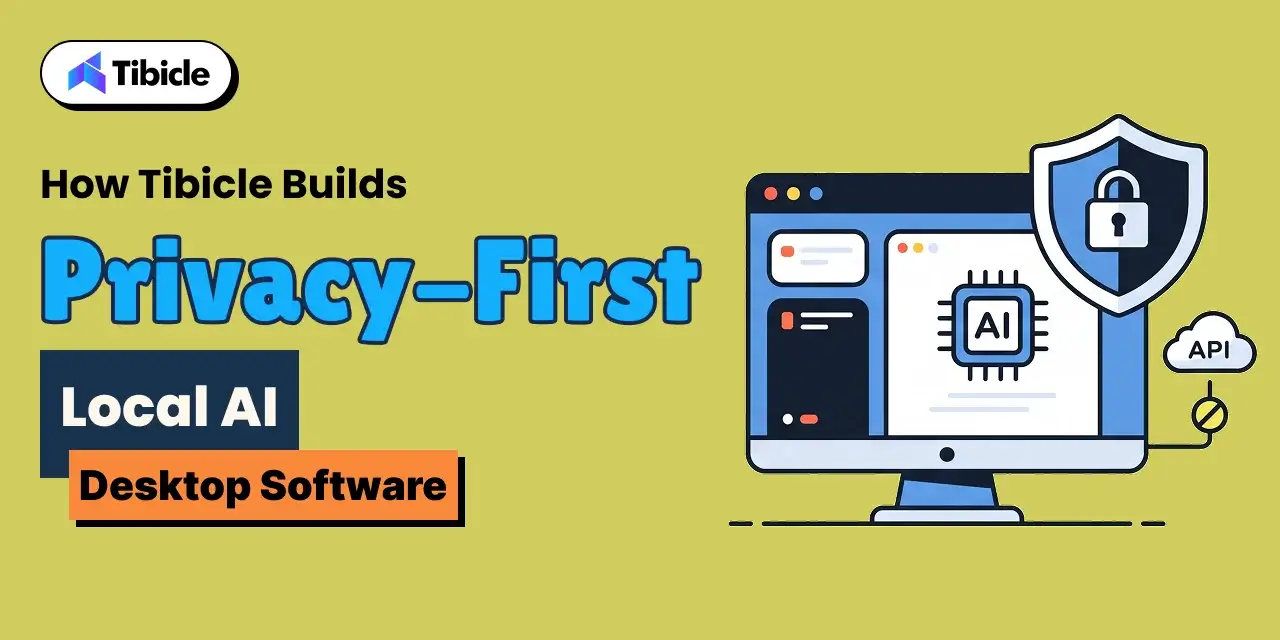
Tibicle designs and builds Electron desktop applications for enterprises that need AI features with a verified zero-API architecture, not a hybrid app marketed as private.
Compliance and Architecture Assessment for Private Local AI Desktop App Development Before Any Code
Every engagement begins with a review of the project’s data residency, GDPR, and air-gapped requirements. These requirements are then mapped to the technical architecture needed to meet them. This process identifies which features can run fully locally from day one. It also highlights potential model and hardware trade-offs before development begins.
Development includes OS-level network-disabled testing, not just removing API keys. This ensures the finished app makes no outbound calls for any AI feature. The verification results are documented as part of the delivery, providing compliance teams with audit evidence that cloud-dependent solutions may not offer.
Ongoing Support and Air-Gapped Model Updates for Private Local AI Desktop App Development
Key Takeaways for Enterprise IT and Compliance Teams: Private Local AI Desktop App Development
- Private local AI desktop app development means zero outbound calls by design, not just a cloud fallback that is rarely used
- Quantization matters more here than in a hybrid app, since there is no cloud model to fall back on when local quality falls short
- Data residency and air-gapped deployment requirements should shape the architecture from day one, not get retrofitted after a compliance review
- Every user’s device becomes part of the infrastructure budget once there is no cloud compute to absorb the cost
Book a compliance and architecture assessment call with Tibicle.
FAQ
What does “no API reliance” actually mean for a private local AI desktop app?
It means the AI feature makes zero outbound network calls to function. The model and inference runtime run entirely on the user’s device, with no cloud endpoint the app depends on even as a fallback.
Can a fully local Electron app match the quality of a cloud-connected AI feature?
For scoped tasks like summarization and extraction, yes, when the model runs above roughly 3.5 effective bits per weight. General-purpose reasoning at frontier-model scale still favors the cloud, which is why scoping the feature to what local hardware can handle matters.
How does private local AI desktop app development support GDPR or data residency requirements?
Since no data ever transfers to a third-party endpoint, there is no cross-border transfer event to document under GDPR. This removes an entire category of compliance work that a cloud API architecture requires.
Can this kind of app run in an air-gapped or network-restricted environment?
Yes. Because the model and runtime ship inside the installer, a fully local app deploys the same way on an air-gapped network as it does on a connected machine, with no configuration change needed.
What hardware should we require from users for a fully local AI desktop app?
The minimum spec should be set by testing the actual quantized model on mid-range hardware, not a developer workstation, and should account for 2026 memory pricing pressure when budgeting RAM requirements.
Does Tibicle build privacy-first, fully local AI desktop software for enterprises?
Yes. Tibicle assesses compliance and architecture requirements before development, verifies zero outbound dependency with network-disabled testing, and supports air-gapped model updates after launch.
Schedule A Developer Interview And Get 15 Days Risk-Free Trial
Schedule a Call

Relevant Blog
3 Best Restaurant Management App for 2026

Prejin Nadar

Mobile AI App Development Company Guide

Diya Koradiya
AI Integration Company for B2B SaaS Guide
Diya Koradiya
Written by
Recent Blogs
Building Private local AI Desktop App Development
What This Guide Covers Who this is for: US tech firms, SaaS companies, startups, CTOs, engineering managers, and product teams looking for experienced Electron.js developers for ongoing private local AI desktop app development and custom desktop application development. Search intent: Hiring and decision. This guide covers where to find Electron.js developers, how to evaluate their […]
3 Best Restaurant Management App for 2026
What This Guide Covers Who this is for: This guide is for restaurant management app operators, multi-location F&B group owners, and general managers evaluating whether a restaurant management app can reduce labor costs, food waste, and manual reconciliation time. Search intent: Comparison and decision. The reader is not researching what restaurant management software is. They […]
Mobile AI App Development Company Guide
What This Guide Covers Who this is for: Mobile AI App Development company for B2B SaaS targeting founders, CTOs, product leaders, and technology decision-makers. It is particularly relevant for teams deciding between an offshore vs nearshore AI engineering team, assessing whether an external partner has the technical capability to take an AI feature from proof […]
Got an Idea? Get FREE Consultation
In our world, there's no such thing as having too many clients

