Introduction
India’s industrial IoT market is projected to reach $30.35 billion by 2034, growing at a CAGR of 12.90%. The global IoT market is projected to reach $1.3 trillion in 2026, and Indian vendors are competing for a major share of that opportunity. Yet the real problem for buyers isn’t finding a list. It’s that most lists of IoT development companies in India are recycled without evaluation criteria, vague on technical depth, and light on the kind of detail that informs a C-level vendor decision.
This guide ranks, compares, and stress-tests the top vendors so decision-makers can short-list faster. It breaks down what separates serious IoT development companies from those that can only build dashboards.
What IoT Development Companies in India Actually Do
Beyond App Development The Full Stack Explained
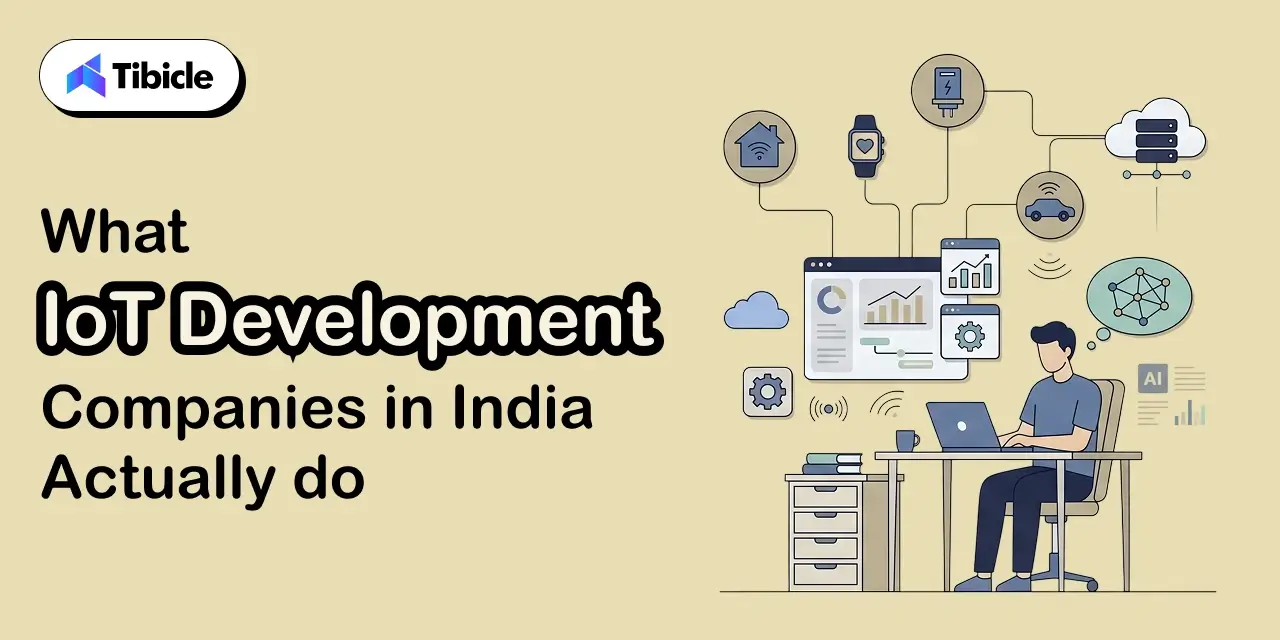
Most buyers arrive at vendor conversations thinking “IoT” means a mobile app that talks to a device. The reality is considerably more layered. A genuine full-stack IoT vendor operates across three distinct layers: the hardware and firmware layer, the software application layer, and the cloud orchestration layer. Conflating any of these with the others leads to misaligned expectations, budget overruns, and failed deployments.
What a full-stack IoT engagement actually covers:
- Device connectivity and firmware writing the low-level code that runs on the hardware itself, managing protocols, power efficiency, and sensor interfacing
- Cloud infrastructure deploying and managing cloud platforms like AWS IoT Core or Azure IoT Hub, including ingestion pipelines, device registries, and security configurations
- Real-time analytics pipelines stream data processing that turns raw sensor output into actionable signals with sub-second latency
- Device lifecycle and OTA updates pushing firmware updates to deployed hardware at scale, without physical access, a capability many vendors simply don’t have
- ERP and CRM system integration connecting IoT data to existing enterprise systems, so operational insights translate into business action
What Separates a Serious IoT Vendor from a Dashboard Builder
The dashboard builder problem is pervasive. Many software companies have packaged their web development capabilities under an “IoT” label and can build a competent frontend visualization. What they cannot do is the hard, foundational work that determines whether a deployment actually works at scale.
Before onboarding any vendor, ask these questions directly:
- Do they handle edge computing, or only cloud-side logic? Edge-capable vendors can process data locally on the device, reducing latency and cloud costs significantly.
- Can they support the MQTT protocol natively? MQTT is the industry-standard lightweight messaging protocol for IoT vendors who can’t answer this fluently are typically app-only.
- Do they have post-deployment firmware update capability? Without OTA update architecture built into the project from the start, every hardware fix requires a field visit.
The answers will immediately stratify your vendor list.
Top IoT Development Companies in India in 2026
Each company below is evaluated on stack depth, industry vertical coverage, and delivery track record, not marketing copy.
Tata Consultancy Services (TCS) Enterprise IoT at Scale
Specialization: End-to-end IoT platforms for Fortune 500 enterprises, with deep investment in connected device management and IIoT platform development. TCS brings certified partnerships with AWS, Microsoft Azure, and Google Cloud IoT to every engagement.
Best for: Large enterprises in manufacturing, utilities, and smart city solutions requiring multi-device, multi-network ecosystems with full compliance documentation.
Key strength: Breadth of vertical coverage and the engineering bench depth to support long-horizon deployments. Their IoT labs in Pune and Chennai have dedicated embedded systems teams, not just cloud engineers.
Infosys AIoT and Predictive Analytics Focus
Specialization: IoT integrated with AI and ML, with a particular emphasis on predictive maintenance and real-time analytics for industrial operations.
Best for: Enterprises running analytics-heavy use cases where the IoT layer feeds AI models for operational intelligence, not just monitoring, but forecasting and autonomous decision-making.
Key strength: Infosys Engineering Services has produced documented outcomes in manufacturing throughput improvement through sensor-driven analytics pipelines. Their edge computing capability is mature and production-tested.
Wipro Industrial IoT and Connected Manufacturing
Specialization: Industrial IoT platforms with a strong focus on manufacturing and logistics verticals. Wipro’s HOLMES platform integrates IoT data with cognitive automation.
Best for: Manufacturing operations seeking to connect legacy OT (operational technology) environments with modern IT infrastructure, a notoriously complex integration challenge.
Key strength: Deep experience bridging the OT/IT gap, including protocol translation and firmware development for equipment that predates modern connectivity standards.
HCLTech Connected Product Engineering
Specialization: Consumer IoT and connected product engineering, with proven capability in firmware development and UX integration from a single vendor.
Best for: Product companies building smart hardware connected appliances, wearables, and consumer electronics where the end-user experience is as important as the device performance.
Key strength: HCLTech’s IoT Works practice combines hardware engineering with UX design, reducing the vendor sprawl that typically plagues connected product development.
L&T Technology Services (LTTS) Deep Embedded Systems Expertise
Specialization: Embedded systems and firmware for industrial and automotive IoT applications. LTTS brings genuine hardware-layer engineering that most software-first vendors lack.
Best for: Industrial IoT companies in energy, automotive, and utilities where firmware reliability and safety compliance are non-negotiable requirements.
Key strength: Unlike most Indian IT vendors, LTTS started from an engineering rather than software services background. Their embedded systems practice is among the deepest in the country.
Persistent Systems Mid-Market IoT with Cloud-Native Architecture
Specialization: Cloud-native IoT development with a focus on mid-market enterprises that need enterprise-grade architecture without enterprise-scale budgets.
Best for: Growing companies in healthcare, retail, and logistics seeking IoT solutions providers in India with modern DevOps practices and cloud integration depth.
Key strength: Persistent’s product engineering DNA means they build for scale from day one, not as an afterthought. Their MQTT protocol and edge computing implementations are production-hardened.
Happiest Minds Security-First IoT Development
Specialization: IoT software development services with an explicit focus on security architecture a differentiator that matters increasingly as connected devices proliferate.
Best for: Regulated industries (healthcare, fintech, utilities) where device security, compliance, and audit readiness are tied to procurement requirements.
Key strength: Zero Trust architecture implementation and device authentication frameworks are core to their delivery model, not optional add-ons.
Tibicle LLP Cost-Efficient, Fast-to-Market IoT Development
Specialization: Full-stack IoT development services with a delivery model calibrated for speed and cost efficiency. Tibicle handles the firmware-to-cloud stack without the overhead structure of larger SI firms.
Best for: Mid-market enterprises and product startups that need IoT app development company India capabilities without enterprise-tier pricing or timelines.
Key strength: Tibicle’s differentiator is time-to-market compression. By keeping hardware, firmware, and cloud integration within a single delivery team, they eliminate the handoff delays that inflate timelines when these are split across vendors. Their pricing transparency across development, cloud infrastructure, and maintenance is uncommon in the market. See how Tibicle approaches IoT project scoping
Cyient Precision Engineering and Industrial IoT
Specialization: Industrial IoT and digital transformation for precision engineering verticals aerospace, defense, and industrial automation.
Best for: Organizations in regulated industrial sectors where engineering documentation, compliance, and safety validation are built into the delivery requirement.
Key strength: Strong background in embedded systems development for mission-critical applications, with certifications relevant to aerospace and defense procurement.
GAVS Technologies Predictive Maintenance and IIoT Platforms
Specialization: Industrial IoT platforms focused on predictive maintenance, asset performance management, and real-time production monitoring.
Best for: Manufacturing and energy companies looking to reduce unplanned downtime through sensor-driven predictive analytics.
Key strength: Their Zero Incident Framework (ZIF) for IT operations extends naturally into IIoT monitoring, giving operations teams a unified view of IT and OT environments.
Comparison Table IoT Development Companies in India 2026
| Company |
Core Strength |
Industry Vertical |
Dev Model |
Pricing Tier |
| TCS |
Enterprise IoT, multi-cloud |
Manufacturing, Smart Cities |
Offshore/Hybrid |
High |
| Infosys |
AIoT, predictive analytics |
Healthcare, Logistics, Manufacturing |
Hybrid |
High |
| Wipro |
Industrial IoT, OT/IT integration |
Manufacturing, Logistics |
Offshore/Hybrid |
High |
| HCLTech |
Connected product engineering |
Consumer IoT, Automotive |
Hybrid |
High |
| L&T Technology Services |
Embedded systems, firmware |
Industrial, Automotive, Energy |
Offshore |
Mid–High |
| Persistent Systems |
Cloud-native IoT, DevOps |
Healthcare, Retail, Logistics |
Offshore/Hybrid |
Mid |
| Happiest Minds |
Security-first IoT |
Healthcare, Fintech, Utilities |
Hybrid |
Mid |
| Tibicle LLP |
Full-stack, fast time-to-market |
Manufacturing, Product Startups, Logistics |
Offshore |
Low–Mid |
| Cyient |
Precision engineering, embedded |
Aerospace, Defense, Industrial |
Offshore |
Mid–High |
| GAVS Technologies |
Predictive maintenance, IIoT |
Manufacturing, Energy |
Offshore |
Mid |
IoT Development Pricing in India: What to Budget in 2026
What IoT Development Companies in India Charge: Hourly Rates vs. Global Markets
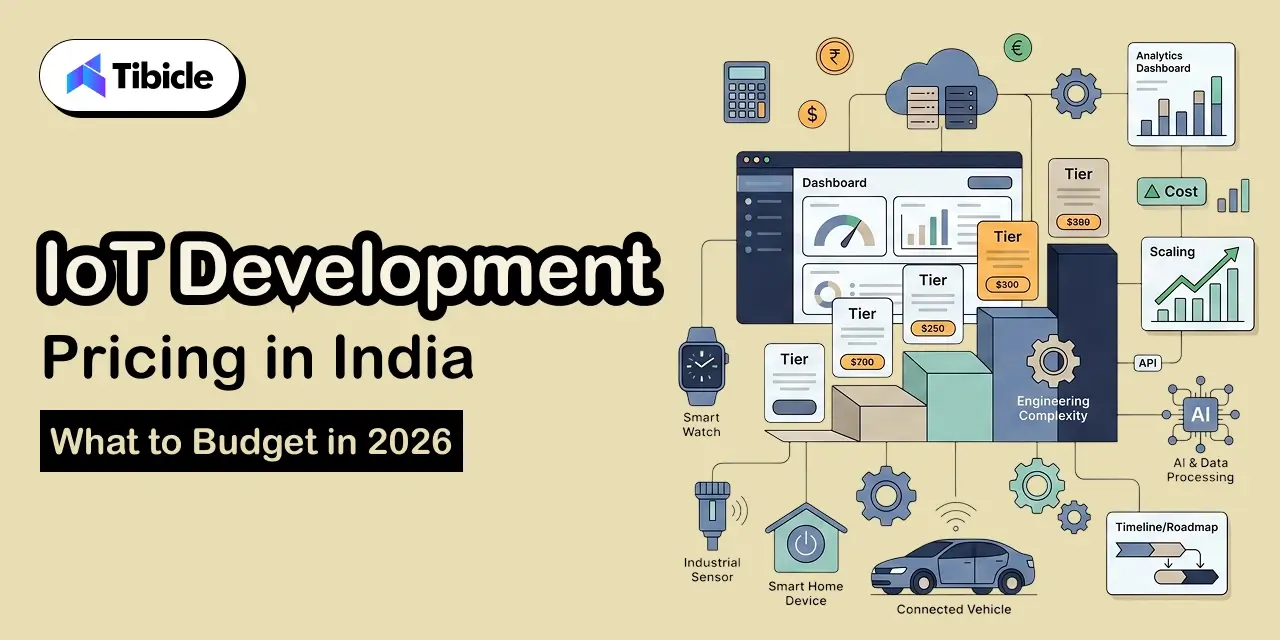
India-based IoT development companies offer significant cost arbitrage at the application and cloud layers. Senior IoT engineers in India typically bill at $40–$80 per hour, compared to $150–$250 per hour in the United States and Western Europe. That’s a 60–70% cost difference on the software and cloud layers.
The gap narrows at the firmware and embedded systems layer, where niche expertise commands a premium regardless of geography. Buyers should not assume the full India rate applies to specialized hardware engineering work.
Project-Level Pricing Benchmarks
Use these figures as order-of-magnitude guides, not fixed quotes. Every engagement varies based on integration complexity, security requirements, and device count:
- Basic IoT application (BLE + single device): $20,000–$50,000
- Smart home or Wi-Fi connected platform: $50,000–$90,000
- Industrial IoT platform (fleet management, manufacturing): $120,000+
- Enterprise IoT ecosystem (multi-network, AI integration, ERP integration): $500,000+
- Ongoing cloud infrastructure costs for mid-size deployments: $2,000–$10,000 per month
Hidden Costs Buyers Consistently Miss
The upfront development quote is rarely the full cost of ownership. Three categories of cost are routinely underscoped:
Firmware maintenance runs at 10–15% of hardware investment annually. Every new device variant, regulatory change, or security patch requires firmware work.
Integration testing with legacy systems adds 20–30% to development timelines when connecting to existing ERP, SCADA, or CRM environments. This is almost always underestimated in initial scoping.
Compliance requirements GDPR, HIPAA, and ISO 27001 add scope and budget that is non-negotiable in healthcare and fintech deployments. Vendors who don’t flag this in the initial proposal are leaving cost surprises for later.
A Forrester study found that companies underestimate IoT project costs by 40–60%. Factor that into your budget ceiling, not just your initial estimate.
Not sure which pricing tier fits your use case? Talk to Tibicle LLP for a scoping assessment, no sales call, no commitment.
ROI and Business Impact of Partnering with IoT Development Companies in India
Where IoT Development Companies in India Deliver Measurable ROI
The business case for IoT investment is well-documented at the operational level. Decision-makers building internal ROI cases can reference these benchmarks:
- Predictive maintenance: Up to 45% reduction in unplanned downtime in manufacturing and utilities deployments
- Real-time production monitoring: 30% throughput improvement documented in manufacturing IoT implementations
- Fleet and logistics IoT: Consistent reductions in fuel costs and route inefficiency, with payback periods typically in the 12–24 month range
How to Build the Business Case Internally
Structure the ROI case across three buckets to align with how CFOs and board members evaluate capital investments:
Cost avoidance reduces downtime, fewer manual interventions, and lower field service costs. This is the most quantifiable bucket and often the fastest to demonstrate.
Revenue enablement, faster product releases driven by real-time operational data, new data-driven services built on top of IoT infrastructure, improved customer SLAs through predictive service.
Risk reduction, security posture improvement, compliance and audit readiness, and reduced liability from equipment failures or data breaches.
Typical IIoT deployments show payback periods of 12–36 months, with larger enterprise ecosystems toward the longer end of that range.
Build vs. Buy vs. Outsource A CFO-Level View
The build-in-house path is tempting for technology-forward organizations. The data argues against it. In-house IoT builds average 18–24 months to market, according to Particle research. The average enterprise IoT project spans 23+ vendors according to PTC data, creating coordination overhead that frequently kills momentum.
Outsourcing to a specialized IoT solutions provider compresses both the timeline and the vendor sprawl. The key is choosing a vendor with genuine full-stack capability hardware through the cloud rather than stitching together point solutions.
Risks and Challenges When Hiring IoT Development Companies in India
Technical Risks Every Buyer Should Probe with IoT Development Companies in India
Vendors who skip firmware update architecture leave buyers with a critical operational gap. If OTA updates aren’t designed into the system from day one, every firmware change becomes a field service event.
Cloud lock-in from proprietary platforms creates long-term leverage for the vendor and cost exposure for the buyer. Insist on portability across cloud platforms as a contractual requirement.
Protocol-level competency gaps are widespread. Not every team that calls itself an IoT company understands MQTT, LoRaWAN, cellular versus BLE trade-offs, or the conditions under which each protocol fails. Probe this directly in vendor conversations.
Vendor Management Risks
Offshore IoT teams without dedicated project managers who understand both hardware and software create integration failures at the boundary between the two. The hardware-software handoff is where most IoT projects derail. It requires a project manager who can hold both sides accountable.
Integration testing is consistently underscoped. When done properly, it consumes roughly 30% of total project timelines. Vendors who quote less are either cutting corners or don’t know what they don’t know.
Security Risks
Zero Trust architecture is the 2026 standard for IoT deployments. Any vendor not implementing it by default is a liability, not just a risk. Every connected device is a potential attack surface.
Ask vendors specifically about device authentication mechanisms, data encryption in transit and at rest, and how they handle device revocation when hardware is compromised or decommissioned. Vague answers are disqualifying.
Vendor Selection Checklist for Choosing IoT Development Companies in India
Before signing a contract with any IoT development company in India, verify each of the following:
- Full-stack capability confirmed the vendor handles hardware, firmware, cloud, and analytics, not just application development
- Industry vertical experience matches your use case. Healthcare, manufacturing, and logistics are different disciplines with different compliance requirements
- Security architecture is Zero Trust by default, not a bolt-on after initial development
- OTA firmware update capability is built into the delivery model, not quoted as an optional scope
- Cloud platform is portable, not locked into one vendor’s proprietary stack
- The integration testing timeline is explicitly budgeted and not collapsed into development estimates
- Post-deployment support SLA is documented with clear escalation paths and response commitments
- Compliance certifications relevant to your industry, ISO 27001, HIPAA, and GDPR, are either held or explicitly scoped into the project
- Pricing model is transparent across development, cloud infrastructure, and ongoing maintenance phases, not just the build phase
Vendors who push back on any of these items during due diligence are telling you something important.
Why Tibicle LLP Belongs on Your Shortlist for IoT Development
Tibicle LLP occupies a specific and underserved position in the Indian IoT vendor landscape: full-stack delivery capability at mid-market pricing, without the overhead and minimums that come with the large SIs.
In the comparison table above, Tibicle sits at the Low–Mid pricing tier with full-stack capability, a combination most vendors can’t deliver. The typical trade-off is that full-stack vendors charge High-tier rates, while Low–Mid-tier vendors are app-only. Tibicle’s model avoids that trade-off through a leaner delivery structure and a team that covers firmware through the cloud without subcontracting the harder layers.
Against the checklist above: Tibicle builds OTA update architecture into projects from day one, implements Zero Trust security posture as a default rather than an optional scope item, and prices transparently across all three phases development, cloud, and maintenance. For enterprises and product companies in manufacturing and logistics where time-to-market compression matters, their delivery model is specifically calibrated for that outcome. See how Tibicle approaches IoT project scoping.
Conclusion
India’s IoT development ecosystem in 2026 is deeper than most buyers realize. The gap between vendors is significant, but it lives at the firmware and integration layer, not the app layer. Any reasonably competent software shop can build a dashboard. Far fewer can handle embedded systems, OTA firmware updates, protocol-level connectivity, and enterprise system integration from a single delivery team.
Use the pricing benchmarks, risk checklist, and comparison table in this guide to short-list vendors aligned to your vertical and budget. The wrong vendor costs 40–60% more and 12+ months of additional timeline, based on how consistently these projects are underestimated.
Tibicle LLP offers a structured IoT scoping session to connect with their team to map your project scope and get a ballpark estimate within 72 hours.
Frequently Asked Questions
How much does IoT development cost in India in 2026?
Basic IoT apps start at $20,000. Industrial-grade platforms range from $120,000 to $500,000 or more. Indian IoT developers charge $40–$80 per hour compared to $150–$250 per hour in the US, a 60–70% cost advantage on the application and cloud layers.
What should I look for in an IoT development companies in India?
Confirm full-stack capability across hardware, firmware, cloud, and analytics. Verify Zero Trust security architecture, OTA firmware update support, and an integration testing budget that reflects the actual complexity of connecting to your existing systems. App-only vendors are not full IoT partners, regardless of how they market themselves.
How long does an IoT project take to complete in India?
Simple IoT apps typically take 2–3 months. Industrial IoT platforms run 6–9 months. Enterprise ecosystems that include AI integration and ERP connectivity typically run 12–18 months or longer, depending on the complexity of legacy system integration.
What is the difference between consumer IoT and industrial IoT development?
Consumer IoT prioritizes user experience and seamless device connectivity. Industrial IoT IIoT requires redundancy, safety compliance, integration with existing manufacturing or logistics infrastructure, and often involves legacy equipment that predates modern connectivity standards. The cost gap between a consumer IoT project and an IIoT platform is typically $100,000 or more.
How do I calculate ROI on an IoT project?
Use three buckets: cost avoidance (downtime reduction, fewer manual processes), revenue enablement (new data products, faster delivery), and risk reduction (security, compliance). IIoT deployments typically show payback periods of 12–36 months. Start with the cost avoidance bucket, it’s the most quantifiable and the fastest to demonstrate.
Why do IoT projects in India cost less than in the US or Europe?
Developer rates are 60–70% lower in India at the application and cloud layers. The cost difference narrows considerably for specialized firmware and embedded systems work, where niche expertise commands a premium regardless of geography. Buyers should budget India rates for software and cloud, but not assume those rates extend fully to hardware-layer engineering.