Introduction
The global ecommerce market is projected to hit $8.1 trillion by 2026, and mobile commerce now accounts for 61 to 75 percent of all online sales worldwide. These numbers are not projections anymore; they are the new baseline. For businesses that want a share of that revenue, ecommerce app development has shifted from a nice-to-have to a strategic priority.
Yet most decision-makers walk into the process without clarity on what it actually costs, how long it takes, what returns to expect, and which development partner is the right fit. That lack of clarity leads to blown budgets, delayed launches, and apps that underperform from day one.
This blog breaks down the full scope of ecommerce app development from cost tiers and platform choices to ROI benchmarks and vendor evaluation criteria so you can make a confident, well-informed investment decision in 2026.
What Is eCommerce App Development and Why Does It Matter in 2026?
Definition and Scope of eCommerce App Development
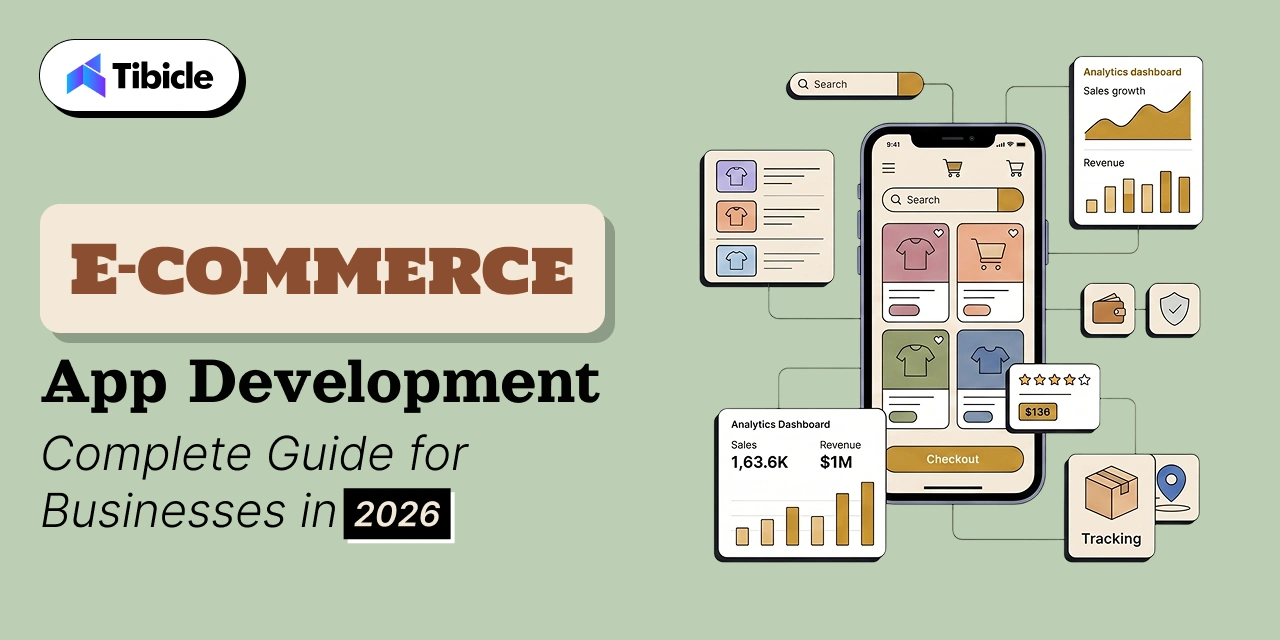
Ecommerce app development is the end-to-end process of designing, building, testing, and deploying a mobile or web application that enables businesses to sell products or services digitally. A complete ecommerce app is not just a product catalogue with a Buy button. It is a full-stack commerce engine that includes product discovery and search, shopping cart functionality, secure checkout, payment processing, order management, customer account management, push notifications, and analytics dashboards. Done well, it becomes the primary digital touchpoint between a brand and its customers.
Market Signals Driving Investment in 2026
The data makes a compelling case for investing in ecommerce app development right now. Shopping app downloads are expected to reach 187 billion globally in 2026. Apps convert users at three times the rate of mobile websites. And yet, despite this, 88 percent of mobile ecommerce apps score mediocre or worse on UX benchmarks according to DesignRush 2026 data which means the competitive bar is still surprisingly low. Businesses that invest in ecommerce app development and build well-designed, performance-optimized ecommerce apps in 2026 have a genuine window to stand apart from the majority of the market.
Types of Ecommerce Apps in Ecommerce App Development and How to Choose the Right Model
B2C, B2B, C2C, D2C, and Multi-Vendor Marketplace
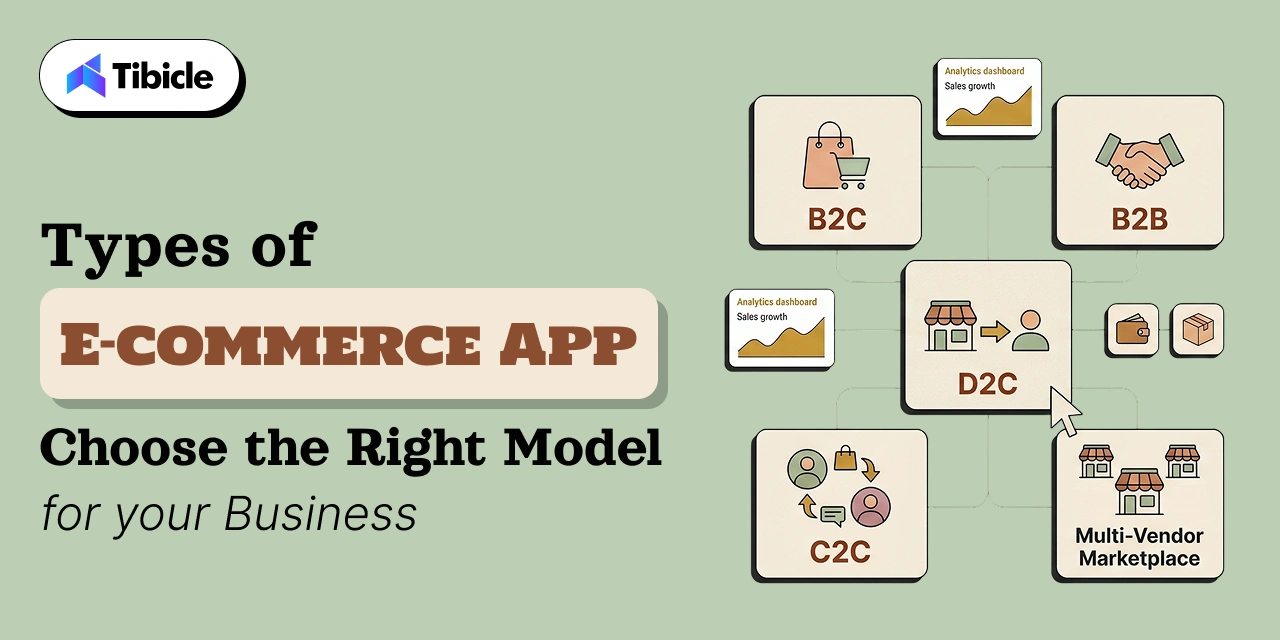
Not all ecommerce apps are built the same way, and the business model you operate under directly shapes the architecture and budget of your ecommerce app development project. Here is a quick breakdown of the primary models:
- B2C (Business-to-Consumer): The most common model, where a brand sells directly to end consumers. Think fashion, electronics, FMCG.
- B2B (Business-to-Business): Accounts for 70.7 percent of total ecommerce market share globally. Requires features like bulk ordering, tiered pricing, invoice-based payments, and account-level access controls.
- D2C (Direct-to-Consumer): The fastest-growing ecommerce model in India. Brands bypass retail intermediaries and sell straight to buyers, which demands strong brand storytelling, personalization, and owned data capabilities.
- C2C (Consumer-to-Consumer): Peer-to-peer platforms such as resale or rental marketplaces. Requires trust and verification layers.
- Multi-Vendor Marketplace: An app that hosts multiple independent sellers. The most complex model to build and one that demands robust vendor management, commission tracking, and dispute resolution systems.
How Business Model Affects Architecture and Budget
A single-vendor B2C ecommerce app and a multi-vendor marketplace app are built on fundamentally different technical foundations. Single-vendor apps have simpler data models, fewer user roles, and lower backend complexity. Multi-vendor apps require role-based access, seller dashboards, multi-wallet payment flows, and real-time inventory sync across vendors. Subscription-based commerce also introduces its own logic layer for recurring billing, plan management, and churn prediction. Choosing the wrong architecture early is one of the most expensive mistakes in ecommerce app development. The cost to re-architect mid-project is significant.
Core Features in Ecommerce App Development
Must-Have Features for Launch
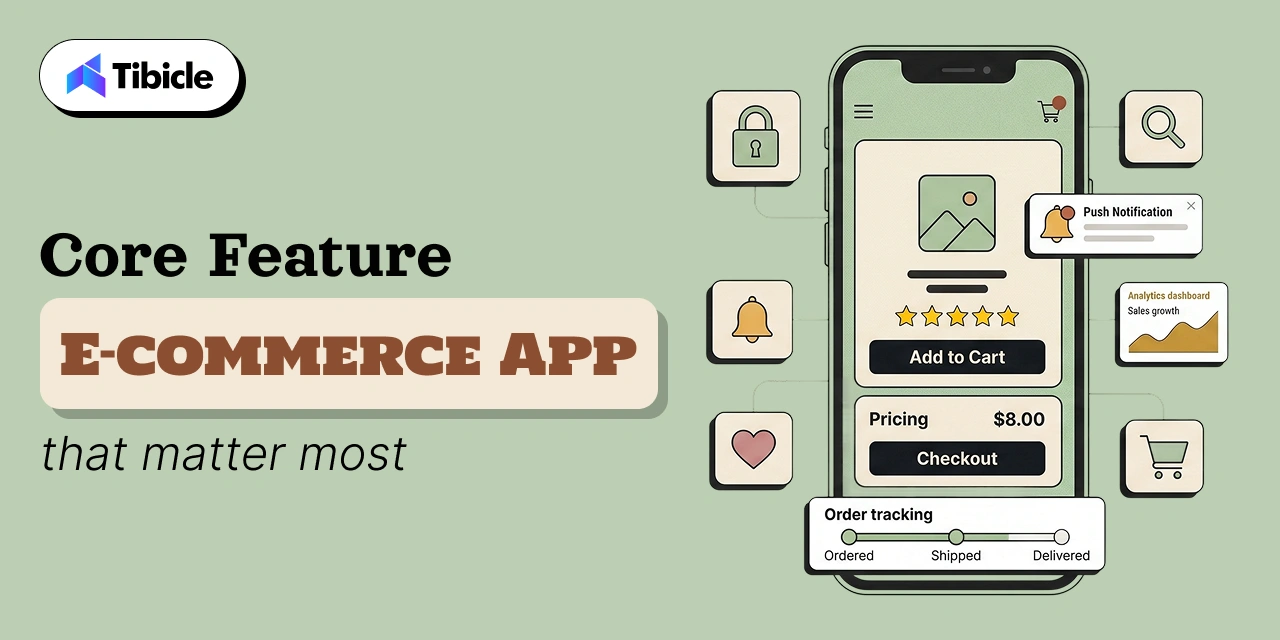
A minimum viable ecommerce app must include these baseline features to function and convert:
- Product Search and Filtering: Faceted search with category filters, price range, and rating. A poor search experience kills conversion before the user ever reaches the cart.
- Secure Payment Processing: Integration with major payment gateways such as Stripe, Razorpay, or PayPal. Multiple payment methods including cards, UPI, wallets, and buy-now-pay-later options are now expected.
- Order Tracking: Real-time order status updates and delivery tracking reduce post-purchase anxiety and customer support load.
- Push Notifications: Personalized, behavior-triggered notifications for cart abandonment, order updates, and promotions are among the highest-ROI features in any ecommerce app.
- Guest Checkout: Forcing account creation before purchase is a proven conversion killer. Guest checkout should be non-negotiable in every ecommerce app development project.
High-Impact Add-Ons for Scale
Once the MVP is live and validated, the following features become significant revenue levers:
- AI-Powered Product Recommendations: Amazon attributes 35 percent of its total revenue to its recommendation engine. For any custom ecommerce app targeting growth, recommendation logic is one of the highest-return engineering investments.
- AR Product Visualization: Lets users preview products furniture, apparel, eyewear in their own environment before purchasing. Dramatically reduces returns and increases purchase confidence.
- Loyalty Programs and Gamification: Points, tiers, and streak-based rewards increase repeat purchase frequency and customer lifetime value.
- Real-Time Inventory Sync: Eliminates overselling and the resulting customer dissatisfaction. Critical for multi-channel retailers.
- App Conversion Rate Optimization (CRO) Tools: A/B testing frameworks, heatmaps, and session replay integrations built into the app enable continuous improvement after launch.
Tech Stack Options for eCommerce App Development in 2026
Native vs. Cross-Platform: Cost and Performance Tradeoffs
On of the most consequential early decisions in any ecommerce app development project is choosing between native and cross-platform development. Native apps built separately for iOS using Swift and for Android using Kotlin deliver the best possible performance, deepest device integration, and the most polished user experience. The tradeoff is cost and time: you are essentially building the app twice.
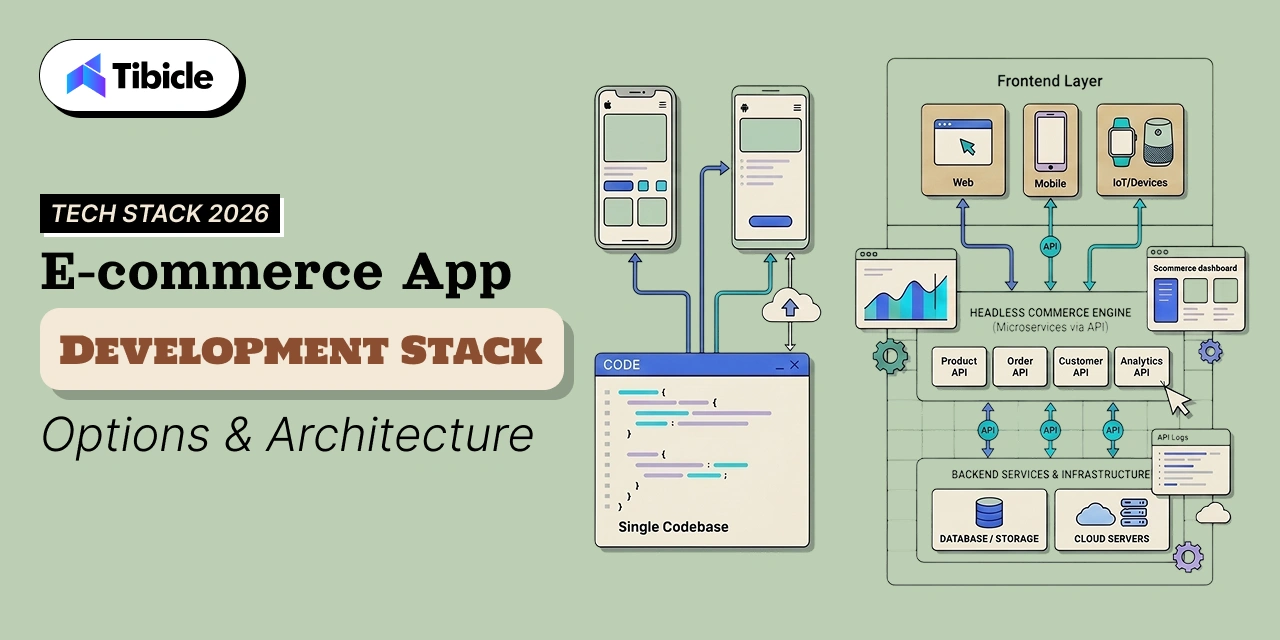
Cross-platform frameworks such as Flutter and React Native allow a single codebase to power both iOS and Android apps. This approach cuts development costs by 30 to 40 percent compared to dual-native builds and significantly reduces time to market. For most B2C and retail ecommerce apps, cross-platform performance is now near-native and entirely acceptable for the end user. Native development remains the right choice only when the app requires deeply hardware-specific features or extremely high-performance rendering that cross-platform engines cannot yet match.
Headless Commerce Architecture
Headless commerce architecture decouples the frontend presentation layer from the backend commerce engine. Instead of a tightly integrated monolith, you get two independently scalable systems connected via APIs. This enables multi-channel delivery; the same backend can power a mobile app, a web storefront, a voice assistant, an IoT device, or an AR experience without rebuilding core commerce logic for each channel. For businesses planning to scale across multiple digital touchpoints, headless architecture is increasingly the right long-term call. It also enables faster frontend development cycles since UI teams can ship changes without touching backend logic. The tradeoff is higher initial complexity and cost, making it better suited for mid-tier to enterprise ecommerce app development projects rather than lean MVPs.
eCommerce App Development Cost Breakdown: 2026 Pricing Tiers
Cost by App Complexity
Ecommerce app development cost varies widely based on the complexity of the product, the features included, and the technology stack chosen. Here is a practical breakdown for 2026:
| App Type |
Cost Revenue |
Timeline |
| Basic MVP(Single – Vendor) |
$20,000 – $50,000 |
2-4 months |
| Mid-Tier(Analytics, Multi- Gateway) |
$50,000 – $120,000 |
4-6 months |
| Enterprise/ AI-Powered |
$120,000 – $300,000 |
6-12 months |
| Multi- Vendor Marketplace |
$80,000 – $250,000 |
6-10 months |
These ranges assume a competent development partner with a full team of product manager, designer, frontend developer, backend developer, and QA engineer. Outliers exist in both directions, but these are realistic planning benchmarks.
Hidden Costs Most Businesses Miss
The quoted development cost is only part of what you will actually spend on your ecommerce app. Decision-makers frequently overlook:
- Maintenance and Updates: Industry standard is 15 to 20 percent of the original build cost per year. An app left without ongoing maintenance degrades in performance and security.
- App Store Fees: Apple takes 15 to 30 percent of in-app revenue. Google Play applies a similar structure. These are ongoing costs, not one-time.
- Cloud Hosting: Depending on traffic volume and architecture, cloud infrastructure costs typically range from $200 to $2,000 per month. High-traffic apps can exceed this significantly.
- PCI-DSS Compliance Audits: If your app handles card payments directly, PCI-DSS compliance audits cost between $2,000 and $8,000 annually, depending on your transaction volume and scope.
- Third-Party API Costs: Payment gateways, mapping services, analytics platforms, and push notification providers all carry usage-based pricing that scales with your user base.
How Developer Location Impacts Pricing
Developer location is one of the biggest levers in ecommerce app development cost. North American and Western European development teams typically charge $100 to $200+ per hour. Eastern European agencies range from $40 to $80 per hour. South Asian agencies, including those in India, typically range from $20 to $50 per hour often with comparable technical quality for standard ecommerce builds. The key considerations beyond rate are IP ownership (ensure it transfers fully to you in the contract), communication quality, and post-launch support availability across time zones.
ROI of eCommerce App Development: Is the Investment Worth It?
Revenue Impact Metrics
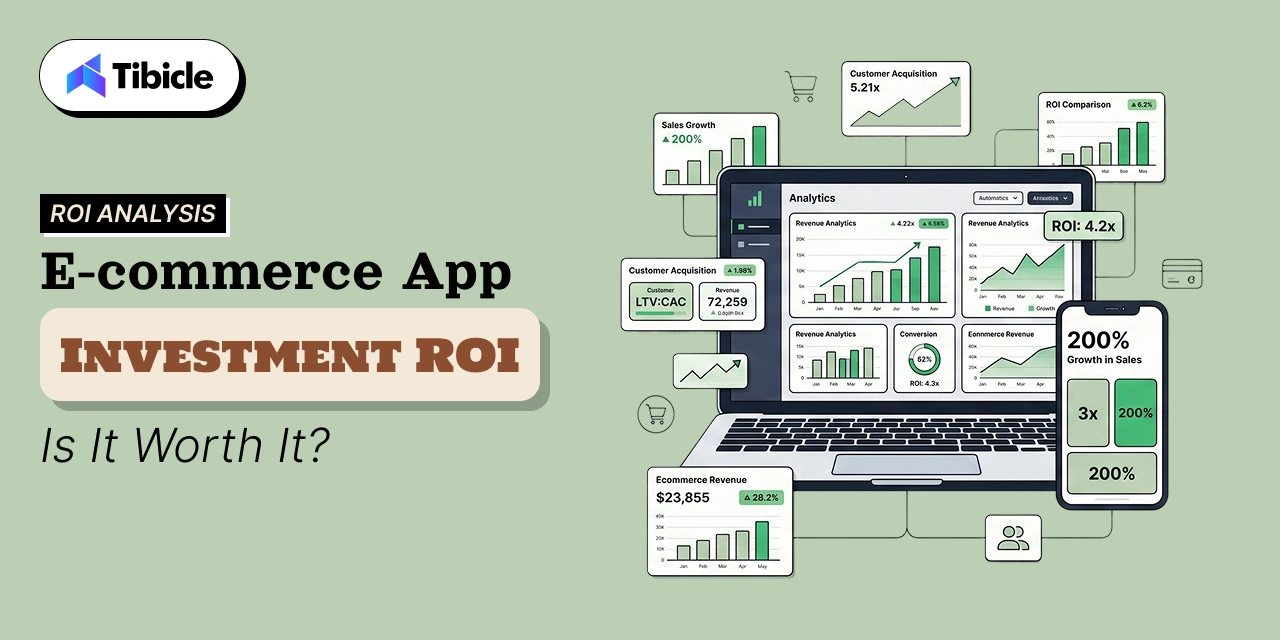
The ROI case for ecommerce app development is strong when the app is built and marketed correctly. Key benchmark data for 2026:
- App users spend three times more per transaction and return two times more frequently than mobile web users, a compounding advantage for customer lifetime value.
- A well-designed user interface can increase conversion rates by up to 200 percent, according to Maze research. When strong UX design is paired with performance optimization, that figure can reach 400 percent.
- Push notifications, an exclusive capability of native and cross-platform apps over mobile web, deliver some of the highest engagement rates of any owned marketing channel, typically 4 to 8 percent click-through rates versus 1 to 2 percent for email.
- Apps with personalization features such as AI-powered product recommendations consistently see 10 to 30 percent higher average order values compared to non-personalized experiences.
Cost-to-Revenue Framework for Decision-Makers
- When evaluating whether to build an ecommerce app, the right question is not “What does it cost?” but “What is the cost of not building it?” Here is a practical framework:
- Customer Acquisition Cost (CAC) Reduction: Owned push channels reduce dependence on paid advertising. Every user who opts into push notifications becomes a zero-marginal-cost remarketing audience.
- Customer Lifetime Value (CLV) Gains: Apps with loyalty programs and personalization features consistently increase CLV by 20 to 40 percent over mobile web equivalents.
- Breakeven Timeline: Lean MVPs scoped tightly around must-have features typically reach breakeven three times faster than over-engineered, feature-heavy apps. An MVP-first approach to ecommerce app development is almost always the financially smarter entry point.
- Attribution Clarity: Apps provide first-party data that is unaffected by iOS privacy changes or third-party cookie deprecation, a structural advantage for performance marketing.
Native vs. Cross-Platform vs. No-Code: A Comparison for Businesses for Ecommerce App Development
Choosing your development approach is one of the highest-leverage decisions in the entire ecommerce app development process. Here is a direct comparison across the key business dimensions:
| Factor |
Native |
Cross-Platform |
No-Code/Low-Code |
| Cost |
High ($100k+) |
Medium ($40K-$80K) |
Low($15K-$40K) |
| Timeline |
6-12 months |
3-6 months |
5-8 weeks |
| Performance |
Best |
Near-native |
Adequate for simple apps |
| Scalability |
Full |
High |
Limited |
| Best For |
Enterprise, complex UX |
Most Retail / B2C |
MVPs, market testing |
When to Choose Each Approach
Native development is the right call when your app requires deeply hardware-specific functionality, you are targeting a premium segment where app performance is a brand statement, or your long-term roadmap includes advanced features that cross-platform frameworks do not yet support.
Cross-platform development particularly with Flutter or React Native is the right choice for the majority of retail, B2C, and mid-market B2B ecommerce apps. It delivers near-native performance at 30 to 40 percent lower cost, which makes it the default recommendation for most ecommerce mobile app development projects in 2026.
No-code and low-code platforms are appropriate for market testing, internal tools, or early-stage MVP validation where speed is more important than scalability. They are not appropriate for production ecommerce apps targeting significant transaction volume or complex user journeys.
Common Risks and Challenges in eCommerce App Development
Technical Debt from Wrong Platform Choice
Choosing the wrong tech stack or architecture at the start of an ecommerce app development project can create technical debt that compounds painfully over time. A no-code platform that works for an early MVP will hit hard ceilings at scale. A monolithic backend architecture that cannot be decoupled will make adding new sales channels prohibitively expensive. These decisions are difficult and costly to reverse after launch. The right approach is to choose a stack that matches not just your current needs but your 18 to 24 month growth trajectory.
Scope Creep and Budget Overruns
Scope creep is the silent budget killer in ecommerce app development. Features added mid-project without formal change management inflate total project costs by approximately 25 percent on average. The most effective counter-strategies are milestone-based contracts that require sign-off before additional scope is introduced, a strict MVP-first philosophy that defers non-essential features to post-launch phases, and a clearly documented feature backlog maintained throughout the project.
Security and Compliance Failures
An ecommerce app handles sensitive financial and personal data, which makes security a non-negotiable priority not an afterthought. GDPR compliance is required for any app serving European users, and violations carry fines of up to 4 percent of global annual revenue. PCI-DSS compliance is mandatory for apps processing card payments. A data breach, beyond the direct financial cost, causes lasting brand damage that quantifiably affects revenue. Building compliance from day one is significantly cheaper than retrofitting it after a breach or regulatory audit. When evaluating any ecommerce app development company, security compliance track record is a mandatory screening criterion.
Vendor Selection Checklist: How to Choose the Right eCommerce App Development Company
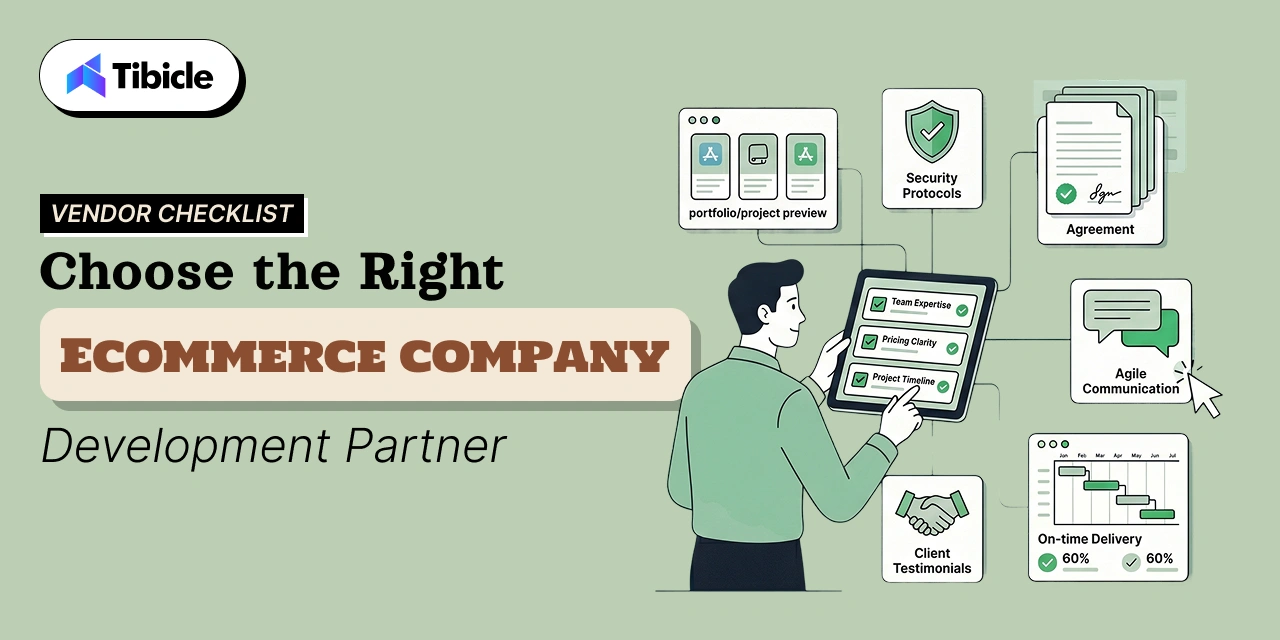
10-Point Evaluation Framework
Choosing the right ecommerce app development company is as consequential as the technology decisions themselves. Use this framework to evaluate every vendor you consider:
- Portfolio with Live eCommerce Apps: Look for published, downloadable apps on the App Store and Play Store not Dribbble mockups or design files. Live apps reveal real-world quality.
- Proven Experience with Your App Type: A vendor that specializes in B2C retail apps is not automatically the right partner for a B2B procurement marketplace. Verify category-specific experience.
- Transparent Cost Breakdown: Any vendor who cannot provide a detailed, itemized estimate is either inexperienced or deliberately vague. Walk away from vague proposals.
- Post-Launch Maintenance and SLA Terms: The app is a long-term product. Clarify who handles bugs, OS updates, and performance monitoring after launch, and at what cost.
- Cross-Platform vs. Native Expertise: Confirm the team is proficient in the specific cross-platform app framework or native stack recommended for your project.
- AI/ML Integration Capability: If personalization and recommendation features are in scope, verify that the vendor has delivered AI-powered commerce features in prior projects.
- Security Compliance Track Record: PCI-DSS and GDPR are baseline requirements. Ask directly for compliance documentation and references from regulated clients.
- Communication Cadence and Project Management Tools: Confirm sprint cadence, reporting format, and which project management tools (Jira, Linear, Notion) will be used to track progress.
- Client Retention Rate and References: A high repeat client rate is the strongest proxy for vendor quality. Request references and actually call them.
- IP Ownership Clarity in Contract: Ensure the contract explicitly states that all source code, design assets, and proprietary logic transfer fully to you upon final payment.
Red Flags to Watch For
Avoid any ecommerce app development company that offers vague project timelines without defined milestones, has no documented post-launch support plan, cannot clearly articulate how IP ownership is handled, or provides references they cannot connect you with directly. These are reliable indicators of either inexperience or misaligned incentives.
Need a transparent cost estimate and development roadmap for your ecommerce app? Talk to the Tibicle team for a no-obligation consultation.
Why Tibicle Is a Strong Choice for eCommerce App Development
Across the vendor evaluation criteria outlined above, Tibicle consistently checks the boxes that matter most to businesses investing in ecommerce app development for the first time or scaling an existing commerce operation.
Tibicle has hands-on experience delivering custom ecommerce app projects across B2C and B2B models, with expertise in both Flutter-based cross-platform builds and native iOS/Android development. The team operates a full-cycle engagement model: from discovery and product scoping through UI/UX design, development, QA testing, and post-launch support. There are no handoffs between disconnected vendors at different stages; one team owns the full product lifecycle.
Pricing is milestone-based and transparent. Every project begins with a detailed scope document and itemised cost breakdown, so clients always know exactly what they are paying for and what they are getting. Tibicle’s AI and cross-platform expertise directly map to the highest-value features discussed in this guide: recommendation engines, personalization logic, and Flutter-based ecommerce mobile app development at 30 to 40 percent lower cost than dual-native builds.
When measured against the 10-point vendor evaluation framework in the previous section, Tibicle delivers on portfolio depth, compliance awareness, communication standards, and IP ownership clarity all without the overhead of an enterprise agency.
Explore Tibicle’s ecommerce app development services and request a detailed project scope tailored to your business model.
Conclusion
Ecommerce app development in 2026 is not an IT expense, it is a growth investment with measurable, documented returns. The decision framework is straightforward: start with your business model, define your feature scope, select the right development platform, establish a realistic budget, and choose a vendor whose expertise and working model align with your goals.
Apps convert better, retain users longer, and generate higher average order values than any other digital commerce channel. The businesses that build high-quality ecommerce apps this year are not just chasing a trend they are building durable competitive infrastructure.
The window for differentiation is still open.Across the market, many ecommerce apps still struggle with UX. Development decisions are often made without a clearly defined ROI framework, while vendor partnerships are frequently selected based on price instead of long-term capability. Getting each of these decisions right is what separates ecommerce apps that scale from ones that stagnate.
Get in touch with Tibicle to plan your ecommerce app with clear timelines, costs, and ROI targets.
Frequently Asked Questions
How much does ecommerce app development cost in 2026?
Ecommerce app development cost in 2026 ranges from $20,000 to $300,000 or more depending on complexity. A basic MVP for a single-vendor B2C app typically costs between $20,000 and $50,000, while enterprise-grade or AI-powered builds can reach $120,000 to $300,000+. Multi-vendor marketplace apps fall in the $80,000 to $250,000 range. Additional ongoing costs including maintenance, hosting, app store fees, and compliance should be factored into the total investment.
How long does it take to build a custom ecommerce app?
Timeline depends on scope and approach. A basic MVP ecommerce app can be delivered in 2 to 4 months. Mid-tier apps with analytics, multiple payment gateways, and custom UI take 4 to 6 months. Enterprise and AI-powered ecommerce apps require 6 to 12 months. Choosing a cross-platform framework over native development typically reduces the timeline by 20 to 40 percent without meaningful performance compromise for most ecommerce use cases.
Should I choose native or cross-platform development for my ecommerce app?
For most retail, B2C, and mid-market B2B ecommerce apps, cross-platform development using Flutter or React Native is the recommended choice. It cuts costs by 30 to 40 percent and delivers near-native performance. Native development is the right call only when the app requires deep device-specific hardware access, very high-performance graphics, or platform-exclusive features that cross-platform frameworks cannot support. The performance gap between cross-platform and native has narrowed significantly in 2025 to 2026.
What features are essential for an ecommerce app to launch successfully?
The non-negotiable features for a successful ecommerce app launch are: robust product search and filtering, secure payment gateway integration with multiple payment methods, real-time order tracking, behavior-triggered push notifications, and guest checkout. These five features directly address the most common points of friction in the purchase journey. AI-powered product recommendations, AR visualization, and loyalty programs are valuable add-ons for the next phase but should not delay your initial launch.
How do I measure the ROI of my ecommerce app after launch?
Post-launch ROI measurement for ecommerce app development should track four primary metrics: conversion rate improvement versus mobile web baseline, average order value per app user, customer return frequency and retention rate, and Customer Lifetime Value growth over 6 to 12 month cohorts. Secondary metrics include push notification click-through rates, cart abandonment recovery rate, and Customer Acquisition Cost reduction from owned push channels. Establish baseline benchmarks before launch so you have a clean before-and-after comparison.