Introduction
India has become one of the fastest-growing hubs for MVP development, driven by cost efficiency, strong engineering talent, and rapid product delivery capabilities. Choosing the right MVP development company is one of the most critical decisions for early-stage startups. .
Most company listicles give you surface-level rankings without the critical details that actually determine project outcomes. They skip pricing transparency, tech stack depth, and post-launch scalability, the three factors that separate successful MVP launches from costly rebuilds six months down the line.
This guide delivers what decision-makers actually need: transparent rankings of 10 leading development services providers in India based on delivery speed, cost structures, domain expertise, and verified client outcomes. By the end, you’ll have a clear framework for shortlisting the right MVP partner with confidence.
If you’re also planning your product budget, you can explore our detailed guide on mobile app development cost to understand full pricing breakdowns.
What Makes a Good MVP Development Company in India?
A reliable MVP development company doesn’t just build fast; it builds for scale.
Speed vs. Scalability: Why You Cannot Optimize for Both Without a Plan
Most India-based MVP software development companies deliver MVPs in 8–16 weeks, with the fastest-closing projects in just 4–6 weeks. Speed sounds attractive, especially when you’re racing to market. But here’s the brutal truth: speed without proper architecture planning causes over 60% of post-launch rewrites.
The companies that slash timelines often skip critical infrastructure decisions. They build what works today, but fractures under tomorrow’s user load. A well-architected MVP takes slightly longer upfront but saves you from the 2x–3x rebuild costs when your user base scales from hundreds to thousands.
The Three Non-Negotiables for C-Level Buyers
When evaluating minimum viable product development partners, three criteria matter more than impressive portfolio screenshots:
Agile delivery with milestone-based billing protects your investment. You pay as value gets delivered, not upfront in full. This structure aligns incentives and gives you exit points if the partnership isn’t working.
Tech stack alignment with your 12-month roadmap prevents technical debt. If your MVP app development India partner suggests technologies they’re comfortable with rather than what your product actually needs (MERN, Django, Flutter, AWS), you’re setting yourself up for expensive migrations later.
Post-launch support SLA with defined response windows is non-negotiable. Most firms offer vague ‘support’ without specifying bug fix timelines. Enterprise-grade partners define response times: critical bugs within 4 hours, high-priority bugs within 24 hours, and feature requests within weekly sprints.
Why Choose India for MVP Development in 2026?
The numbers tell a clear story. Average Indian MVP development builds cost between $10,000 and $50,000, compared to $80,000–$200,000 in the US or UK for an equivalent scope. That’s a 60–75% cost reduction without compromising on engineering quality when you work with the right partners.
India produces 1.5 million STEM graduates annually, creating a deep talent pool that sustains technical expertise across modern frameworks and cloud architectures. The country’s time zone (IST) enables 4–6 hours of daily overlap with European markets, facilitating near-real-time collaboration that eliminates the lag common in fully asynchronous offshore arrangements.
ISO-certified firms dominate the Indian market, signaling process maturity beyond just competitive pricing. When you hire MVP developers India from established agencies, you’re accessing teams that follow rigorous quality assurance protocols, maintain secure development environments, and deliver under formalized IP protection standards.
Key advantages at a glance:
- Cost efficiency: 60–75% lower than US/UK rates
- Talent availability: 1.5M annual STEM graduates
- Agile certification: ISO-certified process frameworks
- IP protection: Formalized contracts and NDA standards
How to Choose the Right MVP Development Company in India?
Technical Evaluation Criteria
Frontend and backend stack depth determines whether your rapid prototyping phase will translate into production-ready code. Ask about specific experience with React, Node.js, Python/Django, and Flutter, not just bullet points on a capabilities deck, but active projects using these stacks in the past 12 months.
Cloud-native architecture capability separates firms that truly understand agile development methodology from those that bolt cloud services onto monolithic designs. Verify experience with AWS, GCP, or Azure deployments, including auto-scaling configurations and managed database services.
API integration experience relevant to your domain matters more than generic integration capabilities. If you’re building fintech, ask about payment gateway implementations (Stripe, Razorpay). For SaaS platforms, dig into authentication systems (Auth0, Firebase) and analytics pipelines (Segment, Mixpanel).
Commercial Evaluation Criteria
Fixed-price versus time-and-materials (T&M) engagement models each serve different scenarios. Fixed-price works when requirements are crystal clear and unlikely to change, think straightforward marketplaces or content platforms. T&M makes sense for exploratory builds where user feedback will drive iteration.
Milestone payment structures protect both parties better than upfront lump sums. Standard practice among reputable offshore software development firms involves 30% upfront, 40% at midpoint delivery, and 30% upon final handoff. Be cautious of any agency demanding 50%+ before showing working code.
Source code ownership and IP transfer clauses must be explicit in contracts, not assumed. Some agencies retain code ownership and license it back to you. Others charge 5–10% of project value for complete IP transfer at handoff. Clarify this upfront to avoid expensive surprises.
Signals That Predict Delivery Risk
Clutch or G2 ratings below 4.5 with fewer than 25 reviews should trigger extra diligence. Either the firm is too new to have built a reputation, or previous clients weren’t satisfied enough to leave positive feedback. Neither scenario inspires confidence for complex builds.
No dedicated QA team mentioned in proposals is a red flag for product-market fit validation. Testing shouldn’t be developers checking their own code during lunch breaks. Professional shops staff dedicated quality engineers who write test plans, execute regression suites, and validate edge cases.
Vague post-launch support terms are common dealbreakers, especially for SaaS builds. ‘We’ll support you after launch’ means nothing without defined SLAs. Get specifics: How many days of bug fixes are included? What response times for critical issues? When does paid maintenance begin?
To help you choose the right MVP development company, we’ve compared the top-performing firms in India.
Top 10 MVP Development Companies in India Compared (2026)
Selecting a partner for minimum viable product development isn’t just about finding a coder; it’s about finding a strategic ally who understands the stakes of a startup product launch. Based on the successful formatting of our previous industry analysis, we have profiled the top 10 firms in India. These rankings are based on their ability to balance rapid prototyping with long-term architecture, their agile development methodology, and verified product validation outcomes.
1. Tibicle LLP
Tibicle LLP ranks as a premier MVP development company recommendation for 2026, focusing on lean, milestone-driven delivery for B2B SaaS and startup clients. They prioritize transparent fixed-price models and utilize a structured discovery sprint to reduce scope risk before building begins.
Key Features:
- High-velocity “Discovery Sprints” to prevent scope creep and align product vision.
- Cloud-native AWS setups built specifically for post-MVP scalability.
- Full intellectual property (IP) handoff and source code ownership at project close.
- 90-day post-launch support window to ensure system stability under real traffic.
Services Offered: SaaS MVP builds, rapid prototyping, React & Node.js development, cloud-native architecture.
Best For: Founders who need fast-to-market builds without architecture compromises or hidden costs.
Avg. Project Size: $10,000 – $49,999
Client Review: ⭐⭐⭐⭐⭐ 5.0/5.0
2. PixelCrayons
PixelCrayons is a leading choice for offshore software development, recognized for its ability to handle complex industry compliance and high-tier agile delivery. They offer a flexible resource model that allows startups to scale their team size rapidly based on project needs.
Key Features:
- “Plug-and-Play” team models allowing developer scaling within 48 hours.
- Pre-configured builds for GDPR and HIPAA compliance.
- Deep expertise in DevOps to ensure a seamless transition to a full-scale product.
- Utilizes a global delivery model with a focus on ISO-certified processes.
Services Offered: mvp development company india, MERN stack development, Python, Blockchain frameworks.
Best For: Complex FinTech or Healthcare startups requiring strict data security and compliance.
Avg. Project Size: $25,000 – $75,000
Client Review: ⭐⭐⭐⭐⭐ 4.8/5.0
3. ValueCoders
ValueCoders stands out for its dedicated team model, providing startups with expert developers who act as a direct extension of the in-house staff. They emphasize technical vetting and rigorous quality assurance to maintain a high client retention rate.
Key Features:
- Every assigned developer has a minimum of 5 years of experience in their tech stack.
- Rigorous IP protection framework with $0-cost source code transfer.
- Agile delivery with milestone-based billing to ensure financial transparency.
- Focus on full-cycle development from initial concept to long-term maintenance.
Services Offered: Custom software development, hire mvp developers india, AI/ML integrations, Java & PHP development.
Best For: Enterprises or well-funded startups seeking long-term technical partnerships and dedicated engineering talent.
Avg. Project Size: $10,001 – $50,000
Client Review: ⭐⭐⭐⭐⭐ 4.8/5.0
4. Hidden Brains
Hidden Brains is a globally recognized mvp software development company that excels in high-end UX/UI and backend stability for disruptive ideas. They combine market analysis with technical execution to provide comprehensive end-to-end consulting.
Key Features:
- “User-First” design methodology creating interactive prototypes before coding.
- Access to an in-house R&D lab for testing AI and IoT features.
- Comprehensive end-to-end consulting including deep market analysis.
- Specialized tech stack selection guidance to ensure long-term viability.
Services Offered: minimum viable product development, React/Node.js builds, Hybrid mobile engineering, UI UX design.
Best For: Startups needing heavy technical guidance and high-fidelity design to secure early investment.
Avg. Project Size: $25,000+
Client Review: ⭐⭐⭐⭐⭐ 4.7/5.0
5. Moon Technolabs
As a leader in mvp app development india, Moon Technolabs focuses on a “Mobile First” philosophy to drive rapid consumer validation. They are experts at shortening the time between wireframes and live mobile store deployments.
Key Features:
- High-speed deployment cycles for Apple App Store and Google Play Store.
- Performance benchmarking ensuring <2 second load times on budget devices.
- Focus on high-engagement mobile interfaces to drive early user retention.
- Expertise in cross-platform frameworks to reduce time to market.
Services Offered: Mobile MVP development, Flutter, React Native, iOS/Android Native engineering.
Best For: On-demand service apps or consumer-facing mobile marketplaces needing a fast launch.
Avg. Project Size: $10,000 – $40,000
Client Review: ⭐⭐⭐⭐⭐ 4.9/5.0
6. EnactOn Technologies
EnactOn Technologies is an AI-first product engineering company that has built 500+ products for clients across 65+ countries since 2013. They run a structured scoping process before writing any code to cut features that aren’t essential in version one, and they specialize in taking over vibe-coded prototypes and turning early traction into a platform that scales.
Key Features:
- Structured scoping process that removes non-essential features before development starts, protecting founder budget on v1.
- Four-gate release review (functional, security, performance, and deployment) on every build.
- AI-accelerated engineering that speeds up the build itself, under senior human review.
- Takes over vibe-coded prototypes built in Lovable, Bolt, Replit, Cursor, v0, or Claude Code and hardens them for production.
Services Offered: MVP & SaaS development, AI-prototype rescue and productionization, dedicated engineering teams.
Best For: Non-technical, early-stage SaaS and AI founders.
Avg. Project Size: $5k+
Client Review: ⭐⭐⭐⭐⭐ 4.8/5.0
7. Ouranos Technologies
Ouranos Technologies is an offshore software development company that helps startups, SMBs, and enterprises build custom software, web, mobile, and SaaS applications. Founded in 2014, the company offers full-cycle product development and flexible engagement models, including fixed-price engagements specifically suited to MVPs and POCs.
Key Features:
- 12+ years of technology experience and 109+ completed projects, according to the company’s website.
- Full-cycle development covering discovery, project planning, architecture, UX/UI, development, testing, deployment, and ongoing support.
- Flexible fixed-price and time-and-material engagement models for different project requirements.
- Expertise across web, mobile, SaaS, AI/ML, DevOps, CRM, and ERP technologies.
Services Offered: Custom software development, MVP development, SaaS application development, web and mobile app development, AI/ML development.
Best For:Startups and businesses that need custom MVP development with the flexibility to continue into full product development and long-term support.
Project Size: Custom/Project-based
Client Review: ⭐⭐⭐⭐⭐ 4.8/5.0
8. Aalpha Info Systems
Aalpha Info Systems is a top choice for founders seeking cost-effective and secure MVPs without the overhead of larger agencies. They specialize in fast turnarounds for straightforward web and mobile applications.
Key Features:
- Exceptional time to market for web and mobile concepts.
- Specialized in integrating new MVPs with older legacy systems.
- Transparent, line-item pricing focusing only on essential validation features.
- High standards for data security and regulatory compliance.
Services Offered: WordPress (Headless), PHP/Laravel, mvp development services india, Simple mobile builds.
Best For: Bootstrapped startups that need to prove a concept with a limited initial budget.
Avg. Project Size: $10,000 – $35,000
Client Review: ⭐⭐⭐⭐⭐ 4.9/5.0
9. RipenApps
RipenApps specializes in the “Emotional Design” of an MVP, ensuring that early-stage products feel premium and engage users immediately. They focus on high-fidelity UI/UX to help startups stand out in crowded markets.
Key Features:
- Top-tier UI/UX talent focused on high-fidelity, investor-ready designs.
- Integration of gamification principles to drive early user retention.
- Access to partner networks for recruiting initial beta testing groups.
- Focus on “look and feel” as a primary market differentiator.
Services Offered: Swift & Kotlin engineering, Flutter, UI UX design services, Consumer app MVPs.
Best For: B2C apps where user interface and initial “wow factor” are critical for success.
Avg. Project Size: $15,000 – $50,000
Client Review: ⭐⭐⭐⭐⭐ 4.8/5.0
10. Hyperlink InfoSystem
Hyperlink InfoSystem is a large-scale firm capable of integrating emerging technologies into simple MVPs to prove advanced concepts. They offer extensive scalability testing to ensure products are ready for global traffic.
Key Features:
- Integration of AI, IoT, and AR/VR features into initial MVP builds.
- In-house “Stress Lab” to simulate high-concurrency traffic before launch.
- Cross-platform specialists ensuring identical performance across all devices.
- Large talent pool capable of handling multi-technology integrations.
Services Offered: Python (AI), Unity development, Cloud IoT frameworks, mvp software development company services.
Best For: Tech-forward products relying on hardware-software integration or advanced algorithms.
Avg. Project Size: $25,000+
Client Review: ⭐⭐⭐⭐⭐ 4.9/5.0
Comparison Table:
| Company |
Founded |
Clutch Rating |
Avg. Project Size |
Core Strength |
Best For |
| Tibicle LLP |
2021 |
5.0 |
$10K–$49K |
Lean SaaS MVP development with cloud-native scalability |
B2B SaaS startups |
| PixelCrayons |
2004 |
4.8 |
$25K–$75K |
Agile MVP + rapid prototyping |
SaaS / FinTech |
| ValueCoders |
2004 |
4.8 |
$20K–$60K |
Full-cycle software development |
Enterprises |
| Hidden Brains |
2003 |
4.7 |
$15K–$50K |
React / Node.js product engineering |
Startups |
| Moon Technolabs |
2009 |
4.9 |
$10K–$40K |
Mobile-first MVP development |
Mobile apps |
| EnactOn Technologies |
2013 |
4.8 |
$5K+ |
AI-accelerated MVP and SaaS engineering, prototype-to-production rescue |
Non-technical SaaS/AI founders |
| Ouranos Technologies |
2014 |
4.8 |
Custom/ Project-based |
Custom Software, web/mobile/SaaS MVP development and flexible engagement |
Startups, SMBs & enterprises |
| Aalpha Info Systems |
2008 |
4.9 |
$10K–$35K |
Cost-efficient and secure MVPs |
Bootstrapped startups |
| RipenApps |
2017 |
4.8 |
$15K–$50K |
Consumer-focused mobile MVPs |
Consumer apps |
| Hyperlink InfoSystem |
2011 |
4.9 |
$20K–$60K |
AI + IoT product engineering |
Tech-forward products |
How Much Does MVP Development Cost in India?
Pricing Tiers by Project Complexity
Basic web MVPs featuring static content and simple user flows typically cost $8,000–$15,000 with 4–6 week delivery timelines using React and Node.js stacks. These builds suit content platforms, simple directories, or proof-of-concept demonstrations.
SaaS MVPs requiring user authentication, subscription management, and multi-tenant architectures run $20,000–$50,000 over 10–16 weeks. The MERN stack (MongoDB, Express, React, Node) or Django + PostgreSQL combinations dominate this tier, chosen for rapid prototyping capabilities without sacrificing production readiness.
Mobile MVPs for iOS and Android using Flutter or React Native cost $15,000–$40,000 across 8–14 weeks. Cross-platform frameworks reduce costs by 30–40% compared to native development while maintaining performance for most use cases.
AI-integrated MVPs incorporating natural language processing, recommendation engines, or computer vision start at $40,000 and extend to $80,000+ over 14–20 weeks. Python dominates these builds, paired with AWS or Google Cloud AI services for model deployment.
| MVP Type |
Typical Cost (India) |
Timeline |
Recommended Tech Stack |
| Basic Web MVP |
$8,000–$15,000 |
4–6 weeks |
React + Node.js |
| SaaS MVP |
$20,000–$50,000 |
10–16 weeks |
MERN Stack / Django |
| Mobile MVP (iOS/Android) |
$15,000–$40,000 |
8–14 weeks |
Flutter / React Native |
| AI-integrated MVP |
$40,000–$80,000+ |
14–20 weeks |
Python + AWS |
Hidden Costs Buyers Overlook
UX/UI design gets billed separately by over 70% of development firms. Budget an additional $3,000–$8,000 for professional design work if your initial quote only covers engineering. Skipping this expense usually results in MVPs that function but fail to convert because users find them confusing or unattractive.
QA and testing often get excluded from base quotes, with proper testing suites adding 15–20% to total project costs. Without dedicated testing, you’re essentially releasing beta software and hoping users don’t encounter critical bugs during evaluation.
Post-launch bug fixes typically come with 30–90 day windows at no additional cost, but extended support transitions to monthly retainers of $2,000–$5,000 depending on complexity. Factor these ongoing costs into your 12-month budget, not just the initial build expense.
Source code handoff sometimes carries separate fees. Some agencies charge 5–10% of the total project value for complete IP transfer and repository access. Clarify this before signing to avoid surprise invoices when you need to hand the codebase to internal teams.
ROI of MVP Development: How to Measure Returns Before You Build
The Cost of Not Validating
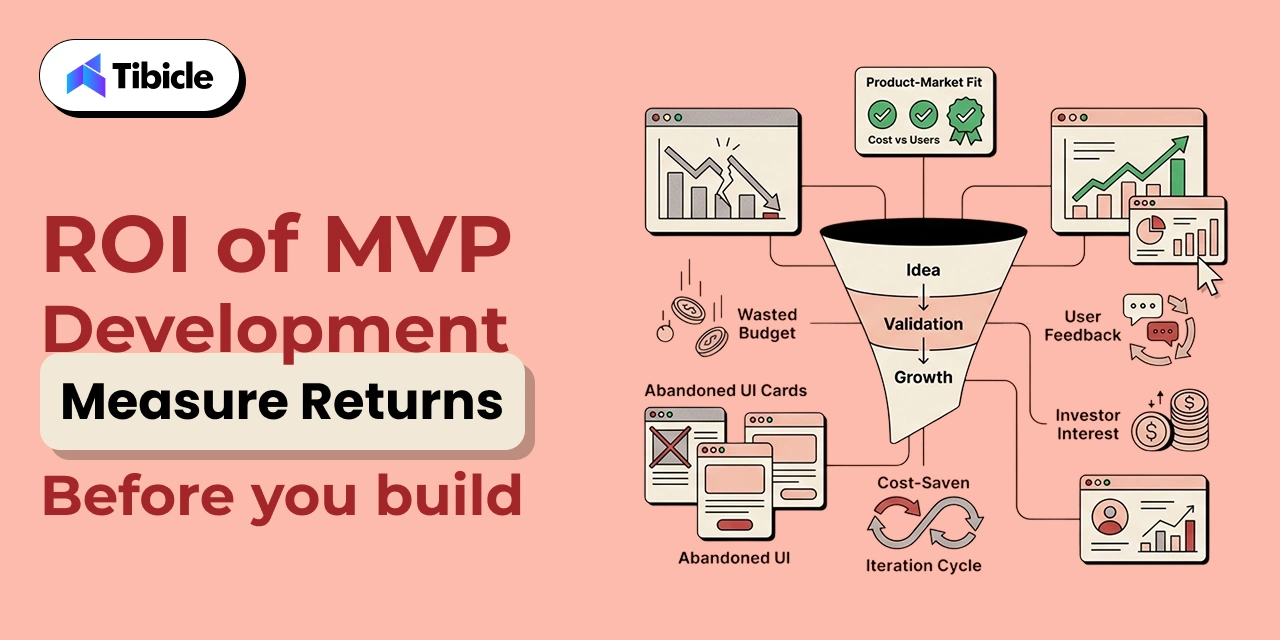
CB Insights research shows that 42% of startups fail due to building products with no market demand. That’s nearly half of all failed ventures dying because they skipped validation. A $25,000 MVP that reveals your target market doesn’t actually want your solution prevents a $300,000+ full-build investment in a product nobody will buy.
MVPs de-risk product development by testing core assumptions with real users before you commit to comprehensive builds. You learn whether people will actually pay for your solution, which features drive retention, and where your initial product thesis was wrong, all for a fraction of the cost of a complete build.
ROI Metrics C-Level Executives Should Track
Customer Acquisition Cost (CAC) at the MVP stage establishes your baseline efficiency. If you’re spending $200 to acquire each early user, you need to understand whether that cost will decrease with scale or whether your fundamental go-to-market approach needs revision.
Time-to-first-paying-customer post-MVP launch reveals whether your value proposition resonates. If you’re 60 days post-launch without a single conversion, your MVP succeeded by proving you need to pivot before investing in full development.
Iteration cost per feedback cycle differs dramatically based on your development cadence. Weekly sprint releases enable faster learning than monthly deployment cycles, even if individual sprints cost slightly more. Measure total learning velocity, not just per-sprint expenses.
Investor signal value matters for funded startups. MVPs generating 100+ active users and demonstrable engagement metrics significantly improve Series A success rates by proving market validation beyond founder conviction.
How to Calculate Expected ROI on Your MVP Investment
Calculate MVP ROI using this framework: (Validated learning value + Avoided full-build cost) / MVP development cost.
Validated learning value represents the market insights you gain from real user behavior. If your MVP proves that users will pay $50/month instead of your assumed $20/month, that insight alone might be worth $100,000+ in prevented revenue model errors.
Avoiding full-build cost quantifies the expense you didn’t waste on features users don’t want. If your MVP reveals that 80% of your planned features are unnecessary, you avoided spending $200,000+ on development that would have generated zero incremental revenue.
Well-executed MVPs typically show 3x–8x ROI within 12 months when product-market fit gets confirmed, and the product progresses to full development. Even failed MVPs that reveal flawed market assumptions generate positive ROI by preventing larger capital losses.
Risks of Choosing the Wrong Development Company
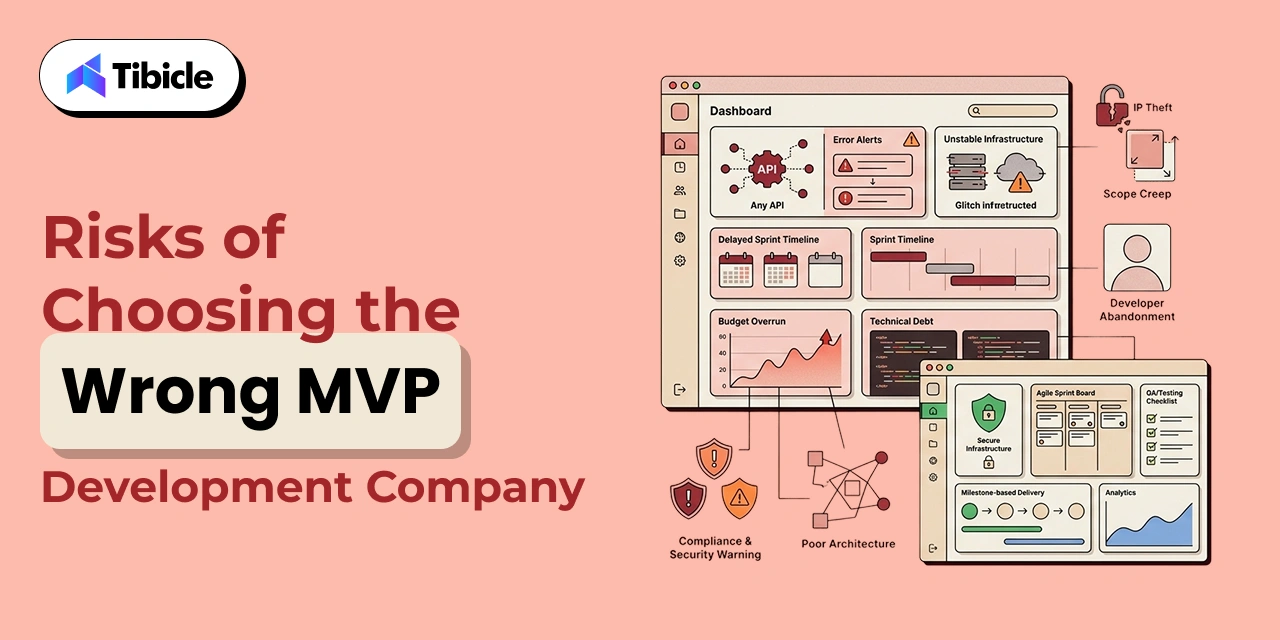
Choosing the wrong MVP development partner can lead to expensive technical, operational, and legal issues that slow down growth and damage product scalability. Many startups prioritize low pricing or rapid delivery timelines, but overlooking engineering quality and process maturity often creates long-term problems after launch.
- Tech debt accumulation: Rushed MVPs built without proper architecture planning often require major rewrites later. Poor database structure, weak APIs, and unscalable infrastructure can cost 2x–3x more to fix after launch than addressing them during the initial build.
- IP theft exposure: Many offshore projects still move forward without strong NDA protection or clear source code ownership agreements. Weak contracts increase risks around intellectual property misuse and ownership disputes.
- Scope creep: Fixed-price contracts without formal change request processes commonly inflate budgets by 30–40% through unplanned revisions, feature additions, and unclear deliverables.
- Abandonment risk: Smaller agencies with limited engineering teams may struggle with resource stability, increasing the risk of project delays or developer turnover mid-build.
- Compliance gaps: FinTech and HealthTech MVPs developed without industry compliance standards built into the architecture can face regulatory restrictions and launch delays later.
Vendor Selection Checklist Before You Sign
Use this checklist during vendor evaluation to protect your investment:
☐ A strong Clutch or G2 profile with 15+ verified reviews and a rating above 4.5
☐ Proven experience in your domain, with at least 2 relevant projects in the portfolio
☐ Clear mention of source code ownership and IP transfer within the contract
☐ A signed NDA before discussing any sensitive product details
☐ Well-defined milestone-based payment structure (avoid 50%+ upfront demands)
☐ Post-launch support clearly outlined, with a minimum 60-day support window
☐ Availability of a dedicated QA/testing team, not just developer-led testing
☐ Compliance readiness for regulations like GDPR if targeting international markets
☐ A dedicated project manager is assigned throughout the engagement
☐ Technology stack aligned with your long-term scalability roadmap
Why Tibicle LLP Earns a Place on This List
Tibicle LLP differentiates through a structured agile development methodology that prioritizes architectural integrity alongside delivery speed. While many agencies promise fast MVPs, Tibicle’s approach ensures those MVPs can actually scale when your product finds product-market fit.
The firm’s transparent fixed-price model with milestone-based billing protects founder interests. You pay as deliverables get completed and validated, not upfront in full. This structure aligns incentives and gives you visibility into progress throughout the build.
Tibicle’s tech stack expertise centers on React, Node.js, and AWS cloud-native architectures designed for horizontal scaling. When your user base grows from hundreds to thousands, your infrastructure scales without requiring expensive rewrites or migrations.
Their engagement model starts with discovery sprints that map technical requirements before code gets written. This front-loaded planning reduces mid-project scope changes that typically derail timelines and budgets.
Best fit: Founders building B2B SaaS or startup products who need fast market entry without accumulating technical debt. Ideal for teams that value architectural planning and transparent communication over rock-bottom pricing.
Conclusion
India delivers the strongest combination of cost efficiency, technical talent, and delivery speed for development company partnerships in 2025. The market’s projected growth from $12.1B to $21.5B by 2033 reflects global recognition of these advantages.
The difference between successful product launches and failed builds comes down to partner evaluation rigor, not budget size alone. Use the technical and commercial criteria outlined in this guide to separate capable agencies from those that oversell and underdeliver.
Every vendor on this list has demonstrated capacity for production-grade builds through verified client portfolios. Your next step: Apply the vendor selection checklist to shortlist 2–3 firms, then run discovery calls focused on your specific technical requirements.
If you’re planning to move beyond MVP, explore our complete guide on custom mobile app development services. Ultimately, selecting the right MVP development company determines how efficiently your idea turns into a scalable product.
Contact Tibicle LLP to scope your MVP build and receive a milestone-based project estimate that protects your investment.
FAQs
Q1: How much does MVP development cost in India?
MVP development in India typically costs between $8,000 and $80,000, depending on technical complexity and feature scope. Basic web MVPs start at $8,000–$15,000 for simple implementations using React and Node.js. SaaS MVP build projects requiring user authentication, subscription management, and multi-tenant architecture range from $20,000–$50,000. AI-integrated or enterprise MVPs with advanced features cost $40,000–$80,000+.
Q2: How long does it take to build an MVP with an Indian development company?
Most Indian MVP development services india providers deliver MVPs in 4–16 weeks, depending on complexity. Simple web MVPs with basic features take 4–6 weeks. SaaS platforms with user management, payment integration, and backend complexity typically require 10–16 weeks. Mobile MVPs using Flutter or React Native fall in the 8–14 week range for cross-platform builds.
Q3: What should I check before hiring an MVP development company in India?
Verify their Clutch or G2 rating exceeds 4.5 with at least 15 verified reviews from recent projects. Review their portfolio for at least two domain-relevant case studies matching your industry or technical requirements. Confirm IP ownership and source code transfer terms are explicitly stated in contracts, not assumed. Ensure the proposal includes a dedicated QA team, not just developers testing their own code. Check that post-launch support includes defined SLAs with specific response times for critical bugs.
Q4: What tech stack do top MVP development company in India use?
Leading hire MVP developers in India firms primarily use MERN stack (MongoDB, Express, React, Node.js) for web applications, Python with Django or Flask for data-intensive platforms, and Flutter or React Native for cross-platform mobile development. Cloud infrastructure typically runs on AWS, Google Cloud Platform, or Microsoft Azure. Your tech stack selection should align with your post-MVP scaling plan, not just what the agency prefers building.
Q5: Is it safe to share my idea with an MVP development company in India?
Yes, when the company signs a formal NDA before discovery discussions begin. Reputable agencies will sign NDAs without hesitation as standard business practice. Additionally, verify that source code ownership is explicitly stated in your contract with clear IP transfer clauses at project completion. Avoid any agency that resists formal IP protection agreements or suggests verbal understandings are sufficient.
Q6: What is the ROI of building an MVP before a full product launch?
Well-executed MVPs prevent costly full builds that fail validation. CB Insights data shows 42% of startups fail from building products with no market demand. A $25,000 MVP that validates your core assumptions prevents $300,000+ in wasted development on features users don’t want. Product validation through MVPs typically shows 3x–8x ROI within 12 months when product-market fit gets confirmed. Even MVPs that reveal flawed assumptions generate positive ROI by preventing larger capital losses.