
Top 7 Restaurant Management Software for ROI in 2026

Jul 14, 2026

Read in 7 Minutes
Table of Contents
- What This Guide Covers
- Introduction
- What Does Restaurant Management Software Actually Do And What It Doesn’t?
- What Separates High-ROI Platforms from Expensive Overhead?
- Top 7 Restaurant Management Software Ranked by Business Impact
- Side-by-Side Comparison: Restaurant Management Software at a Glance
- What Does Restaurant Management Software Actually Cost in 2026?
- ROI Benchmarks: What Operators Actually See After Implementation
- Risks and Implementation Pitfalls That Derail Restaurant Tech Investments
- Vendor Selection Checklist for Restaurant Operators
- Why Tibicle LLP Is Worth Evaluating for Restaurant Software Implementation
- Conclusion
- Frequently Asked Questions
What This Guide Covers
Who this is for: Restaurant operators, multi-location F&B group owners, and operations decision-makers who are actively evaluating restaurant management software platforms for 2026 and need a procurement-grade comparison built on ROI data, not feature lists or vendor marketing.
Search intent: Comparison and vendor selection, the reader is not learning what restaurant operations software does. They are shortlisting platforms, trying to understand which one fits their location count and operational profile, and looking for the cost and ROI numbers to defend the decision internally before signing a contract.
What you will walk away with: A ranked comparison of the top 7 restaurant management software platforms by documented business impact, a full pricing breakdown across all three tiers including hidden Year-2 costs, an ROI calculation framework tied to food cost reduction and labor cost optimization, a 12-question vendor checklist, and a payback period model by platform category, so you sign the right contract the first time.
Introduction
Restaurant net profit margins sit between 3% and 5% (National Restaurant Association, 2025), while labor costs consume up to 35% of revenue (Black Box Intelligence, 2025). With food cost volatility adding further pressure, the margin for operational error is essentially zero. The only sustainable lever left for operators is technology that replaces manual overhead with real-time data. This guide is a procurement-grade comparison not a product listing built for operators evaluating platforms based on one primary filter: measurable ROI. It covers what the software category actually does, where the returns come from, how to read vendor pricing, and which of the seven leading platforms fits which operator profile.
What Does Restaurant Management Software Actually Do And What It Doesn’t?
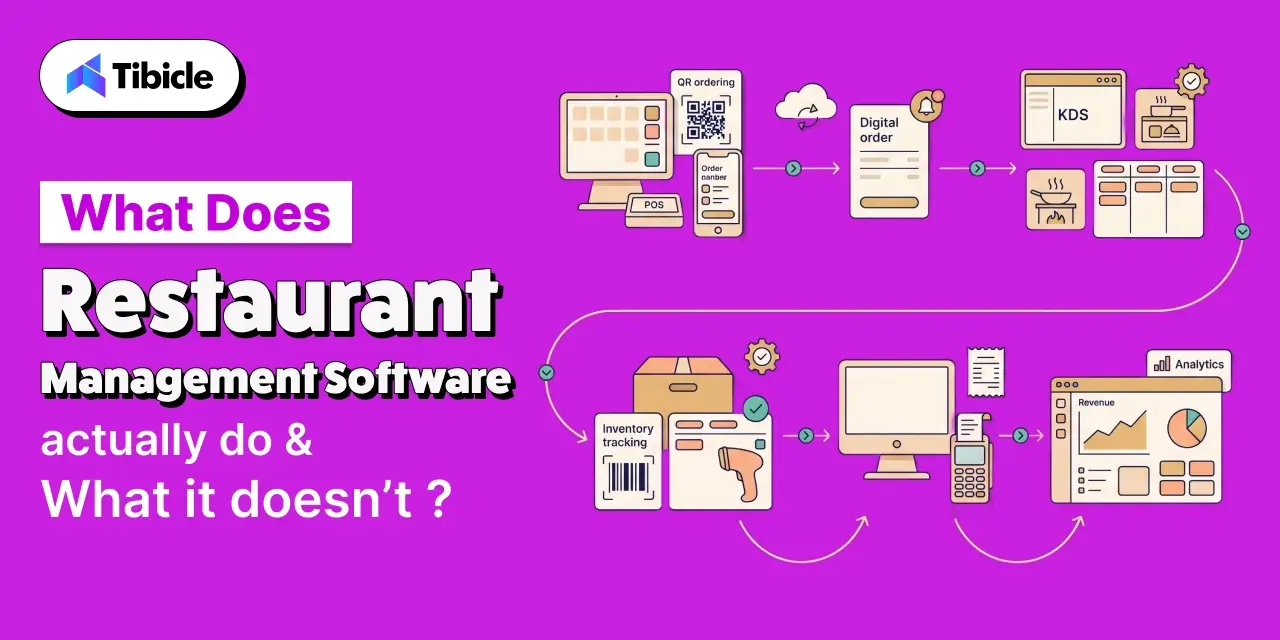
Restaurant management software is not a category defined by features. It is defined by a specific problem: front-of-house and back-of-house operations generate data in silos, and those silos produce waste. A POS system records sales. An inventory sheet records stock. A scheduling tool records shifts. Without a unified operational layer connecting them, operators make decisions on lagging, incomplete information.
Restaurant management software solves for that gap. At its best, it creates a single data layer where sales data informs purchasing decisions, labor schedules adjust to forecast demand, and food cost variance is visible in near real-time not at month-end.
What it does not do: it does not replace operator judgment, it does not fix a broken menu cost structure, and it does not compensate for staff training failures. It amplifies what is already working. Operators evaluating platforms need to start with that framing.
What Core Module Does Restaurant Management Software Need to Include?
The modules that generate documented ROI for restaurant operations are:
- POS and payments: transaction capture, tender type, table-level tracking
- Food cost tracking and recipe costing: theoretical vs. actual cost comparison per dish
- Inventory management and supplier ordering: real-time stock levels, automated purchase orders
- Labor scheduling with cost forecasting: shift creation tied to projected revenue
- Reporting and analytics dashboard: consolidated P&L, food cost %, labor cost % by location
Anything outside these five modules: loyalty apps, reservation widgets, gift card tools generates value only after the core operational layer is producing clean data.
All-in-One Restaurant Operations Software vs. Best-of-Breed Stack — The Real Trade-Off
All-in-one platforms (Toast, Lightspeed) simplify vendor management, reduce integration risk, and lower implementation time. The trade-off: they may underdeliver on specialized functions like food cost analysis or labor compliance compared to dedicated tools.
Best-of-breed stacks (MarginEdge for food cost + 7shifts for scheduling + a separate POS) maximize function per category but require API management, duplicate data entry risk, and higher integration maintenance overhead.
Single-location operators with limited IT resources typically fit all-in-one. Multi-location groups above 5 units increasingly build best-of-breed stacks with a consolidated reporting layer on top.
What Separates High-ROI Platforms from Expensive Overhead?
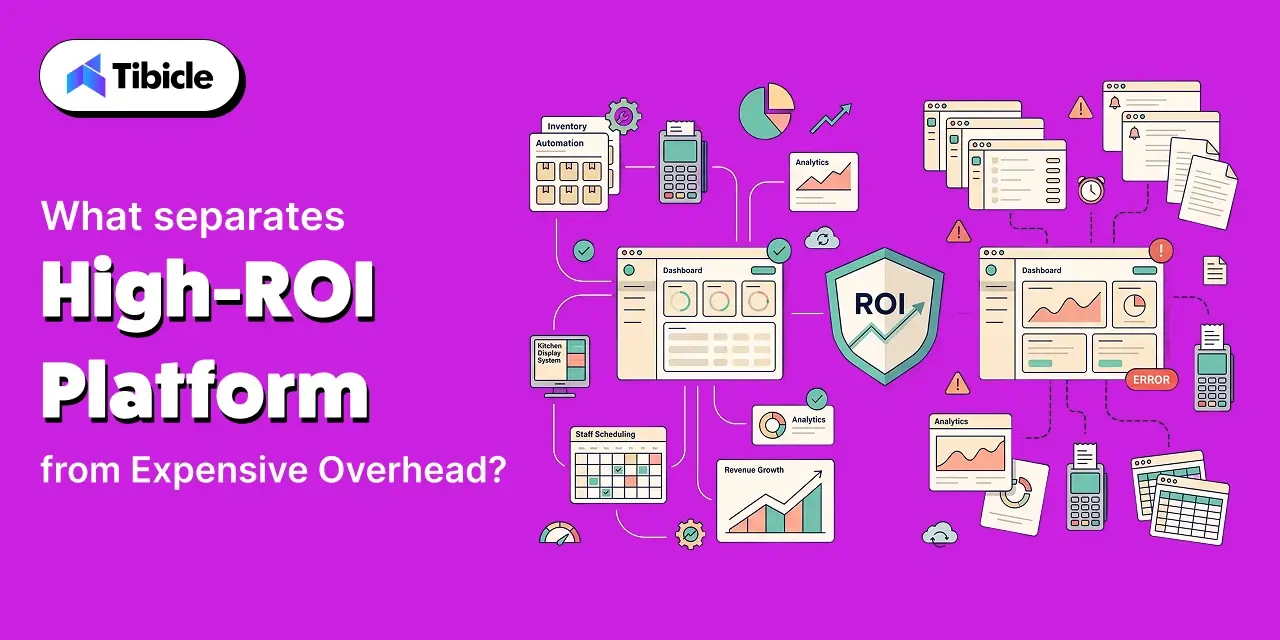
Not all restaurant management software generates returns at the same rate. The platforms that produce documented ROI share four operational characteristics and the ones that drain budgets typically lack at least two of them.
What Are the 4 Signals That Predict Restaurant Management Software ROI?
- POS-to-inventory sync The actual vs. theoretical food cost gap is the clearest indicator of waste. Platforms that sync POS sales data to inventory depletion in real time allow operators to identify variance daily rather than weekly. A 2-percentage-point reduction in food cost on a $40,000/month food spend is $800/month recovered.
- Labor cost as a % of sales, visible in real time Platforms that surface labor cost as a live percentage not just total hours allow managers to cut shifts before the cost compounds. This is the single most actionable metric for floor managers making real-time decisions.
- Automated purchase order workflows Manual ordering introduces two failure points: over-ordering (tied capital, spoilage) and under-ordering (stockouts, menu gaps). Automated PO workflows based on par levels and sales velocity eliminate both.
- Multi-location consolidated reporting For operators running more than two units, the management time cost of reconciling separate reporting environments is typically 5–10 hours per week. Consolidated dashboards eliminate that overhead at scale. (Restaurant365 ROI Data, 2025)
When Does Low-Cost Restaurant Operations Software Actually Cost More?
Manual entry overhead on free or entry-tier plans can outpace subscription cost within 90 days at scale. (Lightspeed Restaurant Industry Report, 2025) The hidden cost structure includes:
- Implementation fees: not reflected in monthly pricing; can reach $2,000–$10,000 for enterprise deployments
- Per-location add-ons: flat pricing that becomes variable as units scale
- API overage charges: triggered when integration call volumes exceed base plan limits
- Support tier restrictions: emergency and after-hours support often locked behind premium tiers
Operators comparing monthly subscription rates without modeling total cost of ownership over 24 months are comparing the wrong number.
Top 7 Restaurant Management Software Ranked by Business Impact
The platforms below are ranked on five criteria: documented ROI outcomes, pricing transparency, POS integration depth, scalability across multiple locations, and real operator results not vendor marketing claims. Each platform has a documented use case where it outperforms the others.
1. Toast POS
Best for: Full-service and QSR operators in the US seeking an all-in-one ecosystem.
Toast runs on Android-based terminals with a free Starter plan entry point, making it accessible for early-stage operators. Its modular architecture allows operators to add online ordering, payroll, loyalty programs, and handheld ordering devices as the business scales. The POS, payments, and back-of-house reporting are native no third-party API required.
Watch out for: Toast is US-centric. Operators with international locations will need a separate solution. Hardware contracts can include lock-in terms that complicate future platform migrations.
2. Restaurant365
Best for: Multi-unit groups needing consolidated back-office financials.
Restaurant365 covers inventory, accounting, labor, and operations in one cloud-based restaurant platform. Its real-time P&L by location is the most cited feature among multi-location operators finance teams can close monthly books in hours rather than days. It integrates with over 50 POS systems.
Watch out for: Implementation costs range from $2,000 to $10,000 or more depending on unit count and data migration complexity. Pricing is enterprise-tier and custom-quoted. Not built for single-location operators.
3. MarginEdge
Best for: Operators prioritizing food cost visibility without a full platform switch.
MarginEdge connects directly to your existing POS and processes invoices automatically, producing a near real-time P&L tied to actual food purchases. Its flat-fee pricing of approximately $330/month makes cost modeling straightforward. For operators who already have a functioning POS and scheduling tool, MarginEdge adds the food cost management layer without requiring a full stack replacement.
Watch out for: MarginEdge is not a POS replacement and does not include labor scheduling. It works best as a specialized layer in a best-of-breed stack, not as a standalone all-in-one.
4. 7shifts
Best for: Restaurants with complex shift patterns and labor compliance requirements.
7shifts produces schedules with 95% labor accuracy by connecting historical sales data with forecasted demand. (7shifts Product Documentation, 2025) Its POS-linked labor cost forecasting allows managers to see the cost impact of scheduling decisions before they publish shifts. Team communication tools reduce no-show rates and shift swap friction.
Watch out for: 7shifts scheduling logic is US-centric and may require configuration adjustment for international compliance frameworks. Outside core scheduling and labor cost management, functionality is limited.
5. MarketMan
Best for: Multi-location operators managing food cost and supplier ordering centrally.
MarketMan covers recipe costing, real-time inventory tracking for restaurants, and supplier order automation in one platform. Operators can set par levels and trigger automated purchase orders, reducing over-ordering and stockout risk across locations. Food cost analysis reports allow operations teams to identify high-variance menu items before they impact monthly margins.
Watch out for: Mid-tier pricing of $200–$400/month becomes relevant only with POS integration. Without a connected POS, inventory depletion tracking requires manual entry, which offsets the efficiency gain.
6. Lightspeed Restaurant
Best for: International or multi-region restaurant brands.
Lightspeed operates across Europe, Canada, and APAC with multi-currency and multi-region POS coverage. Integrated payments and reservation management reduce the number of third-party vendors for operators running across jurisdictions. It is the clearest choice for brands that need consistent POS infrastructure across markets.
Watch out for: In US-only deployments, Lightspeed is less specialized than Toast. Operators concentrated in the US market with no international expansion plans will find fewer reasons to prefer it over domestic alternatives.
7. SevenRooms
Best for: Full-service restaurants prioritizing guest CRM and reservation-driven revenue.
SevenRooms is a guest data platform, not a POS or back-of-house tool. It captures reservation data, builds guest profiles, automates loyalty triggers, and personalizes outreach to drive repeat visits. Restaurant analytics dashboards within SevenRooms show repeat-visit rates, average spend per guest, and campaign attribution.
Watch out for: SevenRooms sits as a CRM layer above a POS it does not replace one. Operators evaluating SevenRooms should already have a functioning POS and operational stack before adding a guest intelligence layer.
Side-by-Side Comparison: Restaurant Management Software at a Glance
| Platform | Best For | Core Strength | Pricing Range | POS Integration | Multi-Location |
| Toast POS | QSR + Full-Service | All-in-one ecosystem | Free–$165+/mo | Native | Yes |
| Restaurant365 | Enterprise groups | Back-office financials | Custom quote | 50+ integrations | Yes |
| MarginEdge | Food cost control | Real-time P&L | ~$330/mo flat | POS-native | Limited |
| 7shifts | Labor scheduling | Labor cost accuracy | $29–$135+/mo | POS-linked | Yes |
| MarketMan | Inventory/procurement | Recipe + supplier mgmt | $200–$400/mo | Via API | Yes |
| Lightspeed | International operators | Multi-region POS | Custom | Native | Yes |
| SevenRooms | Guest CRM | Reservation + loyalty | Custom quote | POS layer | Yes |
Not sure which platform fits your operation? Tibicle LLP’s technology advisory team can run a fit analysis based on your location count, current stack, and margin targets. Book a consultation →
What Does Restaurant Management Software Actually Cost in 2026?
Software pricing in this category is structured across three tiers, and the monthly subscription number operators see during demos rarely reflects what they pay in Year 2 or Year 3. Understanding the full cost structure before shortlisting is non-negotiable.
What Are the 3 Pricing Tiers for Restaurant Management Software in 2026?
Entry tier ($0–$50/month) Basic POS functionality or limited inventory tracking. Suitable for single-location operators in early stages. The visible cost is low; the hidden cost is manual data entry time. At 10 hours/week of manual entry across one location, the labor cost of the “free” plan often exceeds a mid-tier subscription within 60 days.
Mid-tier ($100–$400/month) Covers food cost tracking, scheduling, inventory management for restaurants, or guest CRM. Most mid-market operators in the 1–5 location range operate at this tier. Pricing is usually per-location or flat-fee depending on the vendor.
Enterprise ($500+/month, often custom) Full back-of-house management, multi-location consolidated reporting, compliance management, and dedicated implementation resources. Expect onboarding fees of $2,000–$10,000 or more. Total cost of ownership over 24 months is the right number to compare, not the monthly rate.
What Pricing Red Flags Do Operators Miss Before Signing?
- Per-location add-on fees that compound with scale a $150/month base rate becomes $750/month across five locations
- Hardware lock-in on proprietary terminals switching platforms later requires writing off existing hardware investment
- API overage charges on integrations triggered when call volumes exceed plan limits, particularly relevant in best-of-breed stacks
- Support tier restrictions emergency and after-hours support locked behind premium plans creates operational risk for evening and weekend service
- Year-2 budget blowouts from compliance add-ons, new module releases priced separately, or renegotiated contract terms
ROI Benchmarks: What Operators Actually See After Implementation
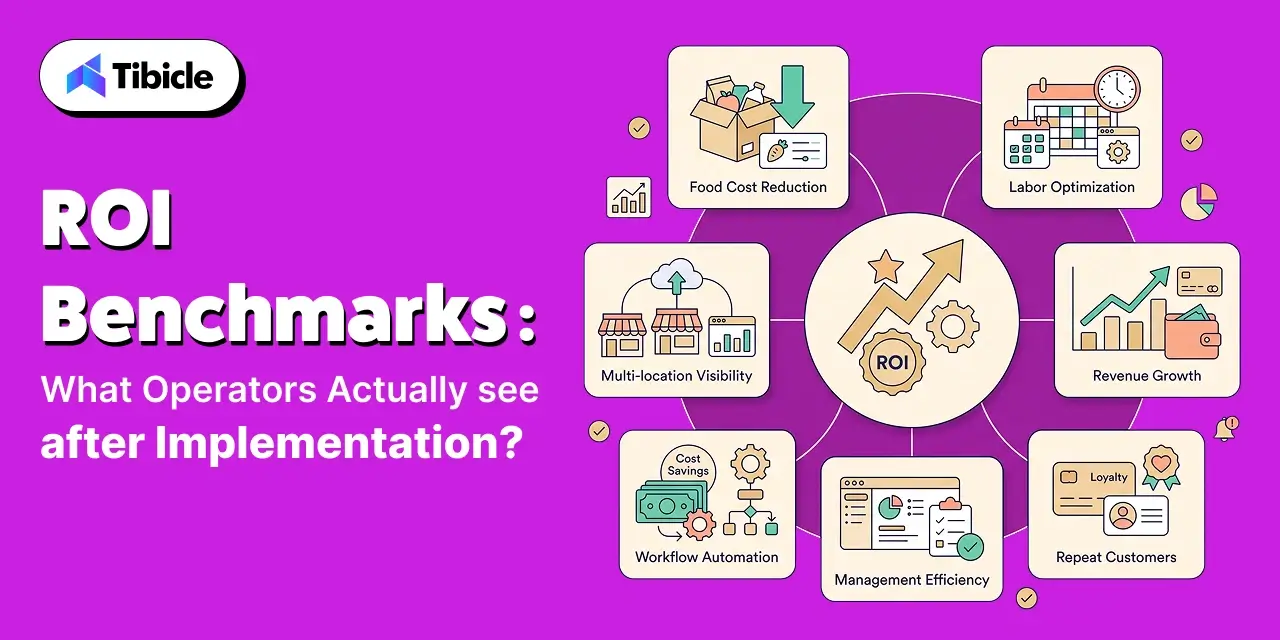
The return on restaurant operations software is documented across four categories. The figures below reflect outcomes reported by platform providers and corroborated by independent operator case studies. (Technomic Restaurant Technology Survey, 2025)
Where Does Restaurant Management Software Generate Measurable Returns?
Food cost reduction Platforms with real-time POS-to-inventory sync consistently reduce food cost variance by 2–4 percentage points. For a restaurant spending $30,000/month on food, a 3-point reduction recovers $900/month.
Labor savings Restaurant scheduling software with POS-linked forecasting cuts excess labor spend by 5–15% within 90 days of implementation. (7shifts Labor Efficiency Report, 2025) On a $15,000/month labor budget, an 8% reduction generates $1,200/month in savings.
Repeat revenue Guest CRM platforms drive 15–25% higher repeat-visit rates compared to walk-in reliance alone. For full-service restaurants where repeat guests represent 30–40% of covers, this is a direct top-line impact.
Management time Consolidated reporting for restaurants eliminates 5–10 hours per week of manual back-office reconciliation per location. At a manager cost of $25/hour, that is $500–$1,000/month per location recovered as productive time.
What Is the ROI Calculation Framework Before You Buy?
Use this formula before finalizing any vendor shortlist:
(Monthly labor savings + food cost reduction + revenue uplift from loyalty) − (subscription cost + implementation cost amortized over 12 months) = net ROI per location
For a 3-location group spending $8,000/month on food and $12,000/month on labor: a 3% food cost reduction generates $720/month in savings. An 8% labor efficiency gain generates $2,880/month. Combined: $3,600/month in operational savings across three locations. Most mid-tier subscriptions break even within 60–90 days on that math.
What Is the Payback Period by Platform Category?
- Restaurant scheduling software: typically 30–60 days
- Food cost platforms: 60–90 days
- Full back-office suites: 6–12 months, with returns compounding at scale as multi-location reporting replaces manual reconciliation
Risks and Implementation Pitfalls That Derail Restaurant Tech Investments
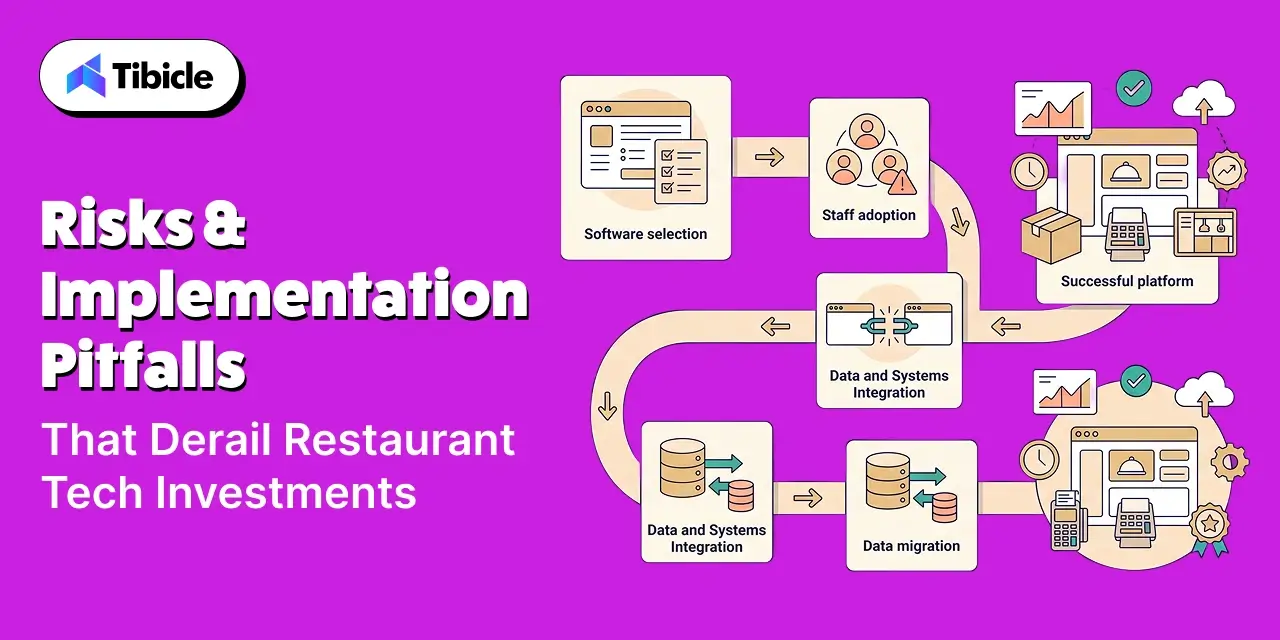
Buying the right platform is step one. Implementing it successfully is where most projects fail. The failure modes are documented and repeatable which means they are also avoidable.
What Are the 5 Reasons Restaurant Software Implementations Fail?
- Staff adoption gaps: platforms chosen without frontline input from servers, kitchen staff, and floor managers get abandoned within 60–90 days. The team that uses the software daily needs to be part of the selection process.
- Integration mismatches: restaurant operations software that does not sync cleanly with your existing POS creates duplicate data entry, which eliminates the efficiency gain entirely.
- Underestimated implementation timelines: multi-location rollouts consistently take 3–6 times longer than vendor projections. Budget for it.
- Data migration failures: historical inventory data, recipe costing records, and supplier pricing not transferred cleanly to the new platform requires rebuilding from scratch, which delays time-to-value by months.
- Scope creep post-contract: adding modules at per-unit rates after signing balloons total cost of ownership beyond what the initial ROI model projected.
How Do You De-Risk the Buying Decision?
- Demand a full cost breakdown including Year-2 and Year-3 projections before signing
- Run a pilot on 1–2 locations before committing to an enterprise rollout
- Verify integration compatibility with your current POS system before shortlisting not after
Vendor Selection Checklist for Restaurant Operators
Use this as a decision filter before finalizing any vendor shortlist. These are the questions that surface cost, fit, and risk factors that standard demos do not cover.
12 Questions to Ask Every Vendor Before You Sign
Operational fit
- Does it integrate natively with your existing POS, or via a third-party API?
- Does it support your current location count and your 12-month expansion plan?
- Can it handle multi-currency or multi-region operations if needed?
Total cost of ownership
- What are the implementation and onboarding fees itemized?
- Are per-location add-ons included in the quoted price or billed separately at scale?
- What does Year-2 pricing look like after the initial contract period?
Data and reporting
- Does it produce real-time food cost and labor cost reports tied to POS data?
- Can it consolidate multi-location reporting into a single restaurant analytics dashboard?
Support and adoption
- What is the SLA for critical support issues during service hours?
- Is onboarding and staff training included or a paid add-on?
Risk management
- What are the contract exit terms and hardware return policy?
- Does the platform have documented uptime SLAs and data security certifications?
Why Tibicle LLP Is Worth Evaluating for Restaurant Software Implementation
Tibicle LLP is not a software vendor. It is a technology partner that helps restaurant operators navigate the buying and implementation decision before committing budget to a platform that may not fit.
The risk operators face without external advisory support: shortlisting a platform based on a surface-level feature comparison, signing a 24-month contract, and discovering integration gaps or hidden costs three months into rollout. That scenario represents 6–12 months of sunk cost, interrupted operations, and a staff team that has lost confidence in the technology initiative.
Tibicle’s advisory work covers three areas directly relevant to this decision: fit analysis against your current tech stack and location structure, POS integration scoping to identify compatibility risks before they surface post-contract, and phased rollout strategy for multi-location groups that need to maintain operational continuity during implementation. The team has experience with multi-location hospitality tech stacks, custom POS integrations, and ROI modeling for operators at different stages of growth.
Speak to Tibicle’s restaurant technology team before you finalize your vendor shortlist. Schedule a fit review
Conclusion
The right restaurant management software is not the most feature-rich option on the market. It is the platform that integrates cleanly with your existing POS, delivers measurable improvement to food cost and labor efficiency, and scales without compounding your cost structure as you add locations. Use the vendor checklist above as the primary filter before any shortlist conversation surfaces the questions that demos are designed to avoid. The comparison table gives you the category fit. The ROI framework gives you the number to model before signing.
Ready to identify which platform fits your locations, stack, and ROI targets? Tibicle LLP’s advisory team works with restaurant operators at every stage. Get your free assessment
Frequently Asked Questions
What is the best restaurant management software for multi-location operators in 2026?
Restaurant365 and Toast POS are the strongest options for multi-location groups. Restaurant365 leads on back-office financial consolidation real-time P&L by location, accounting integration, and consolidated labor management. Toast leads on unified front-of-house and POS operations with a modular add-on structure that scales with unit count.
How much does restaurant management software cost per month?
Pricing ranges from $0 for basic entry-tier tools to $500 or more per month for enterprise platforms. Mid-tier options covering food cost tracking, scheduling, and inventory management typically run $100–$400/month per location, excluding implementation fees and hardware costs.
How long does it take to see ROI from restaurant management software?
Scheduling and labor tools typically show measurable returns within 30–60 days. Food cost platforms average 60–90 days to payback. Full back-office suite ROI compounds over 6–12 months, particularly for multi-location groups where consolidated reporting reduces management overhead at scale.
What is the difference between a POS system and restaurant management software?
A POS handles transaction capture and payment processing. Restaurant management software integrates POS data with inventory levels, labor schedules, food cost tracking, and reporting into an operational layer that supports business decisions not just transaction records.
What are the biggest risks when implementing restaurant software?
Staff adoption failures, POS integration mismatches, underestimated rollout timelines, and hidden Year-2 costs are the four most common implementation pitfalls. Operators who pilot on 1–2 locations before an enterprise rollout consistently report faster adoption and lower total cost of ownership.
Do I need separate tools for scheduling, inventory, and POS or one platform?
It depends on scale. Single-location operators typically benefit from an all-in-one platform that reduces integration complexity. Multi-location groups above five units increasingly use a best-of-breed stack specialized tools for food cost, labor scheduling, and inventory with one consolidated reporting layer connecting them.
Schedule A Developer Interview And Get 15 Days Risk-Free Trial
Schedule a Call

Relevant Blog
Cafe POS System: Features, Pricing & What to Buy in 2025

Dhairya Dadhania

Cloud-Based POS for Restaurants: How It Works & Costs
Dhairya Dadhania
Kitchen Display System: Connect KDS with Your POS
Dhairya Dadhania
Written by
Recent Blogs
Top 7 Restaurant Management Software for ROI in 2026
What This Guide Covers Who this is for: Restaurant operators, multi-location F&B group owners, and operations decision-makers who are actively evaluating restaurant management software platforms for 2026 and need a procurement-grade comparison built on ROI data, not feature lists or vendor marketing. Search intent: Comparison and vendor selection, the reader is not learning what restaurant […]
Cafe POS System: Features, Pricing & What to Buy in 2025
What This Guide Covers Who this is for: Cafe owners, coffee shop operators, and F&B decision-makers who are either running a legacy terminal that is costing them operationally or actively comparing cafe POS systems before making a purchase decision at single-location, multi-location, or growth-stage scale. Search intent: Comparison and purchase decision, the reader already knows […]
Cloud-Based POS for Restaurants: How It Works & Costs
What This Guide Covers Who this is for: Restaurant operators, F&B group owners, and operations decision-makers who are either running a legacy point-of-sale system they have outgrown or evaluating a cloud-based POS for the first time at single or multi-location scale. Search intent: Decision and evaluation: the reader is not learning what a POS is. […]
Got an Idea? Get FREE Consultation
In our world, there's no such thing as having too many clients

