
How to Hire Custom AI Software Engineers: Dedicated Sourcing Guide for US Product Teams

Oct 01, 2026

Read in 9 Minutes
Table of Contents
- What This Guide Covers
- Introduction
- Why Hiring Custom AI Software Engineers Is Different From General Software Hiring
- The Real Cost and Timeline of Hiring AI Engineers Directly
- Direct Hire vs Staff Augmentation vs Dedicated Team
- How to Vet Custom AI Software Engineers for Production Skills
- Avoiding a Costly Mis-Hire on a Small AI Team for hire custom ai software engineers
- Contracts, IP Protection, and Onboarding for AI Engineering Hires
- How Tibicle Sources Dedicated AI Software Engineers for US Product Teams
- Key Takeaways for US Product Teams
- FAQ
What This Guide Covers
Who this is for
Product teams, startups, and mid-market software companies that need to build AI-powered features or scale their engineering capability but lack the resources to hire directly. This includes founders, engineering leaders, CTOs, and hiring managers at companies planning LLM integrations, generative AI products, AI model optimization, or dedicated AI development for hire custom ai software engineers.
Search intent
Comparison and decision. This guide is for teams that already know they need to hire custom AI software engineers but want to understand which sourcing model direct hire, staff augmentation, or dedicated team delivers the greatest operational and financial value. Instead of comparing dozens of vendors, it evaluates hiring approaches, cost structures, vetting processes, IP ownership policies, and expected timelines to help product teams make an informed choice.
What you will walk away with
A practical framework to hire custom AI software engineers, including cost-per-hire benchmarks, vetting methods that screen for production experience, comparison of direct hires versus dedicated teams, contract and IP protection requirements, talent acquisition timelines, red flags in mis-hires, and a clear decision matrix to select the sourcing model that fits your product roadmap and team size.
Introduction
AI skills now appear in 55% more US job postings year-over-year, according to Stanford HAI’s 2026 AI Index Report with Lightcast labor market data (source: https://aiindex.stanford.edu/report/). Yet the supply of engineers who can actually build production AI systems remains constrained. Product teams competing to hire custom AI software engineers are operating in a seller’s market where competition for available talent has intensified. The challenge isn’t just finding someone who understands AI concepts it’s sourcing engineers with shipped experience in LLM integration, model deployment, and real-world failure recovery. This guide walks through how to identify the right hiring model, vet for production skills, structure contracts that protect your IP, and avoid costly mis-hires that derail product roadmaps. Whether you’re scaling a single feature or building a dedicated AI capability, choosing how to hire custom AI software engineers will shape your timeline and budget.
Why Hiring Custom AI Software Engineers Is Different From General Software Hiring
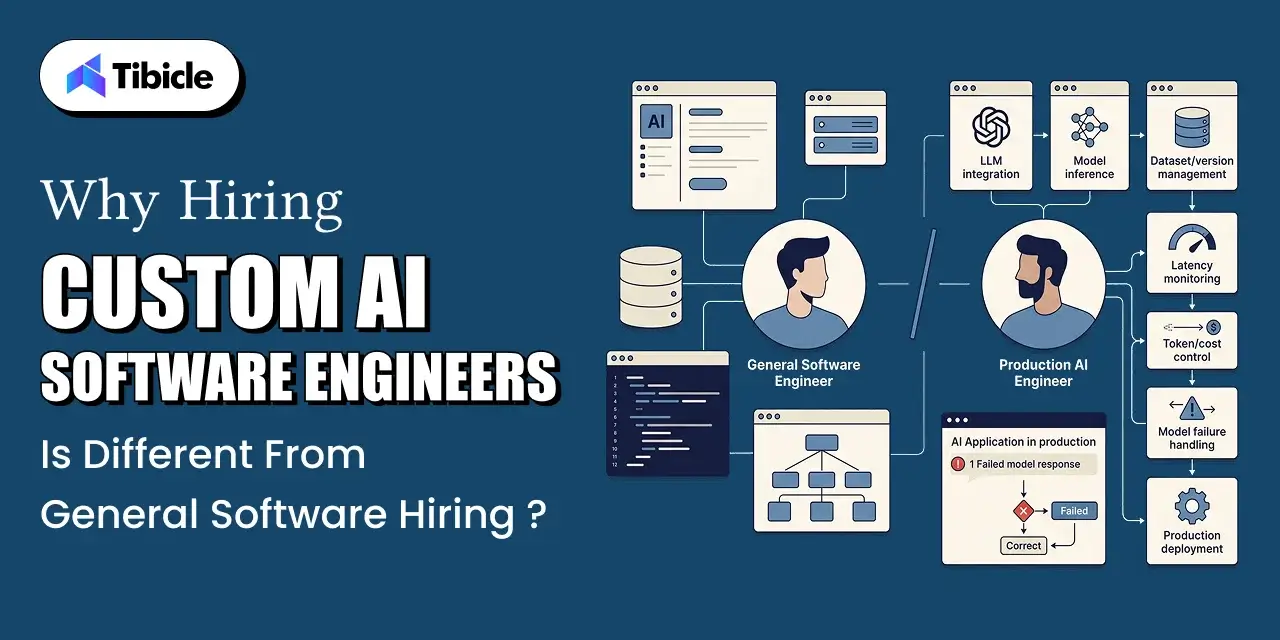
When you need to hire custom AI software engineers, you’re not simply hiring a skilled generalist and adding AI to the job description. The gap between someone who understands AI as a concept and someone who can ship production AI systems is wider than most product teams expect. Demand for AI talent has accelerated faster than supply, creating both scarcity and mismatch. A resume that lists “AI experience” often means coursework or hobby projects. Production experience debugging LLM integrations, handling token limits, managing inference costs, deploying models at scale is a separate skill set entirely. This section explains why those gaps matter and where US teams feel the pressure most.
The Skills Gap Between AI Literacy and Production AI Engineering
AI literacy and production AI engineering capability are not the same thing. An engineer can understand transformer architectures, fine-tuning approaches, and prompt engineering without having built a system that shipped to users. Production AI engineering requires hands-on experience debugging model responses, handling edge cases when an LLM fails, optimizing for cost and latency, managing version control for models and datasets, and integrating AI into existing infrastructure without breaking reliability. When you hire custom AI software engineers, you’re distinguishing between theoretical knowledge and operational ability. The difference shows up quickly in a trial project: a candidate who has only studied AI will reach unfamiliar territory fast, while someone with shipped code knows how to move through it.
Why the Talent Shortage Hits US Product Teams Hardest
Employers globally now report AI skills as the single hardest capability to fill for the first time, according to ManpowerGroup’s 2026 Global Talent Shortage Survey (source: https://www.manpowergroup.com/en/services/talent-shortage). US product teams feel this pressure acutely because domestic AI engineering talent is concentrated in a small number of metros and already employed at scale. When you choose to hire custom AI software engineers domestically, you’re competing not just with other startups but with well-funded AI labs and established tech companies that can offer higher compensation. The typical timeline to fill a direct US hire for AI engineering roles runs 60-90 days longer than general engineering roles, and cost-per-hire premiums are substantial. Teams that restrict themselves to US-only hiring often find their roadmap delayed or their budget exceeded before they land someone.
The Real Cost and Timeline of Hiring AI Engineers Directly
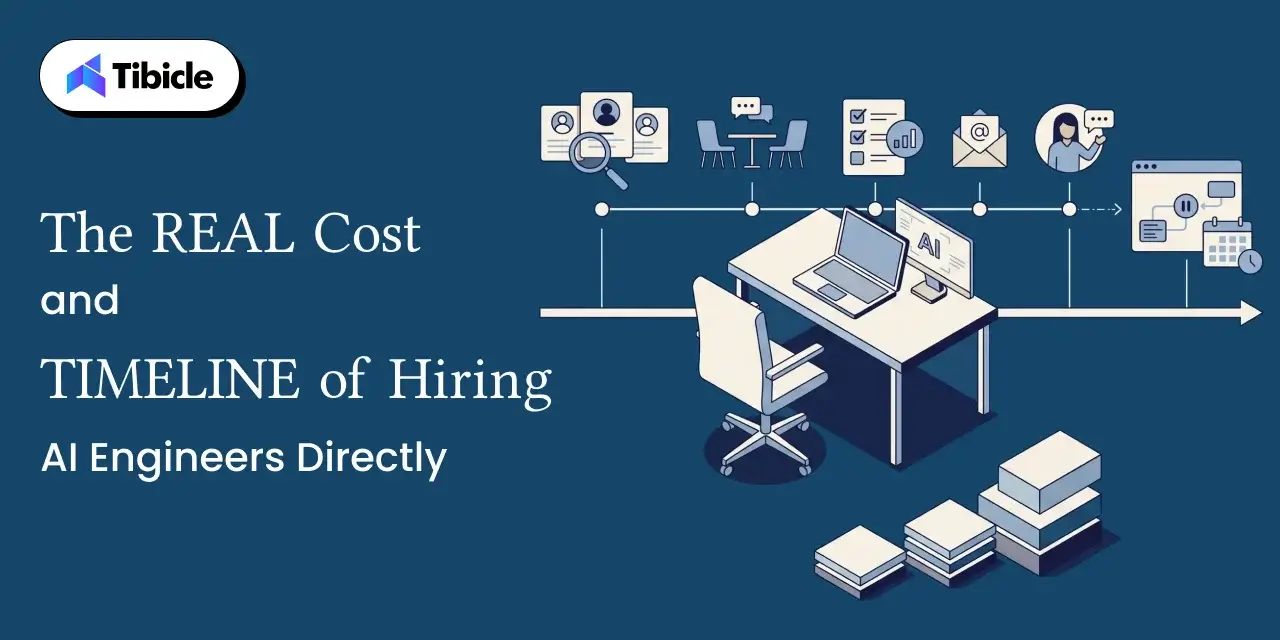
Hiring an AI engineer directly means bringing someone onto US payroll with benefits, equity or bonus, and long-term commitment. The financial and time costs of that path are real. Understanding the benchmarks how long it actually takes, what you’ll spend, and what happens while the seat sits empty clarifies whether direct hiring is the right choice for your product team’s scale and urgency.
Cost-Per-Hire Benchmarks for US Tech and AI Roles
The average cost-per-hire for US tech roles according to SHRM’s 2026 Recruiting Benchmarking research runs significantly higher than the national average across all industries (source: https://www.shrm.org/hr-today/trends-and-forecasting/research-and-surveys/pages/index.aspx). For AI-specific engineering roles, expect that number to rise by 25-40% due to recruiter specialization fees, extended sourcing timelines, and competition for limited candidates. A direct US hire for an AI engineer typically costs $15,000 to $35,000 in recruiting, interviewing, and onboarding expenses alone, before salary. If you then factor in the cost of a vacant seat lost development velocity on your roadmap the financial commitment extends beyond the hiring line item.
Why AI Roles Take Longer to Fill Than Standard Engineering Roles
A standard backend engineering role in a major metro might fill in 30-45 days. When you hire custom AI software engineers, plan for 90-120 days of active sourcing and interview cycles. The reasons are concrete: fewer candidates meet the bar, interviews require deeper technical assessment (generic algorithm problems don’t screen for AI production skills), and passive candidates are harder to reach because so many are already employed. Accepting a lower bar to speed up hiring often creates a more expensive problem later—a mis-hire that costs more to remove than the recruiting delay cost upfront.
What a Vacant AI Engineering Seat Actually Costs a Product Roadmap
While you’re recruiting, your product roadmap stalls. If you had planned a major AI feature or model migration and the engineering seat sits vacant for 100 days, that delay cascades: beta timelines slip, customer commitments move, competitive windows close. For a mid-stage product team, a vacant senior AI engineering role costs approximately $50,000-$100,000 in lost development velocity over a 90-day hiring window. When you factor in recruiting costs, salary, and productivity ramp time, the total cost of direct hiring for a single AI engineer often runs $180,000-$250,000 before they contribute meaningfully to your roadmap.
Direct Hire vs Staff Augmentation vs Dedicated Team
You have three structural models when you need to hire custom AI software engineers: bring someone onto direct US payroll, add a specialist to your team for a specific project window, or assemble a dedicated AI development team to own ongoing feature work. Each model solves a different problem. Choosing the right one saves money and accelerates your timeline.
When a Direct US Hire Still Makes Sense
A direct US hire makes sense when you need someone in a leadership, architecture, or strategic role who will be embedded in your company long-term. If you’re hiring a Head of AI or a principal engineer who will set technical direction, define standards for your entire organization, and own hiring for an AI team, then direct US employment is appropriate. Direct hires also work when your product operates in a highly regulated space where the engineer needs direct access to secure facilities or when your company culture and decision-making require full-time in-person presence. For standalone feature development or ongoing product work, direct hiring often creates unnecessary overhead and cost.
Staff Augmentation for Filling a Specific Skill Gap
Staff augmentation means bringing one or two specialists into your existing team for a defined time window typically 3-6 months to build a specific feature or close a capability gap. This model works when you have a clear scope (build an LLM chatbot integration, optimize model inference costs, migrate to a new framework), existing engineers to manage the work, and a defined end date. Staff augmentation avoids the recruiting delay and reduces your financial exposure: you pay for the time you need, then transition the work to your permanent team. The trade-off is limited continuity; when the augmented specialist leaves, knowledge transfer becomes critical.
A Dedicated AI Development Team for Ongoing Product Work
Organizations that adopt distributed global delivery models for software development report achieving 20% or greater savings, according to Deloitte’s 2025 Global Business Services Survey (source: https://www2.deloitte.com/us/en/insights/focus/technology-trends/2025/global-business-services-trends.html). A dedicated AI development team typically 2-4 engineers sourced offshore or nearshore and managed for ongoing work fits product teams that have a sustained roadmap of AI features. Instead of hiring individual engineers directly, you contract a standing team that becomes an extension of your organization. The team handles requirements gathering, development, code review, and deployment alongside your existing engineering. Dedicated teams reduce cost-per-engineer, compress hiring timelines (you’re accessing pre-vetted talent pools, not recruiting individually), and scale up or down based on your workload. When you hire custom AI software engineers through a dedicated team model, you’re accessing production-grade talent without the recruiting overhead.
| Model | What It Involves | Best Fit |
| Direct US hire | Full-time employee, US payroll, benefits, and long-term equity or comp package | Core leadership roles or highly regulated in-person work |
| Staff augmentation | One or two specialists added to an existing team for a defined skill gap or project window | A single LLM feature or short-term capacity gap |
| Dedicated AI development team | A standing offshore or nearshore team assembled and managed for ongoing product work | Continuous AI feature development on a product roadmap |
How to Vet Custom AI Software Engineers for Production Skills
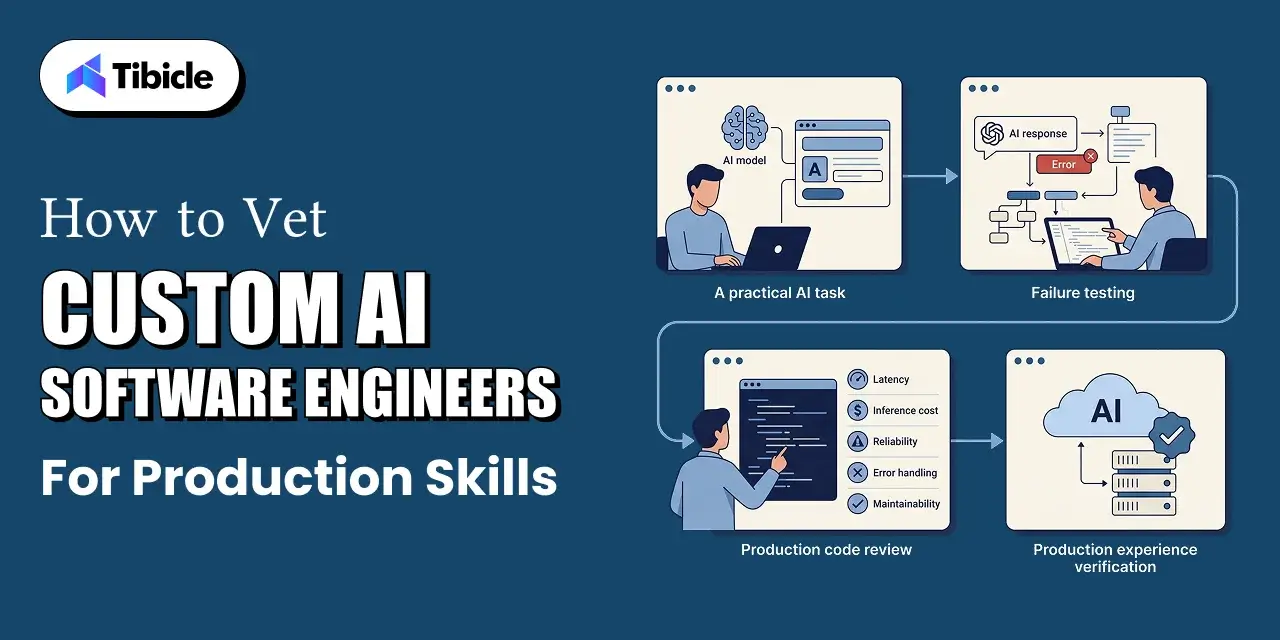
Generic coding assessments algorithm problems, system design hypotheticals, coding challenges on LeetCode-style platforms routinely fail to screen for the skills that actually matter when you hire custom AI software engineers. A candidate can ace a classic algorithms interview and struggle to debug a model’s failure modes or optimize inference costs. This section outlines what a vetting process should test and why it matters.
Why Standard Coding Assessments Miss AI-Specific Skills
Over 60% of developers report that hiring assessments do not reflect real-world tasks they perform on the job, according to HackerRank’s 2025 Developer Skills Report (source: https://www.hackerrank.com/research/developer-skills-report). For AI engineering roles, the gap is wider. A standard algorithm problem doesn’t expose whether a candidate understands how to handle LLM hallucinations, choose between fine-tuning and prompt engineering, manage token consumption, debug latency issues in production, or version control datasets and models. Those skills only show up in actual production work. When you assess someone you plan to hire custom AI software engineers, you’re looking for evidence of having shipped code, not theoretical knowledge.
A Practical Take-Home That Mirrors Real LLM Integration Work
The most effective vetting tool is a scoped take-home project that mirrors real work your team does. Instead of an abstract algorithm problem, ask the candidate to build a small LLM-powered feature or integrate a model into a simple application. The task should be completable in 4-6 hours and should expose real decisions: how they handle the model’s failure cases, whether they think through cost and latency, what they choose to test, how they structure their code. During the review, focus less on whether the code runs and more on the reasoning behind their choices. A candidate who ships working code but hasn’t thought through model limitations is a red flag. A candidate who raises questions about production constraints and trade-offs is showing production thinking.
Code Review as a Signal, Not Just the Interview
Ask candidates to walk through a past production AI system they’ve built or shipped, including what broke in production, how they debugged it, and what they’d do differently. The walk-through is often more revealing than the interview. Someone who can articulate failure modes they’ve encountered, explain how they diagnosed the issue, and describe the fix without flinching is signaling real production experience. Then, review their past code if available GitHub repos, open-source contributions, or samples from previous work. Look for:
- Evidence of shipped code, not just tutorial projects
- How they handle error cases and edge conditions
- Comments or documentation that show they’re thinking about maintainability
- Patterns that suggest experience debugging and iterating under constraints
When you hire custom AI software engineers, your vetting process is your first signal of whether someone has built at scale or only studied it.
Avoiding a Costly Mis-Hire on a Small AI Team for hire custom ai software engineers
A bad hire on a large team creates friction. A bad hire on a small, focused AI team can derail your roadmap. The stakes are higher because AI feature work is often critical path for your product, and ramp time is less forgiving. This section covers what a mis-hire actually costs and the reference and trial checks that catch a mismatch before it becomes expensive.
What a Bad AI Hire Actually Costs a Product Team
According to SHRM’s Recruiting Benchmarking research, the full replacement cost for a mis-hire ranges from 50-200% of annual salary depending on role level (source: https://www.shrm.org/hr-today/trends-and-forecasting/research-and-surveys/pages/index.aspx). For a senior AI engineer earning $180,000-$220,000, that means a bad hire costs your organization $90,000 to $440,000 in total cost to remove and replace. That calculation includes the recruiting and onboarding of the replacement, but it doesn’t capture the damage to your roadmap: missed deadlines, rework of the mis-hire’s code, lost team momentum, and reduced morale. On a lean product team, a single mis-hire can shift your timeline by 4-6 months.
Reference Checks That Verify Production Experience, Not Just Titles
Generic reference checks (“Is this person reliable? Did they meet deadlines?”) don’t catch a mismatch. When you hire custom AI software engineers, reference checks should focus on production outcomes: What systems did they ship? What went wrong? How did they debug it? What do they know about cost, latency, and scale? Call referees who manage the candidate directly and ask specific questions about projects they own. A referee who can’t describe the technical challenges the candidate faced or how they solved them is a weak signal the candidate may not have owned the work they claim.
Structuring a Trial Period Before a Long-Term Commitment for hire custom ai software engineers
Before you commit to a full-time hire or a long-term dedicated team engagement, run a short trial project. For a direct hire, offer a 30-day contract or freelance project to evaluate fit. For a dedicated team, start with a single engineer or a small team on a defined feature before expanding. The trial surfaces mismatches: communication gaps, skill gaps that weren’t visible in interviews, or misalignment on how the team operates. A trial also gives the candidate a realistic view of your work and your team. If the trial doesn’t feel right, the separation is cleaner than exiting a full-time hire three months in.
Contracts, IP Protection, and Onboarding for AI Engineering Hires
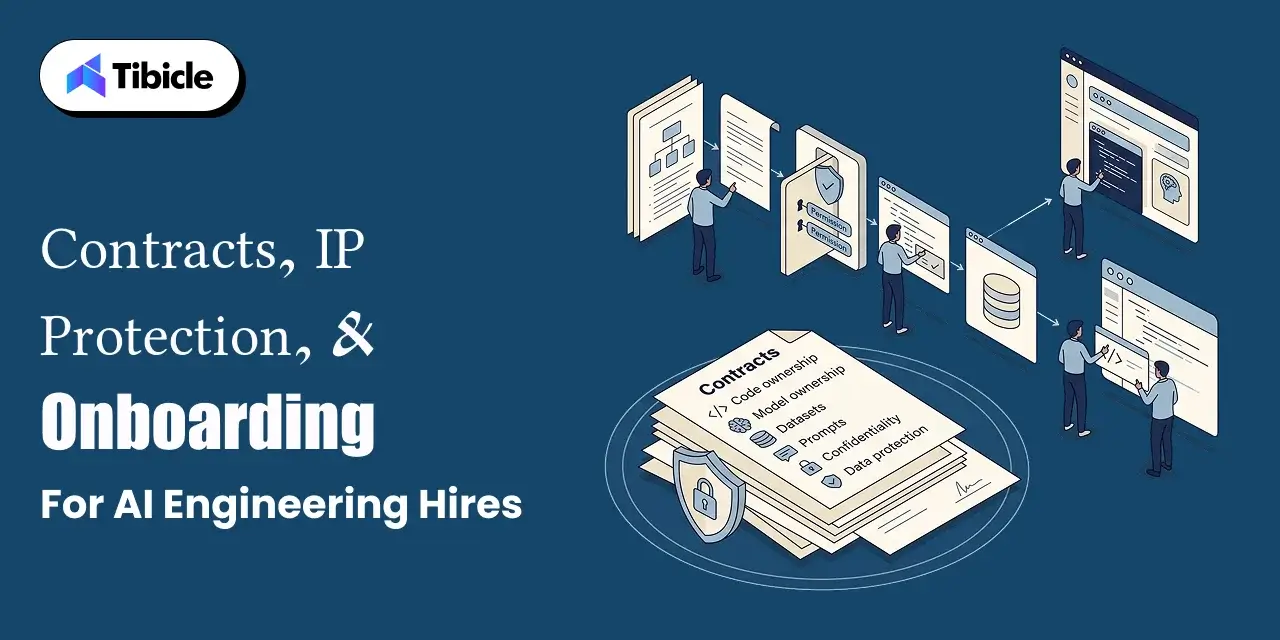
When you hire custom AI software engineers especially offshore or contract engineers the legal and operational foundation matters as much as the hiring decision. Code ownership, confidentiality, access to production systems, and data handling all need to be clear before work begins.
IP Assignment and Confidentiality for AI and Model Work for hire custom ai software engineers
A standard contractor agreement may not adequately cover IP for AI and model work. Your contract should explicitly assign all code, model weights, datasets, prompts, and methodologies created during the engagement to your company. It should include confidentiality language that extends to customer data, your training data, and your LLM fine-tuning approaches. If the engineer has access to your proprietary datasets or customer information, the contract should include data handling restrictions and remedies for breach. Work with an attorney who has experience in software and AI contracts; the stakes are high enough to warrant the investment.
Structuring Engagement Terms for a Dedicated or Contract Hire for hire custom ai software engineers
Dedicated team and contract arrangements require clear engagement terms: scope of work, delivery milestones, communication protocols, acceptance criteria, and payment terms. The contract should specify who owns the code, who decides on architecture, how code review and deployment authority work, and what happens if the team fails to meet a milestone. It should also define exclusivity (can the engineer work for other clients?) and non-compete terms appropriate to your business. If you’re working with a dedicated team provider, the contract should address team stability what happens if the assigned engineer leaves? What’s your recourse? How does the provider handle replacement?
Onboarding an AI Engineer Into an Existing Codebase and Data Environment for hire custom ai software engineers
Onboarding is often rushed, but it’s where mis-hires become expensive. When you hire custom AI software engineers, especially contractors or offshore team members, invest in structured onboarding: architecture documentation, access to necessary systems and datasets, introduction to the existing codebase and any AI systems already in production, and clear context on your product roadmap and technical constraints. Assign a technical lead to be the primary contact and to review early work closely. The first 2-3 weeks are a two-way evaluation; if something feels off, address it immediately rather than hoping it resolves as the engineer ramps.
How Tibicle Sources Dedicated AI Software Engineers for US Product Teams
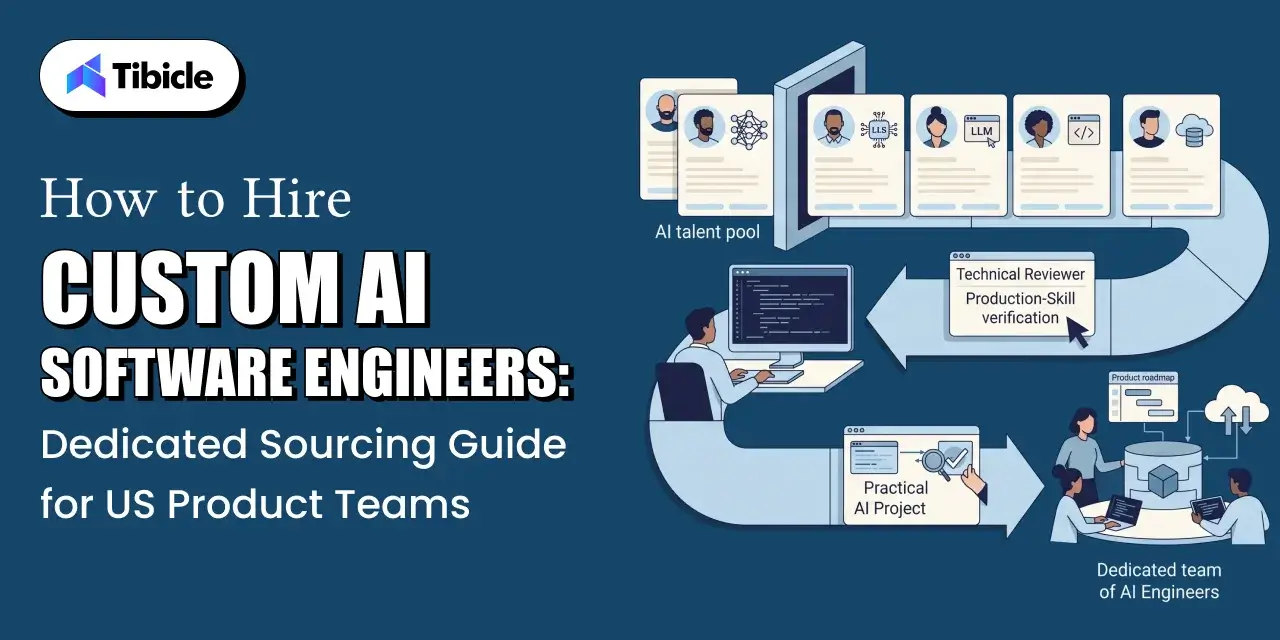
Tibicle specializes in sourcing and managing dedicated AI development teams for US product companies. Instead of navigating recruiting, vetting, and onboarding independently, product teams work with a single partner who handles sourcing, screening, team assembly, and ongoing management. Here’s how the model works.
Pre-Vetted AI Engineering Talent Pool and Screening Process for hire custom ai software engineers
Tibicle maintains a sourced and pre-screened pool of AI engineers with shipped production experience. Every engineer in the pool has been vetted for production skills not just theoretical knowledge through take-home projects, code review, and reference checks. When you need to hire custom AI software engineers through Tibicle, the sourcing work is already done. Instead of a 90-day recruiting cycle, you’re accessing engineers who can start productive work in 2-3 weeks. The vetting standard is high: we’re screening for the same production signals outlined in Section 4 shipped systems, failure recovery, cost and performance optimization, real-world constraints.
Trial Period, Onboarding, and Team Integration for hire custom ai software engineers
Tibicle structures every engagement with a 2-4 week trial project before commitment. The trial lets your team and the engineer evaluate fit while limiting financial exposure. During the trial, Tibicle handles onboarding logistics: environment setup, access provisioning, architecture walkthroughs, and integration with your existing team. A dedicated Tibicle account manager stays involved to ensure smooth communication and escalate issues quickly. After the trial, you either extend the engagement, adjust the team composition, or end the relationship with minimal friction.
Ongoing Engagement, Flexibility, and Scaling the Team for hire custom ai software engineers
Once the trial succeeds, the engagement typically runs month-to-month or for a defined project duration. If your roadmap changes you need more capacity, a different skill set, or a temporary surge for a launch you can adjust the team composition quickly without the lag of recruiting. Tibicle manages team stability: if an assigned engineer needs to leave, we find a replacement without you having to re-screen or restart the vetting process. You scale the team as your product needs change, whether that’s adding a second engineer, shifting focus to a new problem domain, or ramping down after a major project.
Key Takeaways for US Product Teams
Hiring custom AI software engineers means screening for production experience, not AI literacy. They are different. Generic coding assessments routinely miss the skills that matter most for production AI work: debugging model failures, optimizing cost and latency, managing datasets, integrating AI into existing systems. A direct US hire solves leadership and strategic roles. Staff augmentation fills narrow skill gaps on a timeline. A dedicated AI development team scales feature development without recruiting overhead and reduces cost-per-engineer while maintaining quality. IP assignment and confidentiality terms need to be settled before an engineer touches your code or data. A trial project before long-term commitment is the highest-leverage way to avoid expensive mis-hires.
Ready to hire custom AI software engineers for your product team? Book a call to discuss your roadmap and sourcing options: https://calendly.com/tibicle
FAQ
What is the difference between hiring a custom AI software engineer and a general full-stack developer?
A custom AI software engineer has specialized experience building production systems that incorporate LLMs, model fine-tuning, inference optimization, and real-world failure handling. A general full-stack developer has broad capabilities across frontend, backend, and infrastructure but typically lacks deep experience in the constraints unique to AI systems: token limits, latency requirements, hallucination handling, and cost management. When you hire custom AI software engineers, you’re hiring specialists in a narrower domain. A full-stack engineer can learn AI work, but the ramp time and risk are higher.
Should a US product team hire AI engineers directly or use a dedicated team model?
Direct hiring makes sense for leadership, architecture, and long-term strategic roles where deep organizational embeddedness is valuable. For ongoing feature development, a dedicated team model offers lower cost, faster sourcing, reduced hiring risk, and flexibility to scale up or down. Most mid-stage product teams find that a mix works best: hire one or two core AI engineers directly for leadership and architecture, and use a dedicated team to scale feature development. When you hire custom AI software engineers this way, you’re optimizing for both strategic continuity and operational flexibility.
How long does it typically take to hire a qualified AI engineer in the US market?
Recruiting a qualified AI engineer through traditional sourcing runs 90-120 days from job posting to offer acceptance. If you need production-grade experience specifically, add 30-60 days to that timeline because the candidate pool is smaller. Staff augmentation and dedicated team models compress this to 2-4 weeks because you’re accessing pre-screened pools. The trade-off is cost: dedicated teams or augmentation specialists typically cost more per hour than a direct hire, but the time savings and reduced recruiting overhead often make the economics favorable.
What should a technical interview for an AI engineering role actually test?
A technical interview for AI engineering roles should assess production decision-making, not abstract algorithm knowledge. Ask the candidate to walk through a past system they shipped, including failures and how they debugged them. Use a scoped take-home project that mirrors real workbuilding an LLM integration, optimizing inference, or handling model failures. Evaluate their thinking on cost, latency, and reliability. Ask follow-up questions about trade-offs they made and constraints they navigated. The goal is to surface whether they’ve shipped at scale and how they think through production constraints.
How is IP ownership handled when working with a dedicated or offshore AI development team?
IP ownership should be explicitly assigned to your company in the engagement contract, covering all code, models, datasets, prompts, and methodologies created during the work. The contract should also include confidentiality clauses that protect your customer data, training datasets, and proprietary approaches. If the team has access to sensitive information, data handling and security requirements should be specified. A well-structured contract is non-negotiable; the investment in legal review up front saves far more than it costs if issues arise.
Does Tibicle provide dedicated AI software engineers for US product teams?
Yes. Tibicle sources and manages dedicated AI development teams specifically for US product companies. We vet every engineer in our pool for production skills, handle onboarding and team integration, and manage ongoing engagement. Every engagement starts with a trial project to ensure fit before long-term commitment. If your team’s needs change, we scale the team or adjust composition without the lag of traditional recruiting. Book a call to discuss your product roadmap and AI engineering needs
Schedule A Developer Interview And Get 15 Days Risk-Free Trial
Schedule a Call

Relevant Blog
Legacy Application AI Modernization Services

Arjun Shinojiya

Custom Computer Vision Software Development Company
Arjun Shinojiya
Written by

Dhairya Dadhania
Business Development Executive
I'm Dhairya Dadhania, Business Development Executive at Tibicle LLP. I help businesses move beyond their current limitations by defining a clear and ambitious digital vision by focusing on identifying core opportunities and aligning them with purposeful, innovative digital solutions.
Related posts
Legacy Application AI Modernization Services
Who this is for: Engineering leads, CTOs, and IT decision-makers responsible for a legacy web or desktop application who are evaluating AI modernization services for legacy applications rather than a full ground-up rebuild. Search intent: Commercial evaluation with a technical backbone. The reader has moved past “what is legacy modernization” and wants to know where […]
17 Sep 2026 | Arjun Shinojiya
Custom Computer Vision Software Development Company
Who this is for: Engineering leads, product owners, and operations heads at B2B enterprises evaluating a custom computer vision software development company for a real visual-data workflow rather than a demo. Search intent: Commercial evaluation with a technical backbone. The reader has moved past “what is computer vision” and wants architecture choices, accuracy data, and […]
16 Sep 2026 | Arjun Shinojiya
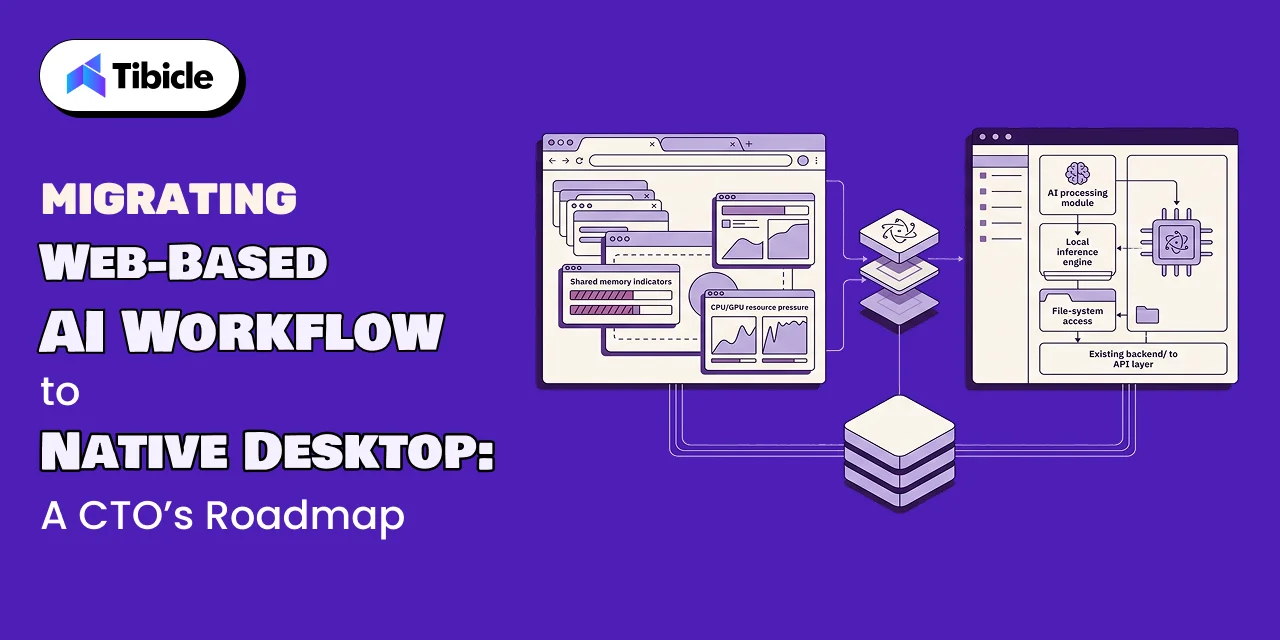
Migrate Web AI App to Electron Desktop via Electron
What This Guide Covers Who this is for CTOs, VP Engineering, and technical founders at companies running an AI feature inside a web app who are weighing whether to migrate their web AI app to Electron desktop. This applies most directly to teams where the AI workflow is central to the product, not a side […]
02 Oct 2026 | Aditya Changlani
Got an Idea? Get FREE Consultation
In our world, there's no such thing as having too many clients

Email
tea@tibicle.com

Phone
+91 9724922880