Introduction
The ai powered ecommerce market crossed $10.5 billion in 2026 and 84% of ecommerce businesses now rank AI as their top strategic priority. That is not a pilot-stage statistic. It reflects a market that has moved from experimentation to operational infrastructure, where AI sits inside search, pricing, logistics, and customer support stacks across companies of every size.
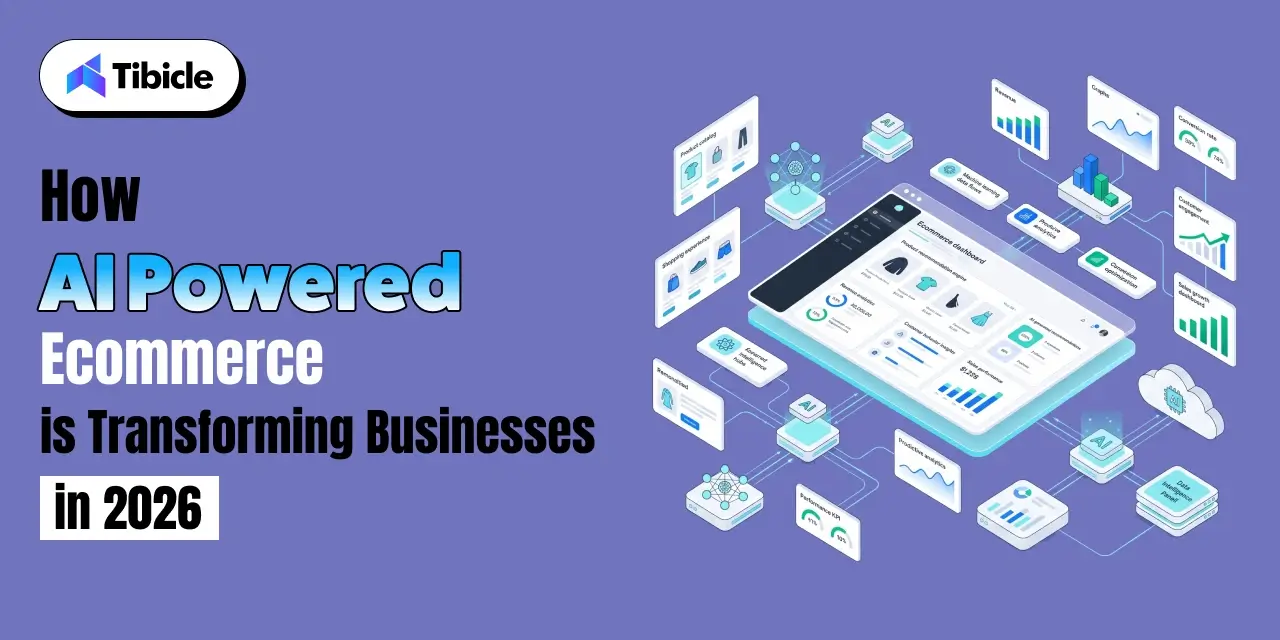
For C-suite leaders, the question is no longer whether to adopt ai in ecommerce. Most competitors already have. The real question is where to invest first, which capabilities deliver measurable returns, and what it actually costs to build or buy the right solution.
This guide breaks down the core use cases, ROI benchmarks, pricing models, risks, and vendor selection criteria that matter for decision-makers evaluating ai powered ecommerce in 2026.
What Is AI Powered Ecommerce? A Quick Breakdown
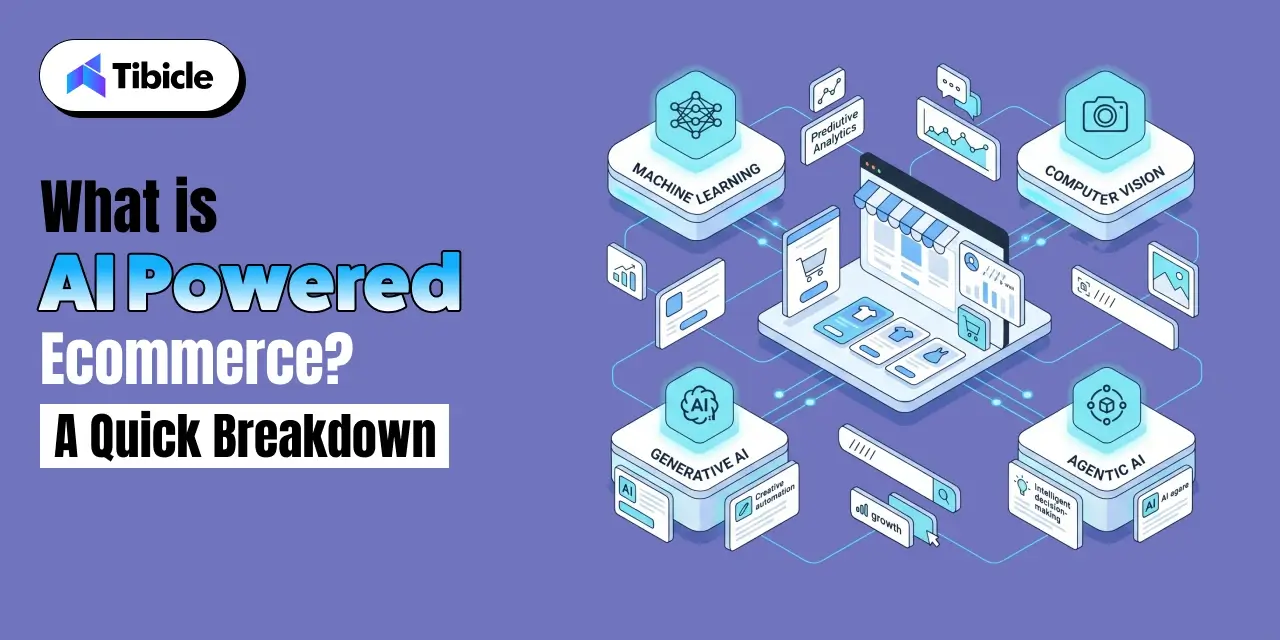
AI powered ecommerce is the integration of machine learning, natural language processing, computer vision, and generative AI into the systems that run online retail. The goal is not automation for its own sake. Each layer serves a specific commercial function increasing revenue, reducing operational cost, or improving customer experience at scale.
Artificial intelligence ecommerce is now built into platforms most retailers already use, from product discovery to post-purchase logistics. The shift from rule-based to AI-driven operations is the defining infrastructure change of 2026. For a broader look at how this connects to retail tech strategy, see our guide on custom eCommerce development for retail businesses.
Core Technologies Behind AI Ecommerce Solutions
These are the five technology layers that power modern ai ecommerce solutions and what each one does in a retail environment:
- Machine Learning (ML): Processes transaction and behavioral data to generate product recommendations, predict churn, and optimize pricing in real time.
- Natural Language Processing (NLP): Powers intent-aware search, conversational chatbots, and review analysis that surface buying signals from unstructured text.
- Computer Vision: Enables visual search and product tagging shoppers upload images to find matching items without typing a keyword.
- Generative AI: Produces dynamic product descriptions, personalized email copy, and on-demand visual assets at scale.
- Agentic Commerce: Executes multi-step tasks autonomously, reordering inventory, adjusting bids, or escalating support tickets without human intervention at each step.
6 High-Impact Use Cases of AI Powered Ecommerce
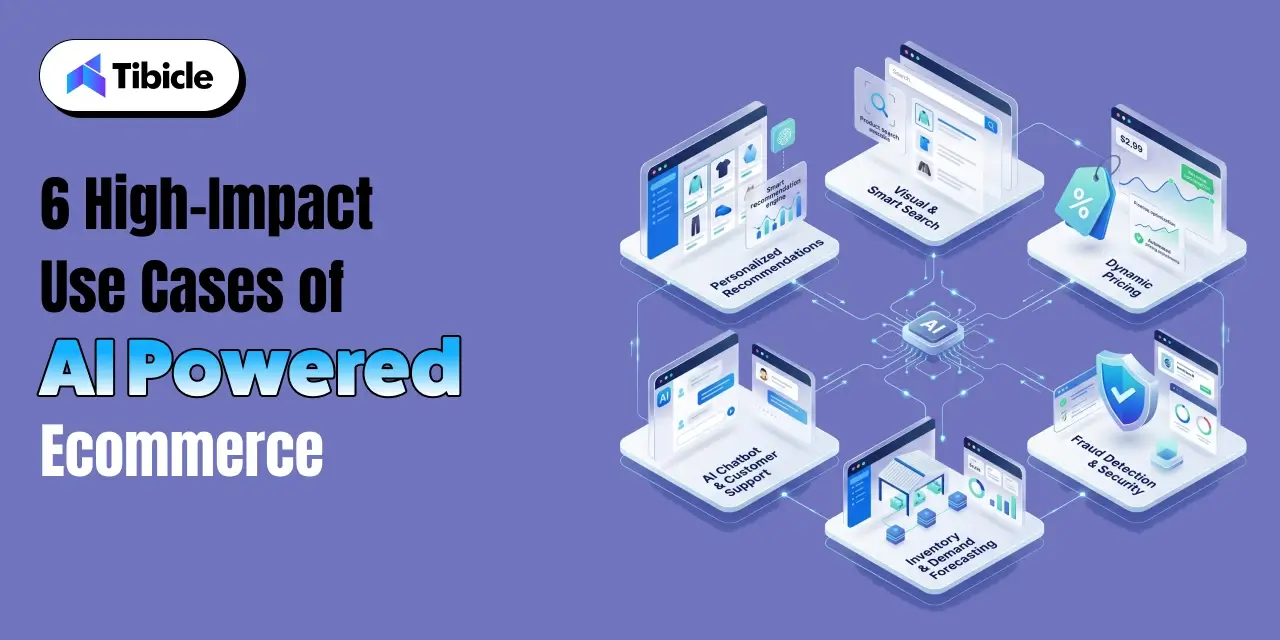
The return on ai powered ecommerce investment concentrates in a small number of high-leverage areas. These six use cases account for the majority of measurable business impact reported by retailers in 2025 and 2026.
Hyper-Personalized Product Recommendations
AI-driven personalized product recommendations contribute between 25% and 35% of total ecommerce revenue for retailers who have fully implemented them. The mechanism is direct: when a shopper sees products matched to their behavior, purchase history, and real-time session data, average order value increases and the likelihood of repeat purchase rises.
The customer lifetime value impact compounds over time. Recommendation engines do not just increase the current order they shape return visit behavior. Retailers running ML-driven recommendation stacks report meaningful gains in both AOV and 90-day retention rates compared to rule-based or manual merchandising approaches.
Intent-Aware Search and Product Discovery
Keyword-based site search is being replaced by semantic search that reads shopper intent rather than matching strings. A shopper searching for “something to wear to a beach wedding” now receives contextually relevant results rather than a literal keyword match.
Visual search has scaled faster than most retailers expected. Google Lens processed over 20 billion searches per month in 2025. Retailers with visual search capabilities capture high-intent shoppers who know what they want but cannot describe it in text a segment that converts at above-average rates once friction is removed.
Dynamic Pricing and Margin Optimization
Fewer than 15% of retailers currently use AI-driven dynamic pricing ecommerce tools, yet those that do report margin gains of 5% to 10%. The gap represents a competitive opportunity that is closing as pricing AI becomes more accessible through SaaS platforms.
Dynamic pricing tools ingest competitor prices, demand signals, inventory levels, and time-based patterns to adjust prices in real time. The result is better margin capture during high-demand windows and reduced excess inventory through price-driven clearance without manual merchandiser intervention.
AI-Driven Customer Support and Conversational Commerce
64% of consumers plan to use AI chatbots ecommerce tools for shopping assistance by 2026. More immediately, AI systems already handle 70% of initial customer interactions for retailers who have deployed conversational commerce tools.
The operational impact is measurable on two lines: support cost reduction through deflection of tier-1 queries, and revenue contribution through guided selling. Chatbots that surface product recommendations during support conversations consistently increase order attach rates versus static FAQ systems. See how this connects to broader customer experience automation strategies.
Predictive Inventory and Supply Chain Management
AI reduces excess inventory holdings by up to 20% and cuts supply chain costs by up to 10% for retailers with sufficient historical data to train demand forecasting models. The mechanism is demand signal aggregation combining sales history, weather data, promotional calendars, and supplier lead times into a single forecast.
Predictive analytics retail applications in supply chain directly reduce the two largest inventory costs: overstock write-downs and stockout-driven lost sales. Both have measurable impact on gross margin, making supply chain AI one of the highest-ROI deployment areas in ecommerce automation.
Fraud Detection and Payment Intelligence
AI fraud detection analyzes transaction patterns in real time device fingerprint, behavioral biometrics, purchase velocity, and network signals to flag suspicious transactions before authorization. The speed advantage over rule-based systems is decisive: AI systems evaluate hundreds of signals per transaction in milliseconds.
The commercial outcome is reduced chargebacks, lower false-positive rates that would otherwise block legitimate orders, and reduced manual review costs. Payment intelligence systems also identify friendly fraud patterns that standard chargeback rules miss, protecting margin in high-volume categories.
AI Powered Ecommerce ROI: What the Numbers Say
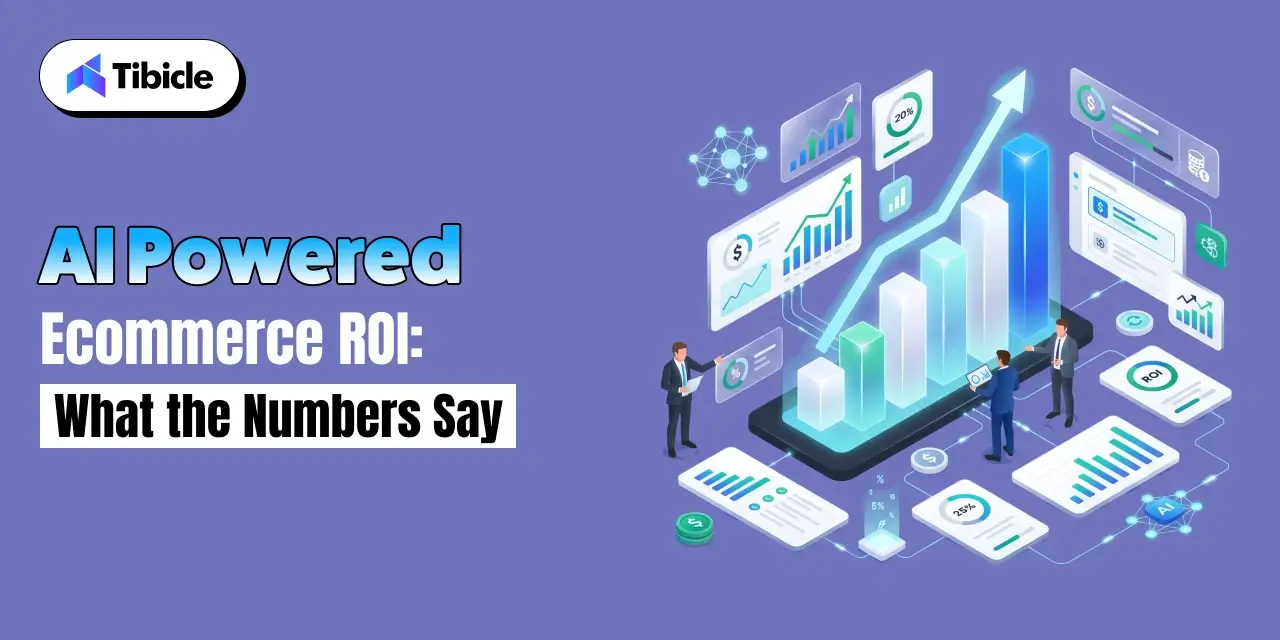
ROI data for ai powered ecommerce now comes from large enough sample sizes to be reliable benchmarks, not anecdotal case studies. The figures below reflect multi-retailer studies and are directional validate against your own baseline before building a business case.
Revenue and Conversion Metrics
69% of retailers report measurable revenue lift from AI deployment. AI-referred shoppers convert at a rate 31% higher than organic traffic across comparable segments. AI personalization drives up to 40% revenue increase versus competitors who rely on manual merchandising or rules-based recommendation engines.
The conversion rate optimization ai effect is most pronounced in three areas: search-to-cart rates, recommendation click-through, and post-add-to-cart completion. Retailers who personalize all three stages see compounding improvement rather than isolated gains. For benchmarks specific to your category, see our ecommerce performance metrics guide.
Cost Reduction and Operational Efficiency
72% of AI-adopting retailers report cost reductions following deployment. Logistics savings range from 5% to 20% depending on network complexity and model maturity. Inventory reductions of up to 35% have been reported in categories with stable SKU structures and clean historical data.
Customer support cost reduction is the fastest-payback deployment area for most mid-market retailers. Deflecting 50% of tier-1 queries to AI without customer satisfaction loss directly reduces headcount requirements and seasonal support scaling costs.
ROI Timeline Expectations
Organizations earn an average of $1.41 for every $1 spent on AI, according to Snowflake’s 2025 industry study. Most organizations achieve satisfactory ROI within 2 to 4 years of deployment. Only 6% report ROI in under 12 months.
The variables that compress timeline most are: data readiness, deployment scope, and internal capability to act on AI outputs. For C-level planning purposes, model a 2-year break-even and treat anything faster as upside.
Pricing Models for AI Ecommerce Solutions
Pricing for ai ecommerce solutions varies significantly based on deployment model, integration complexity, and the level of customization required. The following frameworks apply to mid-market and enterprise buyers evaluating investments in 2026.
SaaS Subscription vs. Custom Development
SaaS platforms like Shopify’s AI features or BigCommerce’s integrated tools operate on monthly subscription models. Deployment is faster weeks rather than months and requires less internal technical resource. The tradeoff is standardization: SaaS AI modules are designed to work for a broad range of merchants, not for the specific business logic of any one retailer.
Custom-built AI tools carry higher upfront investment but deliver alignment with proprietary data structures, pricing rules, and operational workflows that SaaS modules cannot accommodate. For retailers with complex catalogs, multi-region operations, or proprietary fulfillment systems, custom development often produces better long-term unit economics despite the higher entry cost. Our guide on custom vs. off-the-shelf software for ecommerce covers this tradeoff in detail.
Cost Variables That Affect Total Investment
Four variables determine total AI investment beyond the quoted platform or development cost:
- Data infrastructure readiness: Disconnected or low-quality data requires cleaning and architecture work before AI models can be trained. This is frequently the largest underestimated cost.
- Integration complexity: Connecting AI tools to existing ERP, CRM, POS, and CDP systems adds engineering cost proportional to system fragmentation.
- Team training and change management: AI outputs require human interpretation and action. Upskilling commercial and operations teams is a real cost that affects time-to-value.
- Ongoing optimization: Models degrade without retraining. Budget for quarterly model review and continuous improvement as part of total cost of ownership.
Ballpark ranges for mid-market implementations run from $50,000 to $250,000 in year one, depending on scope. Enterprise builds with custom model development and multi-system integration typically begin at $300,000 and scale with complexity.
AI Powered Ecommerce Platform Comparison
Three deployment approaches cover most buyer profiles evaluating ai powered ecommerce in 2026.
| Feature |
SaaS Platforms (Shopify, BigCommerce) |
Custom AI Solutions |
Hybrid Approach |
| Deployment Speed |
Fast |
Slow |
Medium |
| Customization |
Limited |
Full |
Moderate |
| Cost (Year 1) |
Low to Mid |
High |
Mid to High |
| Scalability |
Platform-dependent |
High |
High |
| Data Ownership |
Shared |
Full |
Full |
| Best For |
SMBs, fast launches |
Enterprise, niche needs |
Mid-market scaling |
SaaS platforms are the right starting point for SMBs and retailers running standard catalog structures who need AI capabilities without a large internal engineering team. They offer the fastest path to value in personalization and search.
Custom AI solutions suit enterprise buyers with complex product catalogs, proprietary data advantages, or operational requirements that no off-the-shelf tool supports. The higher year-one cost is offset by full data ownership and the ability to build competitive moats from proprietary AI behavior.
Hybrid approaches where a SaaS platform handles standard functions and custom AI handles differentiated use cases are the most common architecture for mid-market retailers scaling beyond what platforms offer without committing to full custom builds.
Key Risks and Challenges of AI in Ecommerce
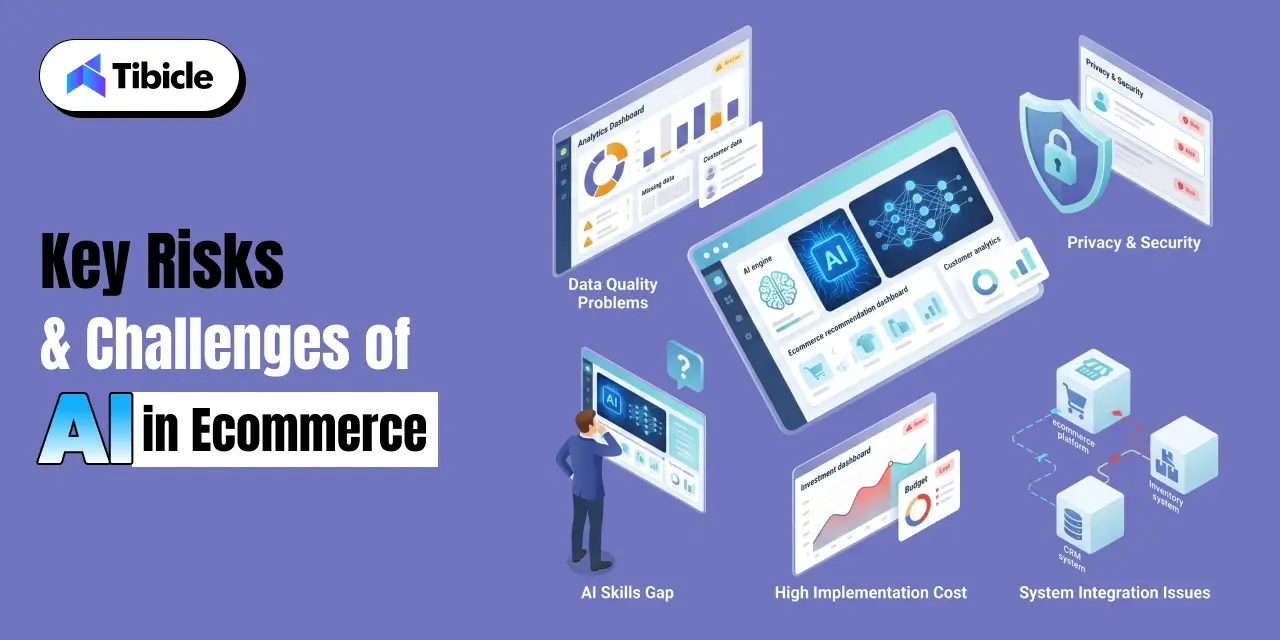
89% of retailers are currently using or testing AI in ecommerce. Only 33% have fully implemented it. The gap is not strategic hesitation it is operational. The risks below are the most common blockers between pilot and production.
Data Quality and Integration Gaps
AI models perform in direct proportion to data quality. Fragmented data across legacy systems, inconsistent SKU structures, and incomplete customer records are the primary reason AI pilots fail to scale. Before evaluating vendors, audit data completeness across transaction history, product catalog, and customer identity resolution.
Integration gaps between AI tools and existing infrastructure, particularly between recommendation engines and inventory systems, create scenarios where AI surfaces out-of-stock products or mispriced items. These are customer experience failures with direct revenue impact. Our ecommerce data architecture guide covers the audit process in detail.
Consumer Trust and AI Transparency
Only 14% of consumers currently trust AI to make purchasing decisions autonomously on their behalf. This is a meaningful constraint on how far agentic commerce can advance in the near term. AI that surfaces recommendations or personalizes content is accepted. AI that takes action without explicit customer approval faces adoption resistance.
Privacy compliance adds a regulatory layer. GDPR in Europe and a growing body of US state-level privacy law govern how customer behavioral data can be collected, stored, and used for AI training. Any ai ecommerce solution that processes EU or California resident data requires explicit compliance architecture, not a checkbox.
Talent and Change Management
Internal skill gaps are the most consistent challenge reported by retailers who have deployed AI. The problem is not just technical it is organizational. AI outputs require commercial judgment to act on. A demand forecasting model that flags overstock requires a buyer who understands how to respond. A pricing AI that recommends a margin increase requires a category manager who trusts the signal.
Cross-functional AI literacy at the executive level is the change management priority that correlates most strongly with successful AI deployment.
Vendor Selection Checklist for AI Powered Ecommerce
Use this checklist before issuing an RFP or entering vendor conversations. It identifies the questions that separate vendors with real deployment capability from those with strong sales materials.
- Pre-built vs. custom build: Does the vendor offer pre-built ecommerce AI modules, or does every capability require a full custom build from scratch?
- Data integration depth: What integration capabilities exist across CRM, ERP, CDP, and POS and which connections are native versus requiring custom middleware?
- Implementation timeline: What is the average timeline for businesses at your revenue scale and catalog complexity?
- Scalability: Can the solution scale across multiple geographies, currencies, and product catalog structures without re-implementation?
- ROI benchmarks: What performance data does the vendor provide from deployments comparable to your business in size, category, and data maturity?
- Ongoing support: What is included post-launch model retraining cadence, optimization review, and SLA for performance degradation?
- Data privacy compliance: How does the vendor handle GDPR and US state-level regulations, and who owns the data used to train models?
Add one question specific to your vertical the answer will separate vendors who understand your category from those pitching a generic platform.
Top AI Ecommerce Tools and Platforms in 2026
The following categories represent the primary tool types buyers evaluate when building an ai powered ecommerce stack. This is a starting point for research, not a ranked review.
- Personalization Engines: Dynamic Yield, Bloomreach, Nosto ML-driven recommendation and content personalization platforms with strong ecommerce track records.
- Conversational AI: Gorgias, Tidio, Intercom chatbot and live-chat tools with ecommerce integrations for cart recovery, product guidance, and post-purchase support.
- Dynamic Pricing Tools: Prisync, Wiser, BlackCurve competitive price monitoring and AI pricing recommendation tools for mid-market and enterprise retail.
- Visual Search and Discovery: Google Vision API, Syte, Visenze image recognition and visual search infrastructure connecting shopper-uploaded images to product catalog matches.
- All-in-One Commerce Platforms with AI Built In: Shopify, BigCommerce, Salesforce Commerce Cloud platforms that integrate AI across search, recommendations, and fulfillment within a single managed environment.
Evaluate each category against your highest-priority use case first. Deploying across all categories simultaneously without sequencing increases implementation risk without accelerating ROI.
Why Tibicle Is a Strong Choice for AI Powered Ecommerce Implementation
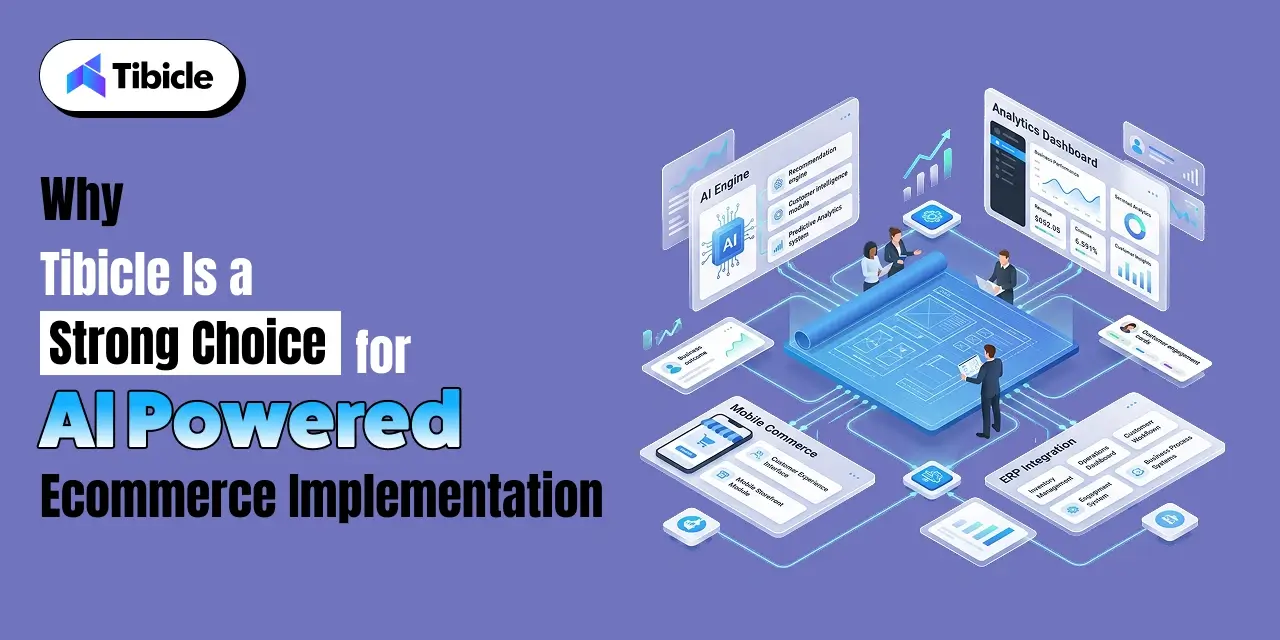
Tibicle builds custom AI ecommerce solutions for mid-market and enterprise clients where standard SaaS platforms reach their ceiling. If the vendor checklist above surfaces gaps in pre-built options catalog complexity, integration depth, or data ownership requirements custom development is the correct path.
Tibicle’s delivery model covers the four areas that determine implementation success: custom AI solution development tied to specific business logic, ecommerce platform integration across CRM, ERP, POS, and CDP systems, data architecture designed for scalability across markets and SKU volumes, and a proven engagement model for clients who need AI to fit their operation rather than adapting their operation to fit a platform.
Retailers evaluating ai ecommerce solutions for 2026 implementation can start with a scoping consultation with Tibicle to identify which use cases match your data maturity and where custom development delivers the best return.
Conclusion
The strategic decision for 2026 is not whether to invest in ai powered ecommerce 84% of competitors are already moving. The decision is where to start and who builds it. Retailers who sequence deployment around their highest-ROI use case, with data architecture in place, reach the $1.41-per-dollar return faster than those who run broad platform experiments without prioritization.
The 69% revenue lift benchmark and 31% conversion improvement are achievable for businesses that match deployment scope to data maturity. The gap between piloting AI and running it as operational infrastructure is closed by the right implementation partner.
Contact Tibicle today to map your AI ecommerce roadmap and identify the highest-return starting point for your business.
Frequently Asked Questions
What is AI powered ecommerce and how does it work?
AI powered ecommerce is the use of machine learning, NLP, computer vision, and generative AI to automate and personalize online retail operations. It works by processing large volumes of behavioral, transactional, and operational data to generate outputs product recommendations, dynamic prices, demand forecasts, chatbot responses that improve revenue, reduce cost, or improve customer experience faster than manual or rules-based systems can.
How much does it cost to implement AI in an ecommerce business?
Cost depends on deployment model and scope. SaaS AI tools built into platforms like Shopify or BigCommerce are available within standard subscription tiers or as low-cost add-ons. Point solutions for personalization or search run $500 to $5,000 per month depending on traffic volume. Custom AI development for mid-market retailers typically starts at $50,000 to $250,000 in year one, with enterprise implementations beginning at $300,000 and scaling with integration complexity and catalog size.
What ROI can businesses expect from AI powered ecommerce in 2026?
The average return is $1.41 for every $1 spent on AI, based on Snowflake’s 2025 industry data. 69% of retailers report measurable revenue lift, and AI-personalized shoppers convert at 31% higher rates than non-personalized traffic. Most organizations reach satisfactory ROI within 2 to 4 years. Faster timelines correlate with data readiness and deployment scope.
What are the biggest risks of using AI in ecommerce?
The three primary risks are data quality gaps that cause AI models to underperform or surface incorrect outputs, consumer trust constraints that limit how far autonomous AI purchasing can advance, and internal talent gaps that prevent teams from acting on AI-generated insights. Privacy compliance particularly GDPR and US state-level data regulations is a regulatory risk that must be addressed in the architecture, not retrofitted after deployment.
How do I choose the right AI ecommerce vendor for my business?
Start with the vendor selection checklist above. Prioritize vendors with documented deployments at comparable business scale, native integration capabilities for your existing tech stack, and clear data ownership terms. Verify ROI benchmarks against businesses in your category and revenue range, not general market averages. For complex catalogs or proprietary operational requirements, evaluate custom development against SaaS options before defaulting to whichever platform has the strongest marketing presence.