Introduction
The global progressive web app market was valued at USD 3.53 billion in 2024 and is projected to hit USD 21.44 billion by 2033, growing at a 18.98% CAGR. Straits Research Yet most businesses still split their budgets across separate iOS and Android builds two codebases, two maintenance cycles, two app store approval processes when a single progressive web app can serve both platforms from one deployment.
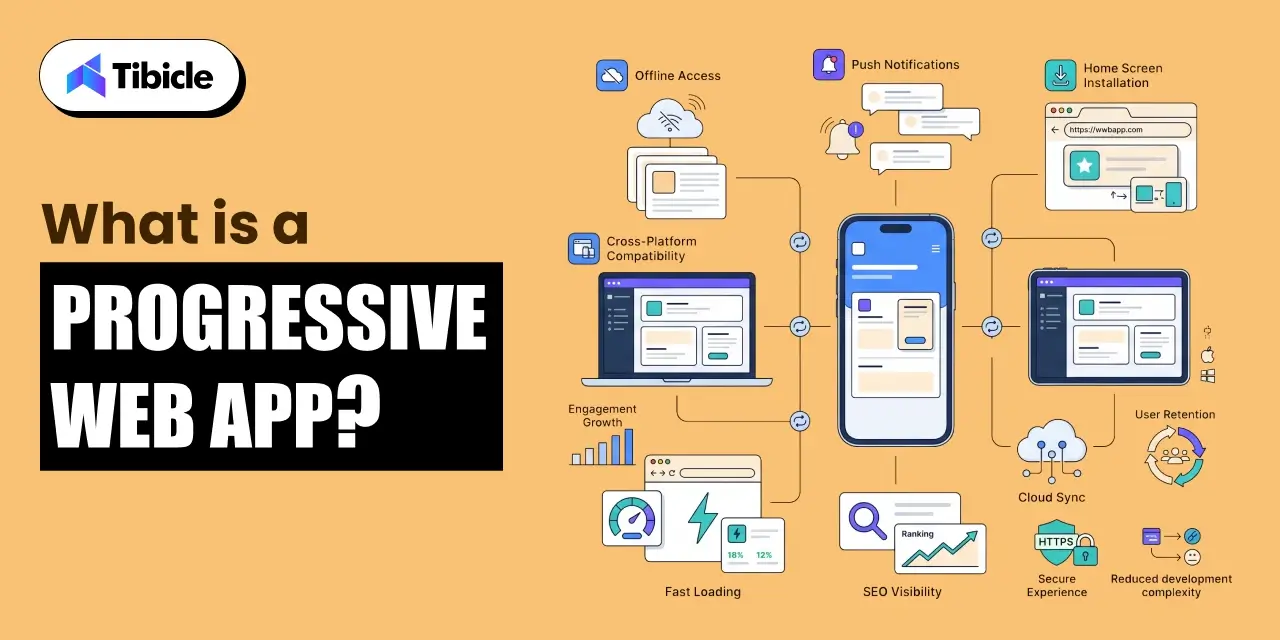
This guide covers what a progressive web app is, how it works, real cost and ROI data, a full comparison with native apps, known risks, and a vendor selection checklist for 2026.
What Is a Progressive Web App?
Core Definition
A progressive web app is a browser-based application built with HTML, CSS, and JavaScript that behaves like a native mobile app. It can be installed on a user’s home screen, works offline, and sends push notifications without requiring distribution through the Apple App Store or Google Play.
PWAs show a 70% increase in session length and a 20% increase in page views per session compared to traditional web apps. ResearchGate, cited by Straits Research The architecture behind this performance is what separates a progressive web app from a standard website.
How Does a Progressive Web App Work?
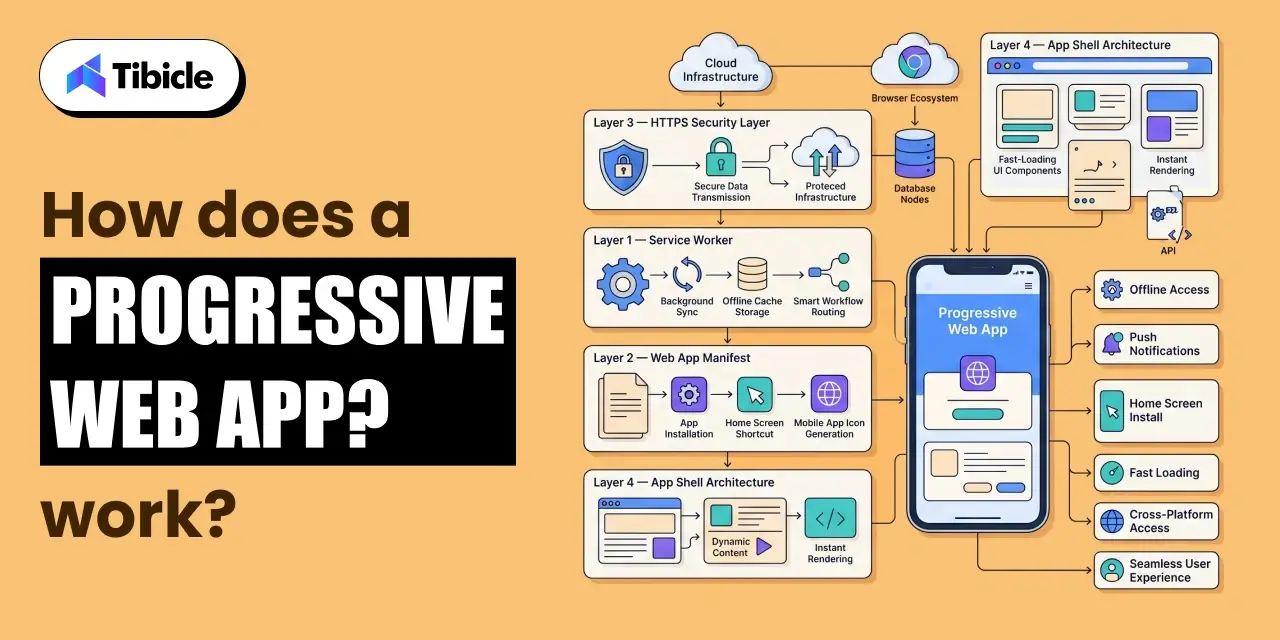
A progressive web app is built on four technical components working together. Each layer handles a specific function, and together they produce the app-like experience users expect on mobile.
What Are Service Workers?
Service workers are background scripts that run separately from the main browser thread. They manage PWA caching, handle offline access, and enable background sync. When a user opens a progressive web app without internet access, the service worker serves cached content instead of showing an error, this is what makes an offline web app possible.
What Is a Web App Manifest?
The web app manifest is a JSON configuration file that defines the app’s name, icon, theme color, and display behavior. It tells the browser how to present the installable web app, whether in full-screen, standalone, or browser mode. This file is what enables home screen installation without an app store.
Why Does HTTPS Matter for a PWA?
HTTPS is mandatory for a progressive web app. All data transmitted between the browser and server must be encrypted. This is not optional browsers block service worker registration on non-secure origins. It also establishes the trust baseline that search engines and users expect.
What Is App Shell Architecture?
App shell architecture loads a minimal set of HTML, CSS, and JavaScript on the first request, just enough to render the UI instantly. Content is then loaded dynamically as the user interacts. This approach cuts perceived load time and improves Core Web Vitals scores, both of which affect search rankings.
PWA Component Overview
| PWA Component |
Function |
Business Impact |
| Service Worker |
Caching, offline access, background sync |
Keeps app functional without internet |
| Web App Manifest |
Defines name, icon, display mode |
Enables home screen installation |
| HTTPS Layer |
Encrypts all data in transit |
Security compliance, browser trust |
| App Shell Architecture |
Minimal UI load, dynamic content |
Faster perceived load, better Core Web Vitals |
Why Businesses Are Adopting Progressive Web Apps in 2026
Cost Reduction with a Single Codebase
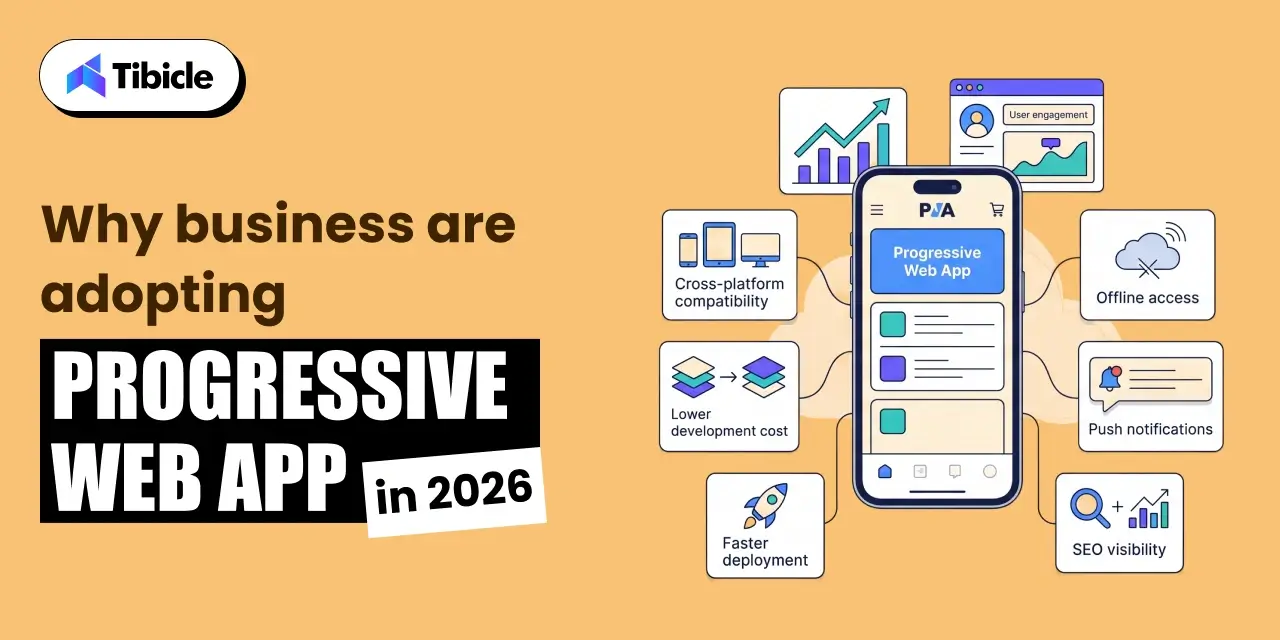
PWA development costs 30%-75% less than building separate native apps. Glance Research, cited by Newly The average PWA development project runs $8,000–$25,000, compared to $50,000–$150,000+ for dual native builds across iOS and Android. For early-stage businesses and mid-market companies, that gap often determines whether a product launches on schedule or gets delayed by 12 months.
A single codebase app also reduces ongoing maintenance overhead. One update deploys across all platforms simultaneously, no separate release cycles, no app store approval queues.
Higher User Engagement and Retention
The business case for progressive web app development is backed by documented results across industries:
- Pinterest saw a 60% increase in engagement after launching its PWA.
- Twitter Lite reported a 65% increase in pages per session and a 75% increase in tweets sent.
- Starbucks doubled its daily active users after deploying a PWA that was 99.84% smaller than its iOS app.
These are not edge cases. They reflect what happens when load time drops, offline access is restored, and the friction of app store downloads is removed.
SEO and Discoverability Advantage
A progressive web app is fully indexable by search engines. Native apps are not as they sit behind app store walls that Google’s crawler cannot access. For businesses where organic search drives acquisition, this distinction matters. PWA development gives you a cross-platform app that also functions as a discoverable web property.
Progressive Web App Use Cases by Industry
E-commerce and Retail
E-commerce holds 31.4% of the PWA market share in 2025. Coherent Market Insights Faster load times, offline browsing, and push notifications for cart recovery make PWAs well-suited for retail. Reducing page load time by one second can lift conversions by up to 7%, a metric that compounds across high-traffic stores.
Media and Content Publishing
Forbes deployed a progressive web app and reported significant improvements in session depth and ad revenue per user. Media publishers benefit from offline reading mode and fast article load times, both of which reduce bounce rate and increase time-on-page, two signals that affect ranking.
Travel and Hospitality
Travel companies using PWAs have reported a 3x conversion rate increase and 180% retention improvement. Clutch.co Offline itinerary access and fast booking flows are the primary drivers. Users in airports or low-connectivity areas can complete bookings without the experience breaking.
B2B SaaS and Enterprise Tools
Enterprise teams use PWAs for offline dashboards, real-time sync across devices, and field sales tools that function without a stable internet connection. The cross-platform app model means a sales rep on Android and a manager on iOS both use the same product, updated at the same time.
Progressive Web App vs Native App: Full Comparison
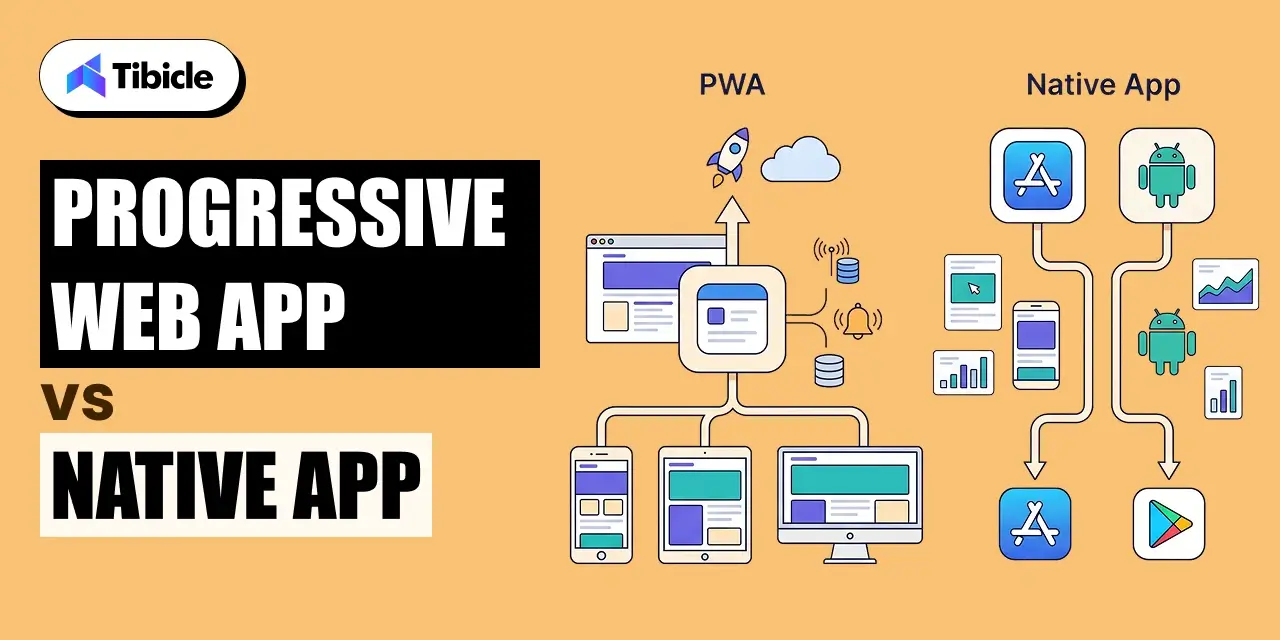
Feature and Cost Breakdown
| Parameter |
Progressive Web App |
Native App |
| Development Cost |
$8K–$25K (single codebase) |
$50K–$150K+ (per platform) |
| Time to Market |
4–8 weeks |
12–24 weeks |
| Maintenance |
Single update, instant deploy |
Separate updates per OS, store approval |
| Offline Support |
Partial (service worker caching) |
Full |
| Device Access |
Limited (camera, GPS, push) |
Full hardware access |
| App Store Presence |
Optional |
Required |
| SEO Visibility |
Fully indexable |
Not indexable |
| Performance Gap |
Under 10% for standard business apps [Brainhub 2025] |
Superior for graphics-heavy apps |
When to Choose a Progressive Web App
Choose a progressive web app when your product serves a broad cross-platform audience, organic search is part of your acquisition strategy, budget or timeline is a constraint, or your core features do not require deep hardware access. E-commerce, SaaS dashboards, content platforms, and service-based businesses typically fit this profile.
When Native Still Wins
Native development remains the right call for applications that require Bluetooth, NFC, AR, or advanced camera control. Gaming apps, financial apps with biometric authentication, and augmented reality tools hit the performance ceiling of what a browser-based app can currently deliver. For those use cases, a native build or React Native hybrid is the stronger choice.
Progressive Web App Development Cost Breakdown
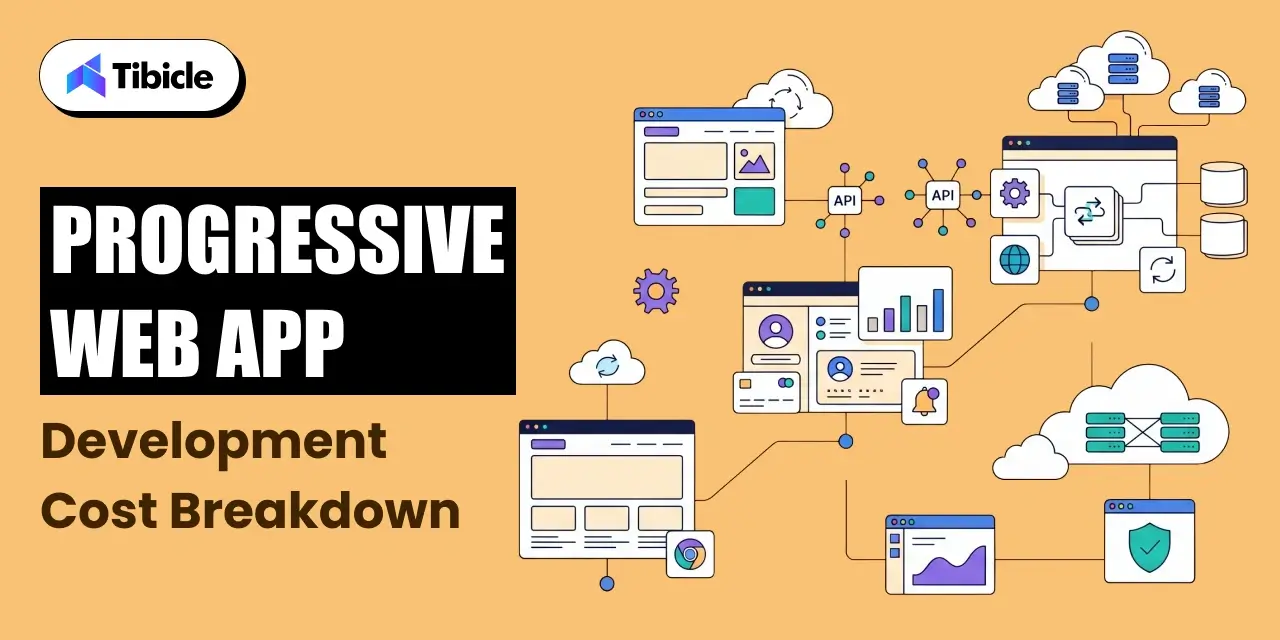
Cost by Complexity Tier
PWA development cost scales with scope. Three tiers cover most business use cases:
- Basic PWA: $8,000–$12,000. Covers simple informational apps, content sites, or lead-gen tools with standard PWA features.
- Mid-range PWA: $15,000–$25,000. Covers e-commerce stores, SaaS dashboards, and tools with third-party integrations.
- Enterprise PWA: $30,000–$60,000. Covers complex API integrations, custom backend architecture, and high-traffic production environments.
Cost Variables
Four factors move the number up or down within each tier:
- UI/UX design complexity: custom design systems cost more than component libraries.
- Third-party integrations: payment gateways, CRMs, ERPs, and analytics tools add scope.
- Backend complexity: real-time sync, custom APIs, and data processing add development hours.
- Developer location: North America and Western Europe carry higher rates; Asia and Latin America typically run 40–60% lower for equivalent output.
Maintenance and Ongoing Costs
A progressive web app has no app store fees and no platform-specific approval delays. Updates deploy instantly to all users. Long-term, this lowers total cost of ownership compared to maintaining two native codebases with staggered release cycles.
ROI of a Progressive Web App: What the Data Shows
Revenue Impact Model
A straightforward ROI model: a business generating $100,000 in monthly mobile revenue at a 2% conversion rate sees a 40% improvement post-PWA launch. That produces $480,000 in additional annual revenue on a $50,000 build cost an 860% first-year ROI. Codebrand The model assumes no increase in traffic, only conversion rate improvement from faster load times and offline access.
Conversion and Engagement Metrics
- Businesses switching to PWAs report a 36% increase in mobile conversions on average. AppVerticals
- Starbucks’ PWA is 99.84% smaller than its iOS app and generated 2x daily active users post-launch.
- Twitter Lite reduced data consumption by 70% while increasing engagement across all measured metrics.
Total Cost of Ownership vs Native
A single codebase app saves up to 60% on development budget over a three-year period. Webshark When you factor in app store fees, separate QA cycles, and platform-specific bug fixes, the savings compound annually.
Looking to build a progressive web app that drives measurable ROI? Tibicle helps businesses plan, develop, and scale PWAs with a conversion-first approach. Talk to our team today.
Risks and Challenges of Progressive Web Apps
iOS Limitations
Safari’s support for PWA features still lags behind Chrome and Edge. Push notification control on iOS is limited, Apple’s implementation of the Web Push standard remains inconsistent across versions. Businesses with a predominantly iPhone user base should test PWA behavior thoroughly on Safari before launch and factor potential workarounds into the development scope.
Limited Hardware Access
A progressive web app cannot access Bluetooth, NFC, or advanced AR capabilities through the browser. Camera and GPS work in most modern browsers, but the depth of hardware integration available to native apps is not currently replicable in a browser-based app. This is a fixed constraint, not a configuration issue.
App Store Discoverability Trade-off
Users conditioned to search the App Store or Google Play may not find your PWA through those channels. While Google Play now supports TWA (Trusted Web Activity) packaging for PWA submission, App Store distribution for PWAs remains limited. Businesses that depend on app store traffic as an acquisition channel should account for this gap.
Performance Ceiling for Complex Use Cases
AR/VR applications, AAA-grade mobile games, and financial apps with heavy cryptographic requirements still favor native architecture. A progressive web app performs within 10% of native for standard business applications, but that gap widens significantly for compute-intensive use cases.
Vendor Selection Checklist for Progressive Web App Development
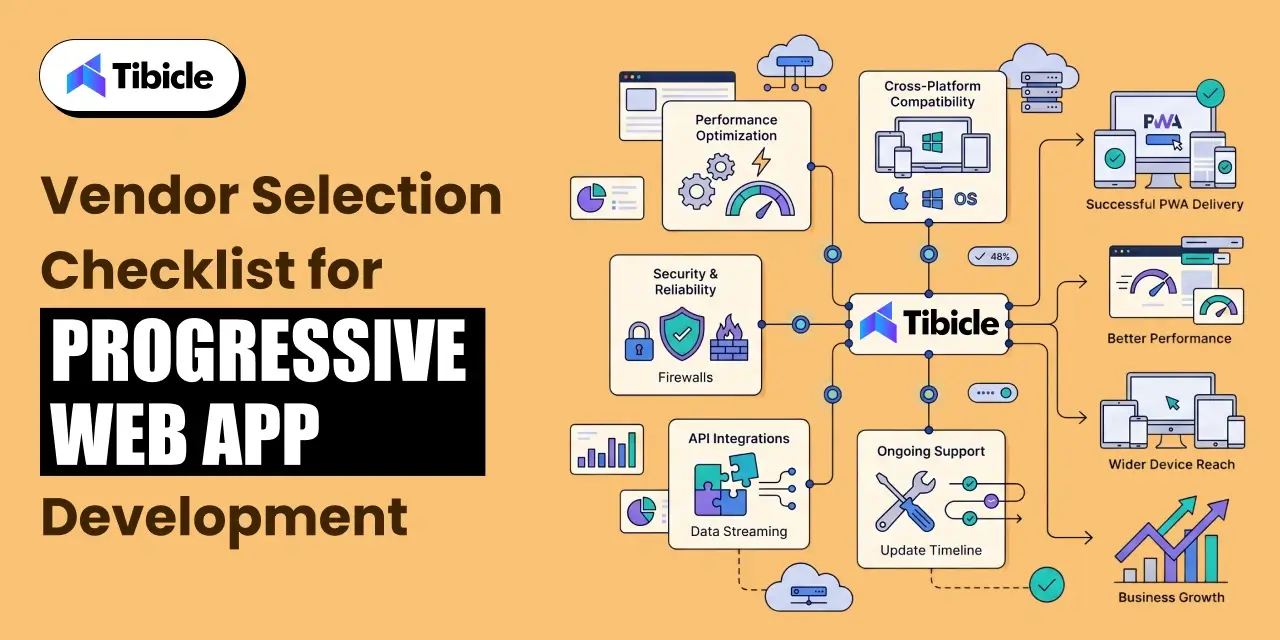
Use this checklist before signing a contract with any PWA development partner:
- Does the vendor have documented PWA case studies with measurable outcomes?
- Do they implement service workers and PWA caching strategies correctly not just add a manifest file?
- Can they handle both frontend frameworks (React, Next.js, Vue) and backend integrations?
- Do they offer post-launch performance optimization, including Core Web Vitals monitoring?
- What is their approach to offline-first architecture and background sync?
- Do they test across Chrome, Safari, Edge, and Firefox before delivery?
- Can they integrate push notifications and background sync across Android and iOS?
- Do they provide Lighthouse audit scores as part of the delivery package?
- What is their maintenance and support model after go-live?
- Do they offer PWA-to-app-store publishing via TWA for Google Play?
A vendor who cannot answer the service worker, Lighthouse, and cross-browser questions directly is likely treating PWA as a checkbox feature rather than an architecture decision.
Top Progressive Web App Development Companies in 2026
Major players in PWA development include Google, Microsoft, OutSystems, Alokai, IBM, GoodBarber, Cloud Four, and DockYard. When evaluating any vendor, the selection criteria that matter most are: cross-platform expertise across React and Vue ecosystems, Lighthouse performance scores on delivered projects, depth of client portfolio in your industry, and the clarity of their post-launch support model. Technical skill and communication structure both matter, delivery without documentation is a recurring problem in this space.
Why Tibicle Is a Strong Choice for Progressive Web App Development
Tibicle brings technical depth in React, Next.js, and Node.js to PWA projects, paired with an SEO-first development approach that aligns with how progressive web apps are discovered and ranked. The team focuses on performance optimization from the architecture stage not as a post-launch patch and follows a documented delivery process that includes Lighthouse audits, cross-browser testing, and structured handoffs. For businesses that need PWA development without the overhead of a large agency, Tibicle offers the same technical capability at a more accessible cost tier.
Want to explore how a progressive web app fits your business model? Reach out to Tibicle for a free consultation.
Conclusion
Progressive web apps reduce development cost by 30–75%, increase mobile conversions by up to 36%, and offer a viable alternative to dual native builds for most business applications. For companies that need cross-platform reach without the budget or timeline of separate iOS and Android projects, a PWA delivers on both counts. The risks are iOS limitations, hardware access gaps, app store discoverability are real but manageable with the right vendor and architecture decisions.
Schedule a free PWA assessment with Tibicle to evaluate your use case and projected ROI. Book here.
FAQs
What is a progressive web app and how is it different from a regular website?
A progressive web app is a browser-based application built with standard web technologies HTML, CSS, and JavaScript that adds native app capabilities on top. A regular website loads fresh content on every page request and cannot function offline. A PWA uses service workers to cache content, allowing it to work without internet access. It can also be installed on a home screen, send push notifications, and load in under two seconds on repeat visits. The gap between a website and a progressive web app is not visual it is architectural.
How much does it cost to build a progressive web app in 2026?
PWA development cost ranges from $8,000–$12,000 for basic builds, $15,000–$25,000 for mid-range projects like e-commerce or SaaS dashboards, and $30,000–$60,000 for enterprise-grade PWAs with complex integrations. Developer location, UI complexity, and backend requirements are the main cost variables. By comparison, a dual native app build (iOS + Android) typically costs $50,000–$150,000+, making PWA development 30–75% less expensive for most use cases.
Can a progressive web app work offline?
Yes. Offline functionality is one of the core features of a progressive web app. Service workers cache key assets and data on the first load. On subsequent visits without internet access, the app serves cached content instead of showing a connection error. The extent of offline functionality depends on the caching strategy implemented during PWA development some apps cache full data sets, others cache only the shell and show a limited offline mode.
Is a progressive web app better than a native app for small businesses?
For most small businesses, yes. A progressive web app costs significantly less to build and maintain, launches faster, and reaches users across iOS and Android without separate codebases. It is fully indexable by search engines, which native apps are not. The trade-off is limited hardware access and some iOS feature gaps. If your product does not require Bluetooth, NFC, AR, or advanced camera control, a PWA delivers comparable user experience at a fraction of the cost.
Do progressive web apps work on iPhones and Safari?
Yes, with limitations. Safari supports core PWA features including home screen installation, service workers, and offline caching. Push notification support on iOS improved with iOS 16.4, but remains less consistent than Chrome or Edge on Android. Full-screen mode and some advanced PWA capabilities are still restricted on Safari. If your audience is predominantly iPhone users, test PWA behavior on Safari specifically and confirm your vendor accounts for iOS limitations in the development scope.
How long does it take to develop a progressive web app?
A basic progressive web app takes 4–6 weeks from scope sign-off to delivery. Mid-range PWAs with e-commerce functionality or dashboard integrations typically run 6–10 weeks. Enterprise PWAs with complex APIs and custom backend architecture can take 12–16 weeks. These timelines assume a defined scope, available design assets, and API documentation from third-party services. Delays in content, design feedback, or API access are the most common schedule risks.