Introduction
eCommerce covers any commercial transaction online, across desktop and mobile alike. mCommerce is the subset specific to smartphones and tablets, via apps or mobile-optimized sites. Mobile commerce hit $2.51 trillion in 2025, or 60% of global e-commerce sales (Statista, 2025). Understanding mCommerce vs eCommerce this way makes clear why mobile readiness is now essential to any modern strategy. As the two increasingly overlap, the real question for businesses is no longer which one to choose, but how well they work together.
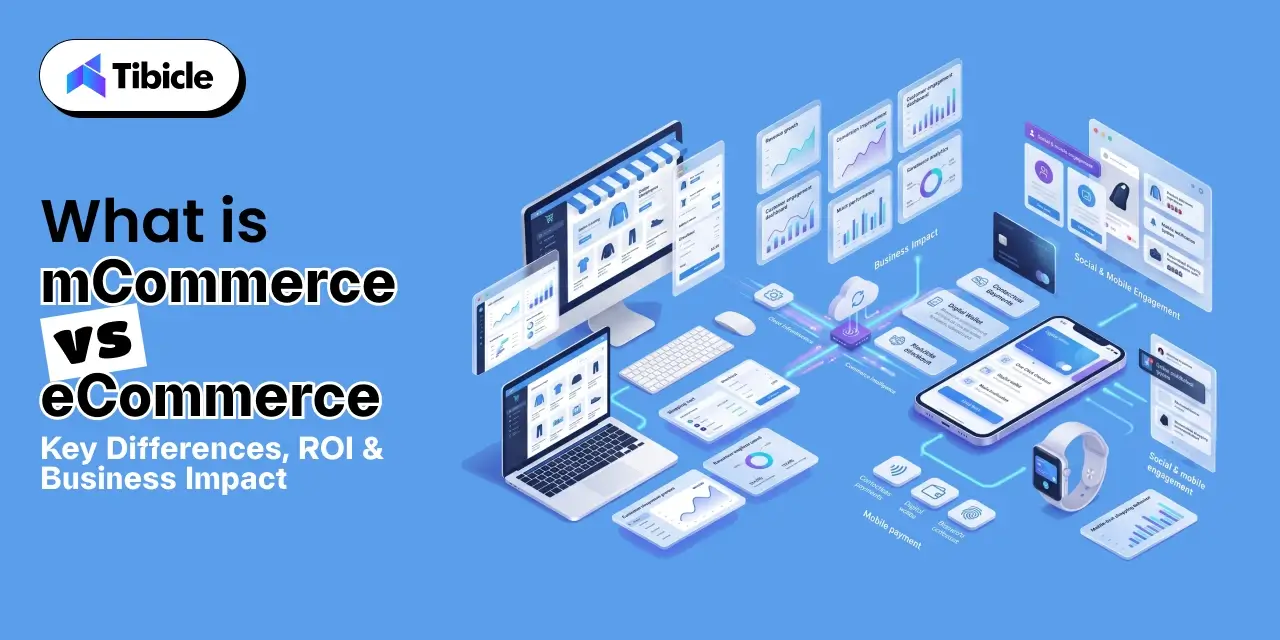
Yet the question most C-suite leaders are still wrestling with is not whether mobile matters but what separates m-commerce vs. e-commerce at the operational and revenue level, and where exactly budget, development resources, and UX investment should be concentrated.
This is not a beginner’s guide to definitions. Companies investing in digital commerce must make high-stakes decisions about platform architecture, development spend, and customer experience design. Getting the m-commerce vs e-commerce distinction wrong at the strategic layer leads to misallocated budgets, underperforming conversion rates, and competitive disadvantage in a market where mobile-first has already become the default consumer expectation.
This guide will break down the structural, financial, and strategic differences between m-commerce and e-commerce, including ROI benchmarks, cost models, risk factors, and a vendor selection framework, everything a decision-maker needs to act, not just understand.
What Is eCommerce? A Quick Operational Overview
E-commerce, in a business context, refers to the buying and selling of goods and services through internet-connected devices, primarily desktops and laptops. It encompasses the full digital transaction infrastructure: product catalog management, payment processing, order fulfillment, and customer data management, typically delivered through a web-based storefront.
The global e-commerce market is projected to be $6.86 trillion in 2025 (eMarketer), spanning both B2B and B2C models. B2C e-commerce powers the consumer retail experiences most people interact with daily. B2B e-commerce, valued at $36 trillion and growing at 14.5% CAGR, drives procurement, wholesale, and supply chain transactions between businesses.
From a conversion standpoint, desktop conversion rates average 3%, outperforming mobile web at 2% (Dynamic Yield). Desktop users tend to be higher-intent buyers: they complete longer research cycles, handle more complex transactions, and show lower cart abandonment rates than their mobile counterparts.
Understanding e-commerce as the foundation is essential before evaluating the differences between e-commerce and m-commerce, because m-commerce does not replace the e-commerce infrastructure. It extends and complicates it.
What Is mCommerce? Why Mobile Is a Separate Strategic Channel
mCommerce (mobile commerce) refers to commercial transactions conducted via smartphones, tablets, and other handheld devices. It is technically a subset of eCommerce, but treating it as merely a responsive version of a desktop site is one of the most common and costly strategic mistakes in digital commerce.
The scale is not a forecast anymore. The US alone has 200+ million adults who have purchased via smartphone (Shopify). Globally, mobile commerce is the primary interface for most consumers, particularly in high-growth markets across Southeast Asia, India, and Latin America.
M-commerce operates across three primary business categories:
Mobile shopping: Purchasing via mobile browsers or dedicated shopping apps, including social commerce platform integrations on TikTok Shop, Instagram, and Pinterest.
Payments on mobile: Digital wallet adoption through Apple Pay, Google Pay, and PayPal, enabling one-tap or biometric-authenticated checkout flows.
Banking on mobile: In-app financial services, BNPL integrations, and account management that support the full commerce transaction lifecycle.
The strategic capabilities that define m-commerce are distinct: push notifications for cart recovery and offer delivery, geolocation targeting for proximity-based promotions, in-app purchasing with reduced checkout friction, and biometric authentication that improves both security and conversion.
Critically, shopping app users convert at 3.5% versus 2% on mobile web (BuildFire). The mobile shopping app development investment is not just a UX upgrade it is a measurable conversion rate improvement that compounds across customer lifetime value.
Understanding the difference between e-commerce and m-commerce at this level is what separates reactive platform decisions from strategic ones.
mCommerce vs eCommerce: Core Differences That Affect Business Decisions
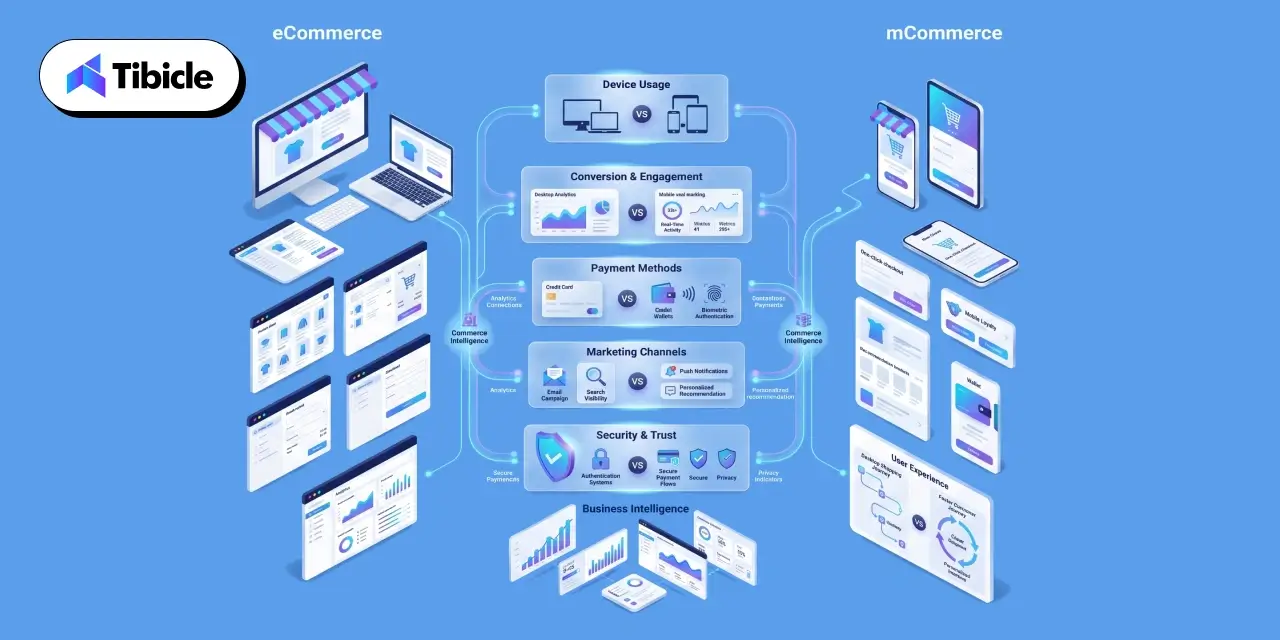
The e-commerce and m-commerce difference is not simply about screen size. At the operational level, the two channels diverge across device behavior, technology requirements, marketing infrastructure, and security posture. Each dimension carries direct business implications.
Device and User Behavior Split
Mobile drives 78% of global e-commerce traffic but only 66% of orders, a conversion gap that represents billions in underperforming revenue across the industry. Desktop users are high-intent buyers: they arrive further along in the purchase journey, complete longer research cycles, and transact with lower abandonment rates. Mobile users browse more, compare across sessions, and are more susceptible to checkout friction. The mobile commerce vs electronic commerce distinction in user behavior is not a preference difference it is a purchase psychology difference that must inform UX and funnel design.
Technology Stack and Development Requirements
E-commerce platforms are built around CMS and website infrastructure, such as Shopify, WooCommerce, Magento, and BigCommerce, with responsive design, payment gateway integration, and SEO-optimized architecture. The technology investment is primarily web-based.
M-commerce requires a fundamentally different technical layer: native app development or progressive web app e-commerce architecture, mobile payment integration with digital wallet providers, push notification infrastructure, biometric authentication, and app store compliance management. The mobile shopping app development requirement alone introduces an entirely new development discipline and cost structure that e-commerce websites do not encounter. This is a central dimension of the m-commerce vs e-commerce decision for any technology leader evaluating build-vs-buy options.
Marketing and Personalization Channels
E-commerce marketing is built around email, organic search, display advertising, and retargeting channels optimized for desktop sessions and longer consideration windows. M-commerce unlocks a distinct and often higher-engagement channel set: SMS marketing, in-app messaging, location-based offers, and social commerce platform integrations where discovery and purchase happen within a single session.
AI-powered recommendations drive up to 25% of mobile revenue (industry benchmarks), and mobile-first strategy increasingly depends on real-time behavioral personalization delivered at the session level, not the campaign level. Mobile conversion optimization through contextual, behavioral, and location-aware personalization is a genuine revenue lever, not a UX enhancement.
Security and Compliance Considerations
The difference between e-commerce and m-commerce extends into the security and compliance layer. Mobile introduces additional attack surfaces: app store compliance requirements, device-level data access permissions, biometric data regulations under GDPR and CCPA, and a fraud environment that is materially worse than desktop.
1 in 20 mobile verification attempts in 2024 were fraudulent. Any m-commerce investment must account for mobile-specific fraud prevention infrastructure, biometric authentication protocols, and ongoing compliance with regional data protection regulations costs and complexity that do not appear in a standard e-commerce platform evaluation.
mCommerce vs eCommerce Comparison Table
| Parameter |
E-Commerce |
M-Commerce |
| Primary device |
Desktop/laptop |
Smartphone/tablet |
| Avg. conversion rate |
3% |
2% (web), 3.5% (app) |
| Traffic share |
35% globally |
62–64% globally |
| Revenue share (2025) |
40% |
60% |
| UX focus |
Full-page layouts, detailed specs |
Speed, thumb-friendly UI, one-tap checkout |
| Payment methods |
Cards, bank transfers, wallets |
Digital wallets, BNPL, biometric pay |
| Personalization |
Email, cookies, retargeting |
Push, geolocation, in-app behavior |
| Development cost |
Lower (website-only) |
Higher (app + mobile web + integrations) |
| Cart abandonment rate |
66% |
80% |
Analysis: The data on m commerce vs e commerce conversion rates reveals something important. Mobile generates the majority of traffic but converts less on the mobile web. The gap is not a demand problem — it is a UX and checkout optimization problem. Businesses that close this gap through mobile shopping app development and streamlined checkout flows access a revenue pool that is already visiting their store.
ROI and Business Impact Where the Revenue Actually Comes From
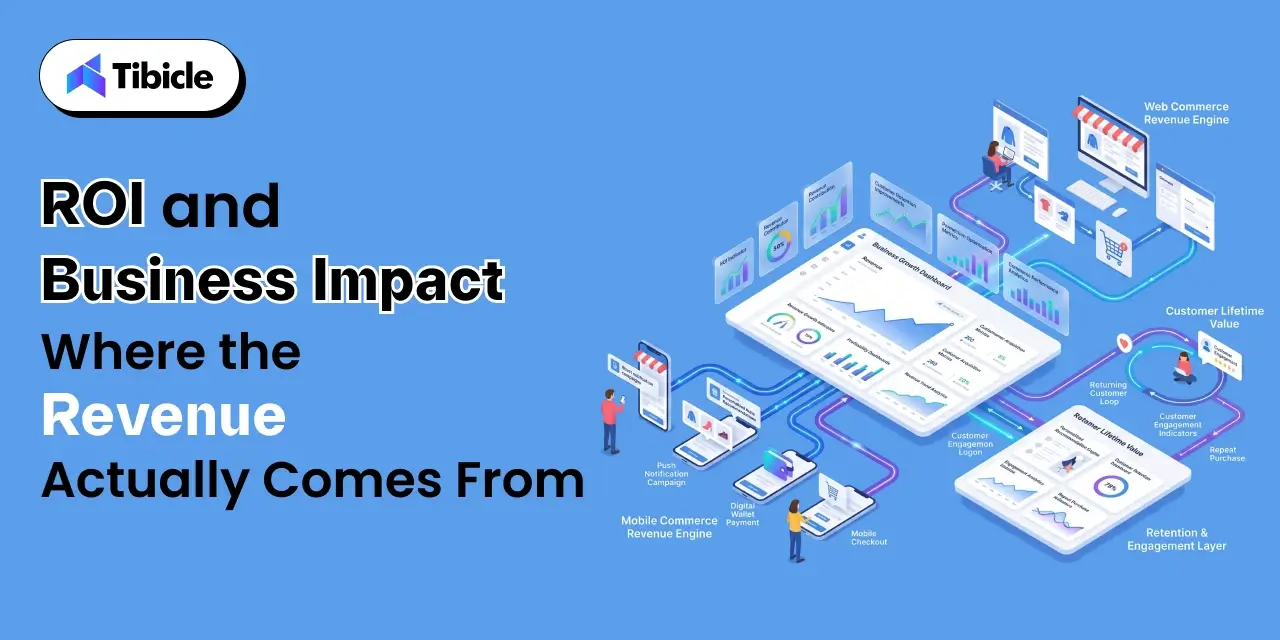
The mobile commerce vs electronic commerce debate becomes less philosophical and more actionable when you look at where revenue is actually being generated.
Revenue Distribution by Channel
M-commerce drives 63% of global retail commerce revenue (Statista, 2025). On Black Friday 2025, 70% of all sales came from mobile devices, a figure that should recalibrate any strategic plan that treats desktop as the primary commerce channel. Mobile app users generate 2.8–5x higher customer lifetime value than web-only shoppers, making the mobile shopping app development investment one of the highest-return capital allocations available in digital commerce.
Cost of Inaction
Businesses without a mobile-optimized experience lose 78% of traffic that never converts. Customer acquisition cost (CAC) has risen 222% over the last decade, a trend that makes high-retention channels like native apps increasingly critical to unit economics. Mobile apps, through push notifications, loyalty mechanics, and personalized re-engagement, deliver higher retention and lower CAC over time than desktop-only or mobile web approaches.
App vs Mobile Web ROI
Abandoned cart push notifications alone can generate $10,000+ per month in recovered revenue for mid-market retailers. App users purchase 33% more often than non-app users. With full mobile payment integration, personalized in-app experiences, and push notification infrastructure in place, total app ROI can scale to 5–10x within the first year of deployment. For businesses evaluating the difference between e-commerce and m-commerce investment, this is the clearest financial argument for committing to native or PWA mobile development.
Cost and Pricing Factors for mCommerce vs eCommerce Implementation
Understanding the cost structure of each channel is essential for accurate ROI modeling and budget sequencing. The e-commerce and m-commerce difference in investment requirement is significant and varies considerably by business maturity.
eCommerce Platform Costs
Website development ranges from $5,000 to $50,000+, depending on platform choice (Shopify, WooCommerce, Magento, or custom builds) and feature complexity. Ongoing operational costs, such as hosting, security, maintenance, and platform licensing, typically run $500 to $5,000 per month. For most businesses, e-commerce web infrastructure is the lower-cost starting point.
mCommerce Development Costs
Native app development for iOS and Android combined typically costs $30,000 to $150,000+, depending on feature depth, integration complexity, and development partner location and seniority. A progressive web app ecommerce alternative ranges from $10,000 to $50,000, delivering app-like performance within a browser context at lower build cost, though with some capability limitations versus native. Ongoing m-commerce costs include app store fees, push notification services, mobile analytics platforms, mobile-specific QA cycles, and compliance monitoring.
Where to Prioritize the Budget
The right sequencing of m-commerce vs. e-commerce investment depends on the business stage:
- Under $1M revenue: Mobile-responsive website first. Optimize for mobile web before investing in app development.
- $1M–$10M revenue: Progressive web app or hybrid app investment. Capture mobile conversion improvements with lower capital outlay than a full native build.
- Above $10M revenue: Dedicated native apps with full mobile payment integration, personalization stack, and push notification infrastructure. At this scale, the ROI math justifies the full investment.
Risks and Challenges of Each Model
No mCommerce vs eCommerce analysis is complete without an honest assessment of the risks on both sides.
eCommerce Risks
Desktop traffic share is declining globally as mobile-first behavior becomes the norm across demographics. E-commerce platforms built without a mobile-first strategy face increasing structural disadvantage. SEO volatility with algorithm updates creates revenue unpredictability for traffic-dependent businesses. And businesses that have not optimized mobile checkout on their desktop-first e-commerce sites are already losing the majority of their traffic to non-converting mobile sessions a compounding loss.
mCommerce Risks
Cart abandonment on mobile sits at 80%, the highest across all commerce channels, and a persistent challenge even for mature mobile experiences. App fatigue is a real risk: 30% of shoppers delete apps due to excessive push notifications, meaning mobile conversion optimization must be balanced against engagement frequency. Security exposure is higher: fraud rates on mobile are significant, and compliance with GDPR, CCPA, and evolving biometric data regulations adds ongoing operational cost. Perhaps most sobering: only 12% of consumers find mobile web shopping “convenient” (Dynamic Yield), a figure that underscores why mobile shopping app development, rather than mobile-responsive web, is the stronger long-term investment for businesses serious about the m-commerce channel.
Vendor Selection Checklist: What to Evaluate Before Building
Whether investing in e-commerce, m-commerce, or both, evaluate every technology partner against these criteria before committing budget:
- Platform flexibility: Does the vendor support both e-commerce and m-commerce from a single codebase or unified backend?
- Mobile-first architecture: Is the platform natively built for mobile-first UX, or is mobile a retrofit of a desktop-first design?
- Payment integration: Does it support digital wallet adoption, BNPL, and biometric payment natively?
- Scalability: Can it handle 2x–5x traffic surges during holiday peaks and flash sales without performance degradation?
- Analytics and attribution: Does it track cross-device customer journeys and mobile-specific KPIs (push open rates, in-app conversion, session depth)?
- Security compliance: PCI-DSS, GDPR, CCPA readiness including mobile-specific data access and biometric regulations?
- Post-launch support: Does the partner provide app store management, push notification strategy, and ongoing mobile QA?
- Total cost of ownership (TCO): Upfront build cost plus 12-month operational cost not just the development quote.
Top Tools and Platforms for mCommerce vs eCommerce in 2026
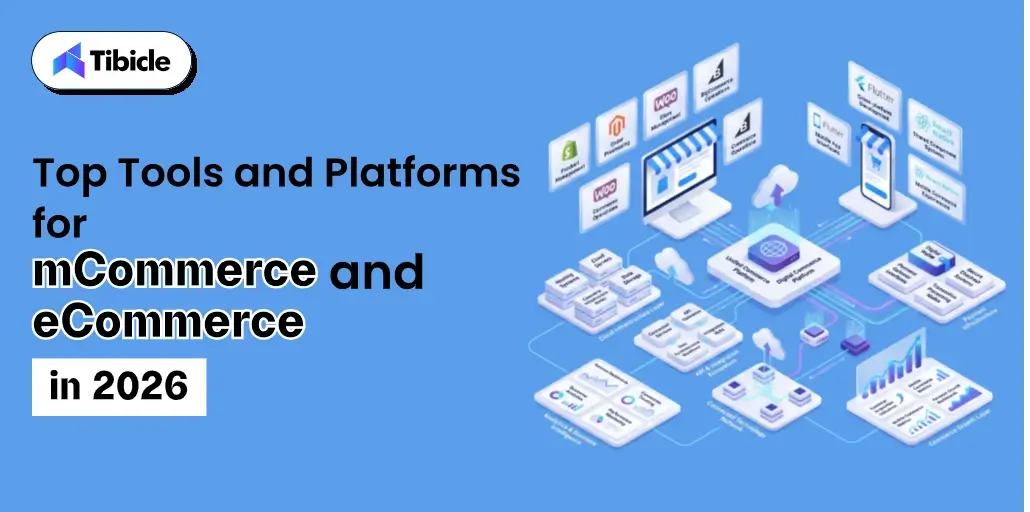
The right platform for your m-commerce vs e-commerce architecture depends on business maturity, budget, and technical requirements. No single platform fits all.
Shopify remains the strongest mid-market option for businesses that need both e-commerce and m-commerce capability quickly. Its PWA support and native mobile payment integration make it a strong default for businesses under $10M revenue.
Magento delivers enterprise-grade flexibility for custom mobile experiences, with deep API-first architecture suited to complex B2B ecommerce and B2C at scale.
WooCommerce with mobile plugins serves budget-conscious SMBs that need mobile-responsive e-commerce without the overhead of a dedicated app investment.
BigCommerce offers native mobile optimization and strong out-of-the-box mobile conversion tools, particularly for mid-market retailers.
React Native and Flutter are the leading custom app development frameworks for businesses building dedicated native mobile apps, enabling shared codebases across iOS and Android, reducing mobile shopping app development cost by 30–40% versus fully separate native builds.
Match the tool to your business stage. Over-investing in enterprise infrastructure at an early stage, or under-investing in mobile at a growth stage, are equally costly mistakes in the m-commerce vs. e-commerce decision.
Why Tibicle Is a Strong Choice for mCommerce vs eCommerce Development
Businesses that have worked through the vendor checklist above and concluded they need a custom build or a development partner capable of delivering both e-commerce and m-commerce infrastructure under a single technical relationship need more than a platform vendor. They need an engineering team.
Tibicle builds custom e-commerce and m-commerce solutions: native iOS and Android apps, progressive web app ecommerce builds, and responsive web platforms designed for a mobile-first strategy from the ground up. The team is based in Ahmedabad with senior development capability across the full stack design, build, QA, and launch, with a transparent pricing model that makes TCO forecasting straightforward.
The use case fit is specific: mid-market and enterprise B2B and B2C businesses that need both desktop and mobile commerce under one technical partner, without the coordination overhead of managing multiple vendors across the commerce stack. Tibicle’s mobile payment integration experience, cross-platform deployment capability, and mobile conversion optimization track record align directly with the criteria outlined in the vendor checklist above.
Talk to Tibicle’s commerce team to scope your mCommerce or eCommerce build and get a technical assessment of where your current architecture is leaving revenue on the table.
Conclusion
The mCommerce vs. eCommerce question is no longer an either/or decision for serious digital commerce businesses. It is a sequencing and budget allocation question one where the wrong answer at the platform architecture stage creates compounding conversion and retention problems that are expensive to unwind.
Mobile commerce is the majority revenue channel: 60% of global e-commerce revenue, 70% of Black Friday sales, and the primary commerce interface for the majority of consumers under 45. But e-commerce infrastructure, the web platform, the backend, the fulfillment and payment systems, remain the foundation on which mobile experiences are built.
For C-suite leaders, the decisions made now on vendor selection, platform architecture, and mobile investment level will directly affect conversion rates, customer lifetime value, and competitive positioning through 2026 and beyond. The businesses that treat mobile-first strategy as a core infrastructure decision, not a UX project, will be structurally better positioned to capture the commerce revenue that mobile is already generating.
Contact Tibicle to discuss your commerce platform strategy and get a custom development roadmap tailored to your current architecture, business model, and 2026 growth targets.
Frequently Asked Questions
What is the main difference between mCommerce vs eCommerce?
eCommerce covers all online buying and selling via the internet, typically through desktop or laptop browsers. mCommerce is a subset of e-commerce that involves transactions conducted specifically through mobile devices like smartphones and tablets. The core e-commerce and m-commerce difference at a strategic level lies in user behavior, technology stack, marketing channels, and conversion mechanics, not just the device used.
Is mCommerce more profitable than eCommerce?
mCommerce now drives 60% of global e-commerce revenue and mobile app users deliver 2.8–5x higher customer lifetime value than web-only shoppers. However, profitability in mobile commerce vs electronic commerce depends heavily on mobile UX quality, the level of app investment (native vs PWA), and how effectively cart abandonment, which runs at 80% on mobile, is addressed through checkout optimization and push notification recovery flows.
How much does it cost to build an mCommerce app?
A native m-commerce app for iOS and Android typically costs $30,000–$150,000+. Progressive web app ecommerce alternatives range from $10,000–$50,000 and deliver app-like performance at a lower build cost. Ongoing costs include app store fees, mobile analytics platforms, push notification services, and mobile-specific QA, typically adding $1,000–$5,000 per month in operational overhead.
Which is more profitable, mCommerce vs eCommerce?
Profitability depends on the business model, product type, and target audience rather than the platform alone. However, with mobile commerce accounting for 60% of global e-commerce sales in 2025, businesses that ignore mobile optimization risk losing a significant share of potential revenue.
Can a business run both eCommerce and mCommerce from the same platform?
Yes. Platforms like Shopify, BigCommerce, and Adobe Commerce support both e-commerce and m-commerce from unified backends. Custom builds using React Native or Flutter can share a single backend while delivering native mobile experiences on iOS and Android. For businesses evaluating mobile commerce vs electronic commerce infrastructure, a unified platform reduces development cost, simplifies analytics attribution, and eliminates backend duplication.
What conversion rate should I expect from mobile commerce?
Mobile web converts at roughly 2%, while mobile apps convert at 3.5%. Desktop e-commerce still leads at approximately 3%. The m-commerce vs e-commerce conversion gap on mobile web is primarily a UX and checkout optimization problem, not a demand problem. Businesses that invest in mobile shopping app development, one-tap checkout, and digital wallet adoption consistently see mobile conversion rates that meet or exceed desktop benchmarks.