Introduction
Most restaurant and food service operators approach the kitchen management software decision backwards. They evaluate software cost before they evaluate operational fit and the downstream consequences are significant. The wrong choice either locks your team into a rigid platform that cannot reflect how your kitchen actually runs, or it drains engineering budget on features that ship 12 months behind schedule while operations absorb the gap.
This is not a software procurement call. It is an operational strategy call, and the variables that determine the right answer are specific to your workflows, your scale, and your competitive positioning. This guide covers what kitchen management software actually includes, where the real decision point sits, what each path costs, the ROI data behind automation, and what to look for whether you are buying a platform or engaging a custom development partner.
What Does “Kitchen Management Software” Actually Cover?
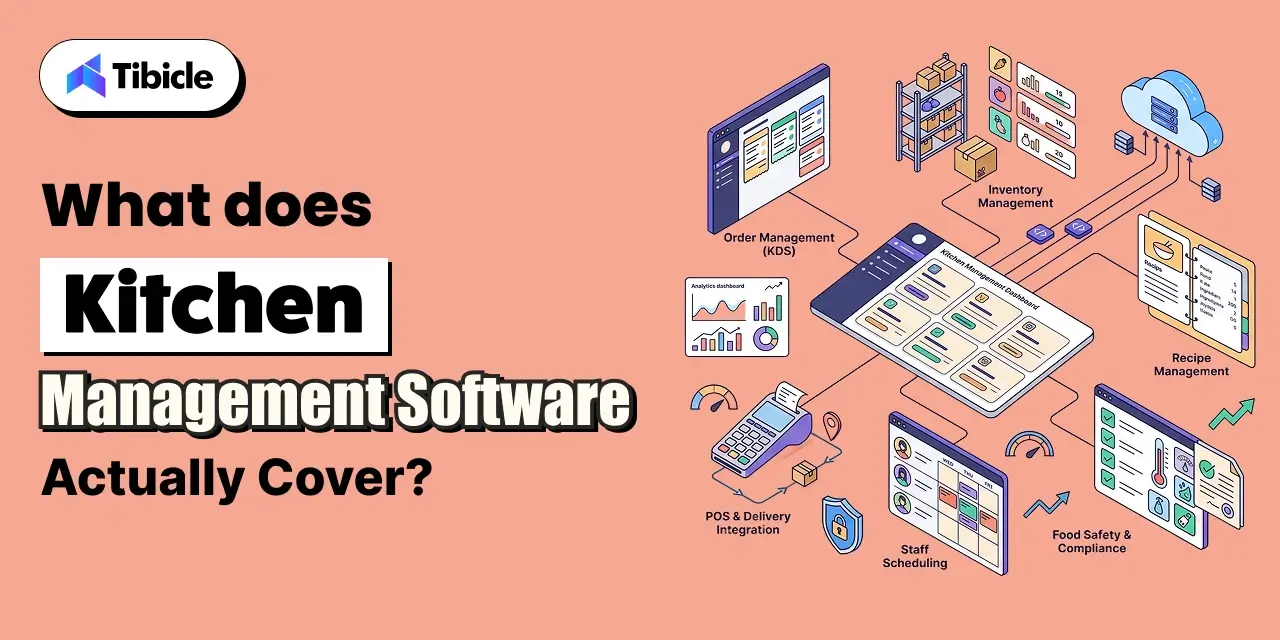
Before any build-vs.-buy analysis is useful, there needs to be a shared understanding of what kitchen management software actually encompasses. The term gets used loosely and executives who underestimate scope tend to make buying decisions that fall short of operational requirements, or scoping decisions for custom builds that leave out critical modules.
The Core Modules That Drive Operations
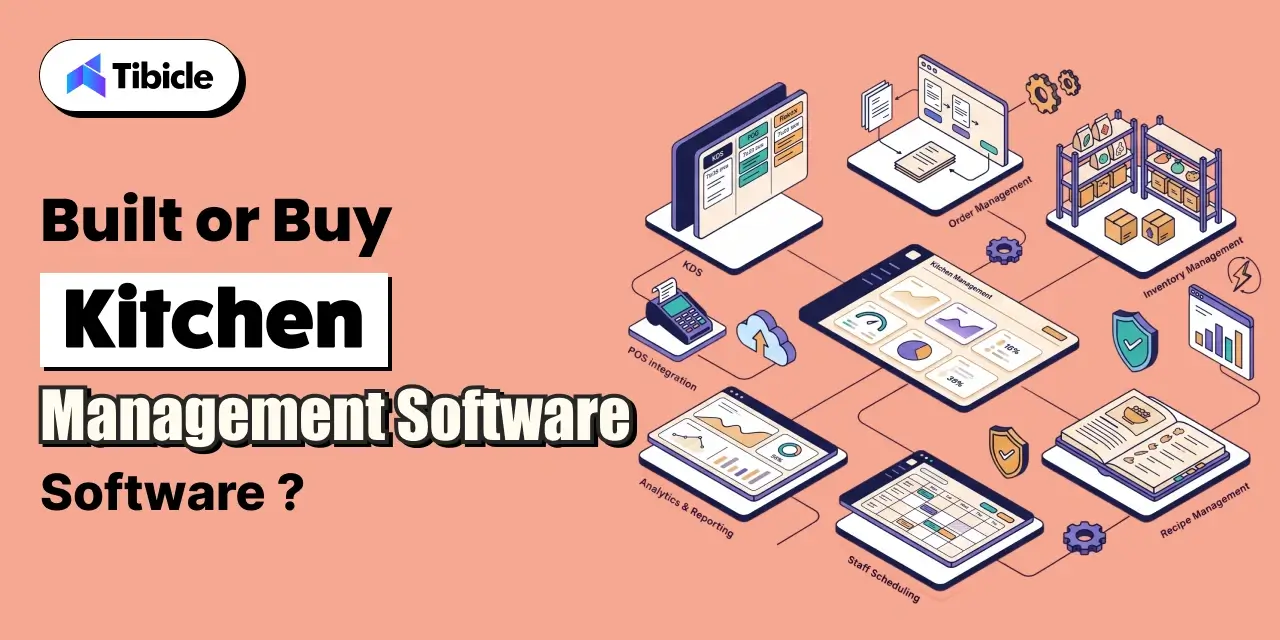
A production-grade kitchen management software system typically covers:
- Order routing and kitchen display system (KDS) integration directing orders from POS to the right prep station in real time
- Inventory and food cost control tracking ingredient consumption against theoretical usage and flagging variance
- Recipe management software with real-time costing tying ingredient costs to menu items and updating margins as prices shift
- Staff scheduling and labor tracking managing kitchen labor against projected cover counts
- HACCP compliance and food safety logs automating temperature checks, cleaning schedules, and food safety documentation
- POS integration and third-party delivery sync connecting order flow across in-house and third-party channels
What “Custom” Means in This Context
Custom restaurant kitchen software does not mean adding a logo to an existing platform. It means building workflows directly around your standard operating procedures the sequencing logic your kitchen team uses, the routing rules specific to your brand structure, the compliance requirements tied to your operating context.
This is most relevant for: multi-location restaurant brands, ghost kitchen operators managing several virtual brands, enterprise chains with proprietary recipes and margin sensitivity, and catering or institutional food service companies whose volume and workflow logic does not fit standard SaaS templates.
The Real Question: Where Does Your Kitchen Operation Diverge From the Norm?
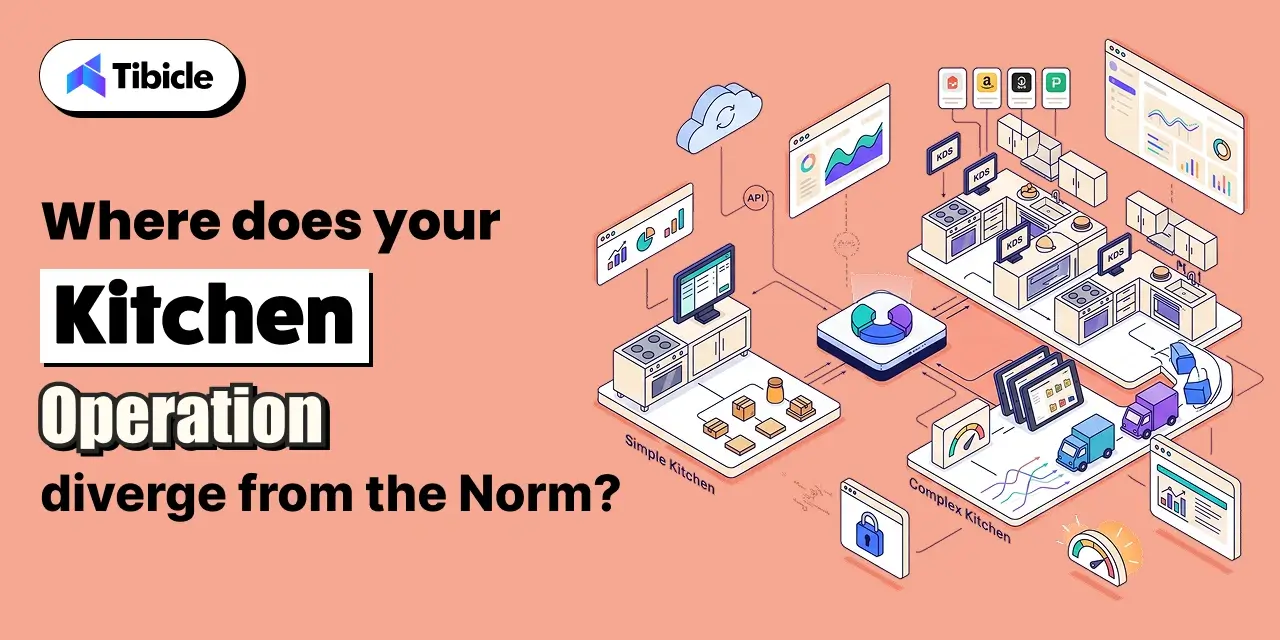
This is the actual decision filter not which software has the best feature list, but how far your back-of-house operations diverge from the assumptions embedded in off-the-shelf platforms. Most kitchen operations software is built around a standard model: a single brand, a linear prep flow, and a limited number of integrations. The further your operation sits from that model, the weaker a bought solution becomes.
When Off-the-Shelf Kitchen Operations Software Is Enough
Off-the-shelf food service management software is a sound choice when:
- You operate one location or a small footprint with consistent workflows across sites
- Your menu follows a standard format with limited recipe costing complexity
- Your integration requirements are narrow one or two third-party platforms at most
- Your technology infrastructure budget sits under $50,000
In these conditions, a commercial platform delivers rapid deployment, predictable cost, and sufficient capability. The trade-off in workflow fit is manageable.
When Custom Kitchen Order Management Becomes a Strategic Asset
Custom kitchen order management becomes the right answer when:
- You operate a multi-brand ghost kitchen managing five or more virtual brands with distinct routing logic
- You run an enterprise chain where proprietary recipe IP and margin sensitivity require internal control over data
- Your catering or institutional food service operation has volume or workflow requirements that standard platforms cannot reflect
- You operate in a high-compliance environment healthcare, schools, hospitality groups where audit trails and food safety log generation need to fit specific regulatory formats
Decision trigger list: If three or more of the following apply to your operation, you likely need a custom build.
- Your order routing rules differ by brand, daypart, or channel
- You manage proprietary recipe costing data you cannot expose to a vendor
- You need real-time kitchen analytics tied to custom KPIs
- Your third-party delivery integration requirements go beyond what standard APIs support
- You operate in a regulated food service environment with non-standard compliance documentation
- You have more than five locations with inconsistent workflows between them
- Your current platform requires constant manual overrides to match actual kitchen operations
Use Cases What Each Path Looks Like in Practice
Buying a Food Service Management Platform
A 12-location QSR chain deploys a SaaS kitchen management platform in six weeks. The system covers order routing, inventory alerts, and kitchen display system integration out of the box. The team is operational quickly and costs are predictable. The trade-off: the platform cannot reflect their proprietary prep sequencing logic without expensive middleware sitting between the SaaS layer and their POS. The workaround works until the chain opens its 20th location and middleware costs compound.
Building a Custom Restaurant Kitchen Software
A cloud kitchen operator running eight virtual brands builds a custom kitchen workflow automation system. The build gives full control over brand-level order routing, real-time kitchen analytics, and dynamic labor allocation tied to live order volume. The trade-off is timeline and upfront investment: the MVP takes six to nine months, with an initial investment between $80,000 and $150,000. By Year 2, the operator has a system that reflects how their kitchen actually runs and a competitive asset no SaaS vendor can replicate for them.
The Hybrid Approach
The increasingly common path for mid-market operators: buy a commercial platform for core modules (POS, order management, basic inventory), and build only what is proprietary. Custom elements typically include routing logic, menu engineering dashboards, and brand-specific analytics. This approach limits custom development scope and cost while protecting the workflows that actually differentiate the operation.
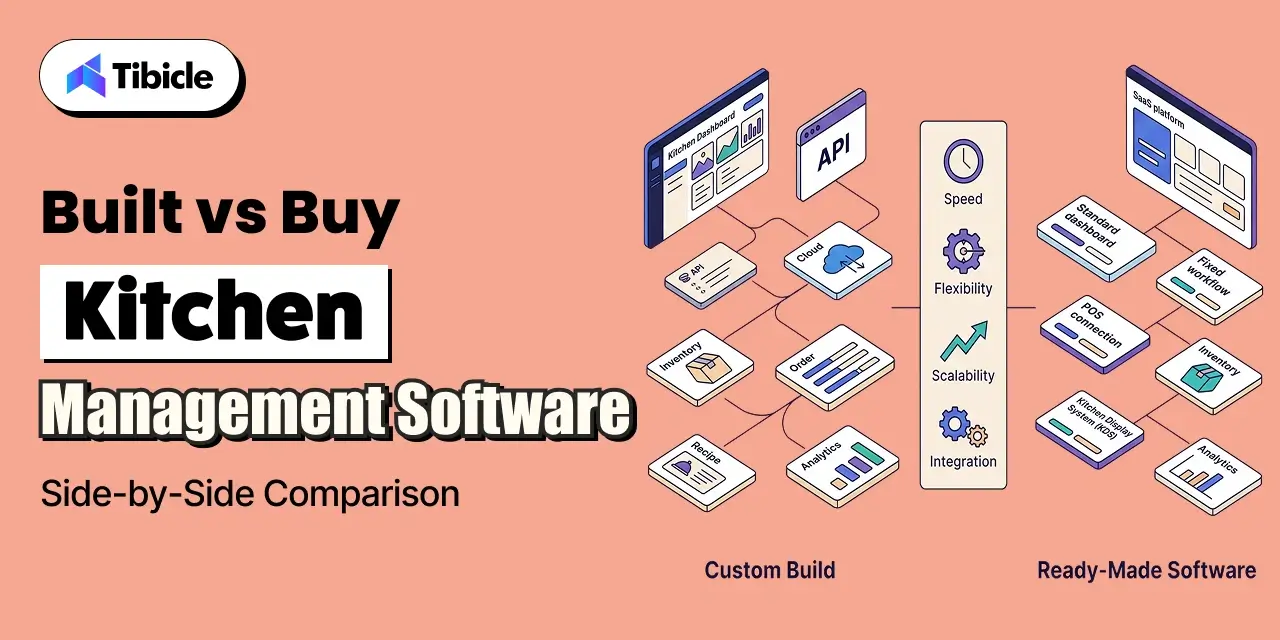
Build vs. Buy Kitchen Management Software Side-by-Side Comparison
| Factor |
Build (Custom) |
Buy (Off-the-Shelf) |
| Time to Deploy |
6–12 months |
2–8 weeks |
| Upfront Cost |
$50K–$200K+ |
$5K–$50K |
| 5-Year TCO |
Lower (no per-seat licensing) |
Higher (recurring fees + add-ons) |
| Customization |
Full |
Limited |
| Scalability |
Built to your growth curve |
Vendor roadmap dependent |
| Integration Depth |
Native |
API-limited |
| Support Model |
Internal or dev partner |
Vendor SLA |
| Competitive Moat |
High, unique IP |
None |
| Risk if Key Dev Leaves |
High |
Low |
| Back-of-House Ops Fit |
Exact |
Approximate |
Off-the-shelf solutions average $1,000–$100,000 in upfront licensing costs, but operators typically pay 2–4x more over five years once licensing escalations, integrations, and workflow workarounds are factored in.
Unsure where your operation falls? Tibicle’s team can run a rapid-fit assessment with no commitment required.
What Does Kitchen Management Software Actually Cost?
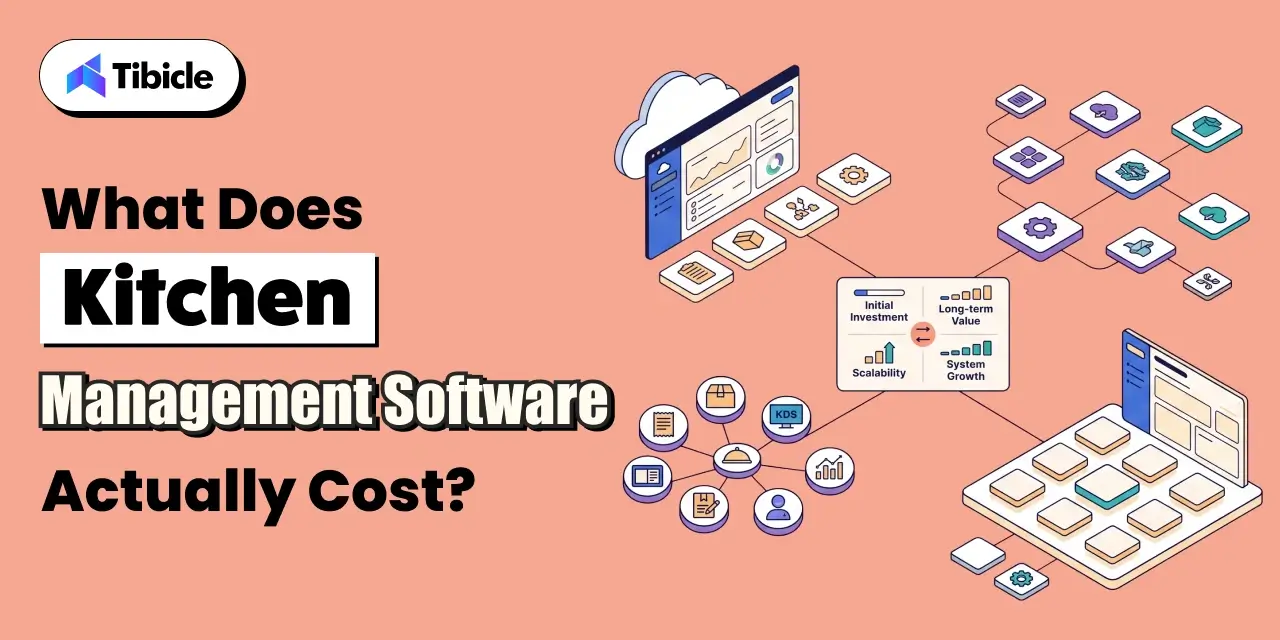
Cost is where most decisions stall not because the numbers are unavailable, but because operators compare upfront cost without accounting for total cost of ownership. The comparison looks very different at Year 1 versus Year 5.
Off-the-Shelf Pricing Benchmarks
- Entry-level SaaS platforms: $10–$100/month per location
- Mid-market platforms: $300–$800/month
- Enterprise platforms: Custom pricing, typically $1,000–$5,000/month for multi-unit groups
- Add-on modules (analytics, loyalty, advanced inventory): $10–$100/module/month
Restaurants consistently underestimate integration middleware costs, which can add $9,000–$15,000 annually often for connections that a purpose-built system would handle natively.
What Custom Kitchen Software Development Costs
- MVP (core order routing + inventory): $50,000–$100,000
- Full mid-range build (KDS, analytics, staff scheduling, POS integration): $100,000–$200,000
- Enterprise-grade with AI demand forecasting: $200,000+
- Timeline: 6–12 months for a production-ready system
The Hidden Cost of Cheap Platforms
Vendor lock-in is not a theoretical risk. Migrating data out of a tightly coupled SaaS platform is expensive and operationally disruptive data portability clauses are rarely as clean as contract language suggests.
Other compounding costs:
- Per-user licensing that increases directly with headcount growth
- Customization fees for workflow tweaks that appear “standard” in the sales conversation but require professional services in practice
- Off-the-shelf tools at Day 365 often deliver significantly less capability than a purpose-built system would for the same operational context forcing manual overrides that absorb the time savings the software was supposed to generate
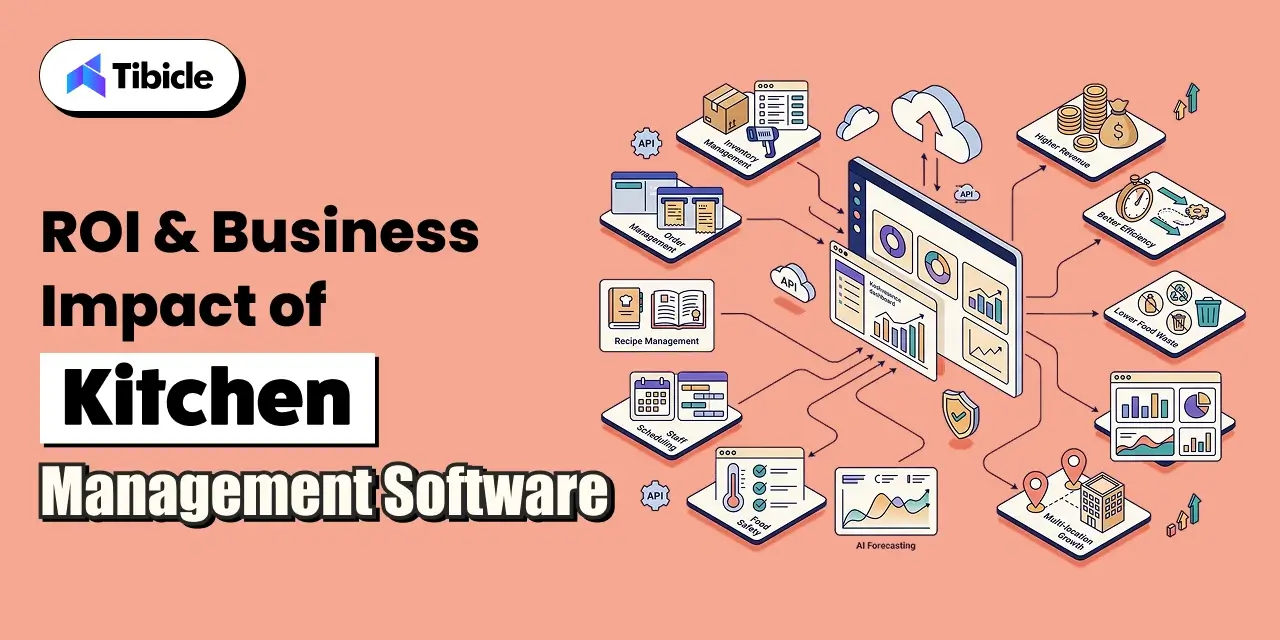
ROI and Business Impact of Kitchen Management Software
What Automated Kitchen Management Delivers
The business case for kitchen management software is well-established across published industry research:
- Restaurants using automated inventory systems cut food waste by an average of 26% and reduce over-ordering by 31%, translating to $18,000–$45,000 in annual savings for a $1M–$2M revenue operation. Leanpath Food Waste Index, 2024
- Manual inventory counting consumes 15–20 hours per week of management and kitchen staff time. Automated kitchen operations software eliminates most of this, freeing that time for higher-value functions. National Restaurant Association, 2024 State of the Restaurant Industry
- A 4.2% average improvement in food cost percentage achievable through real-time kitchen analytics and recipe management software adds approximately $63,000 annually in profit for a $1.5M-revenue restaurant. Hospitality Technology, 2024 Restaurant Technology Study
- AI-powered demand forecasting typically recovers its development cost within 6–12 months for operators above $1M in annual revenue. McKinsey & Company, AI in Food Service, 2023
ROI Comparison Build vs. Buy Over 5 Years
Year 1: Off-the-shelf wins on speed and lower cash outlay. The custom build is still in development or early deployment.
Years 2–3: The custom build crosses break-even as SaaS licensing escalations, middleware fees, and workaround costs compound on the bought side. Operators on standard platforms often add integration layers that push annual costs significantly beyond initial projections.
Years 4–5: Custom builds outperform by 30–60% on total cost of ownership for operators above $1M annual revenue. The competitive differentiation value unique workflows, proprietary analytics, IP control compounds on top of the cost advantage.
Where the ROI Gets Undermined
Two failure modes are common:
- Buying a platform that does not fit your back-of-house operations requiring constant manual overrides that eliminate the time savings the system was supposed to deliver
- Building without a clear MVP scope leading to 20–30% cost overruns and delayed deployment, which pushes break-even further out and erodes internal confidence in the project
Risks and Challenges You Need to Price Into the Decision
Building Custom Kitchen Management Software
- Scope creep: Shifting feature requirements inflate budgets by 20–40% without rigorous project management and a locked MVP definition
- Key-person dependency: If the lead developer exits during or after the build, a replacement typically spends 3–6 months ramping before reaching full productivity
- Delayed time-to-value: Custom systems typically reach full capability at 12+ months post-project start, versus Day 1 for SaaS platforms
- Integration blind spots: Third-party delivery platform APIs and existing POS systems can surface unexpected complexity during development underestimating integration scope is one of the most common budget errors
Buying Off-the-Shelf Kitchen Operations Software
- Vendor discontinuation or acquisition: Your entire operation depends on a third party’s product roadmap and corporate decisions
- Data exposure: Commercial vendors can access your proprietary recipes, menu engineering logic, and order data relevant for any operator whose recipe IP carries competitive value
- Customization ceiling: Workflows that diverge from the platform’s design model require middleware or professional services workarounds, adding cost and fragility
- Per-seat pricing punishes growth: Headcount expansion directly increases software costs, compressing the economics of scaling
- Migration risk: Leaving a tightly coupled platform later is expensive plan for this from Day 1, not when you are already under contract
Vendor and Partner Selection Checklist
Use this checklist in both directions: evaluating a SaaS vendor or assessing a custom development partner.
For Buying a Platform
- Does it support your exact kitchen workflow without requiring middleware?
- What is the contractual exit strategy and data portability policy?
- Does pricing scale per location or per user and what is the 3-year cost projection at your current growth rate?
- Is HACCP compliance and food safety log generation built in, or is it an add-on?
- What is the SLA for downtime, and who bears the cost of kitchen disruption during an outage?
- Can it integrate natively with your current POS and third-party delivery platforms?
For Engaging a Custom Development Partner
- Do they have demonstrated experience in food service management software specifically not just general SaaS development?
- Can they deliver an MVP in under six months with clear milestone accountability?
- Do they use modular architecture that allows future feature additions without full rebuilds?
- What is the post-launch maintenance and support model?
- Do they own the IP after delivery, or do you?
Leading Kitchen Management Software Options in the Market
Several recognized platforms serve the food service sector, each with distinct positioning:
- MarketMan: mid-market inventory and food cost control platform, strongest fit for independent restaurants and small chains with standard recipe management needs
- Lightspeed Restaurant: POS-adjacent platform with kitchen operations modules, suited to single-brand operators needing integrated front-of-house and back-of-house coverage
- Crunchtime: enterprise-grade food service management software used by large multi-unit chains, strong on labor and inventory but with significant implementation complexity
- Syrve (formerly iiko): comprehensive restaurant kitchen software with POS integration, stronger in European and Middle East markets, growing presence in enterprise food service globally
- Apicbase: food and beverage management platform targeting hospitality groups and institutional food service, with menu engineering and procurement modules
Each platform covers the core use case well within its design assumptions. Operators whose workflows, brand structures, or compliance requirements fall outside those assumptions consistently find the gap between platform capability and operational need requires workarounds that erode the value of the subscription.
Why Tibicle LLP Is Worth Evaluating for Kitchen Management Software
If the checklist above leans toward build, Tibicle LLP is a development partner worth a conversation.
Tibicle works with mid-market restaurant groups, ghost kitchen operators, and institutional food service companies that have outgrown off-the-shelf tools. The approach is modular — systems are architected so new features can be added without rebuilding the foundation. Client IP ownership is standard: you own the code on delivery, not Tibicle.
On delivery structure, Tibicle operates with milestone-based accountability and a structured MVP process; the goal is a production-ready core system within a defined timeline, not an open-ended development engagement. Post-launch support is included in the engagement model, not treated as a separate contract.
If your operation fits the build scenario outlined in this guide multi-brand structure, proprietary workflow logic, high compliance requirements, or a scale that makes SaaS licensing economics unworkable Tibicle runs a no-cost discovery session to validate scope and cost before you commit.
Conclusion
The build-vs.-buy decision for kitchen management software is not a technology question. It is an operational strategy question. The right answer depends on how closely your workflows match the assumptions embedded in commercial platforms, how much your recipe and routing IP is worth protecting, and what your five-year cost of ownership looks like at your projected scale. For most single-location or early-stage operators, an off-the-shelf platform delivers fast deployment and manageable cost. For operators above $1M in revenue with complex workflows, multiple brands, or compliance-intensive environments, a custom build or hybrid approach consistently outperforms on both cost and operational fit beyond Year 2.
Talk to Tibicle’s team about whether a custom kitchen management software build is right for your operation. Get a free scope and cost estimate.
FAQs
What is the typical cost of building custom kitchen management software?
Mid-range builds run $100,000–$200,000 for a production-ready system covering KDS, analytics, staff scheduling, and POS integration. MVP builds focusing on core order routing and inventory start around $50,000–$80,000 depending on modules and integration requirements.
How long does it take to build a restaurant kitchen software system from scratch?
A properly scoped MVP typically takes 4–6 months. A full-featured system with real-time kitchen analytics, HACCP compliance logging, and POS integration runs 9–12 months. Timeline is directly tied to how clearly the MVP scope is defined before development begins.
What are the hidden costs of off-the-shelf kitchen operations software?
Licensing fees increase over contract terms. Integration middleware adds $9,000–$15,000 annually for operators with more than two third-party connections. Per-user pricing compounds as headcount grows. Over five years, total costs often run 2–4x the initial contract price.
When does buying a food service management platform make more sense than building?
When you operate fewer than five locations with standard workflows, need rapid deployment, have limited integration requirements, and do not carry proprietary recipe or routing logic worth protecting. The lower upfront cost and faster time-to-value make commercial platforms the right call at this scale.
What should I look for in a custom kitchen software development partner?
Domain experience in food service specifically, IP-first contracts where you own the code on delivery, modular architecture that supports future additions, a documented MVP delivery process with milestone accountability, and a clear post-launch support model.
Can I start with an off-the-shelf platform and migrate to custom software later?
Yes. Many operators follow this path, deploy a commercial platform early, then build custom as workflows mature and scale demands it. Plan for data migration complexity from Day 1. Clean data architecture in your initial platform significantly lowers migration cost when you make the switch.