Introduction
The global retail automation market hit $27.65 billion in 2025 and is projected to reach $77.36 billion by 2034, growing at a 12% CAGR (Fortune Business Insights). That growth rate is not a coincidence, it reflects a fundamental shift in how retail businesses manage costs, scale operations, and serve customers in an environment that no longer tolerates inefficiency.
Retail leaders face several operational challenges today: rising labor costs, complex omnichannel fulfillment, shrinking margins, and unstable supply chains. Manual processes cannot handle these pressures efficiently.Businesses that continue managing these challenges manually are not holding stead, they are falling behind competitors who have already automated.
This guide is written specifically for executives and operations decision-makers who are evaluating retail automation as a strategic investment, not a technology experiment. It explains what retail automation is, breaks down its core types and real-world use cases, and provides the ROI benchmarks, pricing context, and vendor evaluation criteria you need to make a defensible, well-informed decision.
What is Retail Automation?
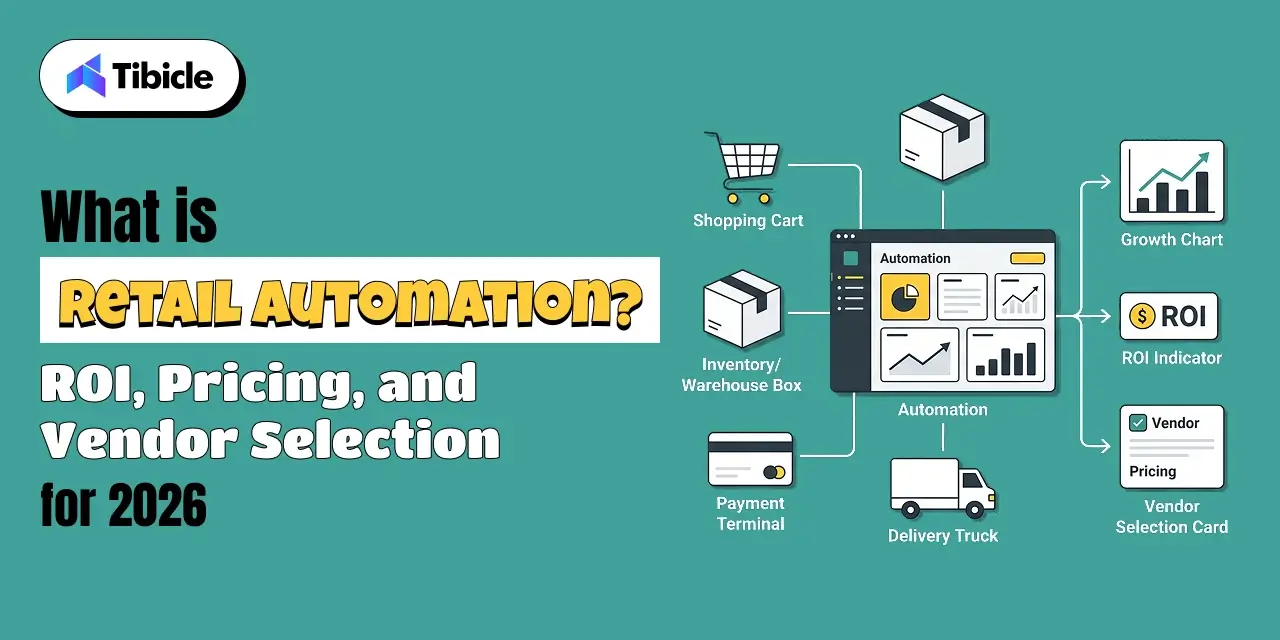
Retail automation is the use of software, artificial intelligence, robotics, IoT sensors, and integrated systems to replace or significantly reduce manual intervention in repetitive retail operations across in-store, warehouse, and digital channels.
The scope of retail automation is broader than most executives initially assume. It is not limited to self-checkout kiosks or customer-facing chatbots. Modern retail automation solutions encompass inventory management, dynamic pricing, supply chain coordination, marketing execution, order fulfillment, workforce scheduling, compliance reporting, and customer analytics. It covers the full operational stack, front-of-store, back-office, warehouse, and e-commerce simultaneously.
According to the World Economic Forum, AI services in the retail sector alone are expected to grow from $5 billion to $31 billion by 2028, underscoring how quickly intelligent automation is moving from pilot programs to core business infrastructure.
What retail automation is not: a single platform purchase, a one-time deployment, or a front-of-store novelty. The most impactful retail automation strategies address back-office efficiency, warehouse throughput, and supply chain visibility in parallel, not just the customer-facing touchpoints that tend to receive the most attention.
Core Technologies Behind Retail Automation
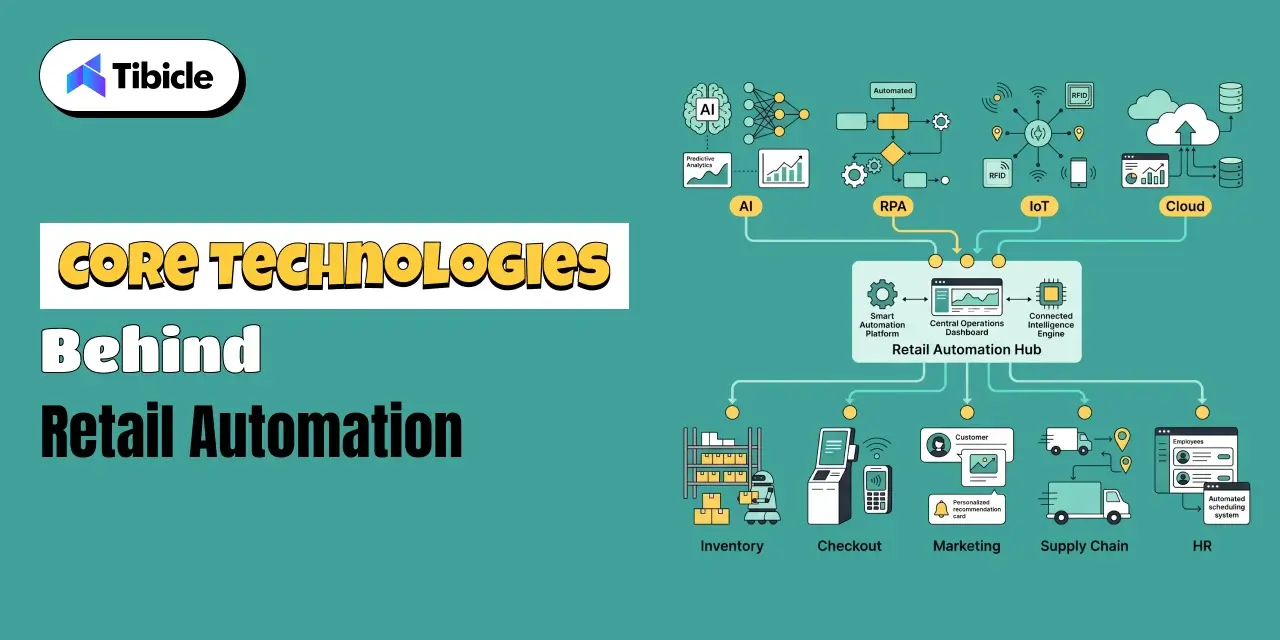
Understanding the technologies behind retail automation helps decision-makers evaluate vendors. It also helps them choose solutions that match their operational needs.
AI and Machine Learning
Artificial intelligence is the analytical backbone of modern retail automation. Machine learning models drive demand forecasting, enabling retailers to predict stock requirements with significantly greater accuracy than rule-based or spreadsheet-driven approaches. AI also powers dynamic pricing, adjusting prices in real time based on demand signals, competitor data, and inventory position, and enables personalized marketing by identifying behavioral patterns across millions of customer interactions.
Data point: 84% of organizations that have invested in AI report positive ROI, according to Deloitte. In retail specifically, AI-driven retail automation has shifted from an experimental budget line to a core profitability lever for businesses operating at scale.
Robotic Process Automation (RPA)
RPA automates rule-based, high-volume tasks that previously required manual handling: data entry, invoice processing, inventory reconciliation, returns documentation, and compliance reporting. Unlike AI, RPA does not learn or adapt, it executes defined workflows reliably at scale, making it particularly valuable for back-office retail process automation where consistency and volume are the primary requirements.
The global RPA market is projected to reach $35.27 billion in 2026 (Grand View Research), driven significantly by retail and logistics adoption across both mid-market and enterprise segments.
IoT and Smart Sensors
IoT-enabled devices allow retailers to monitor inventory levels in real time, track shelf conditions, detect stockouts before they affect sales, and manage temperature-sensitive storage for perishable categories. These sensors feed live data into centralized dashboards, enabling faster and more accurate operational decisions without requiring manual floor checks or periodic audits.
Cloud Computing and Analytics
Cloud infrastructure provides the centralized data access and processing power required for cross-channel retail automation. Cloud-native platforms connect POS transactions, e-commerce activity, warehouse operations, and customer behavior into unified BI dashboards, eliminating the data silos that fragment decision-making in manually operated retail environments.
Types of Retail Automation by Function
Retail automation operates across five primary functional areas. The business case and ROI profile differ meaningfully across each, which is why implementation sequencing matters as much as platform selection.
Inventory and Warehouse Automation
Inventory automation encompasses RFID-based tracking, automated reorder triggers tied to real-time sales velocity and supplier lead time data, and goods-to-person fulfillment systems that move products through warehouses without manual picking. This area consistently delivers the fastest and most measurable ROI for mid-to-large retailers.
Stat: Over 4.6 million commercial warehouse robots will be installed worldwide by the end of 2026 (SellersCommerce), reflecting the scale at which retail warehouse automation is being deployed across the industry globally.
Checkout and Payment Automation
Self-checkout kiosks, cashierless store formats, and contactless payment systems reduce front-of-store labor dependency and decrease transaction times in ways that directly affect customer satisfaction scores. Automated retail systems in this category have moved well beyond novelty deployments.
A frequently cited real-world example: Decathlon’s RFID-based checkout system reduced average transaction time from 20 minutes to under 1 minute by allowing customers to check out an entire cart without scanning individual items, a direct result of integrated retail automation applied at the point of sale.
Marketing and Customer Engagement Automation
Automated retail systems can trigger personalized email campaigns, loyalty program notifications, and product recommendations based on real-time customer behavior, without manual campaign management for each segment. These systems connect CRM data, purchase history, and browsing behavior to deliver contextually relevant engagement at scale, turning customer data into revenue without proportional increases in marketing headcount.
Supply Chain and Order Fulfillment Automation
Retail supply chain automation extends across demand forecasting, dynamic carrier routing, and end-to-end delivery tracking. These systems reduce manual coordination between procurement, warehousing, and logistics teams, improving delivery speed and reducing the costly errors that propagate through manual handoffs across the supply chain.
Back-Office and HR Automation
Payroll processing, workforce scheduling, timekeeping, and compliance reporting are high-volume, error-prone functions that retail process automation handles efficiently. Automating these workflows reduces administrative overhead, decreases compliance exposure, and allows operations managers to focus on strategic decisions rather than routine administrative processing.
Retail Automation Use Cases by Industry Vertical
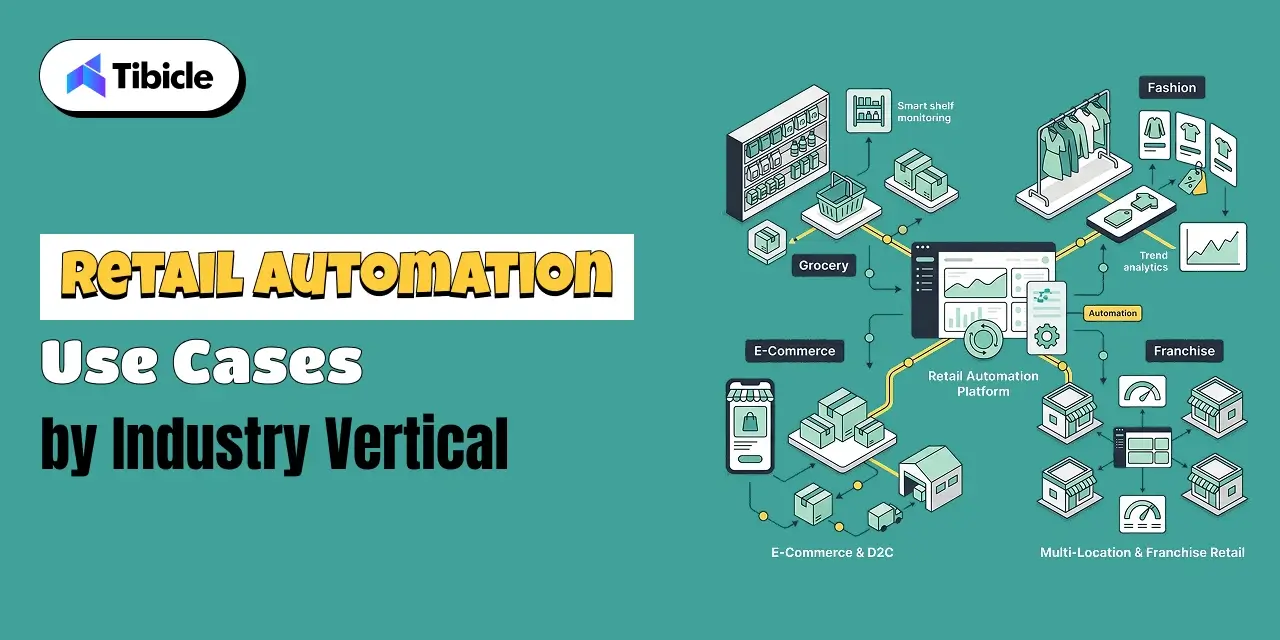
Retail automation applies differently depending on the business model, supply chain structure, and customer base. These are the four most significant vertical applications currently in deployment.
Grocery and Supermarkets
Grocery retailers manage high SKU volumes, tight margins, and perishable inventory, a combination that makes retail automation particularly high-impact in this segment. Key use cases include automated replenishment driven by real-time POS sales data, smart shelf monitoring to detect stockouts and misplacements before they affect revenue, and perishable inventory optimization to reduce waste and markdown costs at scale.
Fashion and Apparel
Fashion retail faces extreme demand volatility at the SKU and regional level, a single color or size variant can swing from overstock to stockout within days of a trend shift. Automation in the retail industry addresses this through demand sensing models that adjust buying and allocation decisions dynamically. Returns automation and visual merchandising analytics also reduce operational complexity in a category defined by high SKU counts and short product life cycles.
E-Commerce and D2C
For e-commerce and direct-to-consumer brands, automated retail systems power the entire order-to-delivery workflow. AI-driven product recommendations increase average order value, warehouse robotics accelerate pick-and-pack throughput, and automated order routing optimizes carrier selection and delivery timelines simultaneously.
Data point: Global online retail sales are projected to reach $6.88 trillion in 2026 (SellersCommerce). At that scale, fulfillment speed and accuracy requirements can only be reliably met through retail automation.
Multi-Location and Franchise Retail
Retail automation is particularly valuable for operators managing dozens or hundreds of locations. Centralized inventory visibility eliminates stock imbalances between stores, standardized automated workflows ensure operational consistency across franchisees, and cross-store performance benchmarking enables management to identify underperforming locations and respond faster than manual reporting cycles allow.
Retail Automation Comparison: Manual vs. Partially Automated vs. Fully Automated
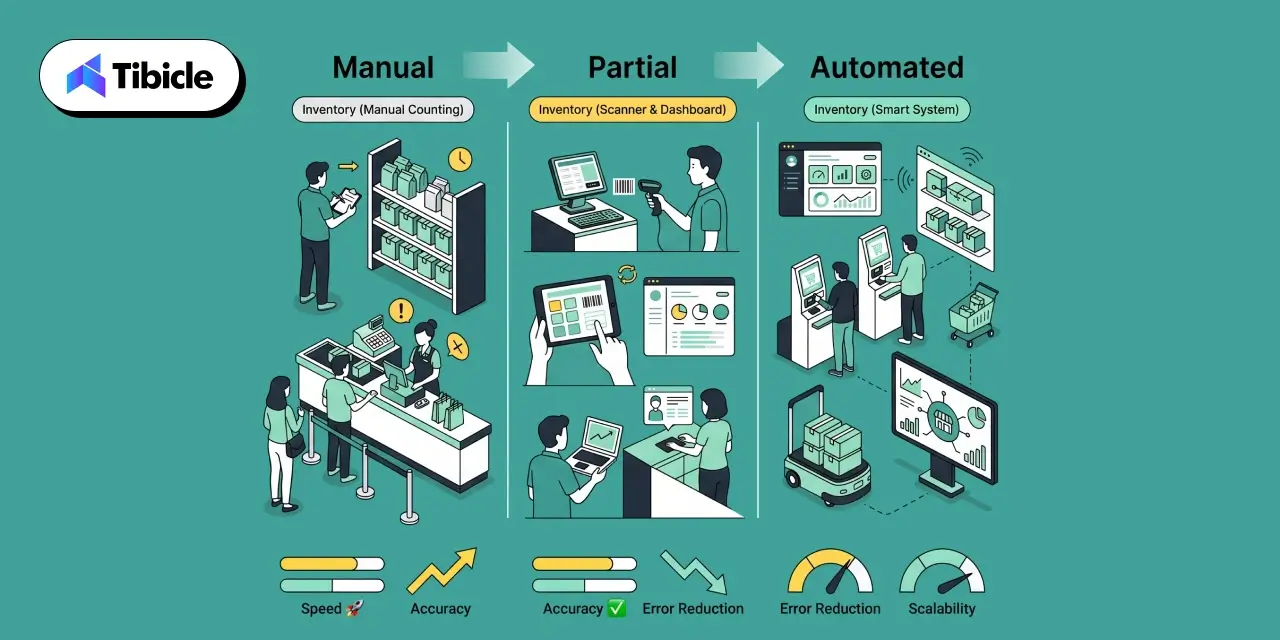
The table below illustrates the operational difference between manual, partially automated, and fully automated retail operations across eight key performance parameters.
| Parameter |
Manual Operations |
Partially Automated |
Fully Automated |
| Inventory Accuracy |
60–70% |
85–90% |
95–99% |
| Order Processing Time |
Hours |
Minutes |
Seconds |
| Labor Dependency |
High |
Medium |
Low |
| Error Rate |
High |
Moderate |
Minimal |
| Scalability |
Limited |
Moderate |
High |
| Initial Investment |
Low |
Medium |
High |
| Long-Term Cost Efficiency |
Poor |
Good |
Optimal |
| Customer Experience |
Inconsistent |
Improved |
Seamless |
When does partial automation make sense? For small-to-mid-size retailers with moderate SKU volumes and limited IT infrastructure, partial retail automation is often the right entry point. Automating high-impact areas, inventory management and POS, before committing to warehouse robotics or AI-driven marketing, allows businesses to build operational maturity and prove ROI without overextending capital.
When does full automation make sense? Enterprise retailers, large e-commerce operators, and multi-location chains managing high transaction volumes and complex supply chains derive the clearest ROI from full-stack retail automation. At this scale, labor cost reduction, throughput gains, and error elimination deliver measurable returns within 2–3 years of implementation, and partial automation creates coordination gaps that compound over time.
How Much Does Retail Automation Cost? Pricing Models and Budget Ranges
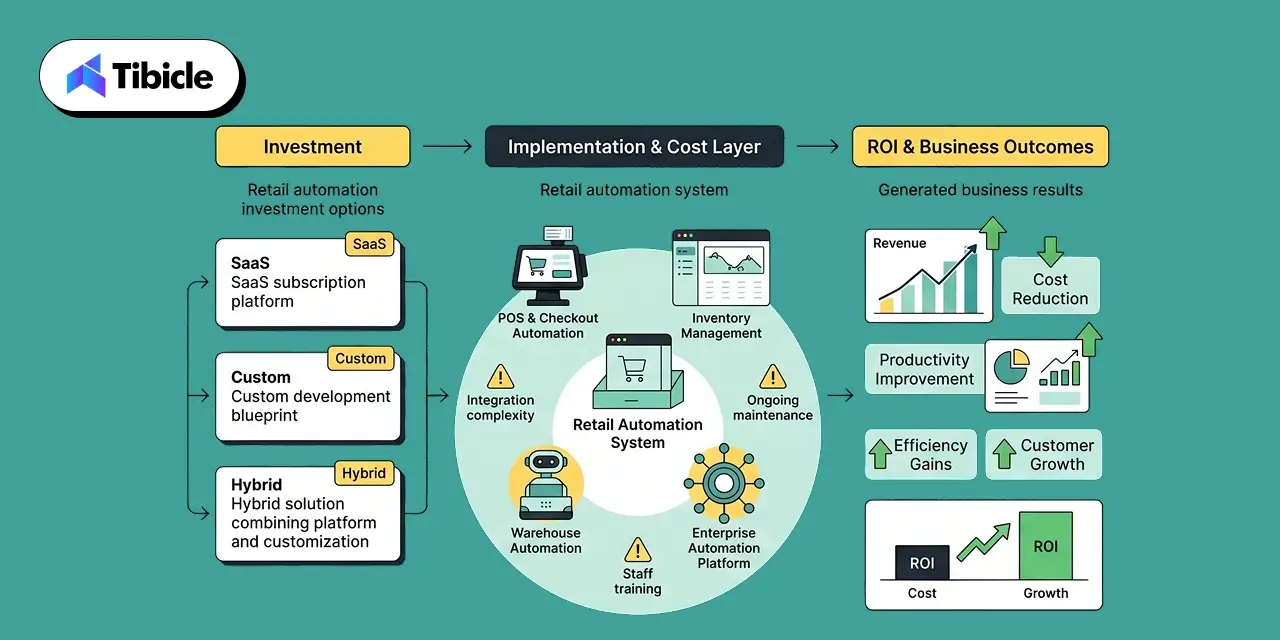
Retail automation investment decisions require clarity on both pricing structure and total cost of ownership, not just the licensing fee presented in a vendor proposal.
Common Pricing Structures
SaaS subscription: Monthly or annual fees per store location, per user, or per transaction volume. This model suits retailers who need fast deployment with lower upfront capital requirements and prefer predictable recurring costs.
Custom development: A one-time build cost plus ongoing maintenance and support. This model fits retailers with unique workflows, legacy system constraints, or competitive differentiation requirements that off-the-shelf platforms cannot address.
Hybrid model: A platform license combined with implementation services and ongoing customization. Common for enterprise retail automation deployments requiring both a proven platform foundation and significant configuration work to match existing operational workflows.
Budget Ranges by Automation Type
- POS and checkout automation: $5,000–$50,000 per store, depending on hardware requirements and software integrations
- Inventory management platforms (SaaS): $500–$5,000 per month, based on location count and feature scope
- Warehouse robotics: $100,000–$1M+ depending on facility size, throughput requirements, and system complexity
- Full-stack retail automation suite (enterprise): $250,000–$2M+ for integrated implementations covering inventory, fulfillment, POS, and analytics
Hidden Costs to Account For
Decision-makers consistently underestimate three cost categories that rarely appear in vendor pricing sheets:
Legacy system integration: Connecting modern retail automation platforms to existing ERP, CRM, or WMS infrastructure often requires custom middleware, adding $20,000–$150,000+ to implementation costs depending on system age and compatibility.
Staff training and change management: Retraining employees and managing the organizational transition to automated workflows is a real cost in both time and productivity impact during the changeover period.
Ongoing maintenance and vendor lock-in risk: Proprietary retail automation platforms may impose annual fee increases, limit customization options, or create switching costs that restrict your flexibility as business requirements evolve. Total cost of ownership calculations must account for these from the start, not after contract signature.
ROI of Retail Automation: What the Data Shows
The business case for retail automation is not speculative. Consistent, cross-industry data from organizations that have implemented automation at scale provides a credible foundation for investment decisions.
Revenue and Efficiency Gains
- Stores deploying automated technology report an 11% increase in customer visits (Research Nester industry survey)
- Organizations that have implemented AI-driven retail automation report 5x–10x returns on investment across multi-year deployments (OneReach AI/Gartner).
- Retailers across segments are actively planning to automate 70% of daily routine tasks by 2025–2026
Live deployments reflect these outcomes., not vendor projections or controlled lab environments.
Cost Reduction Benchmarks
- Labor cost reduction: 20–30% reduction in labor costs for repetitive, rule-based tasks is consistently reported across retail automation implementations
- Data accuracy: Automated data entry and report generation achieve up to 100% accuracy compared to manual processes, eliminating costly errors in inventory counts, order processing, and financial reporting
- Warehouse automation ROI: Most warehouse retail automation investments reach positive ROI within 2–3 years, with ongoing returns increasing as throughput scales
Calculating ROI for Your Business
The standard ROI formula for retail automation investments:
ROI = (Annual savings + Revenue uplift from automation) / Total cost of ownership
The key input variables to quantify before committing to any vendor:
- Labor cost offset: Current annual spend on tasks being automated vs. post-automation labor requirement
- Error reduction savings: Cost of current errors, inventory shrinkage, order mistakes, compliance penalties vs. post-automation error rates
- Throughput increase: Revenue impact of faster order processing and improved inventory availability
- Customer retention lift: Long-term revenue impact of improved service consistency and personalized engagement at scale
Most retailers who complete a structured ROI analysis before implementation find that the business case is clearest in inventory management and warehouse operations, with payback periods in these areas typically ranging from 12–24 months for mid-size deployments.
Risks and Challenges of Implementing Retail Automation
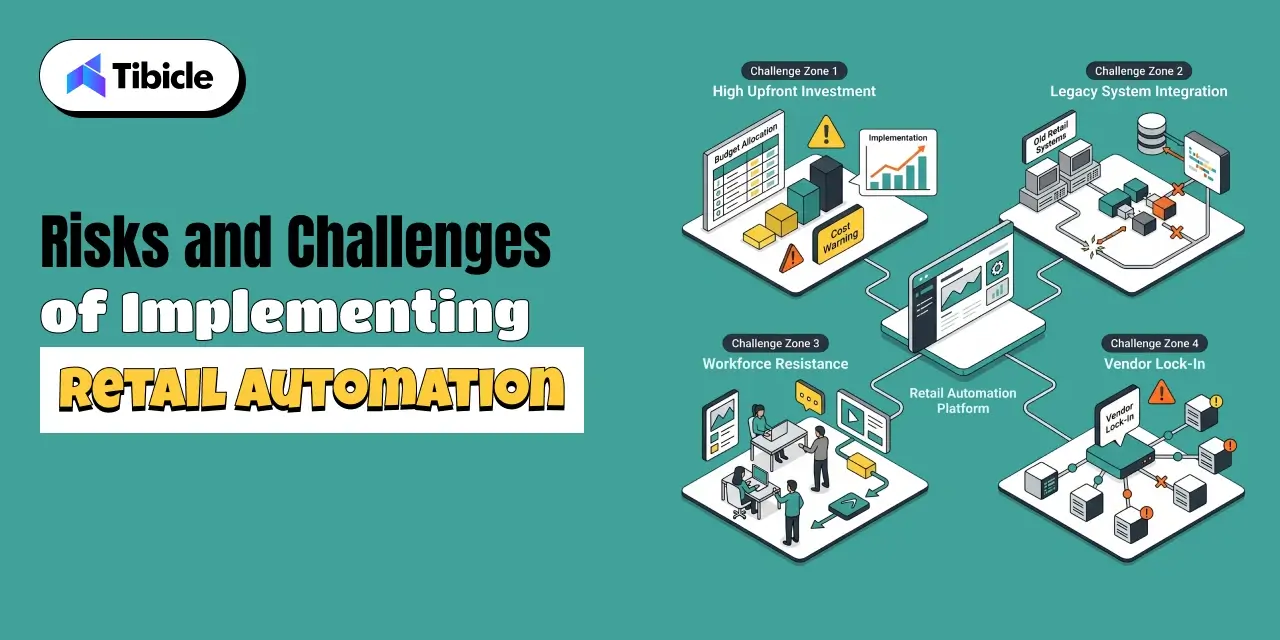
A balanced evaluation of retail automation requires honest assessment of the risks, not just the efficiency gains. These are the four most consistently reported implementation challenges.
High Upfront Investment and Unclear Payback
Retailers often cite budget pressure(41%) and ROI uncertainity(40%) as major barriers, according to the MHI 2025 Annual Industry Report. Without a structured business case and phased implementation plan, large upfront investments in automated retail systems can stall mid-project or fail to deliver expected returns against unclear baselines.
Integration with Legacy Systems
Most established retailers are operating POS, CRM, and inventory platforms that were not built with modern API integration in mind. Connecting new retail automation solutions to this infrastructure creates data silos, synchronization delays, and operational gaps that directly reduce realized ROI. Middleware solutions and phased migration strategies are the standard approach to managing this risk without requiring full infrastructure replacement.
Workforce Resistance and Change Management
Retail process automation displaces tasks before it displaces people, but employees whose roles change significantly are often the most effective friction point in new system adoption. Retailers who build career development pathways alongside automation deployment, provide hands-on training before go-live, and communicate the strategic rationale behind retail automation decisions consistently report faster adoption rates and fewer implementation setbacks.
Vendor Lock-In and Scalability Limitations
Many retail automation platforms are built on proprietary architectures that restrict future flexibility. Once workflows, data structures, and integrations are built around a single vendor’s system, switching costs become a significant operational barrier. Decision-makers should evaluate API-first, modular platforms that allow individual components to be replaced or upgraded independently, without requiring full system replacement when business requirements change.
Vendor Selection Checklist for Retail Automation
Use this checklist before committing to any retail automation solution or vendor contract:
- API-first integration: Does the vendor support modular integration with your existing ERP, CRM, WMS, and POS systems without requiring full platform replacement?
- Multi-channel scalability: Can the retail automation solution scale across multiple store locations, warehouse facilities, and digital sales channels without significant re-implementation?
- Total cost of ownership: Has the vendor provided a complete TCO breakdown, including implementation, training, ongoing maintenance, and integration, not just licensing fees?
- Industry-specific experience: Does the vendor offer documented case studies and use cases in your specific retail vertical (grocery, apparel, e-commerce, multi-location)?
- Time-to-value: What is the reported average payback period from existing clients in comparable deployments?
- Cloud-native architecture: Is the retail automation platform cloud-native with real-time data access and cross-channel visibility built in, not bolted on as an add-on?
- Customization capability: Can the platform be configured to match your specific workflows without requiring heavy custom development from the vendor’s professional services team?
- SLA-backed support: Does the vendor offer guaranteed response times, dedicated onboarding support, and clearly defined escalation paths?
- Data security and compliance: How does the vendor handle data privacy, security certifications (SOC 2, ISO 27001), and regulatory compliance relevant to your markets?
- Exit strategy: What does data portability look like if you need to migrate away from the platform? Is there a documented off-boarding process?
Top Retail Automation Tools and Platforms in 2026
Honeywell offers a broad portfolio of retail automation hardware and software, with particular strength in RFID-based inventory tracking, barcode scanning systems, and supply chain visibility solutions. Their platforms are widely deployed across large-scale warehouse and retail distribution environments globally.
NCR Voyix (formerly NCR Corporation) is one of the most established vendors in checkout automation, POS automation, self-checkout kiosk deployment, and workforce management for retail. Their solutions are commonly found across grocery, convenience, and hospitality retail environments.
Zebra Technologies specializes in mobile computing, RFID, and real-time supply chain visibility. Their devices and software are widely used for inventory management and workforce productivity across retail and logistics operations, with a strong installed base in large-format retail.
AutoStore is a leading provider of robotic micro-fulfillment systems, offering grid-based retail warehouse automation that significantly increases storage density and picking throughput. Their systems are used by retailers requiring high-volume, space-efficient order fulfillment in constrained warehouse footprints.
SAP, Oracle, and NetSuite provide enterprise ERP platforms with integrated retail automation modules covering inventory management, order management, financial reporting, and supply chain planning. These platforms typically serve as the integration backbone for full-stack automated retail systems at enterprise scale.
If you need a custom-built retail automation solution designed specifically around your workflows and existing tech stack, Tibicle’s development team can help.
How Tibicle Supports Retail Automation Projects
Tibicle builds custom retail automation solutions based on each business’s operational needs. Instead of forcing businesses to adjust to fixed platforms, Tibicle creates solutions that fit existing workflows.
With experience across logistics, healthcare, HR, and manufacturing, Tibicle focuses on API-first architecture. This helps connect new automation systems with existing tools without replacing the entire infrastructure.
Tibicle supports mid-market and enterprise retailers that need custom integrations, scalable workflows, or solutions beyond standard platforms.
The key difference is flexibility. Tibicle designs retail automation systems around your processes, helping reduce integration risks, improve implementation speed, and avoid vendor lock-in.
Conclusion
Retail automation is no longer a competitive advantage reserved for the largest global retailers. Rising labor costs, omnichannel complexity, and growing customer expectations have moved automation in the retail industry from optional to operationally essential for any business managing meaningful transaction volume.
Most retail executives are no longer deciding whether to automate. They are deciding where to start, which vendor fits their needs, and how to measure returns before investing.
The decision facing most retail executives today is not whether to automate, but where to start, which vendor model fits their infrastructure and budget, and how to measure returns clearly before committing capital at scale.
The ROI data is consistent across industries and geographies: businesses that adopt retail automation systematically, with a clear business case, structured vendor evaluation, and a phased implementation plan, see measurable returns within 12–36 months. Those that delay continue to absorb the compounding costs of manual operations in an environment that has already moved on.
Ready to build a retail automation solution that fits your business? Contact Tibicle’s team for a free consultation.
Frequently Asked Questions
Q1: What is retail automation and how does it work?
Retail automation uses AI, robotics, IoT, and software to automate repetitive retail tasks like inventory tracking, checkout, fulfillment, and customer engagement. It connects with existing systems to improve speed, accuracy, and efficiency.
Q2: How much does retail automation cost for a mid-size retailer?
Retail automation costs vary based on the solution and business needs. SaaS tools may start around $500/month, while advanced warehouse automation can exceed $1M. Most mid-size retailers invest based on their operational goals and required features.
Q3: What is the average ROI of retail automation?
Retail automation can deliver strong ROI through lower costs, faster operations, and fewer errors. Many businesses achieve positive ROI within 12–24 months, depending on their automation scope and goals.
Q4: What are the biggest risks of implementing retail automation?
The main risks include high costs, integration challenges, employee resistance, and vendor lock-in. However, a phased rollout and proper vendor evaluation can reduce these risks.
Q5: Can retail automation work with existing POS and ERP systems?
Yes, retail automation works with existing POS, ERP, CRM, and WMS systems. Modern solutions use API integrations to connect with existing software and improve workflows.
Q6: How do I choose the right retail automation vendor?
Choose a vendor based on API compatibility, scalability, pricing, industry experience, security, and support. A reliable retail automation vendor should fit your existing systems and help you achieve measurable results.