
The Electron vs Tauri 2026 debate is not about framework popularity. It is a startup resourcing decision. The choice affects runway, team skills, and time-to-market. The application development software market is projected to reach $733.5 billion by 2030, growing at a CAGR of 24.3%, according to Fortune Business Insights. More startups are shipping desktop apps to capture that market than at any point in the last decade.
Electron vs Tauri 2026: Desktop Framework Guide

Aug 27, 2026

Read in 7 Minutes
Table of Contents
- What This Guide Covers
- Introduction
- Electron vs Tauri 2026: What Actually Changed
- Electron vs Tauri 2026 Architecture Differences: Chromium and Node.js vs Native WebView and Rust
- Electron vs Tauri 2026: Bundle Size and Performance
- Talent and Development Speed: JavaScript Depth vs Rust Learning Curve
- Security Model Comparison
- The Decision Matrix: Which Framework Fits Your Startup
- How Tibicle Helps Startups Choose and Build the Right Framework
- Key Takeaways for Startup Founders and CTOs
- Frequently Asked Questions
What This Guide Covers
Who this is for:
Startup founders, CTOs, technical co-founders, product leaders, and engineering teams evaluating a desktop application framework for a new product or considering a migration from an existing Electron vs Tauri 2026 application. It is particularly relevant for small teams balancing time-to-market, engineering talent, application performance, security requirements, distribution strategy, and future mobile plans.
Search intent:
Commercial investigation and technical framework selection. The reader is not looking for a basic introduction to desktop app development. They are comparing Electron vs Tauri in 2026 to determine which architecture creates the lowest delivery and long-term maintenance risk for their startup. The decision comes down to practical factors such as bundle size, memory use, rendering consistency, JavaScript versus Rust talent availability, security posture, ecosystem maturity, and whether the product roadmap includes iOS or Android.
What you will walk away with:
A practical comparison of Electron and Tauri in 2026, covering their architectural differences, bundle size and performance implications, developer talent and hiring considerations, security models, ecosystem maturity, and Tauri 2’s expanded mobile capabilities. You will also get a scenario-based decision matrix showing which framework fits different startup requirements, guidance on when to benchmark a proof of concept before committing, and a framework-selection checklist to help you make the right architecture decision before development begins.
Introduction
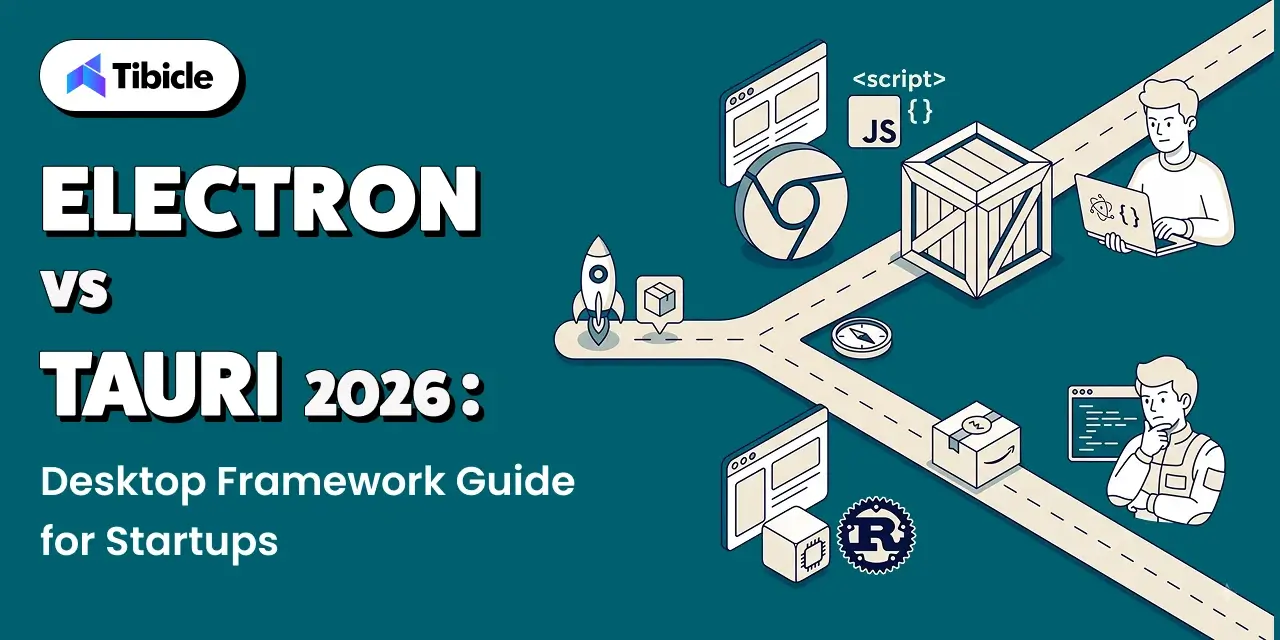
Choosing between Electron and Tauri affects your bundle size from day one. It also affects hiring and security requirements later. A poor choice can create expensive rework. You may need to rebuild the architecture while continuing to ship the product.
This guide covers what changed in 2026, how the two architectures differ, where each framework wins and loses for a Tauri vs. Electron decision for startups, and a direct decision matrix to close the comparison.
Electron vs Tauri 2026: What Actually Changed
Electron did not sit still. It maintained its position as the production standard for desktop apps; VS Code, Slack, Figma, Discord, and 1Password all run on it. That ecosystem weight matters to a startup evaluating which framework will have community support, plugin availability, and Stack Overflow answers in two years. Production pedigree is a risk-reduction argument, not a performance argument.
Electron vs Tauri 2026: Where Electron Still Leads
Electron’s lead in 2026 is ecosystem depth and rendering consistency. Its plugin library, community knowledge base, and track record in production apps of every scale give it a stability argument that Tauri’s newer ecosystem cannot yet match. Consistent Chromium rendering across Windows, macOS, and Linux means a UI built in Electron looks identical on every target platform without OS-specific WebView workarounds. For startups with pixel-sensitive interfaces or teams shipping quickly on a JavaScript-only stack, Electron vs Tauri still resolves in Electron’s favour on these criteria.
Tauri 2 introduced four capabilities that materially changed the framework’s competitive position for startups:
- Native WebView instead of a bundled Chromium runtime — eliminating the 100MB+ overhead that makes Electron installers large by default
- A Rust backend in place of a Node.js main process — trading JavaScript familiarity for memory efficiency and a more restrictive permission model
- iOS and Android targets alongside desktop — making a single Tauri project deployable across all major platforms without a separate mobile framework
- A capability-based permission system declared per app — where system access is explicitly scoped at build time rather than broadly available by default
Electron vs Tauri 2026 Architecture Differences: Chromium and Node.js vs Native WebView and Rust
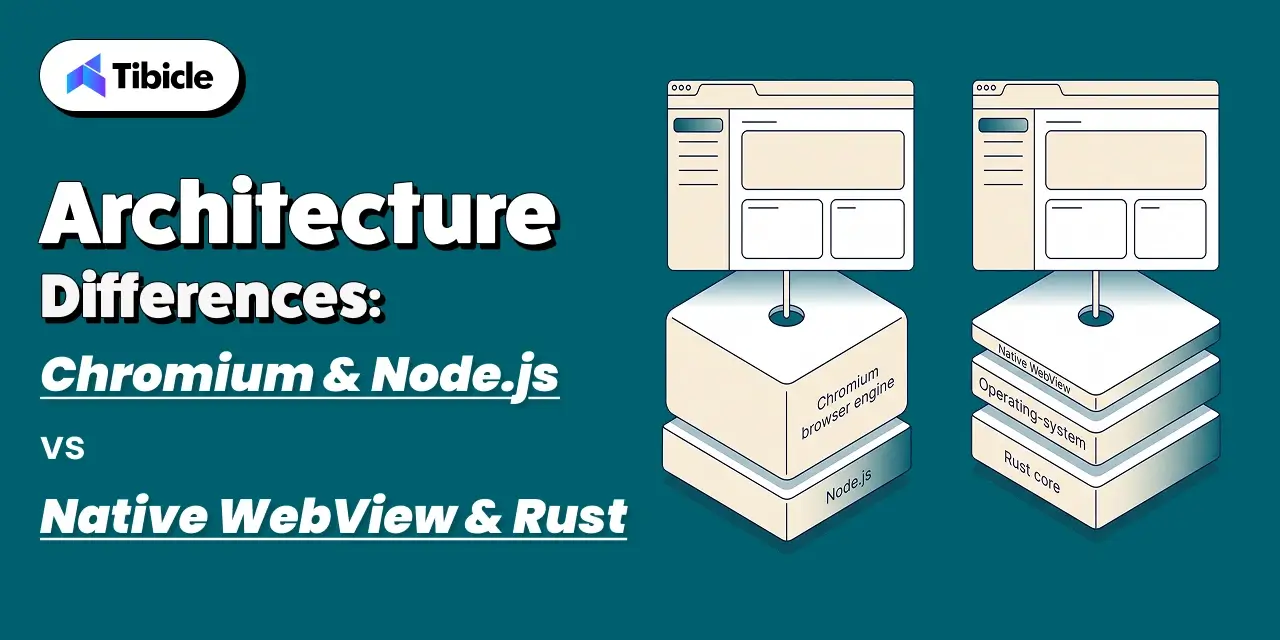
How Electron’s Main and Renderer Processes Work
Electron combines Chromium and Node.js into a single runtime. According to Electron’s official documentation, it “embeds Chromium and Node.js to enable web developers to create desktop applications.” The main process manages application lifecycle and system integration through Node.js. Each application window runs a separate renderer process backed by Chromium. This dual-process model includes Chromium and Node.js. Therefore, every Electron vs Tauri 2026 comparison starts with a larger runtime baseline.
How Tauri’s Rust Core and System WebView Work
Tauri replaces the bundled Chromium runtime with the operating system’s native WebView: WKWebView on macOS, WebView2 on Windows, and WebKitGTK on Linux. The backend process runs in Rust rather than Node.js. The frontend UI layer is still HTML, CSS, and JavaScript. In a Tauri vs Electron for startups architecture review, this means Tauri’s installer ships without a browser engine inside it; the system provides one. The Rust core handles native system calls through an explicit command interface that the frontend invokes over a message-passing bridge.
Why This Difference Drives Bundle Size and Memory Use
Every architectural consequence flows from one root cause: Electron ships a complete browser with every app; Tauri does not. Electron’s bundled Chromium accounts for the majority of its installer weight and is the primary driver of its idle memory footprint. Tauri applications start from a significantly smaller baseline because they inherit the WebView already present on the target OS. The main trade-off is runtime portability versus installation weight. Electron’s Chromium provides consistent rendering across operating systems. Tauri’s native WebView can vary by platform and OS version.

For a startup distributing a cross-platform desktop app without an enterprise IT procurement channel, installer size and startup speed are user-facing product quality metrics, not internal engineering benchmarks. A 150MB installer that users abandon before completing download is a distribution problem, not a framework problem.
Installer Size: Bundled Chromium vs Native WebView
Electron applications ship with a bundled Chromium engine. A minimal Electron app installer typically starts at 50 to 80MB and scales with application logic. Tauri’s official documentation states a minimum application size of under 600KB. The difference is structural: Tauri’s installer contains application code; Electron’s installer contains application code plus a full browser engine. In a Tauri vs Electron for startups distribution decision, this gap matters most when users are downloading from a landing page rather than from a managed enterprise software portal.
Startup Time and Idle Memory Use
Electron’s multi-process Chromium model carries a memory baseline that scales with the number of open windows. A cross-platform desktop app in Electron running a single window at idle typically consumes 100 to 200MB of RAM depending on the complexity of the rendered UI. Tauri applications operating on the native WebView start from a lower baseline because the WebView process is shared with other system applications. On memory-constrained machines, older consumer hardware, and low-end Windows devices, that difference is perceptible to users without any benchmarking required.
Why Startups Should Benchmark Their Own App Before Deciding
Published benchmarks for the Electron framework vs.Tauri 2026 reflect the specific application tested, not your application. The spread between a UI-light Tauri app and a rendering-heavy one is wider than the spread between Electron and Tauri on similar workloads. Before treating any published number as a decision input:
- Run both frameworks against your actual UI, not a hello-world sample
- Measure on the lowest-spec device your target users actually run
- Weigh bundle size against your update and distribution channel; an auto-updater narrows the first-install size advantage
- Treat published benchmarks as directional context, not a final answer
Talent and Development Speed: JavaScript Depth vs Rust Learning Curve
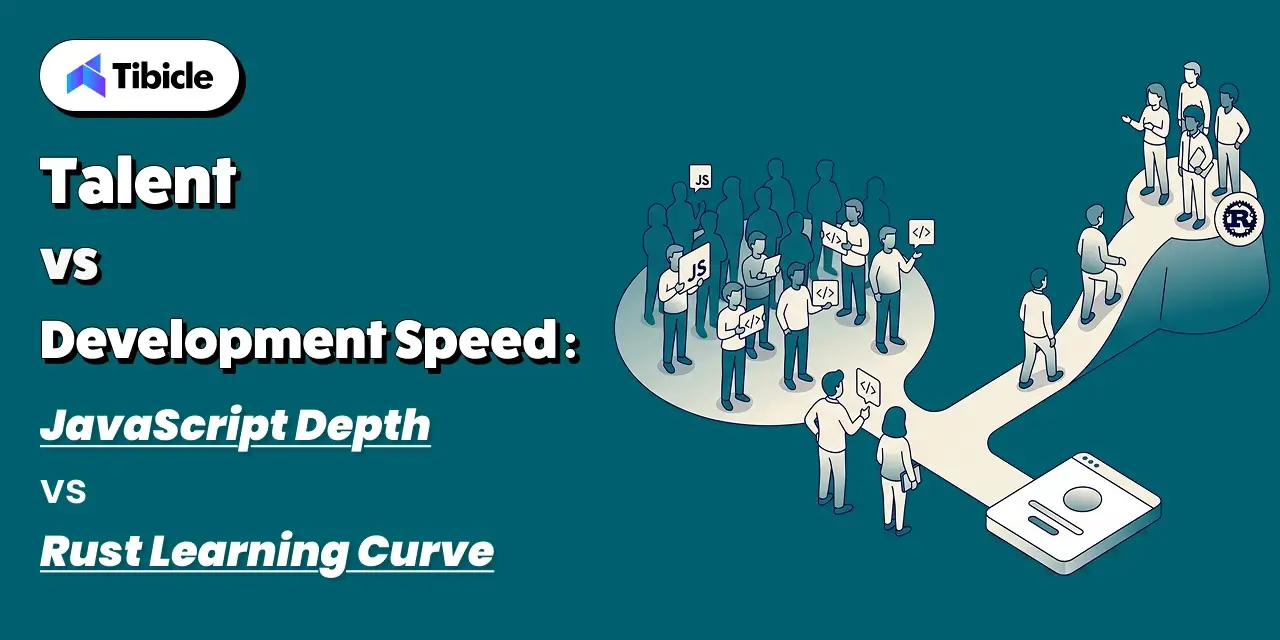
The Electron framework vs Tauri 2026 choice is a hiring decision as much as a technical one. The framework your team cannot fully staff is a delivery risk, and the framework your team cannot onboard quickly is a runway risk. Both considerations hit before the first line of production code.
Image: “Startup development team comparing a large JavaScript ecosystem with a smaller specialized Rust ecosystem, developer tools and technology nodes, modern SaaS illustration, ”
The Size of the JavaScript Hiring Pool
JavaScript is used by 62.3% of professional developers, according to the Stack Overflow 2025 Developer Survey, the largest share of any language in the survey for the 12th consecutive year. An Electron-based stack is accessible to the majority of developers currently working in web or frontend roles. For a startup evaluating Tauri vs Electron for hiring plans, that pool size means faster onboarding, wider contractor availability, and a larger internal knowledge base for debugging production issues.
Rust’s Growing but Smaller Talent Pool
Rust ranked as the most admired programming language among developers in the Stack Overflow 2025 Developer Survey for the fifth consecutive year. Developer enthusiasm for Rust is well-documented. The working pool of engineers with production Rust experience is materially smaller than the JavaScript pool. Tauri can require longer onboarding for engineers new to Rust. It may also create a higher hiring bar for backend contributors. The contractor pool can be smaller as well.
What This Means for a Small Founding Engineering Team
A founding team of two to four engineers with JavaScript backgrounds should not underestimate what the Rust learning curve costs on a fixed runway. Learning Rust while shipping product features is not an abstract risk; it is a timeline risk with a dollar value attached to every week of delayed delivery. Tauri’s frontend remains JavaScript: the Rust exposure is at the command layer that bridges frontend to native system calls. That scope is narrower than full Rust development, but it is not trivial. For Tauri vs Electron for startups with no Rust experience, the question is whether the bundle size and security advantages are worth the onboarding cost on a specific product timeline.
Security Model Comparison
The Electron framework vs Tauri 2026 security comparison starts from each framework’s default posture, not from how carefully a team can configure it. Default matters because most startups ship with default settings at v1 and tighten later.
Electron’s Context Isolation and Sandboxed Renderers
Electron introduced context isolation and sandboxed renderer processes as the recommended security baseline in recent versions. Context isolation prevents renderer code from accessing Electron or Node.js internals directly. The IPC bridge, a defined interface between renderer and main process, is the only sanctioned communication channel. These are meaningful protections when configured correctly. The risk for a startup is that Electron’s default configuration still grants broader system access than Tauri’s baseline, and security hardening requires explicit configuration rather than defaulting to restriction. A cross-platform desktop app shipped under time pressure is at risk of launching with permissive defaults that a later security audit flags.
Tauri’s Capability-Based Permission System
Tauri’s architecture defaults to a capability-based permissions model where every system capability the application requires must be explicitly declared at build time. Filesystem access, network access, shell execution, and clipboard interaction are all scoped and declared rather than available by default. In a startup security review, this produces a smaller and more auditable attack surface from the first release, a meaningful advantage when enterprise procurement requires a security assessment before purchase.
What a Startup Security Review Will Actually Ask For
A Tauri vs Electron for startups security comparison in practice means answering these questions in a procurement questionnaire: what system permissions does the application request, how is IPC between frontend and backend validated, and how are dependencies audited for known CVEs. Tauri’s explicit capability declarations produce direct answers to the first two questions. Electron’s security posture depends on the team’s configuration choices, which means the security answer varies by implementation rather than by framework. For a startup where enterprise sales depend on passing security reviews, Tauri’s default-restrictive model is a procurement advantage.
The Decision Matrix: Which Framework Fits Your Startup

The electron framework vs tauri 2026 decision resolves differently depending on the startup’s specific constraints. Feature-by-feature comparisons obscure the answer; scenario-based matching reveals it. The five scenarios below cover the primary decision drivers for early-stage teams.
Start from your binding constraint, the one that, if ignored, will cost you the most. For most startups, that is either team skill set or a specific product requirement. Match that constraint to the table below.
Neither framework is categorically superior. Electron is safer for teams without Rust experience and products with rendering consistency requirements. Tauri is the stronger choice when bundle size, mobile roadmap, or security review posture are the primary variables.
| Startup Scenario | Recommended Framework | Why |
| Rendering-heavy UI that must look identical across operating systems | Electron | Bundled Chromium guarantees consistent rendering regardless of OS WebView version |
| Small team with no Rust experience that needs to ship fast | Electron | JavaScript-only stack, largest plugin ecosystem, zero Rust learning curve |
| Bundle size or install friction is a stated user complaint | Tauri | Native WebView keeps installers in the single-digit MB range |
| Product roadmap includes iOS or Android from a shared codebase | Tauri | Tauri 2 supports mobile targets alongside desktop in the same project |
| Security review is a top procurement blocker | Tauri | Capability-based permission system scopes system access by default |
Not sure which scenario fits your product? Book a framework selection call with Tibicle’s engineering team before writing the first line of production code.
How Tibicle Helps Startups Choose and Build the Right Framework
Most Tauri vs. Electron for startups decisions are made once and lived with for years. Tibicle’s involvement starts before that decision is made, not after the architecture is locked in.
Framework Selection Workshop and Technical Discovery
Tibicle’s framework selection process starts with a structured technical discovery session: mapping the product’s UI complexity, the team’s existing skill profile, the distribution model (direct download, auto-update, enterprise IT), and the security requirements on the procurement path. That mapping surfaces the binding constraint in the Electron framework vs Tauri 2026 decision for the specific product, rather than relying on a generic framework comparison. The output is a written recommendation with the reasoning behind it, not a vendor pitch for one framework over the other.
Proof-of-Concept Build in Electron or Tauri
After framework selection, Tibicle’s team builds a scoped proof of concept in the selected framework using the startup’s actual UI requirements, not a boilerplate sample. The POC tests the specific interaction patterns, native module integrations, and performance characteristics that the team identified as decision-critical during discovery. This produces a benchmark built on the real product rather than published comparisons, and gives the founding team a live codebase to evaluate before committing to a full build.
Production Build, Packaging, and Long-Term Support
Tibicle supports the full path from POC to production: build pipeline setup, code signing pipeline configuration for Windows and macOS distribution, auto-update integration, and packaging for both direct download and enterprise deployment. Post-launch support covers dependency updates, security patch management, and framework version migrations, including the Tauri 2 upgrade path for teams that built on Tauri 1. For startups building a cross-platform desktop app without a dedicated DevOps resource, that production infrastructure support is the part of the engagement that delivers the most sustained value.
Key Takeaways for Startup Founders and CTOs
Before shortlisting either framework, fix these four points as the decision inputs:
- Electron remains the safer default for rendering-heavy apps and teams without Rust experience; the JavaScript ecosystem, community support, and production track record reduce delivery risk on a fixed timeline
- Tauri wins on bundle size, idle memory, and default security posture at the cost of a Rust learning curve that has a real timeline and hiring implication for small founding teams
- Benchmark the specific app, on the specific device profile of the target user, published Electron framework vs Tauri 2026 numbers reflect someone else’s product, not yours
- The right framework depends on team skills and product roadmap, not which one is newer, which one is trending, or which one has a better marketing site
Book a framework selection call with Tibicle’s team. The session is scoped, structured, and produces a written recommendation before any code is written.
Electron vs Tauri 2026: Frequently Asked Questions
Electron vs Tauri 2026: Is Tauri better for startup?
It depends on the startup’s binding constraints. Tauri vs Electron for startups in 2026 favours Tauri when bundle size, mobile roadmap, or default security posture are the primary decision drivers. It favours Electron when the team has no Rust experience, the UI requires pixel-identical rendering across platforms, or time to market is the top constraint. Neither is universally better.
Does switching to Tauri mean rewriting the whole app?
The frontend layer HTML, CSS, JavaScript is portable between frameworks. The main process logic in Electron (Node.js) must be rewritten in Rust for Tauri’s command interface. For most apps, that represents the majority of the migration effort. A cross-platform desktop app with significant native module integrations will face a more complex migration than one with minimal system calls.
How much Rust do you actually need to know to use Tauri for electron vs tauri 2026?
Tauri’s frontend remains JavaScript. Rust knowledge is required for the command layer, the functions that bridge frontend calls to native system operations. For a simple app with basic filesystem or network access, the Rust surface area is limited. For apps with complex native integrations, hardware access, background processes, and custom system APIs, the Rust requirement grows proportionally. The Electron framework vs Tauri 2026 Rust question is scoped by what the app needs from the OS, not by the framework itself.
Can Tauri and Electron apps share the same frontend code in electron vs tauri 2026?
Yes. Both frameworks render HTML, CSS, and JavaScript in a WebView. A frontend built in React, Vue, Svelte, or plain JavaScript will run in both frameworks without modification. The framework-specific code sits in the main process layer: Node.js for Electron, Rust commands for Tauri. A migration from Electron to Tauri retains the frontend and rebuilds the backend layer.
Is Tauri secure enough for apps handling sensitive data in electron vs tauri 2026?
Tauri’s capability-based permission model is a strong baseline for apps handling sensitive data. Explicit capability declarations at build time mean the application’s system access is auditable from the first release. Whether it meets a specific enterprise security requirement depends on what that requirement asks for. For a Tauri vs Electron for startups security comparison in a procurement context, Tauri’s default-restrictive posture produces cleaner answers to standard security questionnaires than Electron’s default-permissive configuration.
Does Tibicle build in both Electron and Tauri?
Yes. Tibicle’s engineering teams have production experience in both frameworks and do not recommend one over the other as a default. Framework selection follows the technical discovery process described above, matching the framework to the specific product’s constraints rather than applying a blanket recommendation. If the Electron framework vs Tauri 2026 decision is genuinely mixed for a specific product, Tibicle’s team will say so and document the trade-offs before the client commits to either path.
Schedule A Developer Interview And Get 15 Days Risk-Free Trial
Schedule a Call

Relevant Blog
Desktop Application Development Cost Guide for 2026

Diya Koradiya

Electron Memory Optimization: Fixing Leaks in Data-Heavy Apps

Aditya Changlani
Written by
Diya Koradiya
Business Development Executive
I'm Diya Koradiya, Business Development Executive at Tibicle LLP. I connect business ideas with the right technology, turning requirements into purposeful digital solutions. With a strong emphasis on clarity and collaboration, I help clients move forward by aligning practical needs with smart innovation.
Recent Blogs
Electron vs Tauri 2026: Desktop Framework Guide
What This Guide Covers Who this is for: Startup founders, CTOs, technical co-founders, product leaders, and engineering teams evaluating a desktop application framework for a new product or considering a migration from an existing Electron vs Tauri 2026 application. It is particularly relevant for small teams balancing time-to-market, engineering talent, application performance, security requirements, distribution […]
27 Aug 2026 | Diya Koradiya
Desktop Application Development Cost Guide for 2026
What This Guide Covers Who this is for: SaaS founders, CTOs, product managers, engineering leads, and business owners planning to build or launch a cross-platform desktop application development cost in 2026. It is especially valuable for teams evaluating Electron or similar frameworks and looking to create a realistic budget before committing to development, whether working […]
26 Aug 2026 | Diya Koradiya
Electron js development services: Offshore vs Nearshore Guide
What This Guide Covers Who this is for: CTOs, SaaS founders, engineering leaders, product managers, and business owners evaluating Electron.js development services and deciding between offshore, nearshore, or blended development teams. It is especially useful for teams planning cross-platform desktop applications and looking to balance development cost, technical talent, communication, and delivery speed. Search intent: […]
25 Aug 2026 | Diya Koradiya
Got an Idea? Get FREE Consultation
In our world, there's no such thing as having too many clients

Email
tea@tibicle.com

Phone
+91 9724922880