Introduction
eCommerce app features are becoming the biggest factor behind mobile commerce growth in 2026, where mobile eCommerce is projected to account for approximately 73% of all global eCommerce sales. Despite this significant traffic dominance, the average mobile app currently converts at under 2%, while desktop conversion rates are closer to 3.9%. This disparity indicates that the issue is not with traffic volume but with the features of mobile apps.
The businesses closing that gap are the ones building smarter eCommerce app features instead of relying only on ads or influencer campaigns. They are the ones that have built their ecommerce apps around the right features, features engineered to remove friction, increase confidence, and drive repeat purchases at every stage of the buying journey.
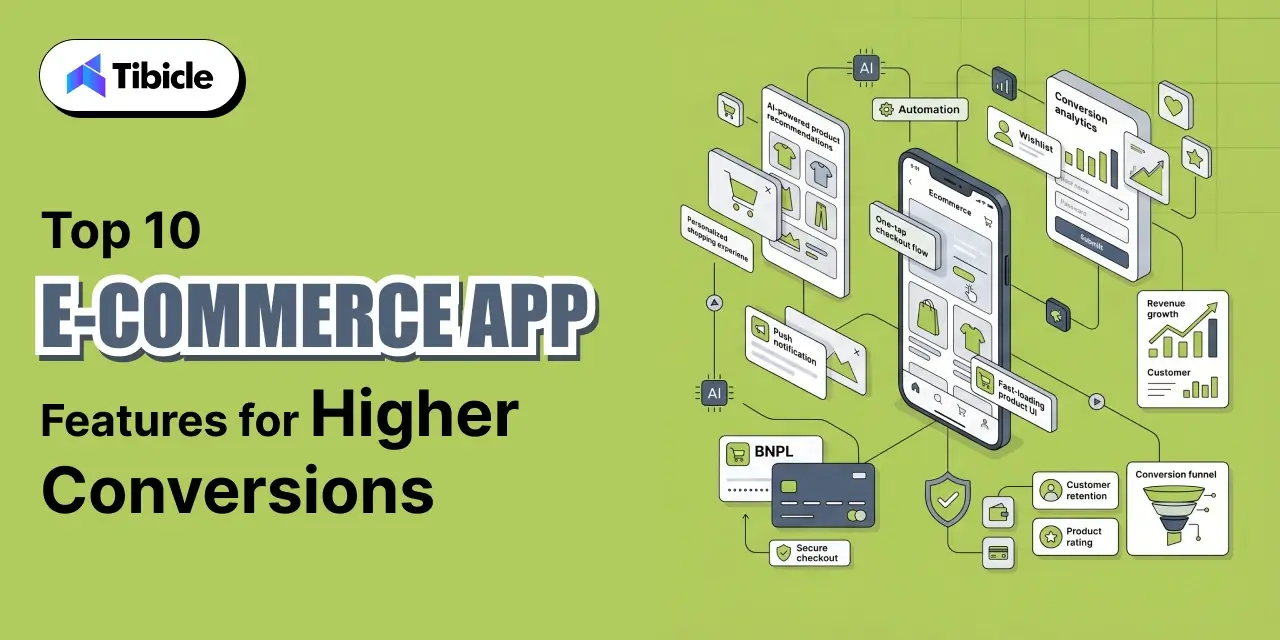
The evidence is compelling: shopping apps convert at nearly 3x the rate of mobile websites. The difference lies not in the platform itself but in what it is built to do. One-tap checkout removes the checkout barrier. AI-powered personalization surfaces the right product at the right moment. Buy Now, Pay Later integration unlocks larger basket sizes. These are not UX niceties. They are revenue levers.
This guide breaks down the best eCommerce app features that directly increase sales, improve retention, and boost conversions in 2026, backed by conversion data, ROI benchmarks, and practical vendor selection criteria so your next build delivers measurable business results.
Key eCommerce App Features That Increase Sales
- AI-Powered Search and Product Discovery
- Dynamic Personalization Engine
- One-Tap Checkout and Mobile Wallets
- Buy Now, Pay Later (BNPL) Integration
- AR-Based Product Visualization
- Behavior-Triggered Push Notifications
- In-App Loyalty and Rewards Program
- Social Commerce and Shoppable Video Integration
- Real-Time Order Tracking with Automated Updates
- Performance Optimization and Sub-3-Second Load Times
What Makes eCommerce App Features Increase Sales?
Revenue Impact vs. Engagement Impact
Not all app features are created equal, and the distinction matters more than most development briefs acknowledge. There are two categories of features: those that improve engagement (time on app, session depth, browse volume) and those that improve revenue (conversion rate, average order value, cart recovery, and repeat purchase rate). The two overlap, but they are not the same.
What Is eCommerce?
eCommerce, short for electronic commerce, is the buying and selling of goods and services over the internet. It covers everything from a single-brand D2C store selling directly to consumers, to large multi-vendor marketplaces, to B2B platforms managing bulk orders between businesses.
What began as basic online storefronts has evolved into a sophisticated, mobile-first ecosystem. In 2026, eCommerce is not just a sales channel, it is the primary commerce channel for a majority of global consumers, with mobile devices driving approximately 73% of all online transactions.
For businesses, eCommerce removes geographical barriers, reduces overhead compared to physical retail, and enables 24/7 selling at scale. For consumers, it offers convenience, price transparency, and an increasingly personalized shopping experience.
Engagement metrics are vanity metrics unless they can be traced back to revenue. A feature that keeps users browsing for longer but does not improve checkout completion is a cost center, not a growth driver. A high-sales feature must directly improve at least one of the following:
- Conversion rate – the percentage of sessions that result in a completed purchase
- Average order value (AOV) – how much each buyer spends per transaction
- Repeat purchase rate – how often buyers return to buy again
- Cart recovery rate – how effectively abandoned sessions are converted to sales
Every feature is evaluated against that framework. If it cannot move one of these four dials, it does not belong on your priority roadmap.
Must-Have eCommerce Mobile App Features for Startups
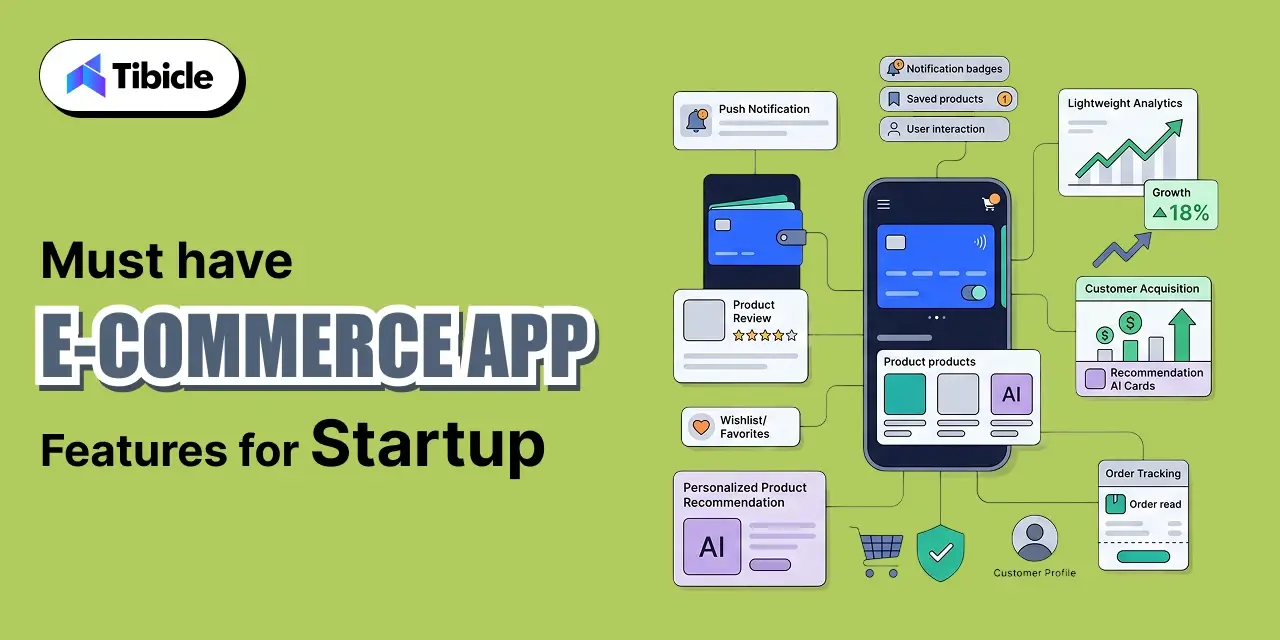
For startups entering the eCommerce space, the priority is not building everything; it is building the right things first. These five features deliver the highest impact at the earliest stage, helping new apps acquire users, reduce friction, and drive repeat purchases without overcomplicating the initial build.
Push Notifications:
For startups with limited marketing budgets, push notifications are the most cost-effective retention tool available. A well-timed, behavior-triggered message, a cart reminder, a back-in-stock alert, or a personalised offer, brings users back to the app without any paid media spend, delivering direct revenue attribution at near-zero cost per conversion.
Mobile Wallets:
Checkout friction is where startups lose the most revenue, and mobile wallet integration is the most direct fix. Supporting Apple Pay, Google Pay, and similar options removes the biggest barrier at the point of purchase, manual card entry. For a new app that has not yet built brand trust, one-tap checkout signals credibility and significantly reduces abandonment at the final step.
Product Reviews:
Trust is a startup’s most significant competitive disadvantage against established brands, and product reviews are the most practical way to close that gap. Displaying genuine buyer ratings and written feedback directly on product pages reduces purchase hesitation and provides the social proof that a new brand cannot yet generate through reputation alone. Reviews also produce fresh, keyword-rich content that supports organic search visibility over time.
Wishlist:
A wishlist captures purchase intent from users who are interested but not yet ready to buy. Users who save products are warm leads; they have expressed clear interest and are substantially more likely to return and complete a purchase than a passive browser. For startups, wishlist data also reveals which products generate the strongest demand, informing inventory planning and promotional strategy before significant budget is committed.
Personalization:
Even at an early stage, basic personalization, recently viewed products, browse-based recommendations, and individually targeted push messages make the app feel relevant to each user rather than generic. Relevance reduces bounce rate, increases session depth, and builds the habit loop that converts first-time buyers into repeat customers. A sophisticated AI engine is not required on day one; meaningful personalization begins with smart application of the behavioral data the app is already collecting.
10 eCommerce App Features That Drive the Highest Sales in 2026
1. AI-Powered Search for eCommerce Apps
Users who actively search for products convert at rates 2 to 3 times higher than those who simply browse. This single data point highlights that AI-powered search is one of the most valuable features in eCommerce app development today. The difference between a user who knows exactly what they want and can find it instantly, and one who leaves because the search yields zero results or irrelevant products, is crucial; it’s the difference between generating revenue and losing potential customers.
Modern AI-powered search goes well beyond keyword matching. It encompasses natural language search (allowing users to type queries like “floral summer dress under 2000”), visual search (enabling product discovery by uploading a photo), typo tolerance that ensures a misspelled query still returns the right result, and behavioral ranking that learns from individual and aggregate purchase patterns to surface the most relevant products first.
For e-commerce apps with large catalogs, this feature is not optional. Findability is the first conversion lever, and every failure at the search layer is a lost sale.
2. Personalization Features in eCommerce Apps
Personalization is the feature category with the most consistently documented revenue impact. On average, personalization lifts revenue by 10 to 15%. Among top performers, the impact is significantly higher; some brands report 40% more revenue from personalized experiences compared to generic ones. Amazon attributes more than 35% of its total revenue to its recommendation engine alone.
In an eCommerce app, a dynamic personalization engine means more than a “you might also like” row at the bottom of a product page. A strong personalization engine dynamically rearranges the homepage based on browsing and purchase history. It also updates product feeds in real time as users engage with products. Personalized push notifications, banners, and promotional offers then help surface products users are genuinely interested in, not what is easiest to promote.
The data is clear: users who see relevant content buy more, buy more often, and churn less. A personalization engine is not a nice-to-have feature for 2026; it is the competitive baseline in high-performing ecommerce apps.
3. One-Tap Checkout for eCommerce Apps
Checkout abandonment is where eCommerce revenue dies. Every additional second of load time at the checkout stage costs approximately 7% in conversions. Every additional form field that a user must fill out manually increases the probability of drop-off. One-tap checkout and mobile wallet integrations are the most direct solution to this problem.
Apple Pay, Google Pay, and Shop Pay have redefined what checkout should feel like on mobile. Shop Pay, in particular, has been documented to deliver up to a 50% conversion lift compared to guest checkout flows. The mechanism is simple: stored payment credentials, pre-filled shipping information, and biometric authentication eliminate the manual data entry that kills mobile conversions.
For any eCommerce app targeting a mobile-first audience in 2026, one-tap checkout is not an advanced feature. It is the minimum standard. The cost of not having it is measurable in lost revenue per session.
4. Buy Now, Pay Later (BNPL) Integration
Buy Now, Pay Later is no longer a payment trend. It is a mainstream consumer expectation that directly influences purchase decisions and basket size. BNPL raises the average basket value by 20 to 50% per transaction. Consumers who use BNPL spend 72% more per transaction than those paying in full upfront. Stripe’s test data across more than 150,000 sessions shows a 14% revenue lift per checkout session when BNPL is offered.
The mechanism is straightforward: BNPL removes the price objection at the point of conversion. A customer who would have abandoned a $8,000 sofa purchase instead spreads the cost into manageable installments and checks out. For fashion, electronics, furniture, and any category with higher average price points, BNPL is a direct conversion lever.
The major BNPL providers – Klarna, Afterpay, Affirm, and regional equivalents- offer well-documented SDK integrations for both iOS and Android. The build cost is relatively low, and the revenue impact is among the most immediately measurable of any feature in this guide.
5. AR-Based Product Visualization
Augmented reality product visualization addresses one of the most fundamental barriers to e-commerce conversion: the inability to see how a product looks in context. According to Shopify’s published data, merchants using AR features see a 94% higher conversion rate and a 40% reduction in return rates compared to those using standard product images alone.
The use cases are strongest in fashion (see how a jacket fits), furniture and home decor (place a sofa in your living room using your phone camera), beauty (try on a lipstick shade), and accessories. These are the categories where “I am not sure how it will look” drives the most abandonment.
AR is no longer prohibitively expensive or technically exotic. WebAR and native ARKit/ARCore implementations have matured significantly. The build cost has come down, and for the right product categories, the ROI case is exceptionally strong: higher conversion, fewer returns, and a differentiated experience that generic competitors cannot easily replicate.
6. Behavior-Triggered Push Notifications
Push notifications remain one of the highest-ROI channels in eCommerce when executed correctly. Well-designed, behavior-triggered push campaigns achieve open rates of 20 to 30% with direct, measurable revenue attribution. Among all push notification types, abandoned cart recovery delivers the highest return on investment, converting a session that was already lost into a completed sale.
The keyword is “behavior-triggered.” Generic broadcast blasts, discount alerts sent to your entire user base simultaneously, are the single fastest way to drive uninstalls. Users who receive irrelevant notifications at inconvenient times delete the app within a week. Behavior-triggered push, by contrast, responds to what individual users have actually done: viewed a product multiple times, added to cart and not checked out, or not opened the app in 14 days.
The right push notification strategy requires a segmentation engine that connects behavioral data to message timing and content. Done correctly, push notifications rival email in direct revenue attribution while operating at a fraction of the cost per conversion.
7. In-App Loyalty and Rewards Program
The economics of eCommerce favor retention over acquisition, and loyalty programs are the most effective structural mechanism for increasing repeat purchase rate. Among top Shopify merchants, a well-implemented loyalty program correlates with a 44% repeat purchase rate, compared to industry averages closer to 25 to 30% for apps without a structured retention mechanism.
In-app loyalty programs do not need to be complex to be effective. Points for purchases, cashback on specific categories, tier-based rewards that create aspiration, and app-exclusive perks that make the app itself worth keeping installed are all proven formats. The highest-performing programs connect loyalty data to the personalization engine so a returning user’s homepage reflects their status, their rewards balance, and products aligned to their history.
Loyalty programs also generate first-party data. Every interaction within the program creates behavioral signals that feed product recommendations, personalized promotions, and push notification targeting, creating a compounding flywheel that improves performance across the entire app over time.
8. Social Commerce and Shoppable Video Integration
Consumer discovery behavior has fundamentally shifted. 43% of Gen Z now start their product searches on TikTok, not Google. Instagram and YouTube have built native shopping layers into their platforms. Livestream shopping, a format that has driven billions in revenue across Asian markets, is rapidly maturing in Western ecommerce contexts. Livestream commerce converts at 5 to 10 times the rate of standard product pages.
For e-commerce apps, social commerce integration means enabling native checkout from social platforms through deep links, integrating user-generated content (UGC) directly into product pages, supporting shoppable video formats within the app, and ensuring that the journey from a social ad to a completed in-app purchase is seamless and uninterrupted.
Brands that close the loop between social discovery and in-app conversion will capture the purchasing behavior of the dominant consumer demographic of 2026. Those who leave the journey fragmented will lose sales at the handoff.
9. Real-Time Order Tracking with Automated Updates
Post-purchase anxiety is a documented phenomenon: customers who cannot see where their order is generate disproportionate support ticket volume, are less likely to reorder, and are more likely to leave negative reviews. Real-time order tracking with automated status updates directly addresses all three outcomes.
A well-implemented tracking feature includes map-based live tracking for last-mile delivery, stage-wise push notifications at each fulfillment milestone, accurate delivery ETAs, and proactive communication in the event of delays.
The result: reduced inbound support load, improved trust scores, and meaningfully higher repeat purchase rates from customers who had a transparent and confidence-building post-purchase experience.
10. Performance Optimization and Sub-3-Second Load Times
Every 1-second delay in mobile load time reduces conversions by approximately 7%. For an e-commerce business generating $10 million annually, a single-second load delay costs roughly $400,000 per year in lost conversions. Performance is not an engineering concern; it is a revenue concern.
Sub-3-second load time targets require a deliberate technical architecture: Content Delivery Networks (CDNs) for asset delivery, aggressive image compression without quality degradation, lazy loading for below-the-fold content, and in many cases a Progressive Web App (PWA) architecture that reduces the performance gap between web and native app experiences.
Performance optimization should be treated as an ongoing discipline, not a one-time build decision. Regular auditing, real-user monitoring, and performance budgets baked into the development process are what separate high-converting apps from average ones.
How These Features Perform Across Business Models
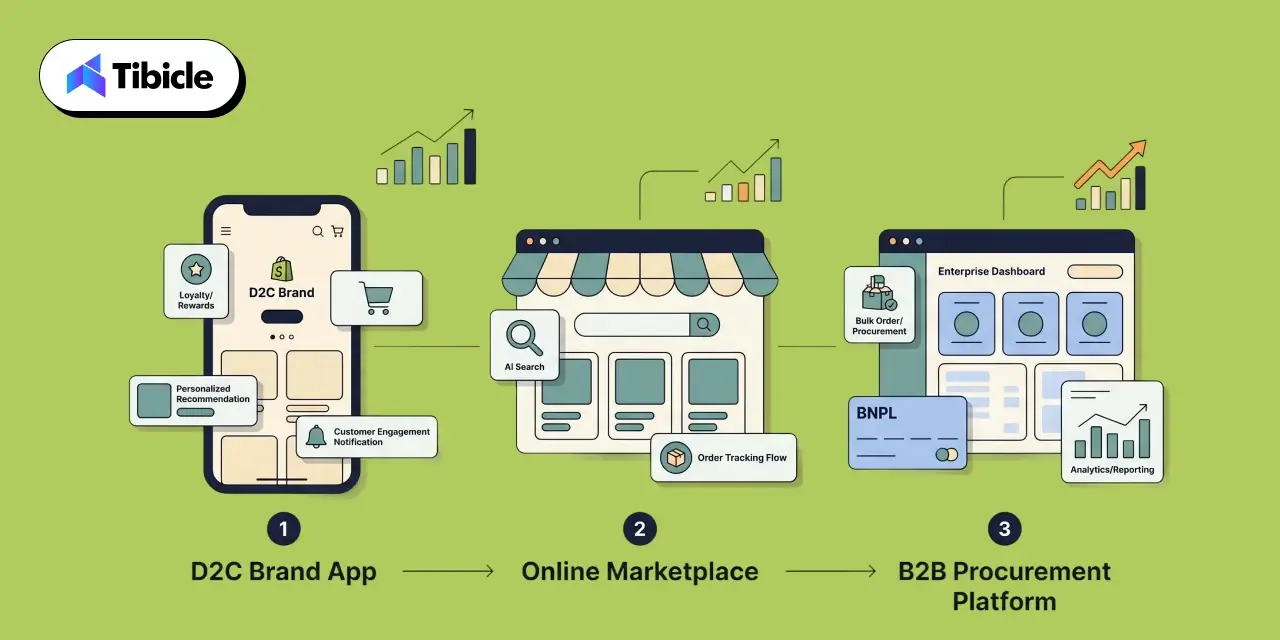
D2C vs. Marketplace vs. B2B eCommerce
Feature priorities shift significantly depending on your business model. The table below maps the highest-impact features to each model and explains why.
| Model |
Top Features |
Why It Matters |
| D2C |
Loyalty, Personalization, AR Visualization |
D2C growth is driven by lifetime customer value. Personalization increases AOV, loyalty drives repeat purchases, and AR cuts the return rates that erode retention margins. |
| Marketplace |
AI Search, Social Commerce |
Conversion lives or dies by product findability across a large catalog. AI search captures intent-driven buyers; social commerce captures discovery-driven ones, the two modes that dominate marketplace commerce. |
| B2B |
BNPL, Real-Time Order Tracking |
Large B2B orders require payment flexibility to protect working capital. Procurement teams expect consumer-grade logistics visibility, and real-time tracking reduces the friction that delays repeat orders. |
Feature Comparison Table: Impact, Cost, and Implementation Complexity
The table below summarizes all 10 features across sales impact, estimated development cost, implementation timeline, and the business model they serve best. Note that cost ranges reflect both custom development and SaaS plugin approaches. Custom builds offer deeper integration and differentiation, while plugins deliver faster time-to-market at lower upfront cost but with a limited customization ceiling.
| Feature |
Sales Impact |
Est. Dev Cost |
Timeline |
Best For |
| AI-Powered Search |
High |
$15K–$60K |
4–8 weeks |
All |
| Dynamic Personalization |
High |
$20K–$80K |
6–10 weeks |
D2C, Marketplace |
| One-Tap Checkout / Wallets |
High |
$10K–$40K |
2–4 weeks |
All |
| BNPL Integration |
High |
$8K–$30K |
2–3 weeks |
D2C, B2B |
| AR Product Visualization |
Medium–High |
$30K–$120K |
8–14 weeks |
D2C, Fashion, Home |
| Push Notifications |
High |
$5K–$25K |
2–4 weeks |
All |
| In-App Loyalty & Rewards |
High |
$15K–$50K |
4–8 weeks |
D2C, Marketplace |
| Social Commerce / Shoppable Video |
Medium–High |
$20K–$70K |
6–10 weeks |
D2C, Marketplace |
| Real-Time Order Tracking |
Medium |
$10K–$35K |
3–6 weeks |
All |
| Performance Optimization |
High |
$10K–$40K |
3–6 weeks |
All |
Note: Cost ranges are indicative for 2026 market rates. Custom builds sit at the upper range and include full integration with existing ERP/CRM stacks. SaaS plugin approaches (Shopify, WooCommerce) sit at the lower range but carry ongoing monthly fees and integration limitations.
Cost of Building eCommerce App Features in 2026
Custom Development vs. Platform Plugins vs. Hybrid Approach
Your build approach determines upfront cost, time-to-market, and long-term scalability. The three primary models are compared below.
| Approach |
Cost Range |
Timeline |
Best For |
Key Limitation |
| Custom Development |
$50,000 – $300,000+ |
4 – 9 months |
High-volume, compliance-heavy, or unique workflow businesses needing full-stack ownership |
Higher upfront cost and longer time-to-market |
| Platform Plugins (Shopify / WooCommerce) |
$0 – $500 / month |
Days – weeks |
Businesses on established platforms wanting fast feature rollout with minimal dev overhead |
Constrained by the platform data model, limited customization, and integration depth |
| Hybrid |
$20,000 – $80,000 |
6 – 14 weeks |
Mid-market businesses that need more than plugins offer but aren’t ready for a full custom build |
Requires careful scoping to avoid integration gaps between custom and plugin layers |
Hidden Costs Most Businesses Miss
The feature build cost is never the total cost. Budget planning that fails to account for the following categories consistently leads to overruns:
- Third-party API fees: BNPL providers, AR platforms, and AI search engines all carry transaction-based or subscription-based fees that scale with usage volume.
- Data storage and processing: Personalization engines, behavioral analytics, and real-time tracking generate significant data volumes. Infrastructure costs scale accordingly.
- Ongoing QA and regression testing: Every app update risks breaking existing features. A structured QA process is a recurring cost, not a one-time line item.
- Compliance: PCI-DSS certification for payment processing, GDPR compliance for user data, and App Store / Play Store policy requirements all carry implementation and ongoing audit costs that should be factored into the total cost of ownership.
ROI of eCommerce App Features: What the Data Shows
Revenue Lift Benchmarks by Feature Category
The ROI case for eCommerce app features is supported by a robust body of published data. The benchmarks below represent documented performance across real-world implementations:
- Personalization: 10 to 15% average revenue increase; top performers report up to 40% uplift from fully integrated personalization engines.
- BNPL Integration: 14% revenue lift per checkout session (Stripe, 150,000+ sessions); 20 to 50% increase in average basket value; BNPL users spend 72% more per transaction.
- AR Visualization: 94% higher conversion rate and 40% reduction in return rates (Shopify merchant data).
- One-Tap Checkout: Up to 50% conversion lift via Shop Pay compared to standard guest checkout.
- Push Notifications (behavior-triggered): 20 to 30% open rates with direct revenue attribution on par with email marketing at a lower cost per conversion.
- Social Commerce: Livestream shopping converts at 5 to 10x the rate of standard product pages.
Payback Period and Break-Even Analysis
For a mid-size ecommerce business generating $5 to $10 million annually, the payback math on strategic feature investment is compelling. A 10% conversion rate improvement achievable through the combination of AI-powered search, one-tap checkout, and a personalization engine translates directly to $500,000 to $1,000,000 in incremental annual revenue.
At a hybrid development cost of $40,000 to $80,000 for those three features, the break-even point falls within 6 to 9 months of launch. For businesses investing in a broader feature set, the payback window extends to 12 to 18 months, still well within a standard investment horizon for technology infrastructure.
The key variable is implementation quality. Features that are poorly integrated, slow to load, or disconnected from the core data layer will not deliver benchmark returns. The ROI figures above assume production-quality implementation with post-launch optimization.
Risks and Challenges of Implementing eCommerce App Features
Over-Engineering vs. Under-Building
One of the most common mistakes in eCommerce app development is feature bloat, building everything on the initial roadmap without validating demand for each feature against your specific user base and business model. An AR visualization feature built for a low-AOV commodity product catalog will not return the same results as the Shopify benchmark data, because the use case does not align. Every feature on this list should be validated against your actual conversion data, customer research, and business model before it enters the development queue.
Conversely, under-building shipping an MVP so stripped down that it fails to meet user expectations creates its own set of problems. An app that launches without one-tap checkout or basic personalization in 2026 is launching into a market where those features are expected, not impressive. The goal is a disciplined roadmap that prioritizes high-impact features first and adds complexity iteratively based on performance data.
Integration Failures and Data Silos
The most common technical failure in eCommerce app development is not a build failure; it is an integration failure. Features that do not communicate with each other cannot deliver their full potential. A loyalty program whose points data is siloed from the personalization engine cannot surface tier-appropriate recommendations. A push notification system that is not connected to real-time inventory cannot send accurate back-in-stock alerts. An order tracking feature that pulls from a different data source than the ERP creates conflicting status messages.
Before a single line of feature code is written, the data architecture must be defined. Every feature in this guide depends on shared data infrastructure: user identity, behavioral signals, transaction history, and inventory state. A vendor who builds features in isolation without addressing data integration is building expensive technical debt.
Security and Compliance Gaps
Payment processing features require PCI-DSS compliance. User data collection and personalization require GDPR compliance (and region-specific equivalents like CCPA for US markets, PDPB for India). App store distribution requires ongoing adherence to Apple App Store and Google Play Store policy requirements, which update regularly. Biometric authentication, one-tap checkout, and BNPL integrations all introduce specific security surface areas that require dedicated QA.
These are not optional considerations to address post-launch. Security and compliance gaps discovered after launch result in app store removal, payment processing suspension, and regulatory penalties, all of which cost significantly more than the preventive compliance work done upfront.
Vendor Selection Checklist for eCommerce App Development
Choosing the right development partner is as important as choosing the right features. Use this checklist when evaluating any eCommerce app development vendor for a 2026 project:
- Does the vendor have verified eCommerce app case studies with documented conversion outcomes, not just design portfolios?
- Can they build for both iOS and Android using a shared codebase (Flutter or React Native) to reduce cost and ensure feature parity across platforms?
- Do they offer post-launch support and iterative optimization, or do they deliver a build and disengage?
- Can they demonstrate integration experience with your existing ERP, CRM, and payment stack or the specific stack you plan to use?
- What is their QA and testing process? Do they conduct device-specific performance testing, regression testing after updates, and security audits?
- Do they provide transparent pricing with milestone-based billing that aligns payment to delivery?
- Can they demonstrate measurable conversion improvements from past e-commerce projects with the data to back the claim?
- Is UI/UX design handled in-house by their team, or is it outsourced to a third party with no accountability to the development process?
- Do they have experience building AI-powered features (search, personalization) or are they relying entirely on third-party plugins for these capabilities?
- Do they have a documented approach to data architecture and cross-feature integration, or do they treat each feature as an independent build?
Why Tibicle Is a Strong Choice for eCommerce App Development
Building a high-converting eCommerce app in 2026 requires more than a team that can write code. It requires a partner who understands the commercial outcomes the features are designed to deliver, has the technical depth to build them at production quality, and has a track record of doing exactly that for clients across industries.
Tibicle operates as a full-stack eCommerce development partner, not a development shop that hands off a build. From UI/UX design through mobile app development (Flutter, React Native, and native iOS/Android) to AI integration and ongoing optimization, Tibicle brings the complete capability set in-house. That means the personalization engine talks to the loyalty program. The push notification system connects to real behavioral data. The checkout flow is tested across devices before it ships.
On Clutch, Tibicle holds 22 verified client reviews with consistent recognition for on-time delivery, transparent communication, and an agile development process that adapts as business requirements evolve. Cross-industry experience spanning edtech, healthcare, logistics, HR technology, and retail means the team brings perspective on what works and what fails across diverse ecommerce contexts.
If you are building or rebuilding an eCommerce app and want to ensure the features you invest in deliver measurable revenue results, the conversation starts with scoping. Talk to Tibicle’s ecommerce team to scope your app features and get a transparent, milestone-based proposal.
Conclusion
The eCommerce app features in this guide are not trend-based picks or feature wish lists assembled from competitor research: documented conversion data, measurable revenue benchmarks, and real-world implementation outcomes back each one. AI-powered search, dynamic personalization, one-tap checkout, BNPL integration, AR visualization, behavior-triggered push, in-app loyalty, social commerce, real-time tracking, and performance optimization are the levers that move the metrics that matter.
The difference between a 2% mobile conversion rate and a 4% mobile conversion rate is not a marketing problem. At $5 million in annual ecommerce revenue, that gap is $2.5 million. At $10 million, it is $5 million. The features in this guide are what close that gap.
Talk to Tibicle’s eCommerce development team to design an app that converts traffic into measurable revenue.
Frequently Asked Questions
What are the most important eCommerce app features for increasing sales?
The highest-impact features for direct sales improvement are AI-powered search, one-tap checkout with mobile wallet integration, dynamic personalization, and BNPL payment options. These four features address the four most common conversion barriers: poor product discovery, checkout friction, irrelevant product presentation, and price objection. For businesses focused on retention alongside acquisition, in-app loyalty programs and behavior-triggered push notifications add a compounding revenue layer.
How much does it cost to develop a custom eCommerce mobile app in 2026?
A comprehensive eCommerce app with the full feature set described in this guide ranges from $50,000 to $300,000 for a custom build, depending on feature scope, tech stack, integration depth, and development location. A hybrid approach combining platform plugins for standard functions with custom development for differentiated features typically ranges from $20,000 to $80,000. Shopify and WooCommerce plugin approaches for individual features range from free to $500 per month in subscription fees, with lower upfront costs but a limited customization ceiling.
Which eCommerce app features give the highest ROI?
Based on published benchmark data, BNPL integration, one-tap checkout, and AI-powered personalization consistently deliver the fastest payback periods and highest revenue lift relative to development cost. BNPL shows a documented 14% revenue lift per checkout session. One-tap checkout via Shop Pay delivers up to 50% conversion improvement. Personalization averages a 10 to 15% revenue increase, with top performers reporting up to 40%. AR visualization delivers the highest conversion lift (94%) but at a higher implementation cost and with category-specific applicability.
Is AR product visualization worth the investment for eCommerce apps?
For the right product categories, yes, the ROI case is strong. Shopify data documents a 94% higher conversion rate and 40% reduction in returns for merchants using AR features. The strongest use cases are fashion, furniture, home decor, beauty, and accessories categories, where visual context significantly reduces purchase hesitation. For commodity products, undifferentiated categories, or low-AOV items, the development cost is harder to justify. The decision should be anchored to your category, your average order value, and your current return rate.
How do push notifications impact eCommerce app revenue?
Behavior-triggered push notifications, particularly abandoned cart recovery and personalized back-in-stock or price drop alerts, achieve open rates of 20 to 30% and generate revenue attribution on par with email marketing at a lower cost per conversion. The critical qualifier is “behavior-triggered”: generic broadcast notifications consistently drive uninstalls and reduce app engagement. A push notification strategy requires a segmentation engine connected to real user behavioral data, combined with careful attention to timing, frequency, and message relevance.
What should I look for when selecting an eCommerce app development vendor?
The most important criteria are verified eCommerce-specific case studies with documented conversion outcomes, in-house UI/UX design capability, experience building for both iOS and Android on a shared codebase, demonstrated integration competency with your existing tech stack, and a transparent milestone-based pricing model. Avoid vendors who treat features as isolated builds without a defined approach to data architecture and cross-feature integration. Post-launch support and optimization capability, not just a build-and-handoff model, is the difference between a launch and a revenue result.