
Shopify vs WooCommerce: Best Dropshipping Platform 2026

Apr 01, 2026

Read in 4 Minutes
Table of Contents
- Introduction
- Shopify vs WooCommerce: At-a-Glance Comparison
- What Shopify vs WooCommerce Actually Costs a Dropshipping Business
- Shopify vs WooCommerce Comparison for Dropshipping Setup
- Shopify or WooCommerce: Which Platform Has Better SEO for Dropshipping?
- Scalability and Performance: Which Platform Holds Up at Volume?
- Payment Gateways and Checkout Experience: Where the Real Difference Lives
- Platform Ownership and Long-Term Risk
- Shopify vs WooCommerce Pros and Cons for Dropshippers: The Final Call
- Conclusion
- FAQs
Introduction
The Shopify vs WooCommerce decision touches transaction fees, supplier tooling, SEO architecture, and how fast you go live. Get it wrong and it costs you quietly, every single month. This guide cuts through the noise with a direct woocommerce vs shopify breakdown across pricing, dropshipping setup, SEO, and scale so you can match the platform to your business, not the other way around.
Over 6.2 million stores run on WooCommerce, while Shopify crossed $4.2 million per minute in sales during Black Friday 2024. Both numbers are impressive but neither tells you which platform actually protects your margins as a dropshipper.
Shopify vs WooCommerce: At-a-Glance Comparison
| Feature | Shopify | WooCommerce |
| Starting Cost | $39/month(Basic plan) | Free plugin: ~$80-$120/month total |
| Transaction Fees | Up to 2% for external gateways | No platform-level transaction fee |
| Setup Difficulty | Low- guided, no technical help | Medium-High- requires configuration |
| Hosting | Fully managed, included | Self- managed, your choice of host |
| Dropshipping
Apps |
Dsers, Spocket, Printify, Oberlo | AliDropship, Syncee, WooDropship |
| SEO Control | Basic- fixed URL structure | Full-custom URLs, schema, Yoast |
| Scalability | Auto-scales, no effort required | Scales with hosting investment |
| Support | 24/7 live chat and email | Community forums and documentation |
| Payment
Gateways |
130+ gateways: fees apply for external | All gateways, no extra platform fee |
| Ownership | Platform-owned: you rent the store | Self-owned, full data and code control |
| Best For | Beginners, fast launchers, solo operators | High- volume, SEO-focused, WordPress users |
What Shopify vs WooCommerce Actually Costs a Dropshipping Business
Neither platform is cheap at scale. But they are expensive in completely different ways and for dropshipping specifically, the structure of those costs matters more than the headline number.
Shopify Pricing: Subscription Plans and Transaction Fees
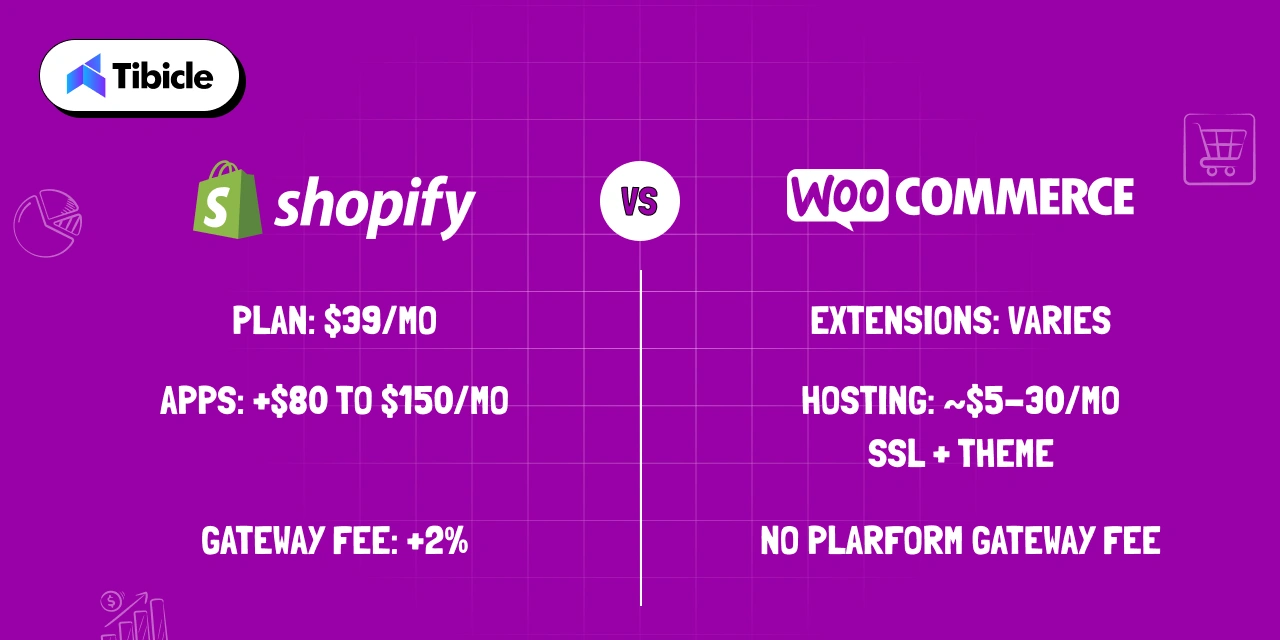
Shopify runs on three tiers: Basic at $39/month, Shopify at $105/month, Advanced at $299/month. Those numbers look manageable until you factor in what sits on top. Use an external payment gateway instead of Shopify Payments and you are paying up to 2% per transaction. Add two or three dropshipping apps and you are looking at another $80 to $150/month easily. The cost structure is predictable and it compounds fast.
WooCommerce Pricing: Free Plugin, Not a Free Business
WooCommerce is free to install, but hosting, SSL, themes, and premium extensions mean your real monthly spend lands between $80 and $120. The advantage is what you do not pay: WooPayments charges 2.90% + $0.30 per transaction with zero platform cut on top, and unlike Shopify, there is no penalty for using an external gateway. At high order volume, that difference adds up to hundreds of dollars a month.
Shopify vs WooCommerce Comparison for Dropshipping Setup
Speed to launch is one of the most cited reasons people choose Shopify. It is also one of the most overrated because the platform you launch on fastest is not always the one that runs smoothest once orders start coming in. This woocommerce vs shopify comparison on setup is really about what kind of operator you are.
Shopify Dropshipping: Apps, Automation, and Speed
Shopify is built for operators who want to move fast and not think too hard about infrastructure. Native integrations with DSers, Spocket, Printify, Oberlo, and AliExpress support one-click product imports and automated order routing to suppliers. Shopify Payments activates immediately with no third-party configuration. The onboarding is tight, the app ecosystem is polished, and a functional dropshipping store is genuinely achievable within a day. For beginners, there is no faster path to live.
WooCommerce Dropshipping: Plugins, Control, and Flexibility
WooCommerce rewards operators who know what they want. AliDropship, Syncee, WooDropship, and the native WooCommerce Dropshipping plugin all cover the essentials automated order notifications, supplier packing slips, inventory sync but they require real configuration. Setup takes longer, no question. The payoff is a fulfillment workflow shaped entirely around your logic, not the platform’s. No transaction fees on external gateways either. Dropshippers already on WordPress get this with almost no added overhead.
Shopify or WooCommerce: Which Platform Has Better SEO for Dropshipping?
Most dropshipping guides treat SEO as an afterthought. That is a mistake. Paid traffic costs are rising, supplier margins are thin, and organic search is one of the few acquisition channels that compounds over time. The shopify or woocommerce decision here is not trivial.
WooCommerce SEO: Full Control via WordPress
Yoast SEO and Rank Math put granular control in your hands: schema markup, canonical URLs, breadcrumbs, internal linking structure. WordPress’s content-first architecture makes building out product guides and long-tail blog content genuinely natural. The one ongoing cost is performance. Core Web Vitals depend heavily on your hosting quality and plugin load, and they will not manage themselves.
Shopify SEO: Built-In Features with Structural Limits
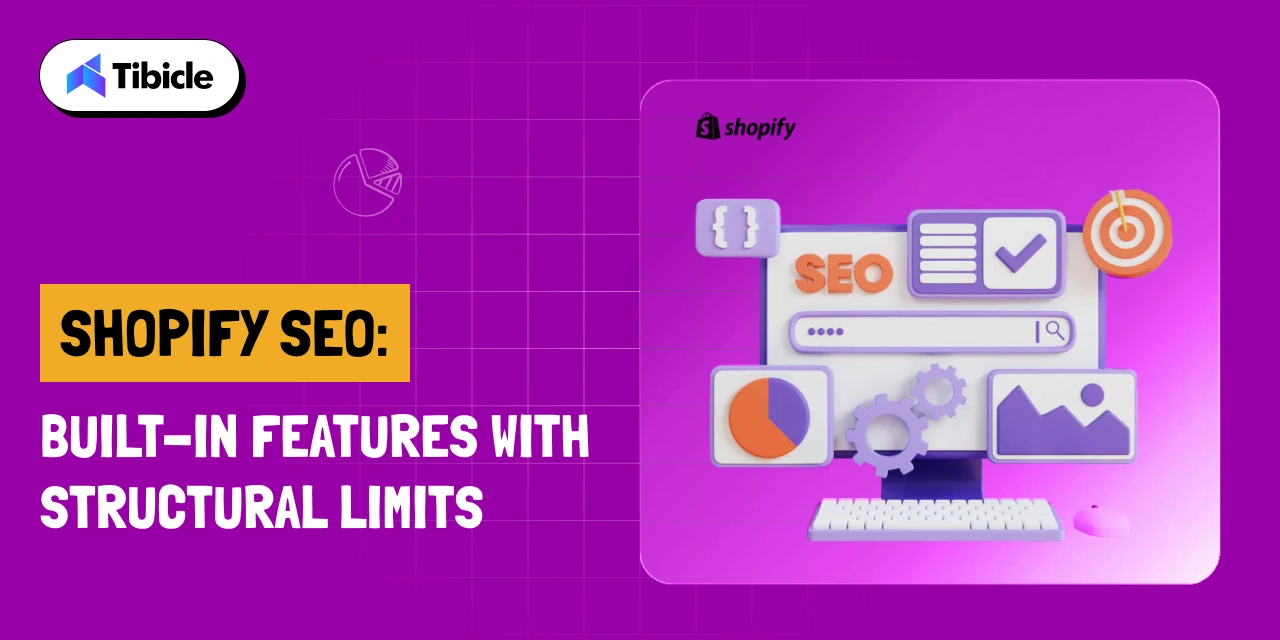
Shopify auto-generates sitemaps, lets you edit title tags and meta descriptions, and keeps the technical basics clean without any configuration. For most stores in non-competitive niches, that is enough. The ceiling shows up in URL structure: /products/ and /collections/ are fixed, with no override. Stores targeting precise keyword architectures will feel that constraint against a WooCommerce competitor who faces no such restriction.
Scalability and Performance: Which Platform Holds Up at Volume?
Shopify processed $4.2 million per minute during Black Friday 2024 with zero downtime on fully managed, auto-scaling infrastructure you never have to touch. No server decisions, no traffic spike anxiety, no 2 AM incident response. The upcoming expansion to 2,000 product variants per listing in 2026 also removes a real ceiling for dropshippers running large catalogues.
WooCommerce performance scales with your hosting quality and plugin discipline. It can handle serious volume but that outcome is your responsibility, not the platform’s. Shopify also provides 24/7 live chat and email support; WooCommerce points you to community forums. For high-traffic stores where downtime has a direct revenue cost, Shopify’s infrastructure advantage is not subtle.
Payment Gateways and Checkout Experience: Where the Real Difference Lives
Most Platform comparisons gloss over payment gateways, but for dropshippers, they dictate your market reach, customer experience, and profit margins.
Shopify: Polished but Penalizing
- The Penalty Fee: While Shopify supports over 130 global gateways, using anything other than Shopify Payments incursa 0.5% to 2% penalty fee per transaction.
- The Impact: If you target markets where Shopify Payments isn’t available or preferred (like Southeast Asia or Latin America), this fee becomes a structural cost that eats directly into your margins.
- The Upside: The checkout experience is highly optimized out of the box, featuring seamless one-page flows and accelerated options like Shop Pay.
WooCommerce: True Gateway Freedom
- The Advantage: WooCommerce imposes zero platform penalties. You can use any local gateway (Stripe, Razorpay, PayTabs, etc.) at no extra cost, providing a massive competitive edge in specific regional markets.
- The Trade-off: The default checkout requires deliberate configuration. You will need to use plugins (like Cartflows) to optimize the flow, but the payoff is a checkout experience built entirely around your needs.
Platform Ownership and Long-Term Risk
What happens to your business if your platform changes its terms? When thinking long-term, ownership matters.
Shopify: Convenience vs Dependency
- Rented Infrastructure: Building on Shopify means renting your foundation. Shopify has historically changed pricing structures, deprecated apps and altered rules forcing live stores to adapt overnight.
- The Trade-off: This dependency is often a fair trade for speed and hands-off maintenance. However, heavy reliance on the Shopify ecosystem leaves you completely exposed to platform-level decisions you cannot control.
WooCommerce: Full Ownership, Full Responsibility
- Total Control: As an open-source platform, your code and data live on infrastructure you own. No platform can force fee changes or deprecate your checkout flow.
- The Trade-off: You are responsible for security patches, hosting upgrades, and performance maintenance. An unmaintained store is a liability, but a well-managed one is a fully-owned asset that carries zero platform dependency risk.
For dropshippers building a brand rather than just testing a niche, this ownership advantage is worth taking seriously before committing.
Shopify vs WooCommerce Pros and Cons for Dropshippers: The Final Call
The shopify vs woocommerce pros and cons conversation usually ends with it depends which is technically true and practically useless. Here is a more honest version:
Choose Shopify if you are:
- Launching your first store and want to be live within days, not weeks
- Running lean with no developer on hand and no appetite for technical maintenance
- Willing to pay a monthly premium for infrastructure reliability and integrated support
Choose WooCommerce if you are:
- Already operating on WordPress and want to avoid the cost of a full platform migration
- Running enough volume that gateway fees make the cost difference genuinely significant
- Serious about SEO and need full technical control over your site architecture
Neither platform is universally better. The right call depends on your technical comfort, your order volume, and how much you are willing to pay for convenience versus how much you are willing to build for control.
Tibicle: Your Partner for Shopify vs WooCommerce builds E-Commerce builds
Clutch Rating: 4.9/5 | 18 verified reviews | Ahmedabad, India
Tibicle handles end-to-end e-commerce development across both Shopify and WooCommerce custom supplier integrations, payment gateway setup, web and mobile builds serving clients in e-commerce, logistics, and retail globally. Post-delivery, clients report steady growth in daily active users, gift transactions, and creator retention.
Hourly rate: $25 to $49 | Minimum project: $1,000+. Best fit: Dropshipping businesses that need platform-agnostic builds with complex third-party integrations handled entirely in-house.
Conclusion
The Shopify vs WooCommerce debate does not get settled by a comparison table. It gets settled when you sit down, map out what your store actually costs to run on each platform, and compare that against how much technical involvement you are genuinely willing to commit to.
Shopify removes friction. WooCommerce removes cost. Your job is to figure out which of those matters more at the stage you are at right now. Start your free Shopify trial or spin up a WooCommerce test store this week not to pick a winner, but to feel the difference firsthand.
FAQs
Is Shopify better than WooCommerce for dropshipping beginners?
Yes. Shopify’s guided setup, built-in hosting, and ready-to-use dropshipping apps make it significantly faster to launch for beginners with no technical background.
Does WooCommerce charge transaction fees for dropshipping orders?
No. WooCommerce does not charge platform-level transaction fees, giving it a meaningful cost advantage over Shopify for stores processing high order volumes.
Which platform has more dropshipping supplier integrations?
Shopify has a larger curated app store with easier one-click integrations. WooCommerce offers more plugins overall but requires more manual configuration to get them working.
Can I switch from WooCommerce to Shopify later?
Yes, migration is possible using third-party tools. However, product data, SEO URLs, and order history all require careful transfer planning to avoid data loss or ranking drops.
Which platform is better for SEO in a dropshipping store?
WooCommerce gives more granular SEO control through WordPress plugins like Yoast and Rank Math. Shopify handles the basics well but limits advanced technical SEO customisation.
Schedule A Developer Interview And Get 15 Days Risk-Free Trial
Schedule a Call

Relevant Blog
3 Best Restaurant Management App for 2026

Prejin Nadar

Custom AI Chatbot Development Services

Diya Koradiya
Enterprise AI Automation Development Agency

Arjun Shinojiya
Written by

Dhairya Dadhania
Business Development Executive
I'm Dhairya Dadhania, Business Development Executive at Tibicle LLP. I help businesses move beyond their current limitations by defining a clear and ambitious digital vision by focusing on identifying core opportunities and aligning them with purposeful, innovative digital solutions.
Related posts
3 Best Restaurant Management App for 2026
What This Guide Covers Who this is for: This guide is for restaurant management app operators, multi-location F&B group owners, and general managers evaluating whether a restaurant management app can reduce labor costs, food waste, and manual reconciliation time. Search intent: Comparison and decision. The reader is not researching what restaurant management software is. They […]
25 Sep 2026 | Prejin Nadar
Custom AI Chatbot Development Services
What This Guide Covers Who this is for: CIOs, CTOs, AI leaders, operations executives, customer support teams, and enterprise technology decision-makers evaluating custom AI chatbot development services for internal knowledge access, customer support, helpdesk automation, or other business-critical use cases. It is particularly relevant for organisations with proprietary knowledge bases, sensitive data, complex access controls, […]
22 Sep 2026 | Diya Koradiya
Enterprise AI Automation Development Agency
Who this is for: Operations leads, CTOs, and process owners evaluating an enterprise AI automation development agency for a full business process rather than a single bolted-on bot. Search intent: Commercial evaluation with a technical backbone. The reader has moved past “what is workflow automation” and wants to know why point-solution RPA plateaus, what end-to-end […]
18 Sep 2026 | Arjun Shinojiya
Got an Idea? Get FREE Consultation
In our world, there's no such thing as having too many clients

Email
tea@tibicle.com

Phone
+91 9724922880