Introduction
The global retail digital transformation market reached approximately $285.76 billion in 2025 and is projected to grow to $487.12 billion by 2030, expanding at a CAGR of 11.26%. Retailers worldwide are investing heavily in cloud technologies, AI-powered automation, data analytics, and connected customer experiences to remain competitive in an increasingly digital marketplace.
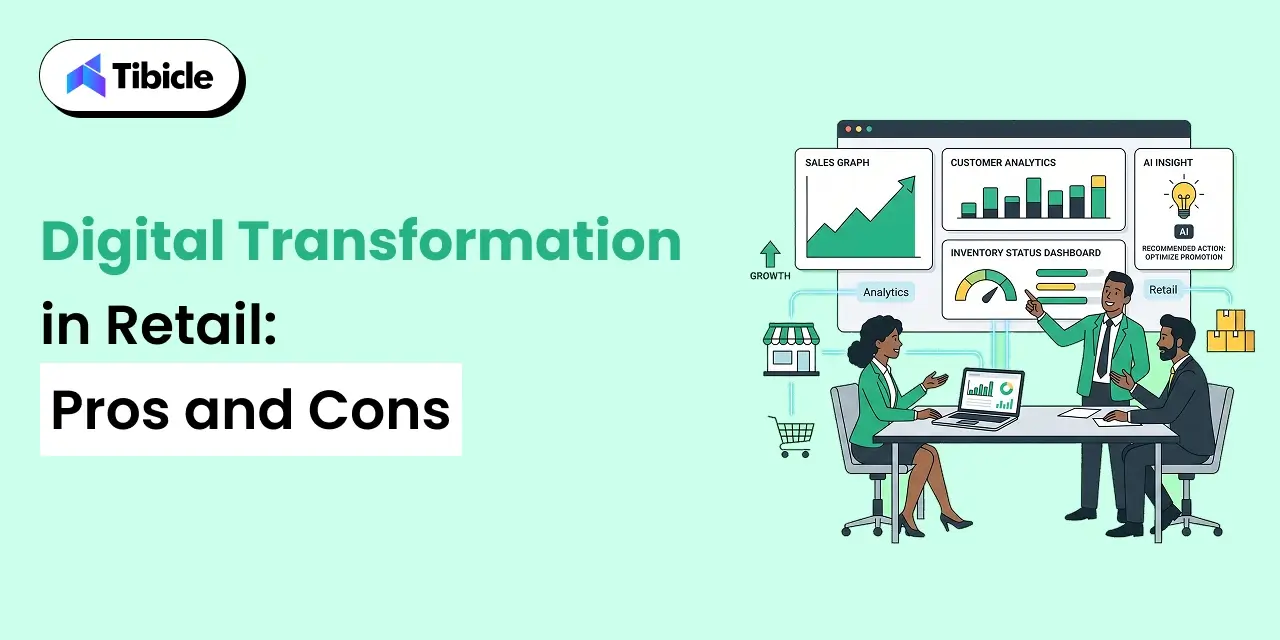
The financial impact is already becoming visible. According to PwC, 30% of global CEOs report revenue growth from digital technologies such as generative AI, while 45% expect additional profitability improvements over the next year. Despite these promising figures, many transformation initiatives fail to generate measurable business outcomes. Significant investments are often made without a clear understanding of implementation complexity, organizational readiness, or long-term return on investment.
For executives evaluating the future of their organizations, the challenge is not deciding whether digital transformation matters. The challenge is determining where the value exists, where risks concentrate, and how investments should be prioritized.
What Is Digital Transformation in the Retail Industry?
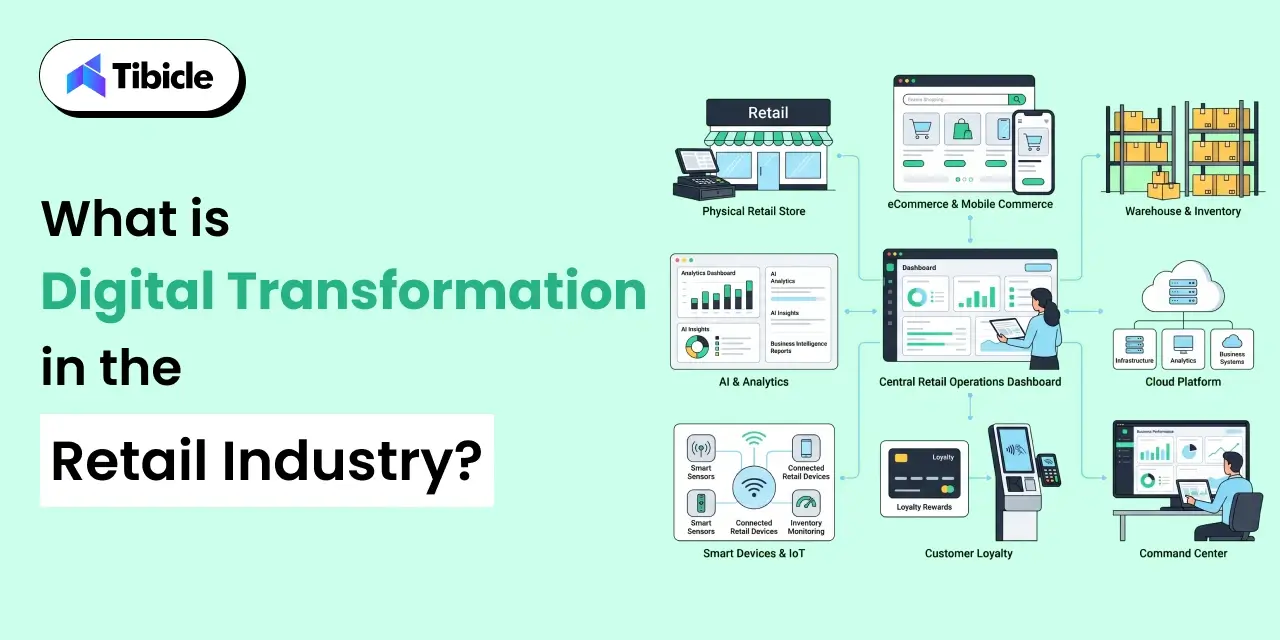
Digital transformation in retail industry refers to the strategic integration of digital technologies across every aspect of retail operations. Rather than focusing on a single technology investment, it involves rethinking how businesses operate, engage customers, manage inventory, optimize supply chains, and make decisions through technology-driven processes.
Many organizations mistakenly assume digital transformation simply means launching an online store or adding mobile commerce capabilities. In reality, the scope is much broader. It includes POS modernization, inventory automation, predictive analytics, workforce enablement, personalized marketing systems, and intelligent fulfillment networks.
A modern retail digital transformation strategy often combines technologies such as artificial intelligence, cloud computing, IoT devices, advanced analytics, and automation platforms to create connected operational ecosystems.
Examples include:
- AI-powered recommendation engines
- Automated inventory forecasting
- Smart warehouse management
- Digital loyalty platforms
- Self-service checkout systems
- Connected customer engagement tools
Industry adoption continues to accelerate. Gartner reports that approximately 91% of retail IT leaders plan to deploy AI technologies by 2026 as part of broader transformation initiatives.
Transformation is no longer viewed as a competitive advantage. Increasingly, it is becoming a business necessity.
Key Pros of Digital Transformation in Retail
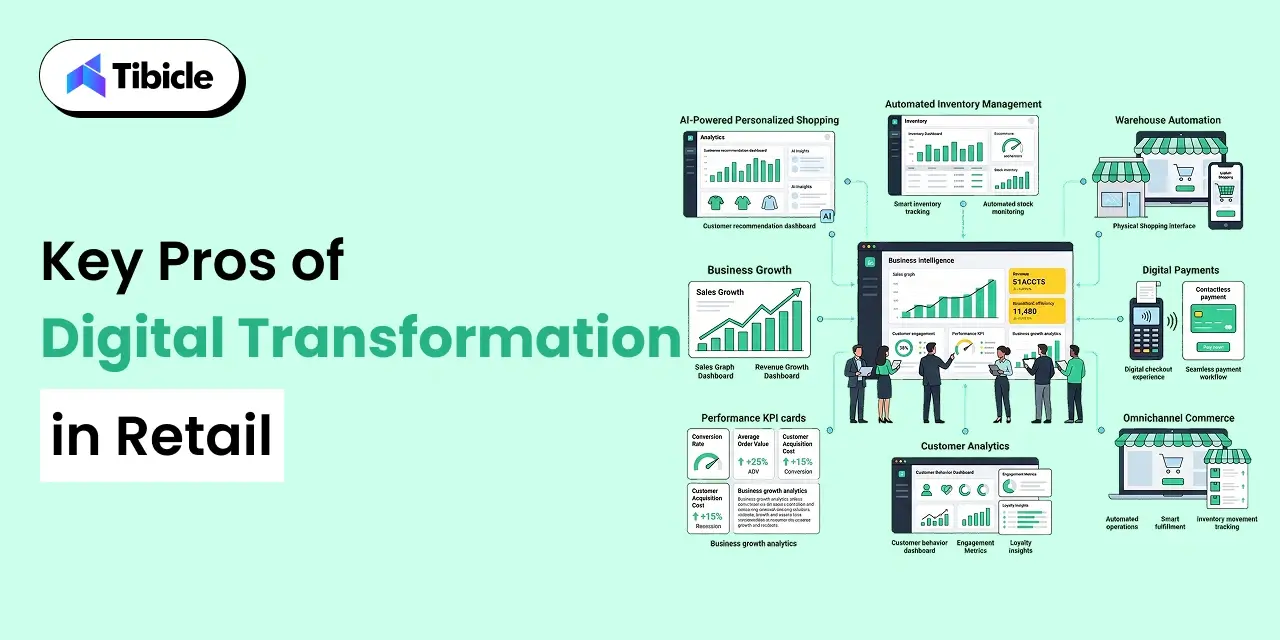
Retail leaders often justify transformation initiatives based on revenue growth, operational efficiency, customer experience improvements, and scalability. While outcomes vary by implementation quality, several benefits consistently emerge across successful projects.
Revenue Growth Through Personalized Customer Experiences
One of the strongest advantages of digital transformation in retail industry is the ability to deliver highly personalized customer experiences.
Modern retailers collect and analyze large volumes of customer data to understand purchasing behavior, browsing patterns, preferences, and engagement history. This information allows organizations to provide tailored recommendations, targeted promotions, and individualized shopping journeys.
Research suggests personalized shopping experiences can increase basket size by up to 40%. Recommendation engines powered by AI and integrated CRM platforms help retailers present the right products to the right customers at the right time.
Today’s consumers increasingly expect these experiences. Whether shopping online, through mobile applications, or in physical stores, personalization has become a major driver of customer satisfaction and retention.
Organizations investing in AI in retail operations are also improving loyalty program performance by creating more relevant and timely engagement opportunities.
Additionally, approximately 65% of retail organizations now view generative AI as a critical component of future ecommerce growth strategies.
Operational Cost Reduction and Process Automation
Reducing operational expenses remains one of the most compelling reasons retailers pursue digital transformation.
Many retail processes still rely on manual workflows, disconnected systems, and repetitive administrative tasks. Automation helps eliminate inefficiencies while improving accuracy and consistency.
Examples include:
- Automated inventory replenishment
- Invoice processing automation
- Workforce scheduling optimization
- Marketing campaign automation
- Demand forecasting systems
Studies show marketing automation alone can reduce marketing overhead by approximately 12.2%.
Meanwhile, RFID tracking and IoT-enabled inventory systems have demonstrated the ability to reduce inventory shrinkage by up to 45% while saving thousands of labor hours annually.
Retail automation not only lowers costs but also enables teams to focus on higher-value activities such as customer engagement, merchandising strategy, and business growth initiatives.
As a result, 56% of CEOs report profit increases directly linked to digital investments.
Scalable Omnichannel Infrastructure
Consumer shopping behavior has fundamentally changed.
Customers now move seamlessly between websites, mobile apps, social commerce channels, marketplaces, and physical stores before completing purchases.
This shift has made omnichannel retail capabilities essential for long-term growth.
Ecommerce currently represents approximately 23% of total U.S. retail sales and continues to grow significantly faster than traditional retail channels.
Modern transformation initiatives help retailers create unified commerce environments where:
- Inventory remains synchronized
- Pricing stays consistent
- Promotions operate across channels
- Customer data is centralized
- Fulfillment options are flexible
A connected infrastructure enables organizations to scale more efficiently while delivering a consistent customer experience regardless of channel.
Faster, Data-Backed Decision-Making
Retail success increasingly depends on decision speed.
Traditional reporting processes often involve multiple systems, delayed updates, and fragmented data sources. This creates decision bottlenecks that slow response times and reduce operational agility.
Digital transformation introduces centralized analytics environments, real-time dashboards, and predictive intelligence tools that accelerate business decision-making.
Common applications include:
- Demand forecasting
- Dynamic pricing
- Inventory optimization
- Procurement planning
- Promotion effectiveness analysis
A modern customer data platform can consolidate information from multiple touchpoints, creating a unified view of customer behavior across channels.
At the same time, supply chain digitization improves visibility into inventory movement, vendor performance, and fulfillment operations.
The result is faster decision-making, improved forecasting accuracy, and greater organizational responsiveness.
Key Cons and Risks of Digital Transformation in Retail
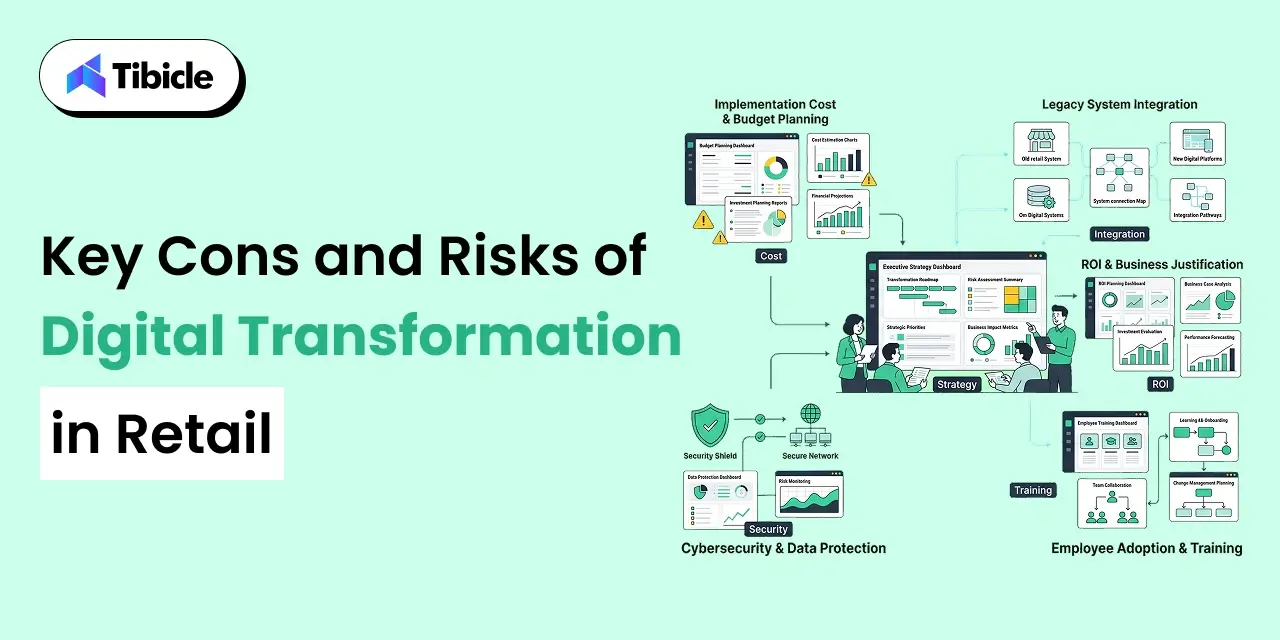
While the benefits of digital transformation in retail industry are substantial, successful implementation is rarely straightforward. Many projects struggle because organizations underestimate costs, integration complexity, organizational resistance, and long-term maintenance requirements.
Understanding these risks helps decision-makers build realistic transformation roadmaps and avoid costly mistakes.
High Upfront Implementation Costs
One of the biggest barriers to digital transformation is the initial investment required.
The digital transformation cost in retail varies significantly depending on project scope, existing infrastructure, and technology requirements. Small pilot initiatives may begin at $15,000–$50,000, while enterprise-wide transformation programs can exceed $500,000.
Costs typically include:
- Software licensing
- Cloud infrastructure
- System integrations
- Data migration
- Consulting services
- Security implementation
- Employee training
Many retailers focus on software pricing while underestimating implementation and operational expenses. This often leads to budget overruns and delayed ROI realization.
The challenge becomes even greater when legacy systems require extensive customization before modernization efforts can begin.
Legacy System Integration Complexity
Many retailers operate technology environments built over decades.
These ecosystems often include:
- Legacy ERP systems
- Standalone CRM platforms
- Aging POS infrastructure
- Custom inventory tools
- Disconnected reporting systems
Integrating modern solutions into these environments can be technically complex and time-consuming.
While cloud-based middleware and phased migration strategies help reduce risk, they also add implementation timelines and project costs.
Organizations frequently discover that integration challenges consume more resources than the new technology itself.
For this reason, system architecture assessments should be conducted before major investments are approved.
Organizational Resistance and Talent Gaps
Technology adoption depends as much on people as it does on software.
Employees often resist changes that alter workflows, introduce new systems, or require unfamiliar skills. Without proper change management, even technically successful projects can fail operationally.
Retailers that invest in employee enablement frequently achieve better outcomes. One major retailer reported a 50% reduction in employee turnover and a 60% decrease in hiring costs after modernizing workforce experiences and providing structured training programs.
However, many organizations lack internal expertise in:
- Artificial intelligence
- Data engineering
- Cloud architecture
- Automation technologies
- Advanced analytics
This talent shortage often creates dependence on external partners and increases implementation costs.
Data Privacy and Cybersecurity Exposure
As digital capabilities expand, so does cybersecurity risk.
Transformation initiatives typically increase the amount of customer, transaction, and operational data collected across the organization.
While this data enables personalization and business intelligence, it also creates additional security responsibilities.
Retailers must address:
- Customer privacy requirements
- Payment security standards
- Regulatory compliance
- Access control policies
- Threat monitoring
Compliance frameworks such as GDPR, PCI-DSS, and region-specific privacy regulations add complexity and cost to transformation programs.
A single security incident can undermine customer trust and significantly impact business performance.
Unclear ROI Timelines for New Retail Formats
Not every digital innovation delivers immediate business value.
Technologies such as:
- AR-powered shopping experiences
- Virtual stores
- Frictionless checkout systems
- Smart mirrors
- Microstores
continue to generate interest, but long-term profitability remains uncertain in many use cases.
While flagship retailers often achieve strong marketing outcomes from these initiatives, widespread scalability has not been consistently demonstrated.
Decision-makers should separate proven technologies from experimental innovations and avoid assuming every emerging technology will generate measurable returns.
A disciplined retail digital transformation strategy prioritizes business outcomes rather than technology trends.
Digital Transformation in Retail: Pros vs. Cons Comparison Table
| Factor |
Pros |
Cons |
| Cost |
12–40% operational savings after deployment |
$15K–$500K+ upfront investment |
| Revenue |
Up to 40% increase in basket size through personalization |
ROI often requires 12–24 months |
| Scalability |
Unified omnichannel infrastructure |
Legacy integration bottlenecks |
| Customer Experience |
Personalized journeys, AI assistants, AR experiences |
Data privacy and security concerns |
| Workforce |
Reduced turnover and improved productivity |
Training and change management costs |
| Technology |
AI, automation, cloud-native flexibility |
Experimental technologies remain unproven |
The comparison highlights a key reality: transformation creates significant value when executed properly, but organizations must account for implementation complexity before expecting measurable returns.
ROI Benchmarks for Retail Digital Transformation
For most executives, the success of a transformation initiative is ultimately measured through business outcomes.
Research indicates that approximately 41% of organizations achieve positive returns within two years of implementing digital transformation programs.
The strongest retail technology ROI typically comes from initiatives focused on operational efficiency, customer retention, and process automation rather than experimental innovation projects.
Retailers leveraging external expertise in analytics and AI implementation often achieve ROI approximately 40% faster than organizations relying exclusively on internal teams.
Automation projects have also demonstrated strong financial performance. Certain robotic process automation implementations report first-year returns approaching 200% when applied to repetitive operational tasks.
One of the most visible examples is Target’s digital transformation strategy. The company’s mobile application supports millions of daily active users, while digital fulfillment initiatives such as Drive Up have become major contributors to overall digital revenue.
To evaluate transformation performance effectively, retailers should monitor:
- Customer retention rate
- Revenue from digital channels
- Net Promoter Score (NPS)
- Customer Lifetime Value (CLV)
- Average Order Value (AOV)
- Operational cost savings
- Inventory turnover improvements
Tracking these KPIs consistently provides a clearer picture of transformation impact than relying solely on revenue growth.
Cost and Pricing Insights for Retail Digital Transformation
The cost of transformation depends largely on business size, technology maturity, and implementation scope.
Cost Breakdown by Transformation Scale
| Project Scope |
Estimated Investment |
| Small Pilot Projects |
$15,000–$50,000 |
| Mid-Scale Transformation |
$75,000–$200,000 |
| Enterprise Transformation |
$300,000–$500,000+ |
Rather than pursuing large-scale transformations immediately, many organizations benefit from phased implementation strategies.
A commonly recommended budgeting approach is the 70-20-10 rule:
- 70% invested in proven technologies
- 20% invested in emerging opportunities
- 10% invested in experimental innovation
This model balances operational stability with innovation.
Hidden Costs Retailers Often Overlook
Beyond technology investments, retailers should budget for:
- Data migration
- Employee training
- Security compliance
- Infrastructure upgrades
- Vendor onboarding
- Integration services
- Ongoing support contracts
These costs frequently exceed initial expectations.
One effective risk-reduction strategy involves launching smaller MVP-style pilots before scaling transformation initiatives across the organization.
This allows retailers to validate business outcomes before committing larger budgets.
Vendor Selection Checklist for Retail Digital Transformation
Selecting the right technology partner can determine whether a transformation initiative generates measurable business value or becomes an expensive operational challenge.
The most successful retail transformation programs prioritize scalability, integration readiness, and long-term business outcomes rather than focusing solely on software features.
Evaluation Criteria for Retail Technology Vendors
Before selecting a transformation partner, executives should evaluate the following:
- Does the solution support modular, API-ready architecture?
- Can it integrate with existing ERP, CRM, and POS platforms?
- Does the vendor have proven retail implementation experience?
- Is a phased rollout approach available?
- Are MVP-first engagement models supported?
- Is pricing subscription-based, project-based, or hybrid?
- Are there vendor lock-in clauses?
- What change management and employee training programs are included?
- Does the vendor provide post-deployment analytics and ROI reporting?
- What security certifications are maintained?
- Does the platform support future scalability requirements?
- How are ongoing support and maintenance handled?
Strong vendors focus on business outcomes, adoption rates, and measurable ROI rather than simply delivering software.
Questions Every Retail Executive Should Ask
Many transformation failures occur because organizations fail to ask critical questions before signing contracts.
Key questions include:
- How long will implementation take?
- What integrations require custom development?
- What are the expected ROI milestones?
- What hidden costs should be anticipated?
- What internal resources are required?
- What risks have been encountered in similar projects?
These discussions often reveal more about vendor suitability than product demonstrations.
Looking for an offshore technology partner to architect your retail digital transformation? Talk to Tibicle’s team for a free consultation and roadmap assessment.
Top Tools and Platforms Driving Retail Digital Transformation
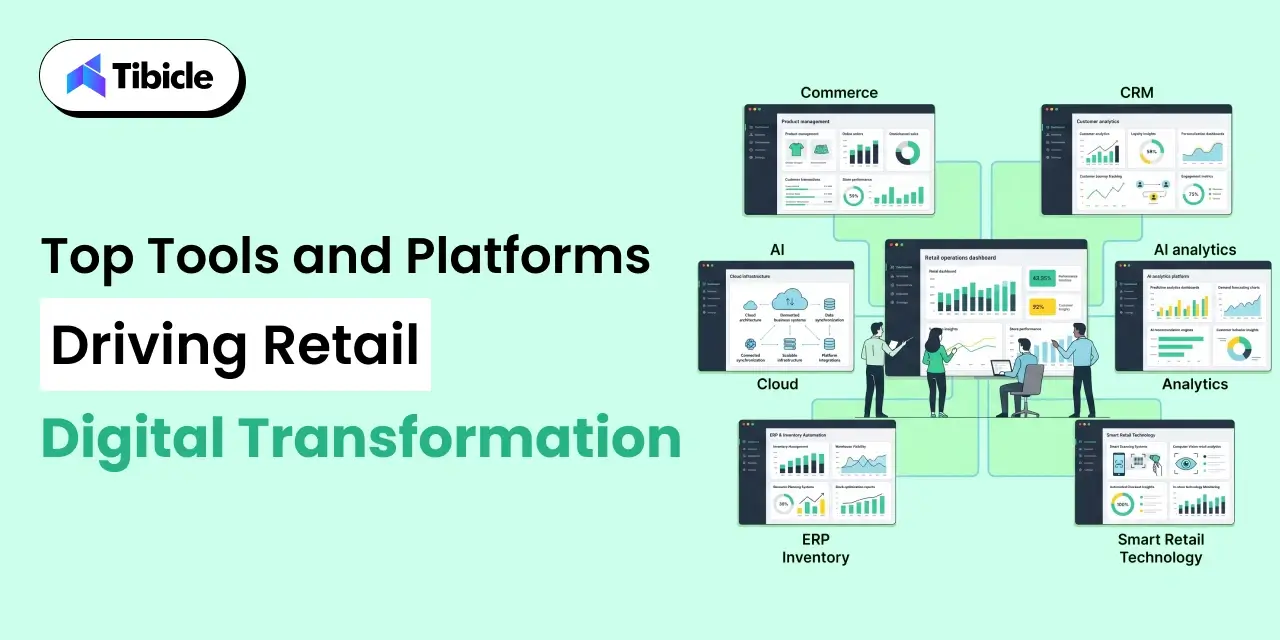
Modern retail transformation initiatives are often powered by specialized technology platforms designed to improve customer engagement, operational efficiency, and scalability.
Shopify
One of the most widely adopted e-commerce platforms, Shopify provides omnichannel commerce capabilities, integrated payments, analytics, and growing AR commerce functionality.
Salesforce Commerce Cloud
Salesforce combines CRM, customer engagement, loyalty management, and unified commerce tools within a single ecosystem.
SAP S/4HANA
SAP remains a leading solution for retailers requiring advanced ERP capabilities, supply chain visibility, procurement management, and enterprise reporting.
Google Cloud Vertex AI
Retailers use Vertex AI to deploy machine learning models for demand forecasting, personalization, inventory optimization, and customer analytics.
AWS for Retail
AWS provides cloud infrastructure, personalization services, data lakes, analytics environments, and scalable retail workloads.
Scandit
Scandit helps retailers improve inventory management and customer engagement through AR-powered barcode scanning and mobile commerce experiences.
Standard AI
Standard AI focuses on autonomous checkout, store intelligence, and computer vision technologies that reduce friction during the shopping experience.
Why Tibicle Is a Strong Choice for Retail Digital Transformation Projects
Many retailers face a common challenge: off-the-shelf software rarely aligns perfectly with operational requirements.
While SaaS platforms solve specific problems, organizations often require custom integrations, automation workflows, analytics systems, and customer experiences that extend beyond standard functionality.
Tibicle helps retailers bridge this gap by providing custom software development, cloud modernization, automation solutions, AI integrations, and managed technology services.
Key strengths include:
- API-ready architecture design
- Cloud migration expertise
- AI and machine learning integration
- Custom retail software development
- DevOps and managed services
- Automation workflow implementation
- Data and analytics engineering
Unlike vendors focused on a single platform, Tibicle supports retailers needing flexible, scalable technology ecosystems built around their unique operational requirements.
With experience across SaaS architecture, cloud infrastructure, automation, and emerging technologies, Tibicle helps organizations implement transformation initiatives through phased, business-driven engagement models.
Explore how Tibicle can support your retail technology roadmap and future growth strategy.
Conclusion
The benefits of digital transformation in retail industry are clear. Organizations implementing the right technologies can improve customer experiences, increase operational efficiency, reduce costs, and create new revenue opportunities.
However, transformation success depends on more than technology selection. Implementation complexity, legacy systems, organizational readiness, and vendor expertise all influence outcomes.
Executives should evaluate opportunities using measurable business criteria rather than focusing solely on technology trends. The comparison framework, ROI benchmarks, cost considerations, and vendor checklist outlined in this guide provide a practical foundation for building a stronger business case.
When approached strategically, digital transformation becomes a growth accelerator rather than a technology expense.
Ready to start your retail digital transformation journey? Contact Tibicle for a free technology assessment and roadmap consultation.
FAQs
What is digital transformation in the retail industry?
Digital transformation in the retail industry involves integrating technologies such as AI, cloud computing, analytics, automation, and IoT across operations to improve customer experience, efficiency, and revenue growth.
How much does digital transformation cost for a retail business?
Costs typically range from $15,000 for focused pilot projects to more than $500,000 for enterprise-wide transformation initiatives, depending on complexity and scope.
What is the average ROI timeline for retail digital transformation?
Research indicates that approximately 41% of organizations achieve measurable ROI within two years of implementation, while targeted automation initiatives often deliver returns more quickly.
What are the biggest risks of digital transformation in retail?
The most common risks include high upfront costs, legacy system integration challenges, organizational resistance, cybersecurity concerns, and uncertain ROI from experimental technologies.
How do I choose the right digital transformation vendor?
Evaluate vendors based on retail experience, integration capabilities, architecture flexibility, security certifications, implementation methodology, pricing transparency, and post-launch support.
Can small and mid-sized retailers afford digital transformation?
Yes. Many retailers begin with focused pilot projects, automation initiatives, or low-code implementations that validate ROI before scaling investment across the business.