Introduction
According to CB Insights, approximately 42% of startups fail because they build products that nobody wants. MVP app development helps founders spend months developing features, hiring teams, and investing heavily in marketing before validating whether a real market exists for their solution.
At the same time, the global MVP development market is projected to reach between $541 million and $569 million by 2031, growing at an estimated CAGR of 8.7–9.5%. This growth reflects a significant shift in how businesses approach software development. Instead of committing hundreds of thousands of dollars to full-scale products, organizations increasingly rely on MVP app development to validate demand before making major investments.
Building a complete software platform without validation can easily consume $250,000–$500,000 in development costs. For founders, product leaders, and innovation teams, this creates unnecessary financial risk and delays critical market feedback.
What Is MVP App Development (And What It Is Not)
It is the process of building a functional product with only the essential features required to solve a specific customer problem and validate market demand.
The objective is not to launch an incomplete product. The objective is to collect real-world feedback, test assumptions, and measure customer behavior before committing substantial resources to a full-scale build.
A successful minimum viable product for startups focuses on learning rather than feature completeness. Instead of building everything at once, teams launch a smaller version that delivers the core value proposition while generating measurable business insights.
This approach follows the principles of the lean startup methodology, where learning speed is often more valuable than feature volume.
MVP vs. Prototype vs. Beta: A Functional Distinction
Many teams mistakenly use MVP, prototype, and beta interchangeably. In practice, these represent different stages of product development and serve completely different business objectives.
| Stage |
Purpose |
User Access |
Functionality |
| Prototype |
Validate concepts and design |
Internal stakeholders |
Limited or non-functional |
| MVP |
Validate market demand |
Real users |
Functional core product |
| Beta |
Test before full launch |
Selected external users |
Broad feature set |
A prototype helps teams evaluate user flows and design assumptions. An MVP helps validate whether users actually want the product. A beta release focuses on refinement before a wider launch.
Understanding this distinction prevents companies from allocating budgets incorrectly and building products that solve the wrong problem.
Why the Definition Matters for Budget Allocation
One of the most common reasons MVP initiatives fail is that stakeholders treat them as smaller versions of a final product rather than validation tools.
Once additional features start entering the roadmap, development timelines expand, budgets increase, and learning cycles slow down. Industry research suggests that approximately 60–70% of MVP projects exceed their original schedules due to uncontrolled feature expansion.
This is why every successful MVP relies on a disciplined feature prioritization framework. The goal is to identify the smallest set of features required to test business assumptions and gather meaningful user data.
Organizations that maintain strict scope control generally reach validation milestones faster and at significantly lower cost.
Why MVP App Development Is a Business Strategy, Not a Technical Shortcut
Many founders assume MVP app development exists primarily to reduce engineering expenses. While lower development costs are certainly a benefit, the true value of an MVP is strategic rather than technical.
An MVP is fundamentally a business validation framework. It allows organizations to test demand, evaluate user behavior, and measure market interest before investing heavily in product expansion, infrastructure, and operational growth.
The companies that succeed are not always the ones that build the fastest. They are often the ones who learn the fastest.
Market Validation Before Capital Commitment
Launching a full-scale product without validation remains one of the biggest financial risks in software development.
Startups using MVP strategies report significantly higher success rates because they test assumptions before making long-term commitments. Investors have also shifted expectations. Nearly 70% of seed-stage investors now prefer companies that can demonstrate market traction rather than relying solely on product concepts.
A properly executed MVP generates measurable signals such as:
- Customer acquisition data
- User engagement metrics
- Retention performance
- Revenue validation
- Product-market fit indicators
These metrics provide evidence that demand exists before significant capital is deployed.
Speed-to-Market as a Competitive Lever
Traditional software products often require 12–18 months of development before reaching users. By contrast, most MVP initiatives launch within 8–16 weeks, depending on complexity and scope.
This shorter timeline allows organizations to:
- Validate ideas faster
- Reach customers sooner
- Gather competitive intelligence
- Reduce opportunity costs
- Improve decision-making speed
Research shows that companies performing product-market fit validation within the first month of launch are significantly more likely to identify sustainable growth opportunities than organizations that spend a year building before collecting user feedback.
An MVP is not designed to be the final product. It is designed to create a rapid learning cycle that informs future development decisions and reduces business risk.
Step-by-Step MVP App Development Process
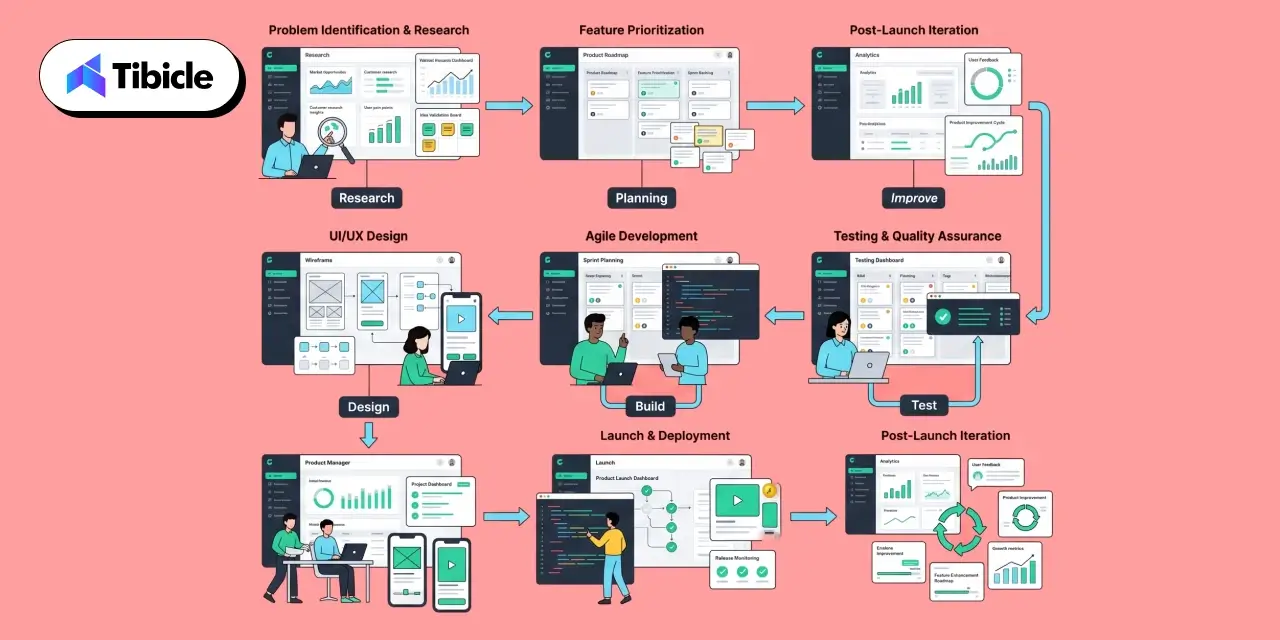
A successful MVP is not created by simply removing features from a larger product vision. Effective MVP follows a structured process designed to validate assumptions, reduce risk, and maximize learning.
Organizations that skip discovery, prioritization, or validation stages often end up rebuilding products after launch, significantly increasing costs and delaying growth.
Problem Definition and Audience Analysis
Every successful MVP starts with a clearly defined problem.
Before writing code, teams should identify:
- The specific customer pain point
- The target audience
- Existing alternatives in the market
- The core value proposition
The goal is not to build features. The goal is to understand what problem users are willing to pay to solve.
This stage often includes market research, competitor analysis, customer interviews, and validation workshops. Organizations that invest time here generally avoid building features that customers never use.
Feature Prioritization Using MoSCoW and RICE Frameworks
One of the biggest challenges in MVP is deciding what not to build.
Two widely adopted prioritization frameworks include:
MoSCoW Method
- Must Have
- Should Have
- Could Have
- Won’t Have
The MoSCoW method helps teams focus on features that directly support validation goals while postponing lower-priority functionality.
RICE Framework
- Reach
- Impact
- Confidence
- Effort
The RICE framework helps product teams quantify feature value and prioritize development efforts based on measurable business outcomes.
Most successful MVPs launch with only 20–30% of the functionality originally proposed during planning.
Tech Stack Selection for Scalability
Technology decisions made during MVP development often influence long-term product scalability.
While the goal is rapid validation, teams should avoid selecting technologies that create expensive migration challenges later.
Common considerations include:
- Frontend framework selection
- Backend architecture
- Database scalability
- Cloud infrastructure
- Security requirements
- Third-party integrations
Many modern products adopt an API-first architecture, allowing future mobile apps, web applications, and integrations to share the same backend infrastructure.
This approach improves flexibility and reduces redevelopment costs as products evolve.
Agile MVP App Development Sprint Execution and QA
Once requirements are finalized, development typically moves into sprint-based execution.
An agile MVP sprint model enables teams to deliver features incrementally while maintaining stakeholder visibility throughout development.
Most MVP projects use:
- 1–2 week sprint cycles
- Continuous stakeholder reviews
- Incremental testing
- Ongoing backlog refinement
Quality assurance should occur throughout development rather than after development ends.
A common misconception is that MVPs can sacrifice quality because they are “minimum” products. In reality, poor user experiences generate misleading feedback and reduce the value of validation efforts.
Launch, Measure, and Iterate
Launching the MVP is not the end of the process.
It is the beginning.
The most valuable insights often emerge after users start interacting with the product.
Teams should establish metrics for:
- User acquisition
- Feature engagement
- Retention
- Conversion
- Customer satisfaction
This creates a continuous user feedback loop that guides future product decisions.
The most successful MVP initiatives rely on post-launch iteration rather than attempting to predict every requirement before launch
MVP App Development Cost Breakdown (2026 Benchmarks)
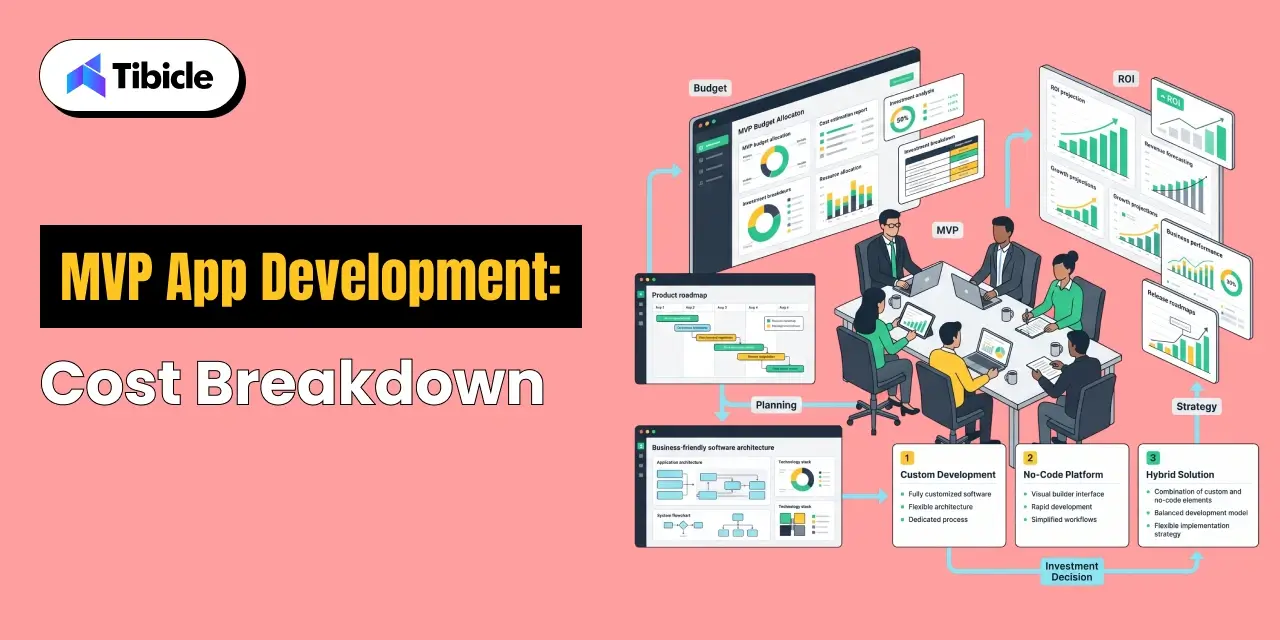
One of the most common questions founders ask is:
“How much does MVP cost?”
The answer depends on product complexity, industry requirements, technical architecture, and development approach.
Understanding realistic cost benchmarks helps organizations avoid underbudgeting and vendor misalignment.
Cost by Complexity Tier
| MVP Type |
Cost Range |
Timeline |
| Simple (Landing Page + CRUD) |
$10,000–$30,000 |
5–8 Weeks |
| Standard SaaS Product |
$55,000–$140,000 |
8–14 Weeks |
| AI-Powered MVP |
$140,000–$300,000+ |
3–6 Months |
| Enterprise / Compliance Heavy |
$200,000–$500,000+ |
4–6 Months |
Simple MVPs focus on validation and user acquisition.
Standard SaaS MVPs include user authentication, subscription workflows, dashboards, and reporting.
AI-powered products require model integration, training infrastructure, and additional testing.
Enterprise MVPs often include security, compliance, and integration requirements that increase both cost and complexity.
Hidden Costs Most Vendors Don’t Mention
The quoted development cost is rarely the complete investment.
Many organizations overlook expenses such as:
- Discovery workshops
- Product strategy sessions
- Third-party APIs
- Cloud infrastructure
- Security testing
- Compliance requirements
- Analytics tools
- Ongoing support
Discovery phases alone frequently cost between $2,000 and $10,000 depending on project scope.
Compliance requirements such as GDPR, HIPAA, or industry-specific regulations can add $25,000–$75,000 to overall project budgets.
Organizations should also allocate resources for post-launch iteration, as user feedback often drives significant product adjustments after launch.
Cost by Development Approach (Custom vs. No-Code vs. Hybrid)
The chosen development methodology has a significant impact on overall cost.
Custom Development
- Highest flexibility
- Best scalability
- Highest upfront investment
No-Code MVP
A no-code mvp can reduce development expenses by up to five times compared to custom development.
Benefits include:
- Rapid deployment
- Lower validation costs
- Reduced engineering effort
However, scalability and customization options are often limited.
Hybrid Development
Hybrid approaches combine low-code platforms with custom development components.
This strategy balances speed, flexibility, and long-term scalability while reducing initial investment requirements.
Industry analysts predict that nearly 70% of new applications will involve low-code or no-code technologies by 2026, making hybrid development increasingly attractive for validation-focused products.
ROI of MVP App Development: Where Returns Actually Show Up
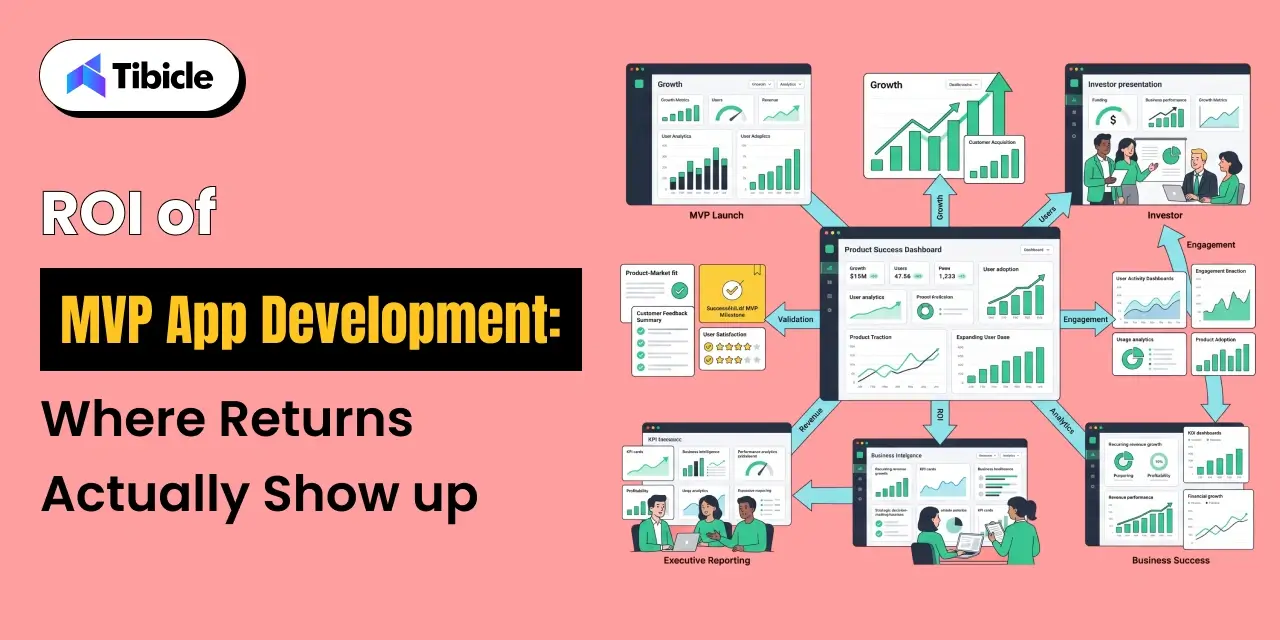
The value of an MVP is not measured solely by development cost savings.
The primary return comes from reducing uncertainty before committing substantial resources.
Avoided Sunk Cost on Unvalidated Products
Many failed software products consume hundreds of thousands of dollars before teams realize there is insufficient market demand.
The average failed SaaS initiative can burn between $250,000 and $500,000 before meaningful customer validation occurs.
An MVP provides an early go/no-go signal, helping organizations identify whether additional investment is justified.
Even a failed MVP can create value by preventing significantly larger financial losses.
Investor Conversion and Valuation Engineering
Investors increasingly favor products with measurable traction rather than purely conceptual business plans.
Companies that bootstrap to $50,000–$100,000 in annual recurring revenue before fundraising often achieve significantly stronger valuations than businesses raising capital with only prototypes or pitch decks.
An MVP demonstrates:
- Market demand
- Customer interest
- Revenue potential
- Product viability
This makes fundraising conversations more data-driven and significantly less speculative.
Lower Post-Launch Churn
Products built around assumptions frequently struggle with adoption and retention.
MVP-driven development uses real customer behavior to guide product evolution.
As a result, teams make decisions based on evidence rather than internal opinions.
Continuous customer validation and structured feedback collection often reduce churn while improving retention, engagement, and overall customer satisfaction.
Organizations that actively iterate based on customer behavior typically build stronger products than teams that attempt to perfect every feature before launch.
MVP App Development Approaches Compared
There is no single development approach that works for every business. The ideal strategy depends on budget, validation goals, scalability requirements, and time-to-market expectations.
Custom Build vs. No-Code vs. Hybrid vs. Pre-Built
| Factor |
Custom Build |
No-Code |
Hybrid |
Pre-Built |
| Cost |
$50K–$150K |
$5K–$15K |
$25K–$50K |
$10K–$40K |
| Timeline |
4–6 Months |
2–4 Weeks |
8–12 Weeks |
2–4 Weeks |
| Scalability |
High |
Limited |
Moderate |
Moderate |
| Customization |
High |
Limited |
Strong |
Limited |
| Maintenance |
Flexible |
Platform Dependent |
Moderate |
Vendor Dependent |
| Best For |
Novel Innovation |
Quick Validation |
Moderate Customization |
Proven Business Models |
Custom development provides maximum flexibility but requires larger upfront investments.
No-code platforms enable rapid validation at significantly lower costs, making them attractive for early-stage founders testing demand.
Hybrid development combines custom engineering with low-code acceleration tools, often providing the best balance between speed and scalability.
Pre-built solutions work well when businesses are entering proven markets and can adapt existing frameworks rather than creating entirely new products.
Industries Where MVP App Development Delivers the Highest ROI
Certain industries benefit more from MVP strategies because market validation significantly reduces risk before major investments are made.
Fintech and Digital Lending
Fintech products often involve regulatory requirements, customer trust concerns, and complex financial workflows.
Launching an MVP enables organizations to validate:
- Lending demand
- User acquisition costs
- Transaction behavior
- Retention patterns
before investing heavily in compliance infrastructure and enterprise-grade systems.
Healthtech and Remote Patient Monitoring
Healthcare solutions require extensive validation due to strict compliance requirements and high development costs.
MVPs help healthcare innovators test:
- Patient adoption
- Provider engagement
- Monitoring workflows
- Operational feasibility
before expanding into broader healthcare ecosystems.
EdTech and Competency Platforms
Education technology products often depend on user engagement and learning outcomes.
MVP development helps teams validate:
- Course completion rates
- Student engagement
- Subscription willingness
- Content effectiveness
before scaling content production and platform capabilities.
PropTech
Among startup sectors, PropTech consistently demonstrates strong MVP performance.
Industry research suggests PropTech startups achieve some of the highest MVP-to-Series A conversion rates because property marketplaces, tenant services, and real estate automation platforms can be validated efficiently before large-scale investment.
Risks and Challenges in MVP App Development
While MVP strategies reduce risk, poor execution can create misleading results and expensive technical debt.
Treating “Minimum” as a Quality Excuse
One of the most common mistakes is assuming an MVP can be low quality because it contains fewer features.
This assumption is dangerous.
Users judge products based on functionality, performance, and usability—not development philosophy.
A buggy MVP often produces false-negative validation signals because customers abandon the product due to poor experiences rather than lack of demand.
Minimum should define scope boundaries, not quality standards.
Scope Creep After Scope Lock
Feature expansion remains one of the largest causes of budget overruns.
Once development begins, stakeholders frequently request:
- Additional dashboards
- Reporting systems
- Notifications
- Integrations
- Advanced permissions
These additions create delays, increase costs, and reduce learning speed.
Poorly controlled scope creep can increase overall development costs by three to five times the original estimate.
Vendor Lock-In With No-Code Platforms
While no-code platforms accelerate validation, they may create long-term dependency on proprietary ecosystems.
Common challenges include:
- Limited customization
- Export restrictions
- Platform pricing increases
- Migration complexity
Organizations should understand migration pathways before committing to a no-code strategy.
Compliance Gaps Discovered Post-Launch
Many startups postpone compliance discussions until after launch.
This creates significant risks for industries such as:
- Healthcare
- Finance
- Insurance
- Education
Retrofitting security and compliance controls later often costs substantially more than incorporating them during planning.
MVP App Development Vendor Selection Checklist
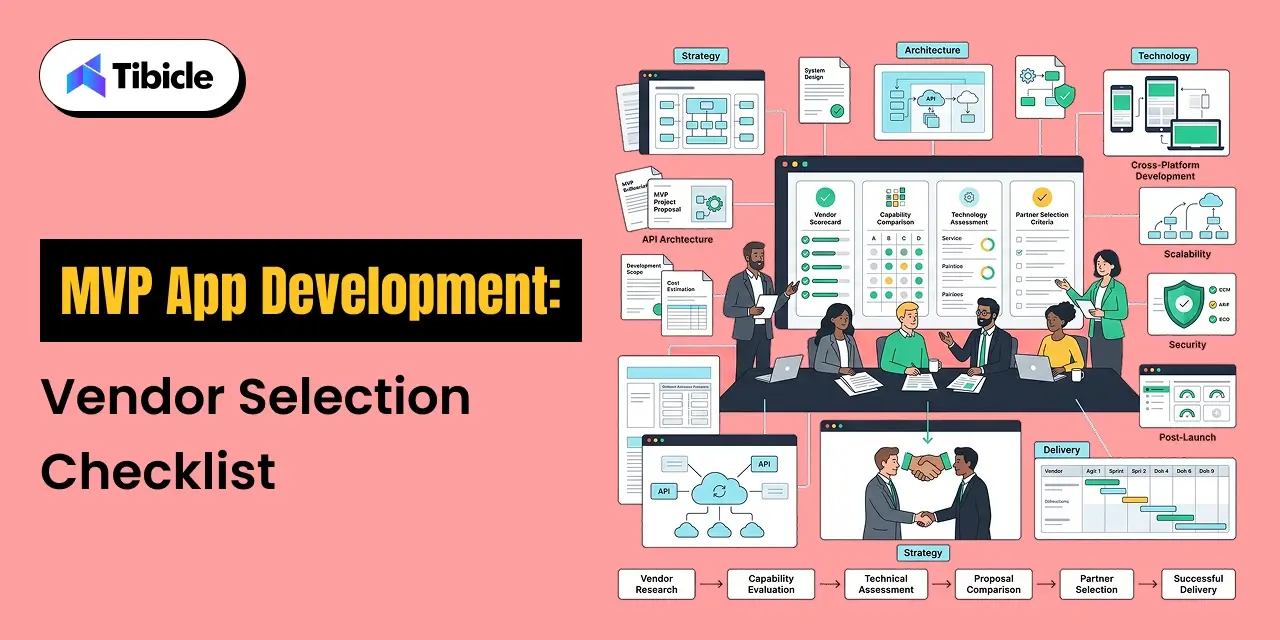
Selecting the right partner often has a greater impact on outcomes than selecting the right technology stack.
10-Point Evaluation Criteria
Before selecting an MVP software development company, evaluate:
- AI-first architecture readiness
- Fixed scope commitment before Sprint 1
- Post-launch accountability is included in contracts
- Verified client reviews and references
- Compliance planning during discovery
- Hybrid low-code capability
- Transparent pricing structure
- Dedicated post-launch iteration support
- Cross-platform development expertise
- Measurable client success stories
Strong vendors focus on validation outcomes rather than feature volume.
Red Flags That Disqualify a Vendor
Warning signs include:
- No paid discovery phase
- Unrealistically low pricing
- Lack of post-launch support
- Monolithic architecture recommendations
- No product strategy involvement
- Absence of client references
- Fixed timelines without discovery
The best vendors challenge assumptions and help refine product strategy rather than simply accepting feature lists.
Why Tibicle Is a Strong Choice for MVP App Development
Many organizations fail not because their idea lacks potential, but because they overspend before validating market demand.
Tibicle approaches MVP app development with a validation-first mindset focused on reducing risk, accelerating learning, and maximizing ROI.
The team combines:
- Offshore development efficiency
- Agile delivery methodologies
- Cross-industry product experience
- Scalable architecture planning
- Post-launch support structures
Rather than building oversized products, Tibicle helps founders and enterprises launch focused MVPs that generate actionable market feedback while maintaining long-term scalability.
Whether you’re building a SaaS platform, marketplace, fintech product, healthcare application, or enterprise tool, Tibicle helps align product development with business validation goals.
Talk to Tibicle’s team about scoping your MVP before committing to a full-scale build.
Conclusion
MVP app development is not simply a way to reduce engineering costs. It is a strategic approach to allocating capital more effectively while minimizing market risk.
With 42% of startups failing because they build products without sufficient demand, validation has become one of the most important stages of modern product development.
Organizations that adopt MVP strategies often achieve higher success rates, faster market feedback, stronger investor confidence, and significantly lower development waste.
The potential savings are substantial. Avoiding a failed full-scale build can preserve $250,000–$500,000 in capital while creating valuable market insights.
Ready to validate your product idea? Get a free MVP scoping session with Tibicle’s development team and identify the fastest path to market validation.
FAQs
How much does MVP app development cost in 2026?
MVP app development costs typically range from $10,000 for simple products to $300,000+ for AI-powered platforms. Standard SaaS MVPs generally fall between $55,000 and $140,000.
How long does it take to build an MVP App?
Most MVPs launch within 8–16 weeks. No-code solutions may launch within 2–4 weeks, while enterprise MVPs often require 4–6 months.
What is the difference between an MVP and a prototype?
A prototype validates concepts and design flows. An MVP is a functional product used by real customers to validate demand and collect behavioral data.
Should I use no-code tools to build my MVP App development ?
No-code platforms work well for rapid validation and cost-efficient testing. However, businesses expecting significant growth should evaluate long-term scalability requirements before committing fully.
What features should an MVP App development include?
An MVP should contain only the features necessary to deliver the core value proposition. Most successful MVPs launch with 5–7 essential screens and a limited feature set.
How do I choose the right MVP App development company?
Evaluate discovery processes, post-launch support, technical architecture, compliance planning, pricing transparency, client references, and measurable success outcomes before selecting a vendor.