
Risk Management In IT Projects

May 13, 2026

Read in 4 Minutes
Table of Contents
- Introduction
- What Risk Management In IT Projects Actually Means
- The Five Core Risk Categories In IT Projects
- How The Risk Management Framework Works In Practice
- Risk Management In IT Projects Vs General Project Risk Management
- What It Costs To Skip Structured Risk Management
- Risk Management Tools: What To Evaluate And What To Pay
- ROI Of Risk Management In IT Projects
- Common Challenges When Implementing Risk Management In IT Projects
- Vendor Selection Checklist For IT Risk Management Tools
- Top Tools For Risk Management In IT Projects
- Why Tibicle LLP Is Worth Evaluating For IT Project Risk Management
- Conclusion
- FAQs
Introduction
According to PMI’s 2025 Pulse Report, only 58% of IT projects finish within budget, and just 52% are delivered on schedule. These figures show that risk management in IT projects is not just a compliance activity but a financial protection mechanism. Organizations that implement structured IT project risk assessment and project risk mitigation strategies complete significantly more projects successfully.
When risks are ignored, issues like scope creep, regulatory exposure, and talent drain begin to affect outcomes. Modern software project risks go beyond technical failures and impact business continuity, customer trust, and long-term scalability. Without a defined Risk Management framework for IT teams, even well-funded projects can fail.
Effective risk management in IT projects requires understanding how structured frameworks reduce failures, control costs, improve delivery stability, and strengthen long-term project success.
What Risk Management In IT Projects Actually Means
Beyond The Definition
Risk management in IT projects is not just about maintaining a risk log. It serves as a structured decision-support system throughout the entire project lifecycle, addressing both risks and opportunities, ensuring better outcomes across budget, timeline, compliance, and performance.
Also, it combines tools like an IT risk register, predictive analysis, and monitoring systems. Techniques such as qualitative risk analysis and quantitative risk analysis help teams make informed decisions rather than assumptions.
Where Most IT Teams Get It Wrong
Many teams treat risk identification as a one-time task during project kickoff. Others confuse risks with issues and respond only after problems arise. A major gap is the absence of ownership, where no clear person is responsible for executing the risk response plan.
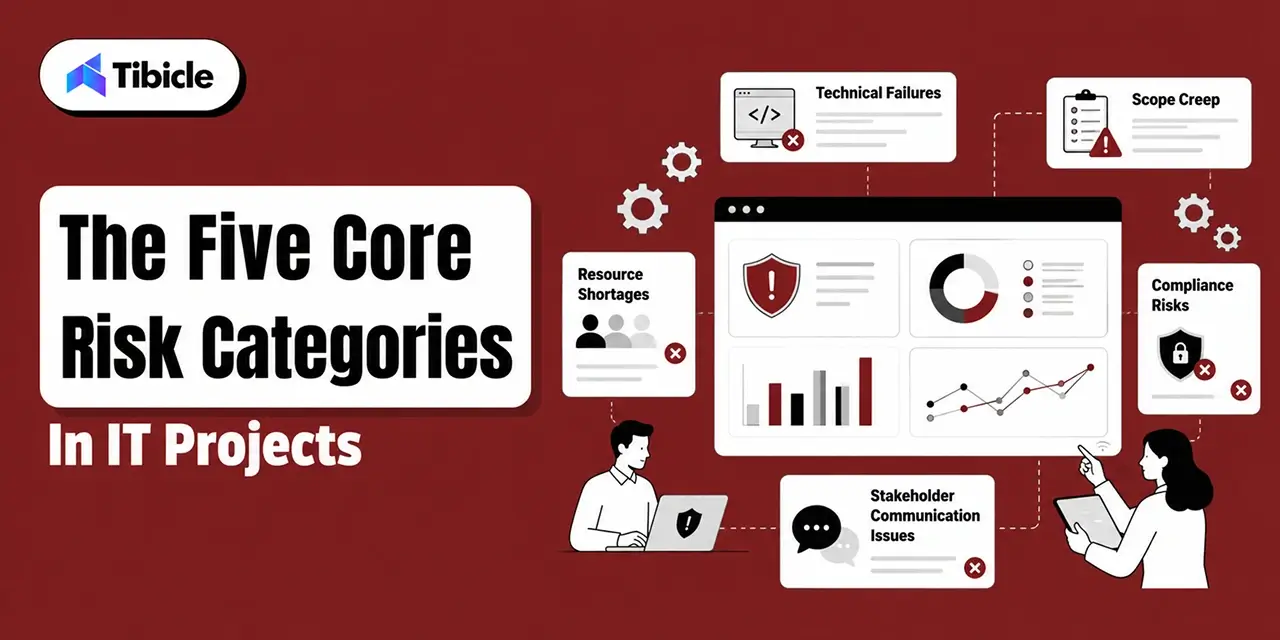
The Five Core Risk Categories In IT Projects
Technical Risk
Technical risks include untested technologies, integration failures, and architectural gaps. These are among the most common software project risks and can disrupt delivery if not addressed early.
Scope Risk
Scope creep is one of the most frequent issues in IT projects. As requirements expand without control, budgets increase, and timelines get extended.
Resource Risk
Resource risks arise from skill shortages, employee attrition, and dependency on external vendors. These factors directly impact delivery timelines and quality.
Regulatory And Compliance Risk
IT projects often need to comply with standards like GDPR, HIPAA, and ISO 27001. Failure to meet these requirements can result in penalties and audits.
Stakeholder And Communication Risk
Poor communication leads to misaligned expectations and unclear requirements. Effective stakeholder risk communication is essential to avoid rework and delays.
How The Risk Management Framework Works In Practice
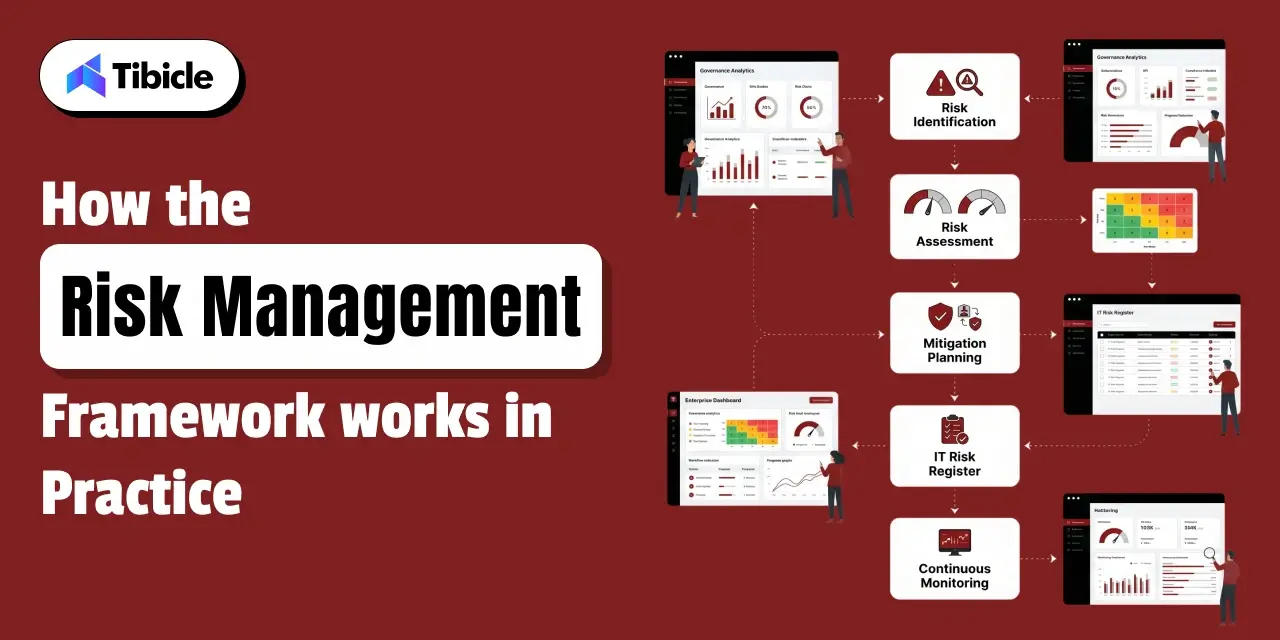
Step 1: Risk Identification
Risk identification involves structured brainstorming, expert input, and analysis of past data. Teams using structured methods identify more relevant risks than those using informal approaches.
Step 2: Risk Assessment
A risk matrix is used to prioritize risks based on probability and impact. Advanced projects may use Monte Carlo simulation to analyze uncertainty in timelines and budgets.
Step 3: Risk Response Planning
Organizations define responses such as avoid, mitigate, transfer, accept, or exploit. A well-defined risk response plan reduces the likelihood of major failures.
Step 4: IT Risk Register Setup
An IT risk register includes details like risk ID, probability, impact, owner, mitigation strategy, and review schedule.
Step 5: Continuous Monitoring
Risk Management is an ongoing process. Regular reviews and updates ensure risks are tracked and controlled effectively.
Risk Management In IT Projects Vs General Project Risk Management
| Factor | General Project Risk | IT Project Risk |
| Primary Risk Driver | Timeline and labor | Technical and integration risks |
| Regulatory Exposure | Low to moderate | High |
| Risk Speed | Slower | Fast moving |
| Tools | Basic tools | Advanced platforms |
| Stakeholders | Moderate | High complexity |
| Monitoring | Periodic | Continuous |
Key takeaway: Risk Management in IT Projects requires specialized frameworks because risks are faster, more complex, and compliance-focused.
What It Costs To Skip Structured Risk Management
When Risk Management in IT Projects is ignored or treated informally, the financial impact compounds quickly. Studies show that nearly 70% of IT projects exceed their original budgets when risks are not actively identified and managed. This is not just due to unexpected failures but also because of predictable issues that were never addressed through proper IT project risk assessment.
The cost can be broken into three categories. First, direct costs such as rework, missed deadlines, and resource inefficiencies. Second, indirect costs include reputational damage, reduced stakeholder trust, and lost market opportunities. Third, compliance costs, where organizations face penalties, audits, or operational restrictions due to regulatory gaps.
Tools like contingency planning and a structured risk heat map allow teams to visualize exposure and prioritize action before risks escalate. Without these mechanisms, small issues evolve into large-scale failures, increasing both financial and operational pressure on teams.
Risk Management Tools: What To Evaluate And What To Pay
Tool Categories
Organizations evaluating tools for Risk Management in IT Projects must understand the range of available options. Entry-level project management tools such as Wrike and ClickUp include basic risk tracking modules, typically priced between $9.80 and $39.97 per user per month, making them suitable for smaller teams.
Mid-market IRM platforms like LogicManager and StandardFusion follow a quote-based pricing model, focusing on specific use cases rather than user seats. These tools are designed for organizations requiring structured project risk mitigation strategies without full enterprise overhead.
Enterprise-grade GRC solutions such as ServiceNow GRC, Riskonnect, and Archer Evolv offer fully customizable implementations, often priced based on scale, integrations, and compliance requirements. Open source platforms like Eramba provide a cost-effective alternative with a free community version and optional enterprise licensing.
What Drives Pricing Up
Pricing is influenced heavily by industry requirements. Organizations in sectors like healthcare, fintech, and aerospace require advanced compliance modules, which significantly increase costs.
Infrastructure decisions also matter. Cloud hosted vs self hosted deployment impacts both flexibility and upfront investment. Additionally, features like SSO and RBAC access control are often restricted to higher-tier plans, further increasing total cost.
Not sure which setup fits your project scope and team size? Tibicle LLP helps IT teams build lean, audit-ready frameworks. Book a Free Risk Assessment Call.
ROI Of Risk Management In IT Projects
Measurable Gains
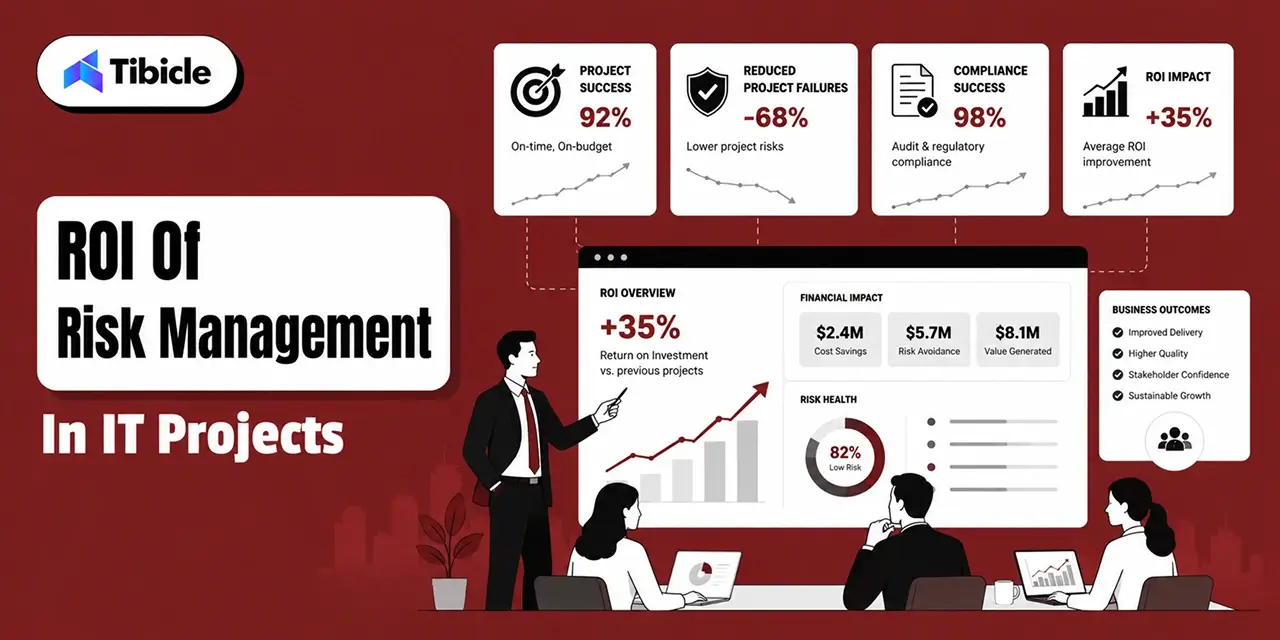
Investing in structured Risk Management in IT Projects delivers measurable business outcomes. Organizations that implement proactive project risk mitigation strategies reduce project delays by approximately 28% on average. At the same time, projects using structured tools and frameworks finish closer to their original budgets by nearly 20%.
Beyond financial metrics, Risk Management improves stakeholder confidence and strengthens audit readiness. Teams are better prepared for compliance reviews, reducing remediation costs and avoiding last-minute disruptions. Effective handling of software project risks also leads to improved delivery consistency and predictable outcomes.
How To Build The Business Case Internally
To secure leadership buy-in, Risk Management should be positioned as capital protection rather than operational overhead. The ROI model is straightforward:
prevented rework cost plus avoided penalties plus accelerated delivery value minus tool and implementation cost.
Presenting this case jointly to the CFO and CTO ensures alignment between financial and technical priorities, increasing the likelihood of adoption.
Common Challenges When Implementing Risk Management In IT Projects
Despite clear benefits, organizations face multiple challenges when implementing Risk Management in IT Projects. One of the most common issues is siloed risk data, where teams maintain separate spreadsheets with no centralized visibility. This limits collaboration and delays decision-making.
Another challenge is resistance from delivery teams who view risk processes as unnecessary overhead rather than a value-driven activity. Without strong leadership sponsorship, risk culture fails to develop across teams.
Integration is also a major barrier. Many organizations struggle to connect risk tools with existing systems like Jira or ServiceNow, resulting in fragmented workflows. Additionally, over-reliance on automated risk scoring without human validation introduces inaccuracies, making IT project risk assessment less reliable.
Vendor Selection Checklist For IT Risk Management Tools
Selecting the right tool for Risk Management in IT Projects requires a structured evaluation approach. Organizations should first verify whether the platform supports required compliance frameworks such as ISO 27001, GDPR, HIPAA, and SOC 2.
Integration capability is equally important. The tool should connect seamlessly with systems like Jira, Okta, Azure AD, and AWS to ensure smooth workflows. Pricing models must also be evaluated carefully, whether based on per-user licensing or job-to-be-done outcomes.
A strong solution should include a configurable IT risk register, customizable scoring models, and clear reporting dashboards. Features like a risk heat map should be easily understandable for stakeholders.
Other factors include SLAs, incident response commitments, onboarding support, and scalability across multiple IT projects.
Top Tools For Risk Management In IT Projects
Several tools dominate the Risk Management in IT Project landscape, each serving different organizational needs. ServiceNow GRC provides enterprise-grade capabilities with deep integration across IT ecosystems. LogicManager follows a jobs-to-be-done pricing model and is well-suited for mid-market organizations.
Archer Evolv offers a modern SaaS based experience with AI-driven capabilities and an improved user interface. OneTrust focuses heavily on privacy and data governance, making it ideal for GDPR intensive environments.
For smaller teams, Wrike and ClickUp offer basic risk tracking features within project management tools. Eramba stands out as an open source option that supports compliance standards like ISO, PCI, and SOC2 while remaining cost-effective.
Why Tibicle LLP Is Worth Evaluating For IT Project Risk Management
Tibicle LLP works with organizations that need a structured Risk Management framework for IT teams without the complexity of enterprise GRC platforms. It is particularly suitable for mid-sized technology projects where standard tools lack flexibility but full-scale solutions are unnecessary.
The company helps teams build IT risk registers, define risk response plans, and create reporting systems that are audit-ready from the start. This is especially valuable for organizations preparing for certifications such as ISO 27001 or SOC 2 while managing active project delivery.
Their approach focuses on balancing simplicity with effectiveness, ensuring that risk processes support delivery rather than slow it down.
Conclusion
The difference between successful and failed projects is rarely budget or tools alone. It is the discipline of structured Risk Management in IT projects that determines outcomes. Organizations with mature risk practices consistently achieve higher success rates and improved delivery performance.
If your IT projects are running without a defined Risk Management process, the exposure is already increasing. Building a structured system ensures better control, reduced uncertainty, and long-term success.
FAQs
What is Risk Management in IT Projects?
Risk management in IT projects is the structured process of identifying, assessing, and responding to risks to protect the timeline, budget, and compliance outcomes.
What are the most common risks in IT Projects?
Common risks include scope creep, technical failures, unclear requirements, resource gaps, regulatory non-compliance, and vendor dependency.
How do you build a risk register for an IT project?
A risk register should include risk ID, description, probability, impact, owner, mitigation action, and review schedule.
What is the difference between qualitative and quantitative risk analysis?
Qualitative analysis ranks risks using probability and impact, while quantitative analysis uses techniques like Monte Carlo simulation to estimate outcomes.
How much does IT Risk Management software cost?
Costs range from entry-level tools under $40 per user per month to enterprise solutions with custom pricing.
When should a company invest in a dedicated risk platform?
A dedicated platform is required when projects involve multiple teams, compliance requirements, or high financial and operational risk.
Schedule A Developer Interview And Get 15 Days Risk-Free Trial
Schedule a Call

Relevant Blog
Custom AI Chatbot Development Services

Diya Koradiya

GraphRAG Implementation Services

Arjun Shinojiya
Enterprise AI Automation Development Agency
Arjun Shinojiya
Written by

Recent Blogs
Custom AI Chatbot Development Services
What This Guide Covers Who this is for: CIOs, CTOs, AI leaders, operations executives, customer support teams, and enterprise technology decision-makers evaluating custom AI chatbot development services for internal knowledge access, customer support, helpdesk automation, or other business-critical use cases. It is particularly relevant for organisations with proprietary knowledge bases, sensitive data, complex access controls, […]
GraphRAG Implementation Services
Who this is for: Engineering leads and product owners at enterprise SaaS companies evaluating GraphRAG implementation services for a knowledge base or retrieval system that vector search alone is not answering well. Search intent: Commercial evaluation with a technical backbone. The reader has moved past “what is GraphRAG” and wants to know when a knowledge […]
Enterprise AI Automation Development Agency
Who this is for: Operations leads, CTOs, and process owners evaluating an enterprise AI automation development agency for a full business process rather than a single bolted-on bot. Search intent: Commercial evaluation with a technical backbone. The reader has moved past “what is workflow automation” and wants to know why point-solution RPA plateaus, what end-to-end […]
Got an Idea? Get FREE Consultation
In our world, there's no such thing as having too many clients

