
What Is a Product Roadmap? The Complete Guide for 2026

Jun 10, 2026

Read in 4 Minutes
Table of Contents
- Introduction
- What Is a Product Roadmap?
- Types of Product Roadmaps: Pick the Right One for Your Team
- How to Build a Product Roadmap in 5 Steps
- Top Product Roadmap Tools in 2026
- Common Product Roadmap Mistakes to Fix in 2026
- Why Tibicle Is the Right Partner for Product Roadmap Execution
- Conclusion
- Frequently Asked Questions
Introduction
Your product roadmap is the document everyone references and almost no one trusts. According to Airtable’s 2025 Predictions Report, 92% of product leaders are directly responsible for revenue outcomes, yet only 26% have high visibility into the ROI of their launches. That gap does not come from weak strategies. It comes from roadmaps that disconnect vision from execution.
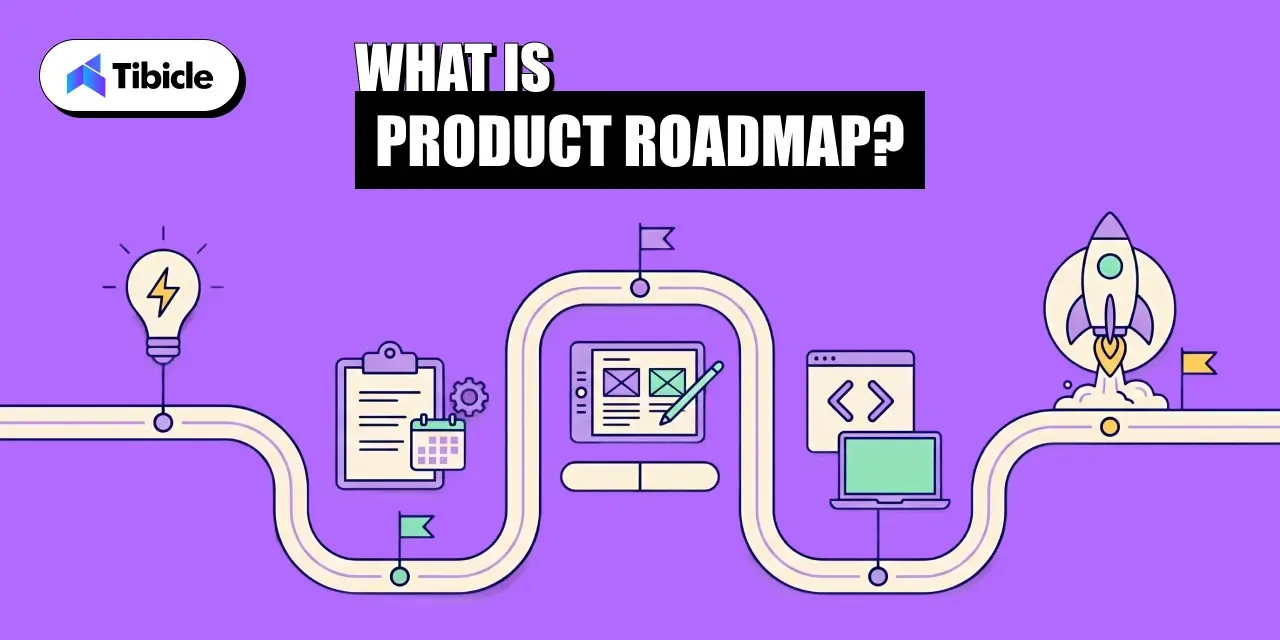
A product roadmap is a high-level strategic document that shows what a team is building, why it matters, and when it ships. Done right, it aligns engineering, marketing, sales, and leadership around a single source of truth. Done wrong, it becomes a graveyard of features nobody needed.
This guide covers everything you need to build a product roadmap that actually drives outcomes: the right format, the right prioritization frameworks, the right tools, and the most common mistakes teams make in 2026.
What Is a Product Roadmap?
A product roadmap is a strategic plan that maps the direction, priorities, and progress of a product over a set time horizon. It answers three questions: what are we building, why are we building it, and when will it ship.
The product roadmap sits between high-level company strategy and ground-level sprint planning. It is not a backlog, not a Gantt chart, and not a commitment list. It is a communication tool, and the moment it stops communicating clearly, it stops being useful. It is also useful in Custom software development to scale better.
Key distinction: A product roadmap shows strategic intent. A project plan shows task execution. Conflating the two is the single most common reason product roadmaps fail to align teams.
4 Core Components of Every Effective Roadmap
Every product roadmap that works in practice shares four components:
- Vision: A one-to-two sentence statement of the product’s long-term direction, anchored to a business outcome.
- Goals and OKRs: The measurable milestones the roadmap exists to achieve, tied to revenue, retention, or activation.
- Initiatives and Features: The strategic bets being placed, grouped by theme rather than listed as individual tickets.
- Timeline: A rough time horizon, typically quarters, not hard shipping dates.
Types of Product Roadmaps: Pick the Right One for Your Team
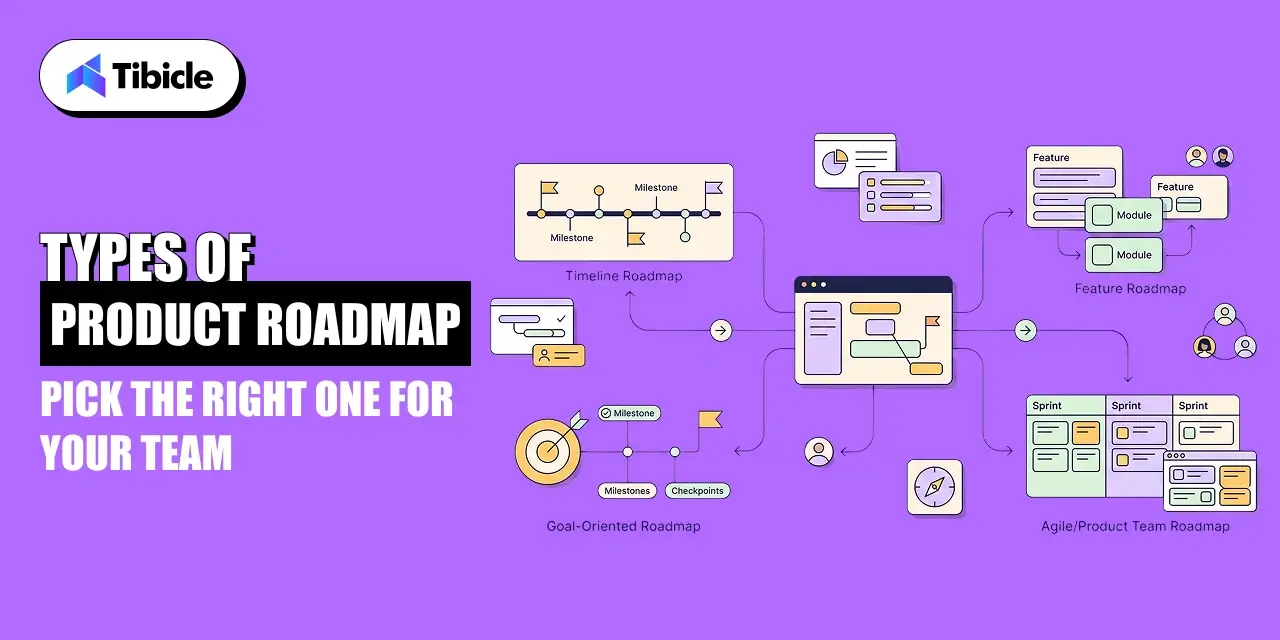
Choosing the wrong product roadmap format is like choosing the wrong map for a trip. A city map will not help you navigate a national park. The three formats below cover most team needs in 2026.
Now Next Later Roadmap
The Now-Next-Later product roadmap organizes initiatives by priority horizon rather than calendar date. ‘Now’ holds what the team is actively building. ‘Next’ holds what ships after current work is complete. ‘Later’ holds validated ideas that are not yet resourced.
This format is best for teams running in uncertain or fast-changing environments where committing to calendar dates creates more confusion than clarity. It keeps the product roadmap honest by making prioritization explicit.
Theme Based Roadmap
The theme-based product roadmap groups initiatives under strategic outcomes rather than feature categories. Instead of ‘Improve Search’ appearing as a line item, it becomes ‘Reduce time-to-first-result by 40% for enterprise users.’ Every item on the roadmap ties to a measurable business theme.
This is the format most aligned with modern OKR-driven organizations. According to the State of Product Management Report 2026 by Product-Led Alliance and ProductPlan, 49.2% of teams cite resource and capacity constraints as the main cause of roadmap misalignment. Theme-based roadmaps reduce that friction by making trade-offs visible.
Timeline Based Roadmap
The timeline-based product roadmap uses a Gantt-style view showing when initiatives ship against a calendar. It is the most familiar format to stakeholders outside the product team, which makes it useful for executive reviews and go-to-market alignment.
The risk: timelines create implicit commitments. Sales teams start quoting ship dates. Marketing plans campaigns around them. When the roadmap slips, trust erodes. Use timeline-based roadmaps only when the audience understands they are estimates, not contracts.
How to Build a Product Roadmap in 5 Steps
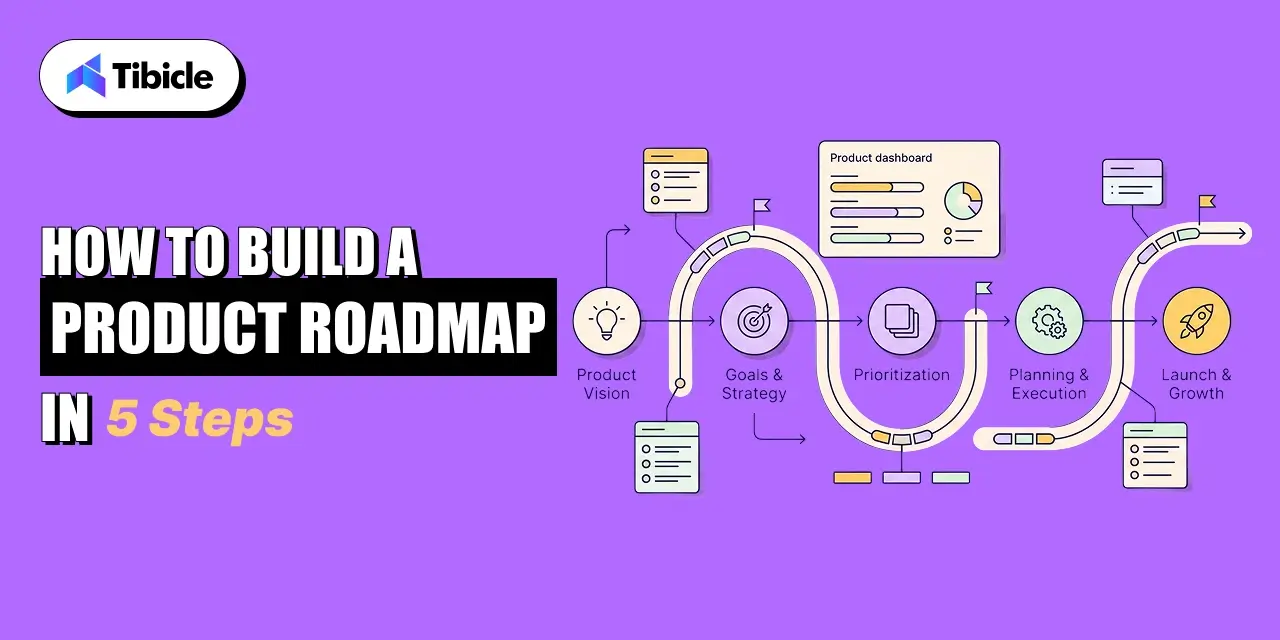
Building a product roadmap that holds up is a repeatable process. Here are the five steps that produce roadmaps teams actually work from.
Step 1: Define Your Product Vision
A product roadmap without a product vision is a to-do list with extra formatting. The vision defines the 12-to-36-month destination the product development is navigating toward. Keep it to two sentences. Make it specific enough that a new hire reading it in three months would know which initiatives belong on the roadmap and which do not.
Step 2: Align with OKRs and Business Goals
Every initiative on the product roadmap must trace to a business goal. If it cannot, it does not belong. Productboard’s CPO Survey found that 39% of product investments were failing due to a lack of clear company strategy. OKR alignment is how the roadmap prevents that problem. For each initiative, answer: which OKR does this move, and by how much?
Step 3: Collect and Prioritize Customer Feedback
Airtable’s product roadmap research shows that teams using AI to synthesize feedback at scale identify trends across channels in real time and prioritize initiatives with more evidence behind them. Run a structured voice-of-customer process: analyze support tickets, CRM notes, sales calls, and survey data. Segment feedback by customer tier and use case before adding anything to the roadmap.
Step 4: Apply a Prioritization Framework
Raw feedback and stakeholder requests need a scoring system before they become roadmap items. The two most used frameworks in 2026 are RICE scoring and MoSCoW.
RICE scores each initiative on four dimensions: Reach (how many users it affects), Impact (the expected improvement per user), Confidence (how certain the team is), and Effort (engineering weeks required). The formula is (Reach x Impact x Confidence) / Effort. Higher scores surface first.
MoSCoW categorizes items as Must-have, Should-have, Could-have, or Won’t-have for the current cycle. It is faster to apply than RICE and works well when the team needs a quick consensus mechanism for a quarterly planning session.
Step 5: Draft the Roadmap and Review with Stakeholders
Draft the product roadmap in whichever format fits your audience. Share it with engineering, marketing, and sales before finalizing. The goal is not consensus on every item. The goal is eliminating surprises. Stakeholders who are surprised by a roadmap stop trusting it. Stakeholders who helped shape it defend it.
Top Product Roadmap Tools in 2026
The product roadmap tool market is projected to reach $52.85 billion by 2031. The right tool depends entirely on your team’s size, tech stack, and how much of the roadmap workflow you want integrated versus standalone.
| Tool | Best For | Key Strength |
| Aha! | Enterprise teams, detailed planning | Most complete product management suite |
| Productboard | Customer-feedback-driven prioritization | Built-in feedback capture and scoring |
| Airtable | Flexible, cross-functional teams | Customizable views, AI-assisted prioritization |
| Jira | Engineering-centric teams | Native sprint and backlog integration |
AI is changing how roadmap tools operate. Among teams already using AI in roadmapping, 37% report better feature prioritization and 32% cite stronger data analysis, according to Airtable’s research. Tools like Airtable now auto-generate roadmap drafts from customer data, reducing the manual synthesis work that previously consumed hours of PM time.
Common Product Roadmap Mistakes to Fix in 2026
Even well-intentioned roadmaps break down in the same ways. Here are the five most damaging patterns:
- Treating the roadmap as a feature list. A product roadmap that lists 40 features with ship dates is a project plan, not a roadmap. Consolidate to themes and outcomes.
- Locking timelines too early. Sales and marketing need planning lead time, but committing to specific ship dates 12 months out creates false precision. Use quarters, not months.
- Skipping engineering input. Roadmaps built without capacity data get blown up in the first sprint review. Involve engineering in the prioritization stage, not just after the fact.
- Not sharing the roadmap broadly enough. Atlassian’s State of Product 2026 found that 84% of product teams are concerned that what they are building will not succeed in the market. Most of that fear comes from insufficient feedback loops, not bad ideas.
- Failing to cut. A product roadmap without a ‘won’t do this quarter’ list is not a prioritization tool. Saying no clearly is the most important function of the roadmap.
Why Tibicle Is the Right Partner for Product Roadmap Execution
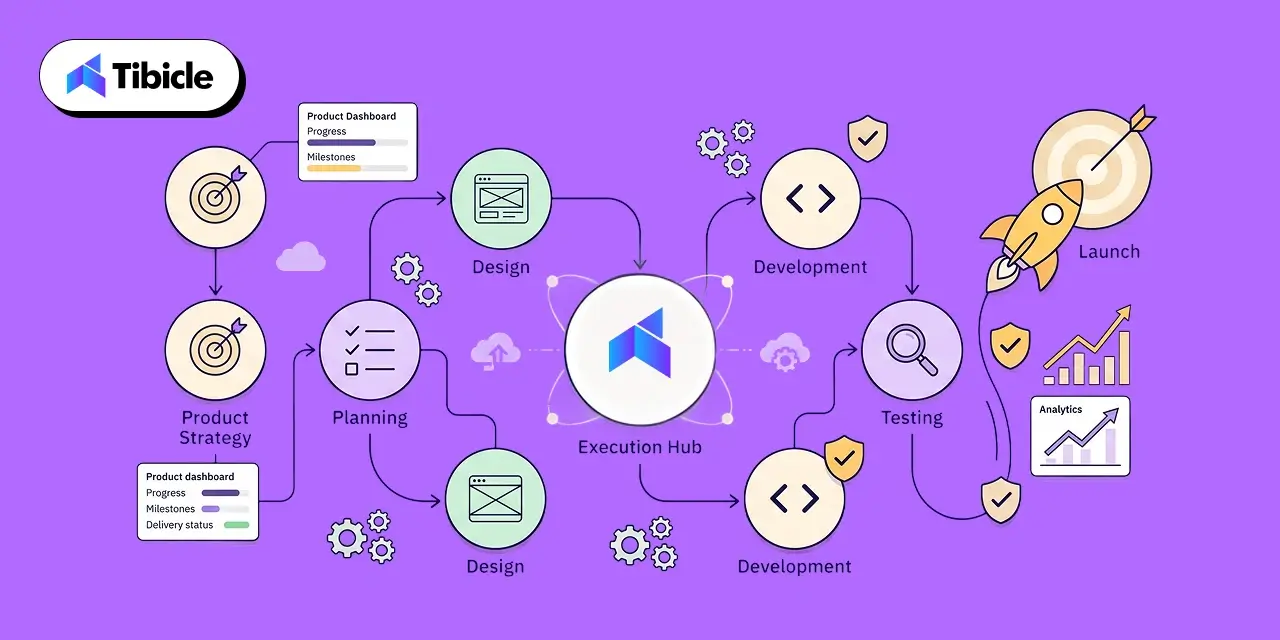
A product roadmap is only as strong as the team executing it. Tibicle is an AI-first software development company that has delivered 60+ projects with 100% job success across startups and enterprises. Their product consulting practice handles the full build lifecycle, from discovery and requirements definition to UI/UX, backend development, QA, and deployment making them a direct fit for teams who have a roadmap and need a technical partner to ship it.
What separates Tibicle from generalist dev shops is delivery structure. They run sprint-based engagements with weekly reviews, milestone-based accountability, and clear documentation at every stage. Clients on Clutch report that Tibicle delivered ahead of schedule and adapted to scope changes without breaking timelines. For product teams working from a Now-Next-Later or theme-based roadmap, that operational discipline means the roadmap stays credible rather than becoming the graveyard of features that most failed roadmaps turn into.
Tibicle’s engagement models, dedicated developers, team augmentation, or fixed-scope, map directly onto where most product teams get stuck: not strategy, but capacity. If your roadmap is clear and your internal team cannot execute it at the pace your business requires, Tibicle’s dedicated resource model gives you focused engineers who own your system rather than splitting attention across multiple clients.
Conclusion
A product roadmap that cannot drive execution is a presentation, not a strategy. The frameworks, formats, and prioritization tools covered in this guide give you the structure to build a roadmap your teams will work from. The next step is making sure the technical capacity exists to ship what the roadmap calls for.
If your team is at the point where execution speed is the bottleneck, talk to Tibicle. They have built the full stack web, mobile, AI, and SaaS for startups and enterprises that needed a reliable team to turn roadmap priorities into shipped product.
Frequently Asked Questions
What is a product roadmap used for?
A product roadmap communicates a product’s strategic direction across engineering, marketing, sales, and leadership. It aligns teams around shared priorities and gives stakeholders a clear picture of what is being built, why it matters, and roughly when it ships.
What is the difference between a product roadmap and a sprint backlog?
A product roadmap operates at a strategic level, typically covering quarters or years, and shows initiatives tied to business outcomes. A sprint backlog operates at a tactical level, covering the next one to two weeks, and contains specific tasks that developers pick up and complete. The roadmap decides what to build next. The backlog decides who is building what today.
How often should you update a product roadmap?
Most high-performing product teams review their roadmap monthly and perform a full refresh each quarter. The Now-Next-Later format allows lighter touch monthly updates. Timeline-based roadmaps typically need quarterly recalibration to stay credible with stakeholders.
What is the Now-Next-Later framework in product roadmaps?
Now-Next-Later is a product roadmap format that organizes initiatives by priority horizon rather than calendar dates. ‘Now’ holds active work. ‘Next’ holds what follows. ‘Later’ holds validated ideas not yet resourced. It reduces false precision in planning and keeps teams focused on the current priority set without overcommitting to future timelines.
Which product roadmap tool is best for small teams?
Airtable and Productboard both serve small teams well. Airtable is more flexible and integrates broadly with existing tools. Productboard is stronger for teams that want built-in customer feedback capture tied directly to prioritization. Jira works if your team is already living inside Atlassian’s ecosystem and wants roadmap and backlog managed in one place.
Schedule A Developer Interview And Get 15 Days Risk-Free Trial
Schedule a Call

Relevant Blog
Enterprise LLM Integration Services

Prejin Nadar

Building Private local AI Desktop App Development
Prejin Nadar
Written by

Recent Blogs
Enterprise LLM Integration Services
What This Guide Covers Who this is for Enterprise LLM integration services help engineering leaders, platform teams, and technology executives turn existing model access into working production workflows. This guide is for organisations connecting OpenAI, Claude, or both to systems that support real business processes, including CRM platforms, ticketing systems, document pipelines, and internal tools. […]
When to Hire an AI Software Development Consulting Firm.
What This Guide Covers Who this is for Engineering leaders, technology executives, and AI teams often struggle to turn completed initiatives into measurable results. This guide helps organisations address stalled pilots, failed AI implementations, rising costs, poor data quality, and workflows that function technically but fail to deliver measurable business value. An AI software development […]
Building Private local AI Desktop App Development
What This Guide Covers Who this is for: US tech firms, SaaS companies, startups, CTOs, engineering managers, and product teams looking for experienced Electron.js developers for ongoing private local AI desktop app development and custom desktop application development. Search intent: Hiring and decision. This guide covers where to find Electron.js developers, how to evaluate their […]
Got an Idea? Get FREE Consultation
In our world, there's no such thing as having too many clients

