Introduction
In 2026, mobile app development cost ranges from $25,000 for a basic MVP to over $500,000 or enterprise-level platforms. In fact, most mid-sized apps typically fall between $60,000 and $150,000.
The biggest mistake founders make is assuming that the app development cost depends only on the number of screens. However, in reality, it’s influenced by much deeper factors like architecture decisions, backend complexity, AI integrations, platform choice, and the team you hire.
According to Clutch industry data, nearly 60% of app projects exceed their initial app development cost estimate due to poor planning. At the same time, Statista reports show that mobile app expectations are increasing, keeping overall mobile app development pricing stable despite faster development tools.
This guide explains every cost variable so you can plan without surprises, especially if you’re exploring professional mobile app development services for your project.
Mobile App Development Cost in 2026: Baseline Numbers by Complexity
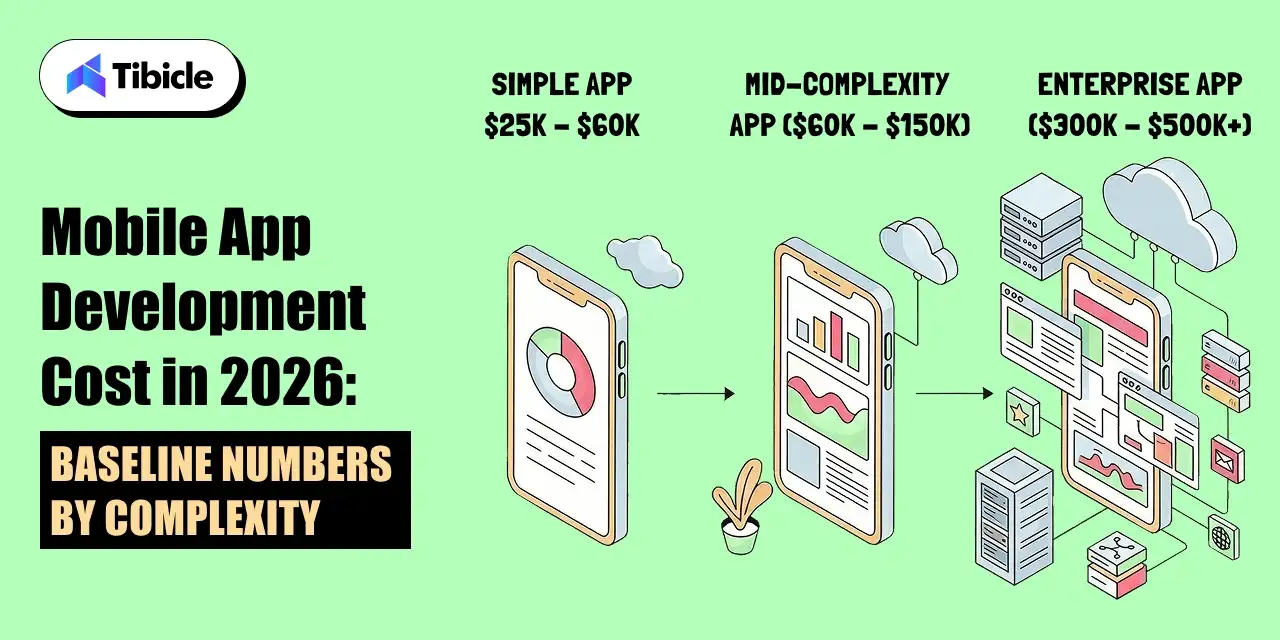
To put it simply, the cost to build a mobile app depends heavily on the complexity of your product.
Cost Summary Table:
| App Type |
Estimated Cost |
Timeline |
Best For |
| Simple Apps |
$25,000 – $60,000 |
2–4 months |
MVPs, internal tools |
| Mid-Complexity Apps |
$60,000 – $150,000 |
3–6 months |
Startups, scalable products |
| Enterprise Apps |
$300,000 –$500,000+ |
6–12+ months |
Large-scale platforms |
Simple Apps ($25,000 to $60,000)
Generally, simple apps are usually built for basic use cases such as internal tools or early MVPs. These apps focus on delivering a core idea quickly without unnecessary complexity.
Typically, at this level, apps usually involve:
- Basic authentication (login/signup)
- Around 5–10 screens
- Minimal backend or database
- Built for a single platform (iOS or Android)
- Development timeline of 2–4 months
Therefore, these apps are ideal if you want to validate an idea fast and keep your initial investment low.
Mid-Complexity Apps ($60,000 to $150,000)
his is where most real-world products fall. As a result, these apps serve real users and include more structured functionality, integrations, and scalability.
At this level, apps usually involve:
- Multiple user roles (admin, users, etc.)
- Third-party integrations like payments or APIs
- Dashboards, analytics, and reporting features
- Cross-platform development using Flutter or React Native
The cross-platform app development cost is significantly lower here because a single codebase reduces both development time and long-term maintenance costs. This makes it a smart choice for companies trying to optimize their mobile app development budget.
Complex and Enterprise Apps ($300,000 to $500,000+)
Enterprise apps are built for scale, performance, and long-term growth. These are not just apps; they are full systems that support business operations.
They typically include:
- AI features and automation
- Real-time data processing
- Integration with systems like ERP or EHR
- High-level security and compliance requirements
- Scalable backend infrastructure
If your product involves AI, custom ML models, or vector databases, the custom mobile app development cost increases further. According to Gartner, enterprise applications with advanced integrations require significantly higher upfront investment but deliver long-term ROI when built correctly.
Average Mobile App Development Cost by Platform
Platform choice directly impacts your mobile app development cost.
| Platform |
Estimated Cost |
| iOS App Development Cost |
$40,000 –$150,000 |
| Android App Development Cost |
$40,000 –$150,000 |
| Cross-Platform App Development Cost |
$60,000 –$120,000 |
Cross-platform development is often 30–40% cheaper compared to building separate native apps.
However, for apps requiring advanced hardware features, native development may still be required, increasing the overall app development cost estimate.
Key Factors That Affect Mobile App Development Cost

Platform Choice: iOS vs Android vs Cross-Platform
Your choice of platform has a direct impact on your total cost. Building separate native apps for iOS and Android increases both time and budget since you’re essentially building two products.
That’s why many companies are now choosing cross-platform development. Frameworks like Flutter or React Native can reduce overall cost by 30–40% because you maintain a single codebase.
However, if your app depends heavily on hardware features like AR, camera processing, or device-specific capabilities, native development may still be required, which increases the cost.
AI and Backend Integration
AI has become one of the biggest cost drivers in modern apps. A standard AI-integrated mobile app costs $60,000 to $200,000 in 2026, especially when using advanced features through AI integration services.
But the real cost increase comes when you go beyond basic integrations. Custom model training, vector database setup, and large language model (LLM) integrations require additional infrastructure and expertise.
In 2026, many apps are also adopting agent-based AI systems, which further increases backend complexity and overall development cost.
Development Team Location and Hourly Rates
Where your development team is located plays a huge role in pricing. Developers in the US typically charge between $100 to $200 per hour, while experienced developers in India can deliver similar quality at 60–70% lower rates.
That’s why many companies are moving towards a hybrid model, keeping product strategy in-house while outsourcing development to reduce costs without compromising quality.
At the end of the day, your total cost comes down to a simple equation:
Total development hours multiplied by hourly rate.
Mobile App Development Cost Breakdown by Phase
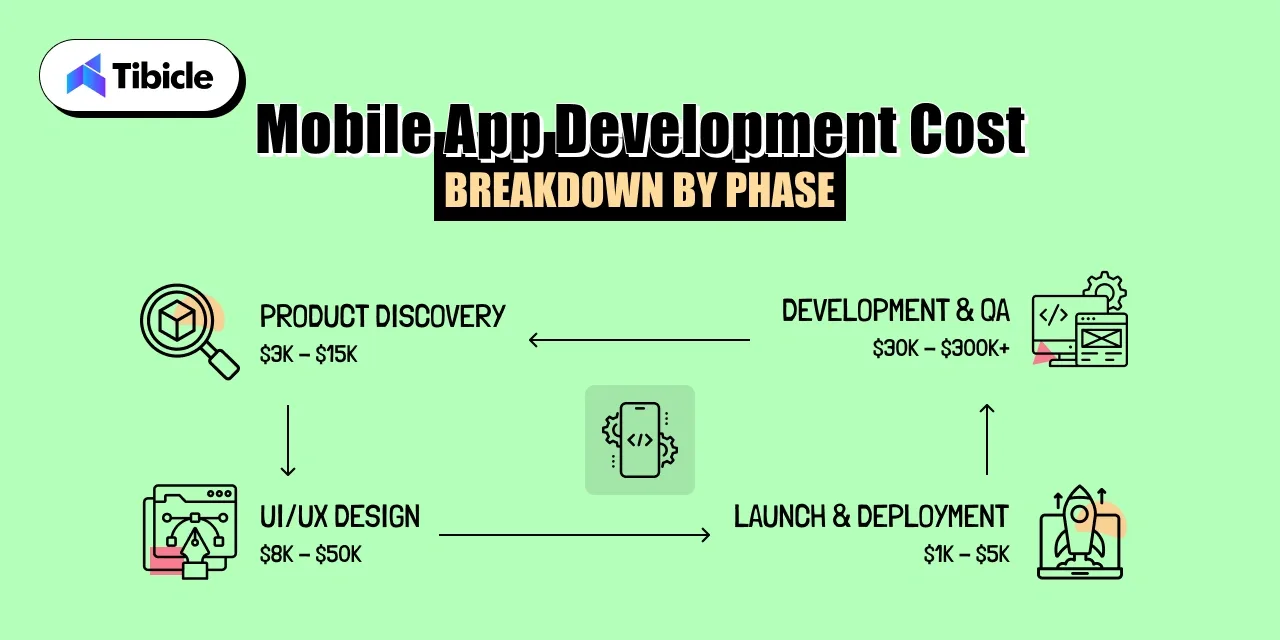
Breaking down the cost into phases helps you understand where your budget actually goes.
Product Discovery and Planning ($3,000 to $15,000)
This is one of the most overlooked stages, but also the most important. Specifically, it includes defining requirements mapping user journeys, and planning the technical architecture.
Skipping this phase often leads to confusion during development, which is one of the main reasons projects exceed their budget.
UI/UX Design ($8,000 to $50,000)
Design is no longer just about visuals. Modern apps require thoughtful user experience, smooth interactions, and sometimes even AI-driven personalization.
The cost depends on how many screens your app has, how complex the interactions are, and how many testing iterations are required.
Development and QA ($30,000 to $300,000+)
This is where most of your budget goes. It includes backend development, frontend interfaces, API integrations, and testing across devices.
With the rise of real-time features and scalable systems, As a result, this phase often accounts for the largest share of the total project budget.
App Store Launch and Deployment ($1,000 to $5,000)
Once development is complete, your app needs to be deployed on the App Store and Play Store. This includes compliance checks, submission processes, and final configurations.
In some cases, especially with Apple, the review process can delay your launch if changes are required.
Mobile App Maintenance Cost: The Budget Most Teams Miss
The mobile app maintenance cost is one of the most underestimated parts of the total budget.
On average, maintaining an app costs around 15–25% of the original development cost every year. This includes updates for new OS versions, fixing bugs, improving performance, and adding new features.
There are also additional post-launch improvements that can add another 20–30% annually, depending on how actively you evolve the product.
Planning your mobile app development budget should always include long-term maintenance.
How to Reduce Mobile App Development Cost Without Cutting Quality
Reducing cost doesn’t mean compromising on quality. It’s more about making smart decisions early on.
Instead of building everything at once, start with an MVP that focuses only on core functionality. This helps you validate your idea without overspending.
Using cross-platform frameworks is another effective way to reduce cost, as it avoids building separate apps for different platforms. Many businesses also choose offshore teams to lower development costs while maintaining quality.
Keeping your initial scope limited and using reliable third-party services for common features like payments or authentication can also save a significant amount of time and money.
Conclusion
Mobile app development cost in 2026 is not a fixed number. It depends on your product complexity, platform choice, team structure, and long-term goals.
Most real-world apps fall between $80,000 and $250,000, while enterprise-level apps go far beyond that due to higher enterprise app development costs and infrastructure needs.
The key is clarity. The better you understand your requirements and plan your execution, the more accurate your budget will be.
If you’re planning your app, it’s always better to get a cost estimate before starting development.
FAQs
What is the average mobile app development cost in 2026?
The average mobile app development cost in 2026 ranges from $25,000 for basic MVP apps to $150,000 for mid-complexity apps. For enterprise-level platforms, the cost to build a mobile app can exceed $400,000, depending on features and integrations.
Is it cheaper to build an iOS or Android app, or choose cross-platform development?
The iOS app development cost and Android app development cost are quite similar today. However, building separate native apps increases the total app development cost, which is why cross-platform development is often the most cost-effective option.
How much does cross-platform app development cost compared to native apps?
The cross-platform app development cost is typically 30–40% lower than native development. For example, a project that costs $100,000 for native apps can often be built for $60,000–$75,000 using frameworks like Flutter or React Native.
What is the mobile app maintenance cost per year?
The mobile app maintenance cost usually ranges from 15–25% of the original development cost per year. This includes updates, bug fixes, performance improvements, and ongoing feature enhancements.
How much does it cost to add AI features to a mobile app?
Adding AI features can significantly increase the mobile app development cost, typically ranging from $60,000 to $200,000, depending on the complexity. Advanced features like machine learning models and automation systems further increase the cost of custom mobile app development.
Can outsourcing reduce app development costs?
Yes, outsourcing can reduce your mobile app development cost by 60–70%. Many companies lower their offshore app development costs by hiring skilled developers from regions like India while maintaining high-quality standards.