Introduction
Mobile commerce accounts for 63% of global retail ecommerce sales in 2025, yet most ecommerce mobile app development projects fail within the first year post-launch. The reason is simple: decisions were made on assumptions rather than business logic. Executives commit budgets based on feature wishlists instead of conversion data. Vendors are selected on pitch decks rather than post-launch support capabilities. The result is predictable: apps that launch but never gain traction, draining resources without returning measurable value.
This guide covers the full spectrum of e-commerce mobile app development, including how to build an e-commerce mobile app, key e-commerce app features, real e-commerce app development costs, and choosing the right e-commerce app development company.
What eCommerce Mobile App Development Actually Involves
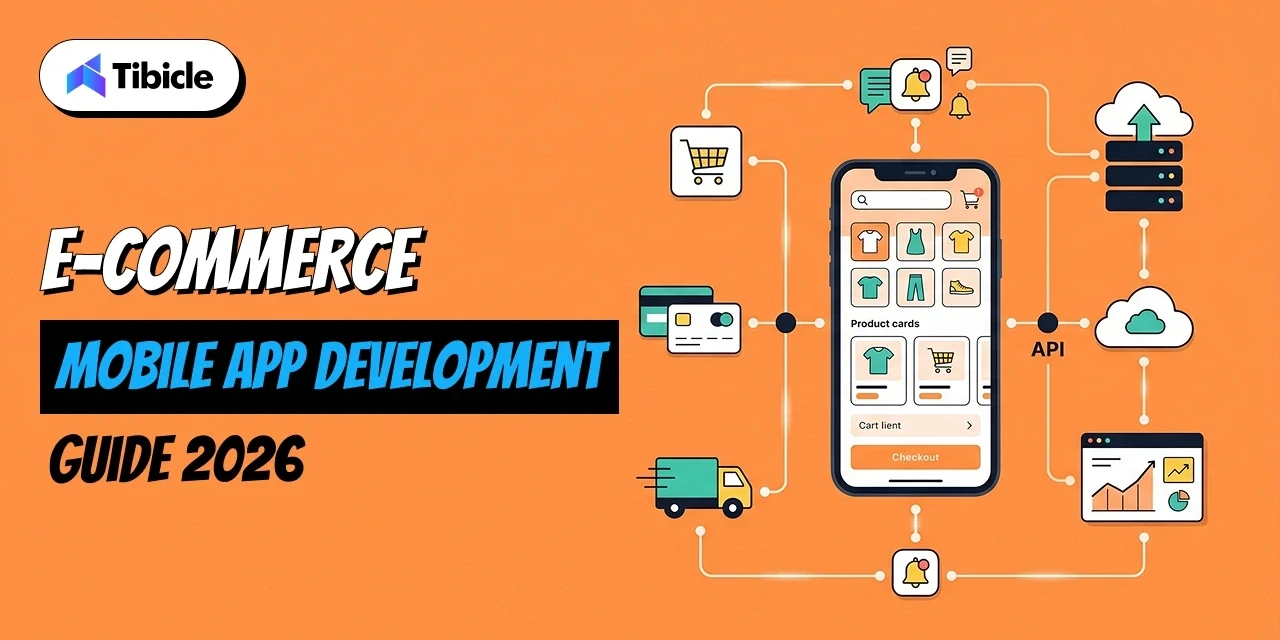
E-commerce mobile app development goes far beyond building a simple shopping interface. It involves designing a complete digital commerce system that connects users, products, payments, logistics, and analytics in real time.
At a technical level, the system consists of a frontend mobile interface, backend servers, APIs, and multiple third-party integrations. The frontend handles user interaction, while the backend manages inventory, authentication, order processing, and data synchronization. APIs bridge communication between the app and external services such as payment gateways, delivery systems, CRM tools, and marketing platforms.
From a business perspective, the complexity varies depending on the model. B2C apps prioritize speed, personalization, and frictionless checkout experiences. B2B apps are significantly more complex, often requiring bulk ordering systems, approval hierarchies, custom pricing models, and ERP integrations.
Types of eCommerce Apps and Which Business Model They Fit
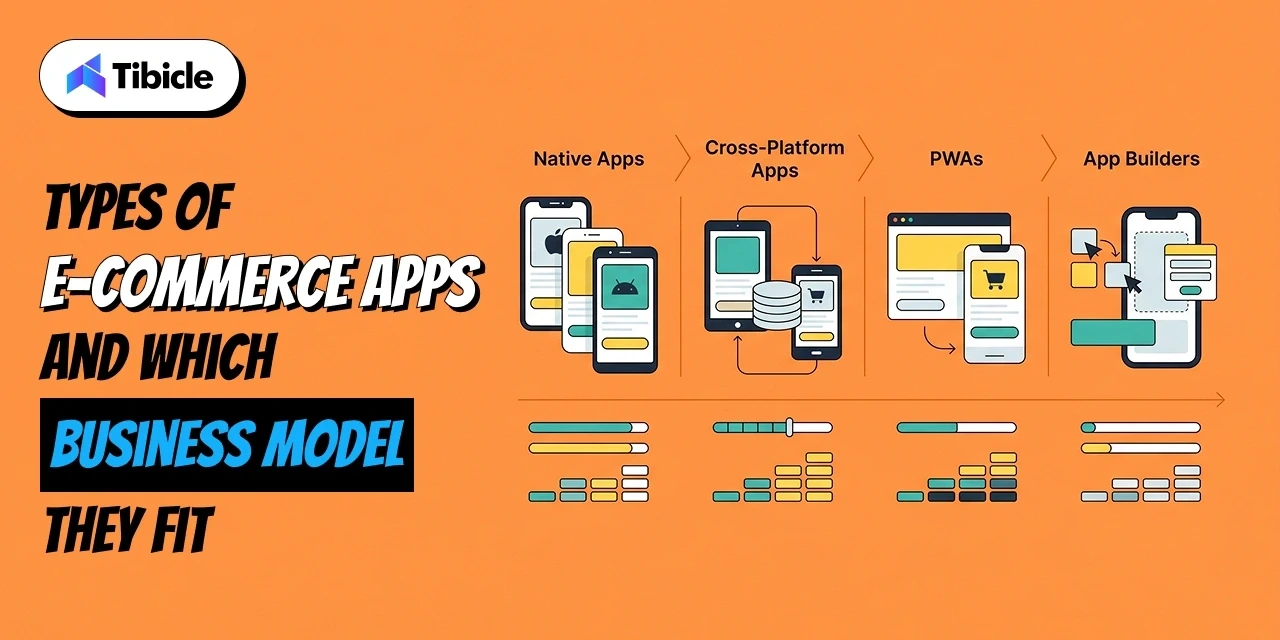
Native iOS/Android apps are built using platform-specific languages (Swift for iOS, Kotlin for Android). They deliver the highest performance and access to device-native features like Face ID, Apple Pay, and camera APIs. Native development requires maintaining two separate codebases, doubling development and maintenance costs.
Cross-platform frameworks like React Native ecommerce app solutions and Flutter allow teams to write code once and deploy to both iOS and Android. A React Native ecommerce app reduces initial development cost by 30-40% compared to native builds while maintaining near-native performance. The trade-off is slightly slower execution speed and occasional limitations in accessing cutting-edge platform features until framework updates catch up.
Progressive Web Apps (PWAs) run in mobile browsers but behave like installed apps. They bypass app store submission entirely, reducing time to market and avoiding the 15-30% commission fees charged by Apple and Google. However, PWAs cannot access push notifications on iOS and lack the performance ceiling of native apps.
App builders like Shopify Mobile App Builder or Appy Pie allow non-technical teams to launch basic shopping app development projects in weeks. Custom ecommerce app development delivers tailored user experiences, proprietary features, and backend control but requires significantly higher upfront investment.
| Approach |
Performance |
Cost |
Scalability |
Time to Market |
| Native iOS/Android |
Excellent |
High |
High |
6-9 months |
| Cross-Platform (React Native, Flutter) |
Very Good |
Medium |
High |
4-6 months |
| PWA |
Good |
Low |
Medium |
2-4 months |
| App Builders |
Basic |
Very Low |
Low-Medium |
2-6 weeks |
Core Features That Directly Affect Conversion Rate
Feature selection in ecommerce mobile app development should focus on ROI. If you’re unsure where to start, explore our guide on ecommerce app features that increase conversion rates. Every feature added increases development cost, extends timelines, and introduces additional QA surface area. The features that matter are those that directly reduce friction in the purchase flow or demonstrably increase repeat purchase rates.
Must-Have Features for Launch (MVP Scope)
An MVP ecommerce mobile app development project should include: a product catalog with category filters, search, and sorting; a persistent shopping cart that syncs across sessions; payment gateway integration with support for credit cards, digital wallets, and region-appropriate payment methods; user account management with saved addresses and order history; and order tracking with real-time status updates and delivery notifications.
Payment gateway integration is a top abandonment point if misconfigured. Users who reach checkout but encounter payment errors rarely return to complete the purchase. Testing payment flows across multiple card networks, handling 3D Secure authentication correctly, and providing clear error messaging when transactions fail are non-negotiable requirements in any e-commerce mobile app development process.
Revenue-Linked Features Often Deprioritized
A push notification strategy tied to cart abandonment rate recovery generates direct, measurable revenue lift. Unlike email or SMS, push notifications have zero incremental cost per send and bypass algorithmic filtering. Triggered notifications sent 1-3 hours after cart abandonment recover 10-15% of otherwise lost transactions.
Personalization engines that surface product recommendations based on browsing history and purchase patterns increase average order value by 15-30%. Loyalty programs and in-app offers create switching costs that reduce customer acquisition cost over time by improving retention rates.
AR product preview features deliver category-dependent ROI. For furniture, apparel, and cosmetics, AR visualization reduces return rates by allowing customers to preview products in context before purchase. For commodity goods or low-consideration purchases, AR adds development cost without a proportional conversion lift.
Features That Add Cost Without Proportional Return
Over-engineered onboarding flows with multi-step tutorials delay users from reaching the product catalog. Data shows most users skip tutorial screens entirely. Excessive social integrations at launch, like Facebook login, Instagram feed imports, and Twitter sharing, rarely see adoption rates above 5%, but add API maintenance overhead and privacy compliance requirements.
Step-by-Step eCommerce Mobile App Development Process
A structured e-commerce mobile app development process reduces the risk of scope creep, missed deadlines, and post-launch rework. The six-stage framework below provides a repeatable structure that scales from MVP launches to full-featured marketplace apps.
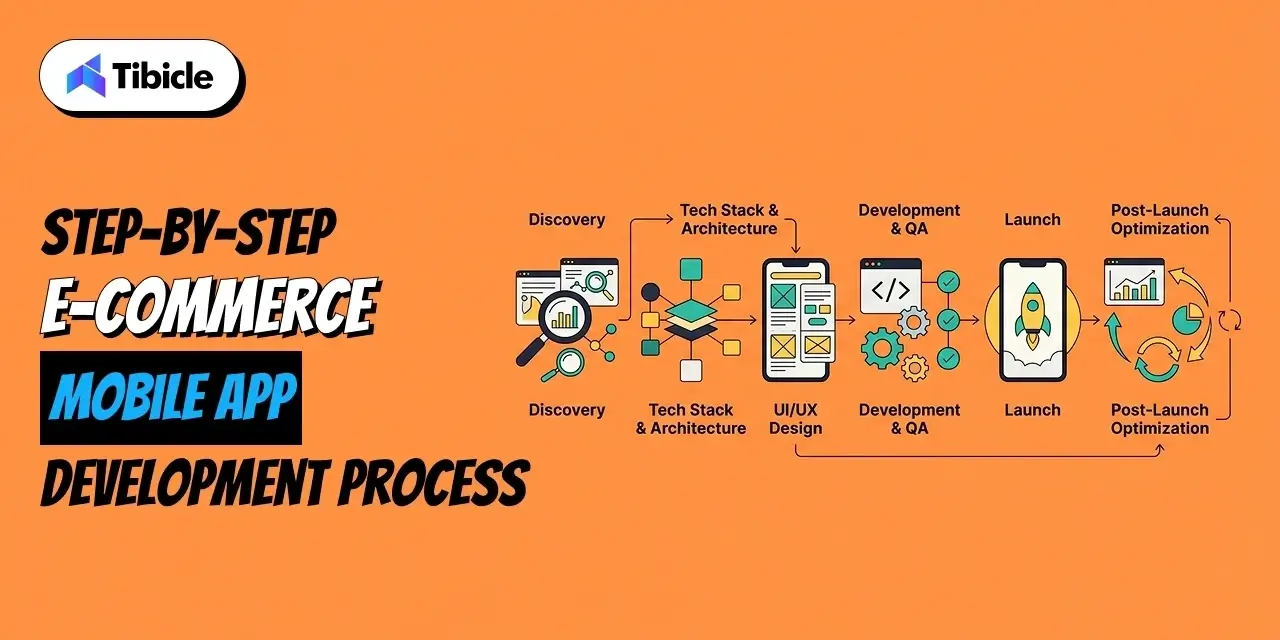
Step 1: Discovery and Scope Definition
The discovery phase defines the entire foundation of e-commerce mobile app development. This stage focuses on understanding user behavior, business objectives, and competitive positioning.
Detailed user research is conducted to identify customer needs, followed by competitor analysis to identify market gaps. A feature prioritization matrix is created to distinguish between essential features required for MVP launch and optional enhancements for future updates.
This phase ensures alignment between business goals and technical execution, significantly reducing the risk of scope creep later in development.
Step 2: Tech Stack and Architecture Decisions
The e-commerce tech stack determines long-term scalability, maintenance cost, and how easily the app integrates with third-party services. Frontend framework selection (React Native, Flutter, native Swift/Kotlin) should align with team expertise and performance requirements. Backend options include managed platforms like Firebase for rapid MVP launches or custom infrastructure on AWS, Google Cloud, or Azure for enterprises requiring full control over data residency and scaling logic.
Database structure decisions made early are expensive to reverse. Relational databases (PostgreSQL, MySQL) suit e-commerce mobile app development projects with complex product catalogs and inventory management needs. NoSQL databases (MongoDB, DynamoDB) scale horizontally for user-generated content and real-time features but require careful schema design to avoid query performance issues at scale.
Step 3: UI/UX Design for Mobile-First Conversions
Design is a critical factor in conversion optimization. A mobile-first design approach ensures that the app is optimized for small screens, fast interactions, and minimal friction. Design elements such as thumb-zone navigation, simplified product discovery, and single-tap checkout significantly improve usability. The goal is to reduce cognitive load and make purchasing as seamless as possible.
A well-designed mobile interface can dramatically reduce cart abandonment rates and increase conversion rates.
Step 4: Development Sprints and QA Cycles
Agile sprint structures in e-commerce mobile app development typically run in two-week cycles. Each sprint delivers a shippable increment: a working feature set that passes QA and could theoretically launch. Security audits should run continuously throughout development, not as a final pre-launch gate. Penetration testing, code reviews for common vulnerabilities (SQL injection, XSS, insecure data storage), and third-party dependency scanning catch issues when remediation cost is lowest.
Device testing matrices must cover the long tail of Android fragmentation. Testing only on flagship devices misses the performance and compatibility issues that affect 60%+ of users in markets like India, Southeast Asia, and Latin America, where mid-tier and budget Android devices dominate.
Step 5: App Store Submission and Launch
App store optimization begins before submission. Metadata requirements differ between Apple App Store and Google Play Store: screenshot dimensions, video preview specs, keyword character limits, and content rating questionnaires all require platform-specific preparation.
Review cycle timelines vary: Apple’s manual review process takes 24-48 hours for initial submissions and can extend to 5-7 days if the app is flagged for additional review. Google Play uses automated scanning with manual spot checks, typically approving apps within hours but occasionally holding submissions for 3-7 days for policy review.
Step 6: Post-Launch Monitoring
KPIs to track from day one include: Daily Active Users (DAU) as a leading indicator of product-market fit, conversion rate measured at every funnel stage (browse to cart, cart to checkout, checkout to purchase), session length showing engagement depth, and retention at D1/D7/D30 revealing whether the app creates habit formation or suffers from install-and-abandon patterns.
Crash reporting, API response time monitoring, and user feedback loops feed continuous improvement cycles. The e-commerce mobile app development process does not end at launch; it shifts from building features to optimizing conversion and retention based on real user behavior data.
Custom Build vs App Builder vs Convert from Website
Choosing between custom ecommerce app development, app builder platforms, and website-to-app conversion services is a cost-versus-control trade-off with long-term implications for scalability and feature flexibility.
| Approach |
Cost Range |
Time to Launch |
Scalability |
Best For |
| Custom ecommerce app development |
$40K-$300K+ |
4-9 months |
High |
Complex catalogs, multi-market expansion, proprietary features |
| App builder platforms |
$500-$5K/year |
2-6 weeks |
Low-Medium |
Small catalogs, simple checkout, limited integrations |
| Site-to-app conversion |
$5K-$25K |
2-6 weeks |
Medium |
Existing Shopify/WooCommerce stores seeking mobile presence |
Key decision factors include catalog size (app builders struggle above 5,000 SKUs), backend complexity (custom APIs, ERP integrations, and multi-warehouse inventory logic all require custom builds), integration count (each third-party service adds compatibility risk in templated platforms), and international expansion plans (multi-currency, region-specific payment methods, and tax calculations require custom development).
eCommerce App Development Cost Breakdown
Understanding e-commerce app development cost requires separating fixed development costs from variable costs that scale with feature complexity, platform choices, and team location.
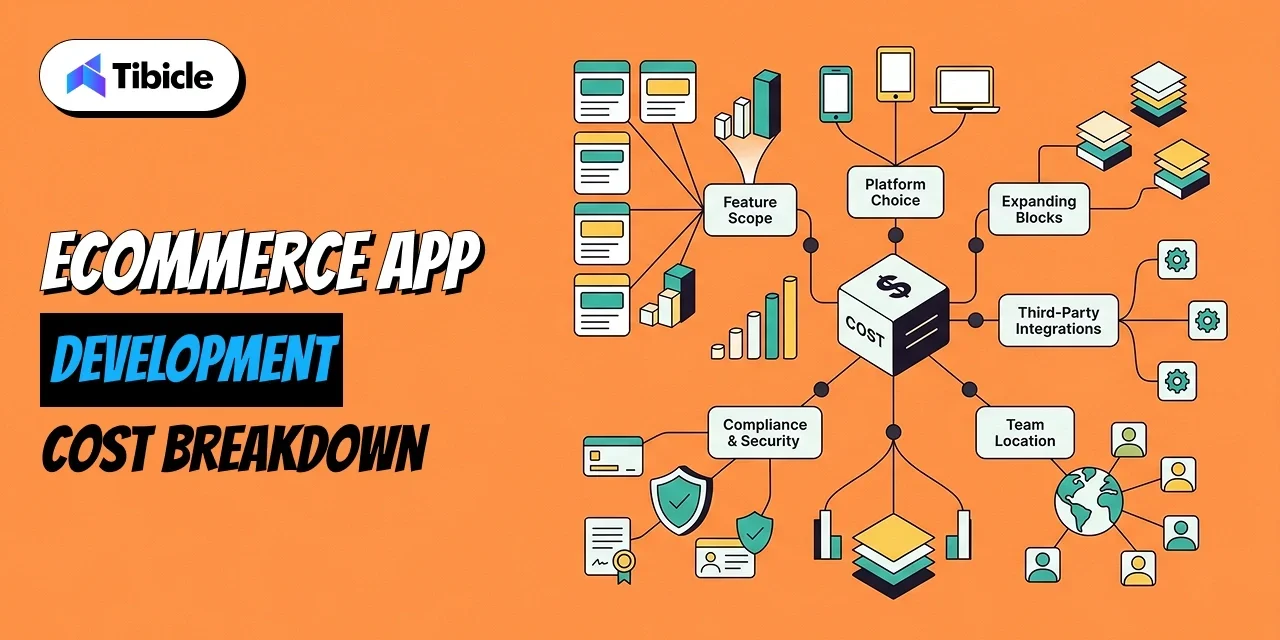
What Drives Cost Up
Feature scope creep is the primary cost driver in e-commerce mobile app development. Each feature added mid-sprint requires design iteration, development time, QA expansion, and documentation updates. Third-party API integrations for inventory management, CRM systems, shipping logistics, and marketing automation platforms each add 40-80 hours of development and testing time.
Building for iOS and Android simultaneously doubles the codebase in native development approaches. Cross-platform frameworks like React Native reduce but do not eliminate this cost. Compliance requirements for PCI-DSS (payment card data security) and GDPR (European user data protection) add legal review, documentation, and technical implementation overhead that can extend timelines by 3-6 weeks.
Regional Pricing Reality
In-house development teams in the US and UK cost $150-$250 per hour fully loaded (salary, benefits, overhead). Outsourced development teams in India and Eastern Europe typically charge $25-$80 per hour. However, hourly rate alone does not determine total cost: communication overhead, time zone misalignment, and rework cycles can erode the apparent savings from offshore development.
Realistic ecommerce app development cost ranges: MVP builds with core features only run $30K-$80K. Full-featured apps with personalization, loyalty programs, advanced analytics, and multi-platform support range from $100K-$300K+. Enterprise marketplace platforms with vendor management, complex approval workflows, and ERP integration often exceed $500K.
Hidden Costs Executives Miss
Ongoing maintenance consumes 15-20% of the initial build cost annually. This includes OS compatibility updates when Apple and Google release new iOS and Android versions, security patches for dependencies, bug fixes reported through user feedback, and infrastructure scaling as user base grows.
App store fees charge 15-30% commission on in-app purchases and subscriptions (reduced to 15% for small businesses under Apple’s Small Business Program). Third-party license renewals for analytics platforms, payment gateway fees, push notification services, and cloud infrastructure scale with usage. QA retesting is required with every major OS update, typically 2-3 times per year per platform.
ROI and Business Impact of eCommerce Mobile App Development
The financial justification for e-commerce mobile app development rests on three measurable outcomes: higher average order value, lower customer acquisition cost through owned channels, and increased customer lifetime value through improved retention.
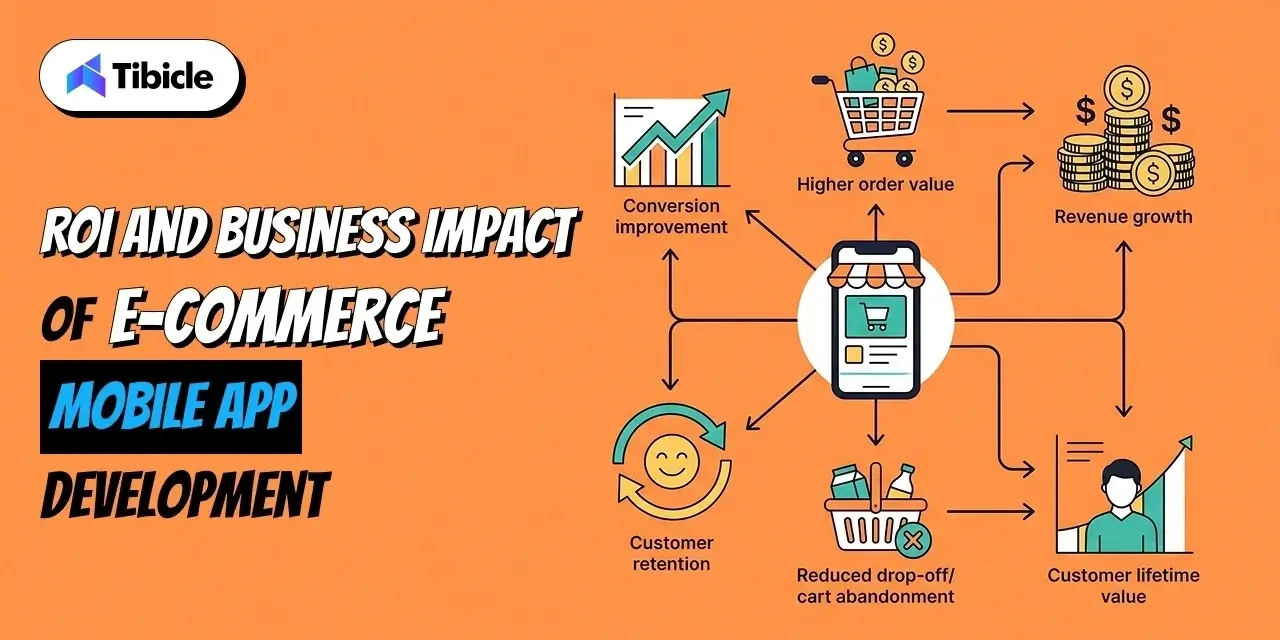
Where ROI Actually Comes From
Mobile apps deliver 3x higher conversion rates compared to mobile browser experiences, according to Criteo’s Mobile Commerce Report. The friction reduction from saved payment methods, biometric authentication, and faster load times directly translates to completed purchases. Apps also demonstrate higher average order value (AOV): users who shop via app spend 2-3x more per transaction than mobile web visitors.
Push notifications provide a direct, algorithm-free communication channel with zero incremental cost per send. Unlike email (deliverability issues, spam filters) or social media (algorithmic suppression), push notifications reach users instantly with open rates of 40-60% for well-targeted messages. This channel drives cart abandonment recovery, flash sale announcements, and reactivation campaigns without ongoing media spend.
Retention rates in apps exceed mobile web by 3-5x at the D30 (30-day) mark. Users who install an app signal higher purchase intent and create a persistent presence on their device that casual mobile web browsers do not. This retention advantage compounds over time: a customer retained for 12 months generates 4-6x more lifetime value than a one-time purchaser.
Metrics to Model Before Committing Budget
Monthly active users needed to break even can be calculated by dividing total ecommerce app development cost by (average order value × conversion rate × gross margin × expected purchases per user per year). If the required user base exceeds your current mobile web traffic by more than 3x, acquisition cost will likely prevent reaching ROI within 18-24 months.
Projected lift in repeat purchase rate should be modeled conservatively. Industry benchmarks show apps increase repeat purchase rates by 20-40% versus mobile web, but this varies significantly by category. Calculate the revenue impact of moving your current repeat purchase rate from baseline to the target percentage.
Cart abandonment rate reduction baseline provides a concrete ROI metric. If your current mobile web abandonment rate is 75% and a well-designed app with saved payment methods and push notification recovery reduces it to 60%, the 15-percentage-point improvement multiplied by monthly cart additions and AOV yields the monthly revenue lift from ecommerce mobile app development.
When an App Does Not Make Financial Sense
eCommerce mobile app development does not make financial sense when annual mobile revenue is below $500K. The development cost and ongoing maintenance burden cannot be justified by the revenue base. Businesses with no existing mobile traffic base face compounded challenges: not only must you build the app, but you must also acquire users to install it, doubling customer acquisition cost.
Organizations with no retention or CRM strategy in place should not invest in e-commerce mobile app development until those foundational capabilities exist. An app amplifies retention strategies; it does not create them. Without lifecycle email campaigns, customer segmentation, and loyalty mechanics already proven on the web, the app will not deliver the retention lift that justifies its cost.
Risks and Challenges to Plan For
Every e-commerce mobile app development project faces predictable risks. Planning mitigation strategies upfront reduces the likelihood of timeline delays, budget overruns, and post-launch failures.
Scope creep mid-sprint is prevented by locking the discovery phase deliverables into a fixed feature specification before development begins. Change requests should be evaluated against impact to timeline and budget, with a formal approval process that requires sign-off from both technical and business stakeholders.
App store rejection cycles can delay launch by 3-6 weeks. Common rejection reasons include incomplete metadata, screenshots that do not accurately represent functionality, privacy policy violations, and payment flow issues. Submitting a beta build for TestFlight (iOS) or internal testing (Android) 2-3 weeks before the planned launch identifies most issues before the production submission.
Security vulnerabilities in payment flows expose businesses to financial liability and regulatory penalties. PCI-DSS compliance is non-negotiable for any e-commerce mobile app development project handling credit card data. Using tokenization through payment gateway integration providers (Stripe, Braintree) rather than processing card data directly reduces compliance scope and risk surface area.
Performance on low-end Android devices is frequently overlooked by teams testing only on flagship hardware. In markets like South Asia, Southeast Asia, India, and Latin America, devices with 2GB RAM and entry-level processors dominate. Testing on representative device profiles prevents the performance issues that lead to high uninstall rates in these high-growth markets.
Vendor lock-in with proprietary app builder platforms creates long-term strategic risk. When business requirements outgrow platform capabilities, migrating to custom e-commerce app development requires rebuilding from scratch. Evaluating data export capabilities and API flexibility during vendor selection preserves future optionality.
Vendor Evaluation Checklist for eCommerce App Development
Selecting the right e-commerce mobile app development partner determines whether the project delivers on time, stays within budget, and achieves post-launch performance targets. Use this checklist to separate capable vendors from those likely to create ongoing problems.
Questions to Ask Before Signing
Do they own or outsource development? Agencies that subcontract work introduce coordination overhead, communication delays, and accountability gaps. Verify that the team presenting the proposal will execute the work.
What is the post-launch SLA and bug fix policy? eCommerce mobile app development does not end at launch. Critical bugs discovered in the first 30-90 days should be fixed under warranty without additional hourly charges. Clarify response time commitments for severity-1 issues that impact checkout or payment processing.
Can they show an e-commerce-specific portfolio with retention metrics? Generic app development experience does not translate to e-commerce mobile app development competency. Request case studies showing conversion rate improvements, cart abandonment reduction, and retention metrics from previous shopping app development projects.
How do they handle OS updates and app store policy changes? Apple and Google update OS requirements and app store policies 2-3 times per year. Vendors should include compatibility updates in ongoing maintenance agreements rather than treating each update as a new project.
What is the data ownership and IP clause in the contract? Some vendors retain ownership of code, design assets, or custom components developed during the project. This creates dependency and limits your ability to switch vendors. Contracts should explicitly transfer all IP to the client upon final payment.
Red Flags in Proposals
No discovery phase included signals a vendor planning to build to a fixed feature list without validating assumptions through user research or competitive analysis. Discovery is not overhead; it is the foundation that prevents expensive rework later.
Fixed-price quotes for complex feature sets are unrealistic. eCommerce mobile app development projects with third-party integrations, custom backend logic, or advanced features cannot be accurately scoped without discovery. Fixed-price bids on complex work either include massive contingency padding or will result in change orders mid-project.
No mention of QA, security audit, or compliance indicates the vendor views testing as optional or outside their scope. Quality assurance should consume 20-25% of development time. Security audits and compliance verification (PCI-DSS for payments, GDPR for EU users) must be explicitly included in the scope and timeline.
Download the Vendor Evaluation Scorecard – evaluate any e-commerce app development partner in under 20 minutes with standardized criteria covering technical capability, process maturity, and contract terms.
Tools and Platforms Used in eCommerce Mobile App Development
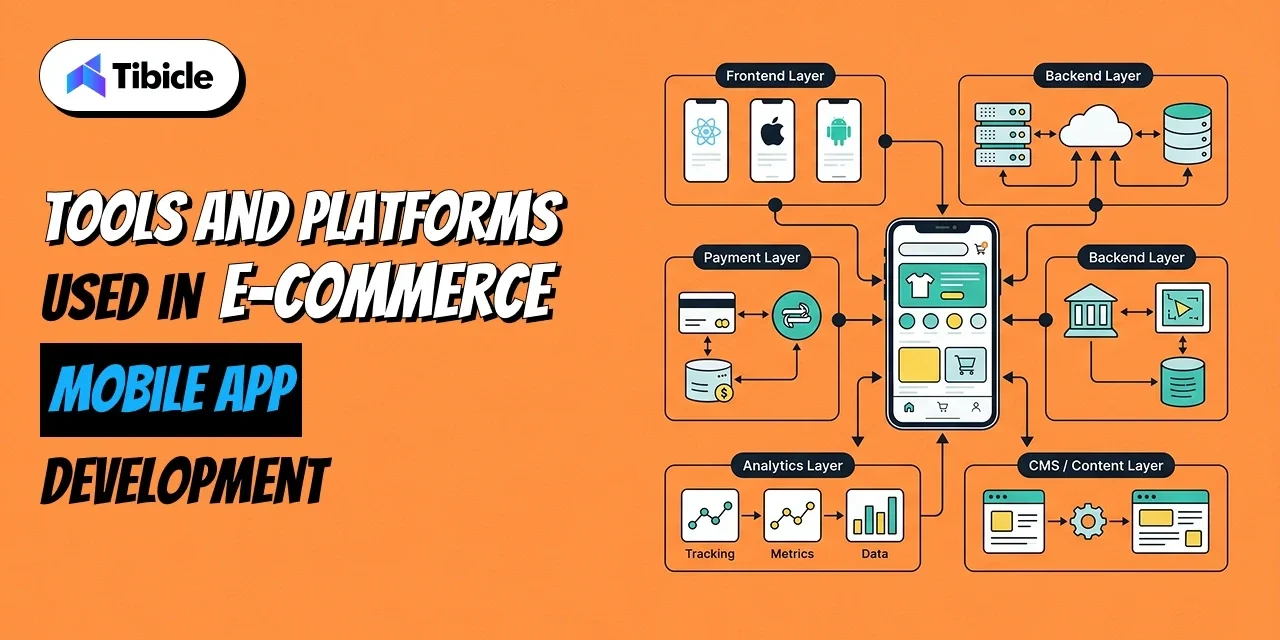
The tools and platforms selected for e-commerce mobile app development determine development speed, ongoing maintenance burden, and how easily the app scales with business growth.
Frontend frameworks: React Native and Flutter enable cross-platform development with a single codebase. Swift (iOS) and Kotlin (Android) are used for native development when maximum performance or platform-specific features are required.
Backend technologies: Node.js provides high concurrency for API-heavy applications. Django (Python) suits projects requiring complex business logic and rapid development cycles. Firebase offers a managed backend-as-a-service that eliminates infrastructure management for MVPs and small-scale apps.
Payment gateway integration: Stripe, Razorpay, PayPal, and Braintree provide SDKs that handle PCI-DSS compliance, support multiple payment methods, and work across regions. Razorpay specifically serves Indian market requirements, including UPI, Netbanking, and local wallet integrations.
Analytics platforms: Mixpanel and Amplitude track user behavior, funnel conversion, and retention cohorts. Firebase Analytics integrates natively with Firebase backend services and provides free basic analytics for apps of any size.
CMS and PIM systems: Contentful provides a headless CMS for managing product content across channels. Shopify Storefront API allows custom e-commerce mobile app development on top of Shopify’s backend infrastructure. Magento supports complex B2B and multi-store ecommerce requirements.
Why Tibicle LLP Is Worth Evaluating for eCommerce Mobile App Development
Most e-commerce mobile app development projects fail not because of technology limitations but because of misalignment between business requirements, technical architecture, and vendor capabilities. Tibicle LLP addresses this gap through end-to-end ecommerce app development with dedicated QA and post-launch support built into every engagement.
The differentiator is architectural flexibility: Tibicle handles both Shopify-native builds for businesses already on Shopify and custom backend development for organizations with proprietary business logic or complex integration requirements. This dual capability reduces the vendor fragmentation risk flagged in the challenges section, where businesses often need separate vendors for platform work and custom development.
Tibicle’s use-case fit centers on mid-market D2C brands scaling beyond $2M annual revenue, B2B procurement apps requiring approval workflows and ERP integration, and multi-catalog marketplaces where vendor management and commission logic demand custom ecommerce app development rather than template solutions.
Talk to Tibicle’s team about your app scope – free 30-minute technical consultation to evaluate whether custom ecommerce app development, platform-based builds, or hybrid approaches best fit your requirements and timeline.
Conclusion
eCommerce mobile app development is a capital allocation decision that requires the same rigor applied to any infrastructure investment: clear requirements, realistic cost modeling, and vendor evaluation based on delivery capability rather than pitch quality. The decision to build, the approach selected, and the partner chosen determine whether the app becomes a revenue-generating channel or a maintenance liability.
Three questions executives should be able to answer before committing budget:
What is the ROI model? Quantify the expected lift in conversion rate, repeat purchase rate, and customer lifetime value with conservative assumptions.
Which development approach fits the timeline? Custom builds require 4-9 months; platform solutions launch in weeks but limit future flexibility.
Is the vendor IP-clean and post-launch capable? Verify ownership clauses in contracts and confirm post-launch support commitments cover OS updates and critical bug fixes.
Ready to scope your e-commerce mobile app? Get a cost estimate and timeline from Tibicle LLP with no obligation. We provide transparent pricing, realistic timelines, and portfolio case studies showing retention and conversion metrics from previous e-commerce mobile app development projects.
Frequently Asked Questions About eCommerce Mobile App Development
How much does ecommerce mobile app development cost in 2025?
eCommerce app development costs range from $30K-$80K for MVPs with core features to $100K-$300K+ for fully-featured apps. App builder platforms cost $500-$5K annually but allow limited customization. In the US/UK, in-house teams charge $150-$250/hour, while outsourcing to India or Eastern Europe costs $25-$80/hour. Additional costs include ongoing maintenance (15-20% of build cost), app store fees, and infrastructure scaling.
How long does it take to build a custom ecommerce app?
Custom ecommerce app development takes approximately 4-9 months from discovery to launch. The timeline includes: discovery (2-4 weeks), UI/UX design (3-5 weeks), development (12-24 weeks), QA and security audits (3-4 weeks), and app store submission (1-2 weeks). Using cross-platform frameworks like React Native can shorten this by 20-30%. While site-to-app conversion tools and app builders can launch in 2-6 weeks, they sacrifice customization and scalability.
What is the difference between native and cross-platform ecommerce apps?
Native ecommerce apps are developed separately for iOS (Swift) and Android (Kotlin), ensuring optimal performance and access to unique features like Face ID and Apple Pay. However, this leads to higher development and maintenance costs due to managing two codebases. In contrast, cross-platform frameworks like React Native and Flutter use a single codebase for both platforms, reducing initial development costs by 30-40%. The downside is slightly reduced performance and potential delays in accessing new platform features until framework updates are made.
How do I calculate ROI before building an eCommerce app development ?
To calculate the ROI of ecommerce mobile app development, focus on three key metrics: apps convert 3x higher than mobile websites, they see a 20-40% increase in repeat purchases, and well-designed apps can reduce cart abandonment by 10-20 percentage points. The formula is: (Monthly revenue lift + Retention value increase – Development cost – Annual maintenance) / Total investment. ROI typically appears within 18-24 months for businesses with over $500K in annual mobile revenue and existing mobile traffic. Apps usually aren’t cost-effective for businesses below this revenue threshold.
What features should an MVP eCommerce app development include?
An MVP ecommerce mobile app should include a product catalog with filters and search, a synchronized shopping cart, payment gateway integration for major cards and wallets, user account management with saved addresses and order history, order tracking with real-time updates, and push notifications for cart recovery and promotions. Deprioritize social media integration, complex onboarding, and AR features unless there’s clear ROI data for specific categories.
How do I choose the right eCommerce mobile app development company?
When evaluating e-commerce app development vendors, consider these five criteria: a proven ecommerce portfolio with measurable conversion outcomes; a clear post-launch SLA for bug fixes and updates; direct developer employment without subcontracting; clear IP ownership clauses transferring all assets to the client; and a discovery phase that includes user research and competitive analysis. Red flags to watch for include fixed-price quotes for complex features, lack of QA or security audits, and absence of a discovery phase in proposals.