
10 Ways Table Management Software Boosts Restaurant Revenue

Jul 17, 2026

Read in 7 Minutes
Table of Contents
- What This Guide Covers
- Introduction
- What a Table Management Software Actually Does
- 10 Ways a Table Management Software Boosts Restaurant Revenue
- Manual vs. Digital: What the Operational Gap Actually Costs
- What Does a Table Management Software Cost in 2026?
- ROI Breakdown What Operators Actually Get Back
- Risks and Challenges to Anticipate Before You Buy
- Vendor Selection Checklist What to Evaluate Before Committing
- Top Table Management Software Worth Evaluating in 2026
- Why Tibicle LLP Is Worth Considering for Your Table Management Implementation
- Conclusion
- FAQs
What This Guide Covers
Who this is for: Restaurant owners, GMs, and multi-location operators running the dining room on paper wait lists or verbal host-server updates, who are evaluating whether table management software can convert unused floor capacity into measurable revenue.
Search intent: Evaluation and decision, the reader isn’t asking what table management software is. They’re deciding whether the ROI on turnover, no-show recovery, and labor forecasting justifies the switch, and which platform fits their cover volume and service model.
What you will walk away with: 10 specific, revenue-tied mechanisms (no-show recovery, turn optimization, waitlist conversion, dynamic staffing, and more), each with a dollar-figure business outcome, a 2026 pricing breakdown across five platforms, including cover-fee traps, a full ROI model for a 60-seat restaurant, and a 12-point vendor selection checklist to run before signing a contract.
Introduction
A 60-seat restaurant running a 10% no-show rate on just 30% reservation traffic loses an estimated $420 every week, not from poor food or slow service, but from how the dining room is managed. That is a recoverable number, and it is only one of the ways manual floor operations drain revenue that the P&L never labels correctly.
The status quo in most independent and mid-size restaurants is invisible: paper wait lists, verbal table updates between host and server, and no record of why Tuesday at 7 pm consistently underperforms. Every gap between covers, every no-show that goes unrecovered, every section running at 60% while another is overloaded, none of it shows up as a line item. It just shows up as a margin that does not move.
A table management system is not an operational convenience. It is a revenue tool built on the capacity you already own. This guide covers 10 specific, measurable ways the right software converts empty seats into revenue, written for restaurant owners, GMs, and operators accountable to P&L, not technology procurement.
What a Table Management Software Actually Does
Beyond Reservations: The Revenue Layer a Table Management Software Adds
The table management software category is not about replacing a reservation widget. It is about creating real-time visibility into every seat in the dining room, what is occupied, what is turning, what is running behind dwell time, and what is recoverable before the service window closes.
The market signal confirms the direction: the table and delivery management segment is growing at a 19.6% CAGR through 2030. Operators who delay adoption are not holding a position. They are falling behind competitors who are building a 12-month data advantage in cover history, peak-period performance, and guest behavior data that compounds in value the longer it is collected.
How Table Management Software Differs from a Basic POS or Reservation Widget
A POS records a transaction after it happens. A seating management system optimizes the conditions that create more transactions before and during service. The distinction is guest flow intelligence versus transactional record-keeping. A table management system tells you how many more sales were possible and what prevented them.
Floor plan management, waitlist sync, real-time table tracking, and reservation coordination are the operational layer. Revenue velocity is the output.
10 Ways a Table Management Software Boosts Restaurant Revenue
1. Cuts No-Show Losses with Automated Confirmation Workflows
Automated SMS and email confirmations, combined with deposit prompts at booking, reduce the empty table time that no-shows create during peak hours. The mechanism is behavioral: guests who confirm a reservation or provide a card on file cancel or adjust at a higher rate than guests who book without friction.
Business outcome: A restaurant running 30% reservation volume at a 10% no-show rate recovers approximately $420 per week through waitlist management backfill when an automated confirmation workflow is active. Annualized, that is $21,840 recovered from a problem that costs nothing to fix at the system level.
2. Increases Table Turns Without Rushing Guests
Real-time table status tracking combined with predicted dwell time alerts allows hosts and managers to pace the floor proactively, identifying tables approaching the end of their service window before the next party arrives, not after they are already waiting. Restaurants that build turnover optimization into front-of-house operations see 20–30% more covers during peak service without measurable negative impact on guest satisfaction scores.
Business outcome: Each additional turn on 10 tables at a $45 average check generates $450 per shift. Across five service days, that is $2,250 per week from the same floor space, the same staff, and the same kitchen.
3. Eliminates Dead Time Between Covers
Manual floor management creates gaps: a table is cleared, the busser signals the host, the host checks availability, a party is pulled from the wait list, and two to four minutes pass while the next cover waits. A table management system collapses that sequence. Cancellations, walk-ins, and reservation updates sync in real time, vacant tables resurface in the host view the moment they become available.
Business outcome: Fewer minutes between parties across 30 tables per service compounds into measurable cover count improvement over a week of operations. Real-time table tracking replaces guesswork with a live floor view that any staff member can read in seconds.
4. Optimizes Floor Layout for Revenue Per Square Foot
Visual floor plan management tools allow operators to test seating configurations, section allocation, and the ratio of 2-tops to 6-tops before service, not during it. Historical analytics surface which sections consistently underperform on revenue, which server sections turn fastest, and where the floor layout is creating bottlenecks that cost covers.
Business outcome: Operators who track section performance by revenue generated, not just seats occupied, identify yield gaps that are invisible in manual systems. A section running at 70% occupancy with 90% of a neighboring section’s revenue is a layout problem, not a demand problem.
5. Converts Waitlist Guests Into Confirmed Revenue
A digital waitlist with SMS notification keeps walk-in guests engaged when the dining room is at capacity, reducing walkaway rate during peak hours when demand exceeds available covers. Seventy-two percent of guests will wait no more than 30 minutes; the variable is whether they stay engaged during that window or leave for a competitor. An automated text update every 10 minutes is the difference between a covered table and a lost party.
Business outcome: Higher waitlist-to-seated conversion during peak periods directly increases covers per service without adding capacity. The restaurant capacity management value here is not more seats, it is fewer seats wasted.
6. Builds Guest Profiles That Drive Repeat Visits
An integrated guest CRM captures visit history, seating preferences, dietary flags, occasion notes, and spend patterns across every interaction. That data transforms the service from generic to personalized, and personalized service drives both larger checks and stronger return rates. A guest whose anniversary dinner is remembered without prompting is not a satisfied customer. They are a loyal one.
Business outcome: Guest retention is cheaper than acquisition at every revenue stage. The data captured by a table management system reduces churn through relevance — the server already knows the table prefers the back corner and ordered the tasting menu last time. That is not a nice-to-have. That is a retention mechanism.
7. Enables Upselling Through Smarter Seat Assignment
Pre-arrival guest data allows hosts to match high-value guests to premium sections, experience seats, or tables suited to their party size and history before they walk in. Servers can prepare table setup, review previous orders, and personalize the interaction before the first greeting. The commercial outcome is incremental spend driven by service quality, not upselling pressure.
Business outcome: A guest assigned to a premium section based on spend history and preference data spends differently than a guest assigned at random. The guest experience improvement is the mechanism, the revenue uplift is the result.
8. Powers Revenue Decisions with Real-Time Analytics
Peak period identification, bottleneck mapping by section, server performance data by cover count and average check, and shift-level occupancy trends, all of this is surfaced by restaurant table turnover and floor analytics within the platform. Managers stop reacting to problems identified after service closes and start pre-empting them before the first party is seated.
Business outcome: A manager who knows that Thursday at 8pm consistently creates a 12-minute gap between covers in section three can staff, pace, and sequence differently. That is a decision only real-time data makes possible.
9. Reduces Labor Waste During Low-Occupancy Periods
Demand forecasting built from historical booking data enables right-sized staffing by shift, not by the manager’s estimate of how busy it “feels” on a given Tuesday. Overstaffing slow shifts and understaffing peak shifts is a margin drain that appears in the labor percentage but is rarely traced to its source. Scheduling decisions made against actual booking data close that gap before the shift is posted.
Business outcome: Labor cost optimization from forecast-driven scheduling is recoverable margin, and it scales directly with location count. Multi-location operators running the same manual staffing process across five units are compounding the same inefficiency five times over.
10. Supports Multi-Channel Bookings Without Operational Chaos
Reservations arriving from Google, Instagram, a website widget, and phone calls simultaneously create a coordination problem when each channel updates a different system. A restaurant reservation software layer funnels every booking source into a single floor plan view, eliminating double-booking, ensuring walk-in visibility is always current, and giving every front-of-house staff member the same real-time picture of the dining room.
Business outcome: POS integration combined with unified booking consolidation means the floor view, the ticket system, and the reservation record all reflect the same state. Dynamic pricing and cover fees by channel become manageable when all channels report to one system.
Manual vs. Digital: What the Operational Gap Actually Costs
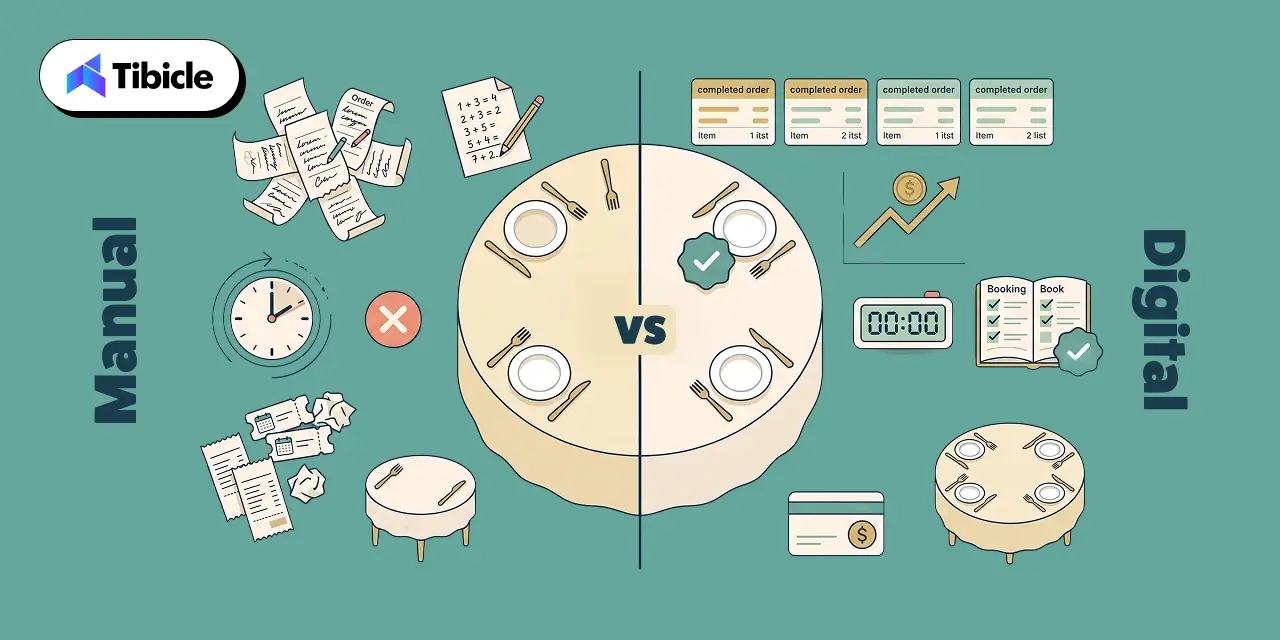
| Factor | Manual / Paper-Based | Table Management System |
| No-show visibility | None — discovered at service | Real-time; backfill automated |
| Table turn tracking | Estimated by staff | Automatic; per-table dwell time |
| No-show recovery | Walk-in hope | Waitlist SMS backfill |
| Peak hour staffing | Based on gut feel | Driven by booking data |
| Guest data capture | Zero or fragmented | Centralized CRM per guest |
| Revenue analytics | Weekly manual tallies | Real-time by section and shift |
| Multi-channel bookings | Phone + one widget | Unified across all channels |
The gap is not about technology preference. It is about how many seats generate revenue per service. Every row in that table represents a decision that manual systems make slowly, inaccurately, or not at all, and that a table management system makes in real time.
What Does a Table Management Software Cost in 2026?
How Pricing Models Are Structured for Table Management Software
Three primary pricing models exist in this category: flat monthly subscription, per-cover fee, and hybrid structures that combine both. The per-cover fee model carries the most risk for high-volume venues. A restaurant doing 1,500 covers per month on OpenTable’s network rate faces $1,500–$2,250 per month in cover charges alone — on top of the subscription fee. That number is rarely visible in the headline pricing conversation.
Pricing Tier Snapshot 2026
| Platform | Starting Price | Cover Fee Model | Best For |
| OpenTable | $149/month | Yes — $0.25–$1.50 per cover | High-visibility venues |
| Resy | $249/month | No cover fees | Upscale and fine dining |
| SevenRooms | ~$700/month | No cover fees | Enterprise and multi-location restaurants |
| Eat App | Free / $129+ | No cover fees | Independent and mid-size restaurants |
| Tablein | From €37/month | No cover fees | Budget-conscious operators |
The Right Question Is Not “What Does It Cost?” It’s “What Does Inaction Cost?”
Every missed no-show, a gap between covers, or a manual seating error that sends a high-value guest to the wrong section each one carries a real dollar cost. The software cost is a line item. The revenue at stake is not, because it never appears on the P&L as a loss. It simply never appears as income.
ROI Breakdown What Operators Actually Get Back
Calculating the Return for a Mid-Size Restaurant
Working example: 60-seat restaurant, $45 average check, five service days per week.
Recovering one additional turn on six tables per night generates $270 per night, $1,350 per week, and $70,200 per year. No-show recovery at $420 per week adds $21,840 annually. Combined impact at conservative assumptions: more than $90,000 in annual revenue upside against a software cost of $250–$700 per month. The business case is not close at this revenue scale.
Metrics That Signal ROI Is Working
- Table turnover rate improvement: target +0.5 to 1 additional turn per peak service period
- No-show rate reduction: baseline 10–15%; optimized target under 5%
- Average covers per service: tracked as a trend line, not a single-night result
- Revenue per available seat hour (RevPASH): the metric that serious operators use to evaluate floor performance across shifts and sections
When ROI Timelines Are Longer Than Expected
Staff training lag, POS integration delays, and behavioral change at the host stand all add time between software deployment and measurable return. Operators who phase implementation starting with reservations and floor plan visibility, then adding guest CRM — see faster adoption and faster payback than those who activate every module simultaneously before staff are comfortable with the core workflow.
Risks and Challenges to Anticipate Before You Buy
Integration Complexity with Existing POS Systems
Not all platforms integrate cleanly with all POS systems. A patchwork connection, one that requires a manual export to sync reservation data with transaction records, defeats the analytics value proposition entirely. Verify native integration with your specific POS model before committing, not after the contract is signed.
Staff Resistance and Training Overhead
System capability is not system utilization. A front-of-house team that does not trust the floor view will revert to verbal table updates within two weeks of go-live. Budget for structured training time, not just the vendor onboarding call, and build adoption tracking into the 30-60-90 day post-launch review.
Per-Cover Fee Structures That Erode Margin at Scale
At high reservation volumes, per-cover pricing outpaces the subscription cost of flat-fee alternatives without the operator noticing until the monthly invoice arrives. Run a six-month projection at current reservation volume before signing any per-cover agreement.
Vendor Lock-In and Data Portability
Guest history is an operational asset. A platform that holds that data without export rights creates a switching cost that does not serve the operator. Confirm data portability terms in writing before signing, specifically: what format does the export use, what data is included, and what happens to the data after account cancellation.
Vendor Selection Checklist What to Evaluate Before Committing
Before committing to any table management software, require clear answers to the following:
- Does it include visual floor plan management with real-time status updates?
- Does it sync reservations, walk-ins, and waitlists in a single floor view?
- What is the true all-in monthly cost at your current cover volume, including per-cover fees?
- Are there per-cover fees and from which booking channels do they apply?
- Does it integrate natively with your existing POS system?
- What guest data is captured, stored, and exportable on account exit?
- Does it offer real-time analytics by section, shift, and server?
- Can it handle multi-location or multi-floor plan configurations?
- What is the onboarding and training timeline and is dedicated support included?
- What happens to your guest data if you cancel the subscription?
- Is a free trial available before a contract commitment is required?
- What are the contract terms monthly versus annual, and what are the exit provisions?
Running a restaurant with over 60 seats and still managing the floor manually? Talk to a specialist at Tibicle LLP to see how the right restaurant reservation software pays for itself in the first quarter.
Top Table Management Software Worth Evaluating in 2026

OpenTable – Largest diner discovery network; strongest for visibility-driven venues where inbound reservations from new guests are the primary goal. Watch per-cover fees closely at volumes above 1,000 covers per month.
Resy (American Express) – Premium positioning with no cover fees; strong fit for fine dining and upscale casual where the guest relationship is the primary asset.
SevenRooms (acquired by DoorDash, 2025) – Enterprise-grade guest CRM and multi-location management; the strongest option for groups running five or more locations with complex guest data requirements.
Eat App – Cost-effective with a free tier available; strong for independent operators and mid-size restaurants evaluating their first digital floor management tool.
Toast Tables – Native POS integration for restaurants already on the Toast ecosystem; eliminates the integration layer entirely for existing Toast users.
Tablein – Budget-friendly flat pricing suited for smaller independent restaurants where cost per seat is the primary evaluation criterion.
TheFork Manager – Strong European market presence with TripAdvisor-backed diner network access; most relevant for operators with significant European diner traffic.
Pricing accurate as of Q2 2026. Verify directly with vendors before purchase, as pricing structures in this category change frequently.
Why Tibicle LLP Is Worth Considering for Your Table Management Implementation
Operators frequently choose the right software and implement it incorrectly, losing the ROI in the first 90 days before the system has a chance to perform. The failure point is rarely the platform. It is the integration architecture, the staff training sequencing, and the absence of a post-launch adoption protocol that holds the gains.
Tibicle LLP works with restaurant groups at the selection and implementation stage — before the contract is signed. The value is cross-platform expertise: Tibicle is not locked into one vendor ecosystem, which means the recommendation starts with the operation’s floor plan complexity and revenue priorities, not a preferred partner relationship.
For multi-location operators and restaurants mid-migration from manual to digital front-of-house operations, that independence matters. The right system implemented correctly outperforms the best system implemented poorly every time.
Evaluating platforms and not sure which fits your floor plan complexity? Tibicle LLP works with restaurant groups at the selection and implementation stage before the contract is signed.
Conclusion
A table management system is not overhead on the P&L. It is a revenue multiplier on the capacity you already own the same seats, the same kitchen, the same staff, generating more covers per service through better information and faster decisions.
The 10 ways covered here are not independent levers. They compound. Turnover improvement funds itself in the first quarter. Guest data becomes more valuable with every visit recorded. Analytics prevent the staffing waste that erodes margin on slow nights. Each function reinforces the others, and the data advantage grows the longer the system runs.
Talk to Tibicle LLP about restaurant tech selection and implementation before you commit to a vendor contract.
FAQs
What is a table management system and how is it different from a reservation tool?
A table management system manages the full lifecycle of a table from reservation intake through seating, service pacing, and turnover while a basic reservation tool handles bookings only. The distinction is operational scope: one manages the transaction, the other manages the floor conditions that determine how many transactions happen per service.
How much does table management software cost for a mid-size restaurant?
Expect $129–$700 per month, depending on platform and feature set. Per-cover fee models can add significantly to total cost at high reservation volumes. Always calculate the all-in monthly cost at your current cover count, not just the subscription headline.
What is a good table turnover rate for a full-service restaurant?
Casual dining benchmarks are 2–3.5 turns per table per dinner service.
Can a table management system reduce no-shows?
Yes. Automated confirmation requests, deposit collection at booking, and SMS reminders are the primary mechanisms. Reducing the no-show rate from 10% to under 5% has a direct, calculable revenue impact of approximately $21,840 annually for a 60-seat restaurant running 30% reservation volume.
What should restaurants look for when comparing table management platforms?
Prioritize: true all-in cost including per-cover fees at your current volume, native POS integration compatibility, guest data portability on exit, real-time floor plan functionality, and the depth of analytics available by section and shift in that order.
Schedule A Developer Interview And Get 15 Days Risk-Free Trial
Schedule a Call

Relevant Blog
3 Best Restaurant Management App for 2026

Prejin Nadar


Mobile AI App Development Company Guide

Diya Koradiya

AI Integration Company for B2B SaaS Guide
Diya Koradiya
Written by
Recent Blogs
Enterprise LLM Integration Services
What This Guide Covers Who this is for Enterprise LLM integration services help engineering leaders, platform teams, and technology executives turn existing model access into working production workflows. This guide is for organisations connecting OpenAI, Claude, or both to systems that support real business processes, including CRM platforms, ticketing systems, document pipelines, and internal tools. […]
When to Hire an AI Software Development Consulting Firm.
What This Guide Covers Who this is for Engineering leaders, technology executives, and AI teams often struggle to turn completed initiatives into measurable results. This guide helps organisations address stalled pilots, failed AI implementations, rising costs, poor data quality, and workflows that function technically but fail to deliver measurable business value. An AI software development […]
Building Private local AI Desktop App Development
What This Guide Covers Who this is for: US tech firms, SaaS companies, startups, CTOs, engineering managers, and product teams looking for experienced Electron.js developers for ongoing private local AI desktop app development and custom desktop application development. Search intent: Hiring and decision. This guide covers where to find Electron.js developers, how to evaluate their […]
Got an Idea? Get FREE Consultation
In our world, there's no such thing as having too many clients

