
What Is IT Outsourcing? A Decision-Maker’s Guide for (2026)

May 18, 2026

Read in 4 Minutes
Table of Contents
- Introduction
- What Is IT Outsourcing?
- The 3 Core IT Outsourcing Models
- What Services Are Included in IT Outsourcing?
- Onshore vs. Nearshore vs. Offshore – Side-by-Side Comparison
- IT Outsourcing Pricing – What Executives Actually Pay
- ROI and Business Impact of IT Outsourcing
- Risks and Challenges of IT Outsourcing
- Vendor Selection Checklist for IT Outsourcing
- Top IT Outsourcing Destinations in 2026
- Key Benefits of IT Outsourcing for Businesses
- Why Tibicle LLP Is Worth Evaluating for Your IT Outsourcing Needs
- Conclusion
- FAQs
Introduction
The global IT Outsourcing market is estimated at $662 billion in 2026 and is projected to reach $1.345 trillion by 2034 at an 8.2% CAGR. At the same time, 77% of employers report difficulty finding skilled technology talent, pushing companies toward global outsourcing partners for delivery support and specialized expertise. Modern outsourcing is no longer viewed only as a cost-cutting tactic. Businesses now use external technology teams to accelerate product development, improve operational continuity, reduce hiring delays, and access global engineering talent without long recruitment cycles. From startups to enterprise organizations, outsourcing has become a strategic delivery model across software, cloud, AI, cybersecurity, and infrastructure operations.
Understanding IT Outsourcing services requires evaluating delivery models, real pricing, ROI potential, and the critical vendor selection factors that impact long-term business success.
What Is IT Outsourcing?
IT Outsourcing is the process of contracting with external providers to manage technology functions rather than building or staffing those capabilities internally. Companies outsource services such as software development, cloud operations, cybersecurity monitoring, helpdesk support, network management, and IT infrastructure to improve efficiency and reduce operational pressure.
By 2026, outsourcing will have shifted from a selective practice to a mainstream business function. Organizations increasingly depend on external partners not only for cost savings but also for continuity, scalability, and innovation delivery. Common engagement approaches include staff augmentation, dedicated engineering teams, and partnering with a managed services provider for long-term operational support. Businesses also use outsourcing to fill specialized skill gaps that are difficult or expensive to hire internally.
The 3 Core IT Outsourcing Models
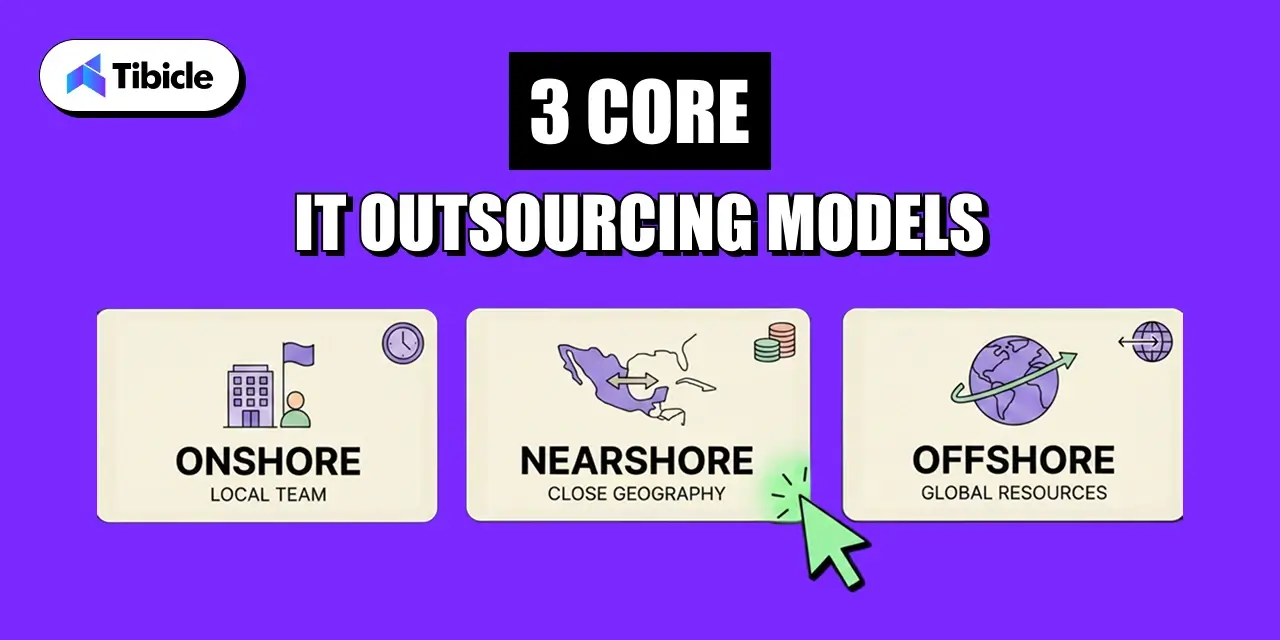
Onshore
Onshore outsourcing involves hiring teams within the same country. This model offers the highest level of communication alignment, legal protection, and compliance support, making it suitable for highly regulated or IP-sensitive projects. However, it is also the most expensive option, with U.S. developer rates commonly ranging from $60 to over $150 per hour in 2026.
Nearshore
Nearshore outsourcing works with providers located within one to three overlapping time zones. This approach balances collaboration quality with moderate cost savings. Companies often achieve 20-40% lower costs compared to onshore hiring while maintaining reliable communication overlap for agile development and iterative delivery cycles.
Offshore
Offshore outsourcing gives businesses access to the largest global talent pool at the lowest operational cost. The offshore developer rates in 2026 range from approximately $15 per hour in South Asia to $70 per hour in mature Eastern European markets. This model works best for scalable development and long-term execution but requires structured governance and communication processes.
Best Fit:
- Onshore → Compliance-heavy and IP-sensitive projects
- Nearshore → Agile collaboration and product iteration
- Offshore → High-scale delivery and cost optimization
What Services Are Included in IT Outsourcing?
Modern businesses outsource far more than basic support operations. Software development outsourcing remains the fastest-growing category, expanding at an estimated 11.5% CAGR as companies seek faster product delivery and specialized engineering talent.
The most commonly outsourced functions in 2026 include cybersecurity monitoring, cloud infrastructure management, DevOps operations, AI/ML engineering, RPA automation, helpdesk services, and enterprise application support. Together, cybersecurity, AI/ML, cloud operations, software development, and IT support account for more than 63% of global outsourcing market value.
Companies increasingly outsource specialized technical functions because maintaining internal teams for every capability significantly increases hiring cost, management complexity, and operational overhead.
Onshore vs. Nearshore vs. Offshore – Side-by-Side Comparison
| Factor | Onshore | Nearshore | Offshore |
| Hourly Rate (2026) | $80-$150+ | $30-$70 | $15-$60 |
| Time Zone Overlap | Full | Partial (4–8 hrs) | Limited |
| Communication Risk | Low | Low–Medium | Medium–High |
| Cost Savings vs. In-House | 10-20% | 30-50% | 50-70% |
| Best For | Compliance, IP | Agile collaboration | Scale, volume |
| Hidden Cost Risk | Low | Low | Medium–High |
Not sure which model fits your tech roadmap? Tibicle LLP can audit your requirements and recommend the right delivery structure, no obligation.
IT Outsourcing Pricing – What Executives Actually Pay
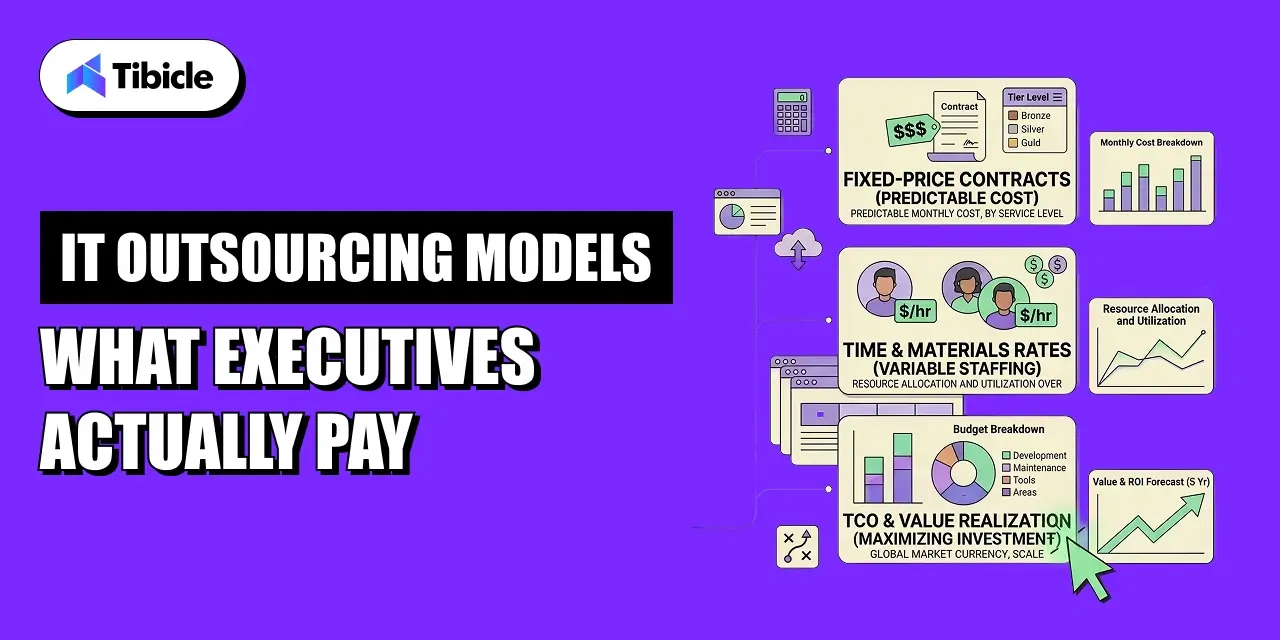
Pricing Models You’ll Encounter
Fixed Price
A fixed-price model works best for projects with clearly defined scope, timelines, and deliverables. It offers predictable budgeting but limits flexibility once development begins.
Time and Materials
This model charges based on actual hours worked and resources used. It is commonly used for evolving projects where scope changes frequently during development cycles.
Dedicated Team
A dedicated team model provides ongoing engineering capacity through a monthly retainer structure. Businesses use this approach for long-term product development and scaling initiatives.
Managed Services
Under managed IT Outsourcing, vendors deliver outcome-based services governed through a formal service level agreement with defined KPIs and support expectations.
Real Cost Benchmarks (2026)
In Latin America, junior developer rates average $29-$44 per hour, mid-level developers $50–$60 per hour, and senior engineers $60-$74 per hour. Many enterprises now combine onshore strategy oversight, nearshore collaboration, and offshore execution to balance communication quality and delivery cost.
Hidden Costs to Budget For
Hidden expenses often include onboarding time, governance overhead, project coordination, communication gaps, and currency fluctuation risks on long-term contracts. Rework caused by collaboration issues can erode 20–25% of projected savings if processes are poorly managed.
ROI and Business Impact of IT Outsourcing
Where the Financial Gains Actually Come From
The financial value of IT Outsourcing services extends beyond labor cost reduction. Faster hiring, shorter delivery cycles, and access to specialized expertise often generate stronger long-term returns than hourly savings alone. Organizations using AI and automation within outsourced security operations save an average of $2.22 million compared to companies without those capabilities.
ROI Calculation Framework for IT Leaders
Step 1: Calculate internal operational cost, including salaries, benefits, overhead, and infrastructure.
> Step 2: Estimate outsourcing cost based on rates, hours, onboarding, and governance.
> Step 3: Include a productivity-loss buffer of 10-15% for offshore and 5% for nearshore operations.
> Step 4: Measure delivery acceleration and earlier revenue realization from faster launches.
Research shows 60% of businesses outsource primarily for cost reduction, with savings often ranging from 40-70% compared to fully in-house hiring models.
Non-Financial ROI Metrics C-Suites Track
Leadership teams also evaluate outsourcing through reduced hiring timelines, improved engineering bandwidth, operational continuity, and stronger vendor management accountability tied to SLA performance metrics.
Risks and Challenges of IT Outsourcing
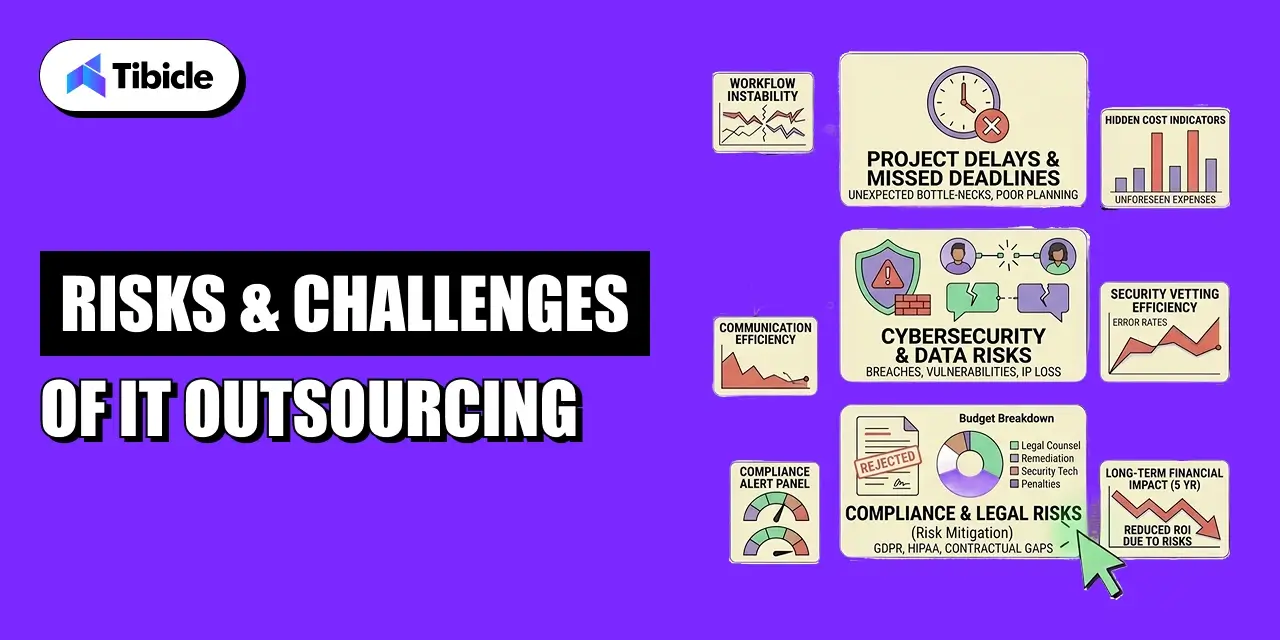
Security and Compliance Exposure
Data security remains one of the biggest outsourcing concerns. By 2024, the average global cost of a data breach reached $4.88 million, while outsourcing firms experienced a major increase in cyberattack frequency. Compliance requirements such as GDPR, DPDP India, and HIPAA make vendor validation critical before contract signing.
Operational Risks That Kill Projects
Common outsourcing failures include scope creep, dependency on individual vendor resources, inconsistent quality during rapid team scaling, and poorly structured SLAs without enforcement mechanisms. Communication gaps and unclear ownership structures also create operational instability during long-term engagements.
How to Reduce Risk Before You Sign
Businesses should begin with pilot engagements before expanding into large contracts. Contracts should include IP assignment clauses, data residency documentation, defined exit terms, and quarterly performance reviews tied to measurable operational benchmarks.
Vendor Selection Checklist for IT Outsourcing
A strong outsourcing partner should satisfy both technical and operational evaluation criteria. Procurement and IT leaders should validate the following before finalizing any engagement:
- Proven delivery experience within your industry
- Verified client references and case studies
- Security certifications such as ISO 27001 or SOC 2
- SLA structures with measurable KPIs and accountability clauses
- Clear intellectual property ownership terms
- Defined communication workflows and escalation paths
- Dedicated account management support
- Ability to scale engineering teams within 30-45 days
- Transparent pricing with a total cost of ownership breakdown
- Exit clauses and knowledge transfer planning defined upfront
The right outsourcing relationship depends as much on governance and communication quality as technical expertise.
Top IT Outsourcing Destinations in 2026
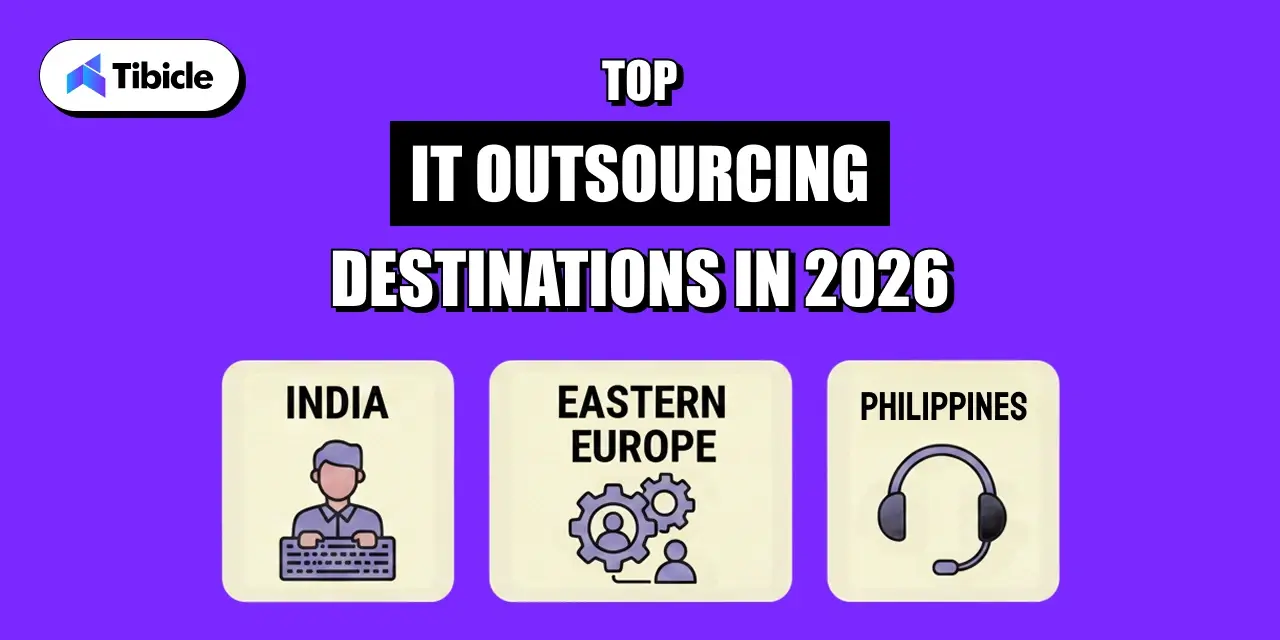
India remains the largest global outsourcing destination with approximately 17.58% market share, making it a leading choice for software engineering, AI/ML development, and scalable support operations. Eastern European countries such as Poland and Romania are known for enterprise software, fintech, and cybersecurity expertise.
Latin America continues to grow as a preferred nearshore region for U.S.-based businesses due to strong time-zone overlap and collaboration efficiency, with Brazil and Mexico leading the market. The Philippines dominates IT support and BPO operations because of its mature service infrastructure and English-speaking workforce.
Key Benefits of IT Outsourcing for Businesses
- cost savings
- faster development
- access to global talent
- scalability
- reduced hiring risk
Why Tibicle LLP Is Worth Evaluating for Your IT Outsourcing Needs
Tibicle LLP aligns closely with the evaluation criteria businesses typically use when selecting outsourcing partners. The company supports multiple delivery models, including dedicated teams, project-based execution, and scalable engineering support for startups and SMBs. Their experience spans SaaS, healthcare, logistics, education, and AI-enabled applications.
Tibicle emphasizes milestone transparency, structured communication workflows, weekly sprint reviews, and documented delivery tracking. Their engagement model also focuses on pricing clarity, scalable resourcing, and collaborative onboarding processes designed to reduce operational friction during project expansion.
If you’re evaluating vendors against the checklist above, Tibicle LLP offers a no-cost initial scope review to assess fit before any contract discussion.
Conclusion
The right IT Outsourcing strategy depends on more than hourly pricing alone. Businesses must evaluate delivery complexity, compliance requirements, internal capability gaps, scalability needs, and long-term operational goals before selecting an outsourcing model. Onshore, nearshore, and offshore structures each offer different advantages depending on communication requirements, budget flexibility, and project risk tolerance.
Companies that treat outsourcing as a strategic delivery partnership rather than a short-term cost tactic typically achieve stronger operational and financial outcomes over time.
Talk to Tibicle LLP’s delivery team to map your IT requirements to the right outsourcing model. Book a Free Consultation.
FAQs
What is IT Outsourcing and how does it work?
IT Outsourcing is contracting an external provider to handle technology functions such as software development, infrastructure management, cybersecurity, or support operations instead of building those capabilities internally. Vendors operate under defined SLAs and agreed delivery outcomes.
What are the main types of IT Outsourcing models?
The three primary models are onshore, nearshore, and offshore outsourcing. Many enterprises use hybrid structures that combine onshore strategy, nearshore collaboration, and offshore execution for scalability and cost efficiency.
How much does IT Outsourcing cost in 2026?
Offshore rates generally range from $15-$60 per hour, nearshore from $30–$70 per hour, and onshore from $80-$150+ per hour depending on region, expertise, and engagement complexity.
What are the biggest risks of IT Outsourcing?
Major risks include data security exposure, SLA non-compliance, scope creep, operational dependency on key vendor resources, and communication gaps during scaling.
What should I look for in an IT Outsourcing vendor?
Businesses should prioritize industry experience, transparent pricing, SLA accountability, security certifications, strong communication processes, and clearly defined IP ownership terms.
What IT functions are most commonly outsourced?
The most outsourced functions in 2026 include software development, cybersecurity, cloud infrastructure management, AI/ML development, DevOps operations, and IT helpdesk support.
Schedule A Developer Interview And Get 15 Days Risk-Free Trial
Schedule a Call

Relevant Blog
Enterprise LLM Integration Services

Prejin Nadar

Building Private local AI Desktop App Development
Prejin Nadar
Written by

Recent Blogs
Enterprise LLM Integration Services
What This Guide Covers Who this is for Enterprise LLM integration services help engineering leaders, platform teams, and technology executives turn existing model access into working production workflows. This guide is for organisations connecting OpenAI, Claude, or both to systems that support real business processes, including CRM platforms, ticketing systems, document pipelines, and internal tools. […]
When to Hire an AI Software Development Consulting Firm.
What This Guide Covers Who this is for Engineering leaders, technology executives, and AI teams often struggle to turn completed initiatives into measurable results. This guide helps organisations address stalled pilots, failed AI implementations, rising costs, poor data quality, and workflows that function technically but fail to deliver measurable business value. An AI software development […]
Building Private local AI Desktop App Development
What This Guide Covers Who this is for: US tech firms, SaaS companies, startups, CTOs, engineering managers, and product teams looking for experienced Electron.js developers for ongoing private local AI desktop app development and custom desktop application development. Search intent: Hiring and decision. This guide covers where to find Electron.js developers, how to evaluate their […]
Got an Idea? Get FREE Consultation
In our world, there's no such thing as having too many clients

