
Software Development RFP Template With a Vendor Scorecard

Nov 26, 2026

Read in 4 Minutes
Table of Contents
- What this Guide Covers
- Introduction
- What Should a Software Development RFP Template Include?
- The Software Development RFP Template, Section by Section
- How Do You Score Vendors With a Software Vendor Scorecard Template?
- How Do You Compare Fixed-Price and Hourly Proposals Fairly?
- What RFP Questions for Software Development Should You Ask?
- What Happens After the RFP Closes?
- Sending Your RFP to Tibicle for software development rfp template
- FAQs
- Conclusion
What this Guide Covers
Who this is for: procurement and vendor managers, CTOs, product leads, first-time software buyers and finance owners who are about to send an software development rfp template to three to six vendors.
Search intent: find a copy-ready RFP template and a way to score vendor proposals before sending the RFP.
What you will walk away with: an eight-part RFP structure with a requirements checklist, security wording mapped to NIST SSDF and OWASP ASVS, a weighted vendor scorecard with a 0 to 5 rubric, a method to compare fixed-price and hourly bids, ten questions to ask vendors, the steps after the RFP closes, and answers to five common questions.
Introduction
In a study of 1,471 IT projects, the average cost overrun was 27%, and one in six projects overran by about 200% (Flyvbjerg and Budzier, Harvard Business Review). A loose RFP feeds that risk, because vendors price whatever the document lets them assume.
This software development RFP template gives every vendor the same scope, the same questions and the same pricing format. It includes a software project requirements checklist you can paste into your own document. A weighted scorecard then makes the bids comparable.
The template suits procurement managers, CTOs, product leads, first-time buyers and finance owners who plan to send an RFP to three to six vendors. Each section is ready to paste into your own copy of the software development RFP template today.
This guide gives you each section, then shows how to score what comes back.
What Should a Software Development RFP Template Include?
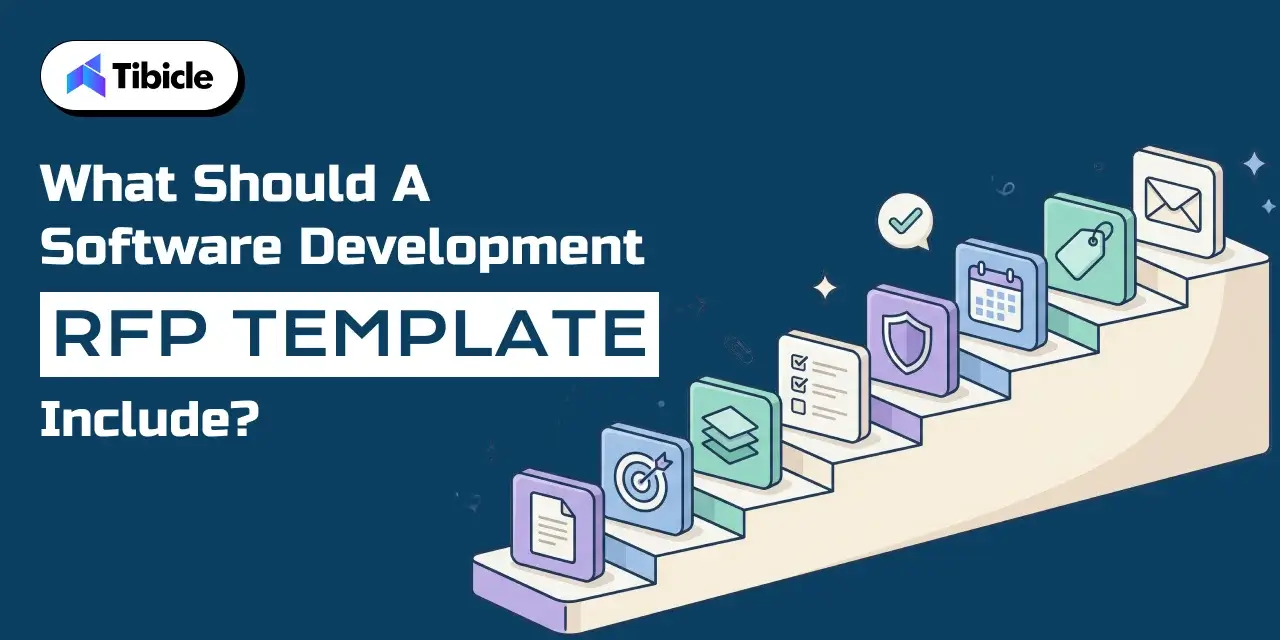
A software development RFP template should include eight parts: overview, goals, scope, requirements, security, delivery, pricing format and submission rules. Each part settles one question a vendor needs answered before it can quote.
Order matters because vendors price what they understand first. A clear overview and goals section lets a vendor judge fit in minutes. Scope and requirements then set the size of the work. Security, delivery and pricing format follow, so every bid arrives in the same shape. Submission rules close the document with deadlines and contacts.
US federal buyers offer a useful model. Federal rules require price to be evaluated in every source selection, and they require the solicitation to state each evaluation factor and its relative importance (FAR 15.304). Private companies are not bound by the FAR, but the discipline carries over. When vendors know how they will be judged, they write proposals that answer those factors directly.
The eight parts, in the order to use them:
- Overview: who you are and who uses the product
- Goals: business outcomes with numbers
- Scope: requirements and integrations
- Requirements: functional and non-functional
- Security: the standards vendors must map to
- Delivery: team, timeline and milestones
- Pricing format: one template for every bidder
- Submission rules: deadline, Q&A window and file format
The Software Development RFP Template, Section by Section
Paste each block of this software development RFP template into your document and replace the examples with your own details.
Company and Project Overview for software development rfp template
- Who you are and what the product does
- Who uses it, and how many users
- Whether this is a new build, a rebuild or an extension of an existing system
Goals and Success Measures for software development rfp template
- Business outcomes with numbers, such as “cut quote turnaround from 3 days to 1”
- The date by which each outcome should be measurable
- The person who signs off on success
Scope and Software Project Requirements Checklist for software development rfp template
Use this software project requirements checklist to keep scope specific:
- Functional requirements written as user stories, each with acceptance criteria
- Non-functional requirements: performance, availability, accessibility and data retention
- Integrations with named systems and their APIs
Security and Compliance Requirements for software development rfp template
- Ask vendors to map their process to the NIST Secure Software Development Framework (NIST SP 800-218).
- Name a verification level from OWASP ASVS 5.0 for your application (OWASP ASVS).
- Ask each vendor to attach evidence for every practice it claims.
Delivery Team and Timeline for software development rfp template
- Team roles, with named people
- Time-zone overlap with your team
- Sprint cadence and milestones
Pricing Format and Submission Rules for software development rfp template
- One pricing template for every bidder
- Deadline, Q&A window and file format
How Do You Score Vendors With a Software Vendor Scorecard Template?
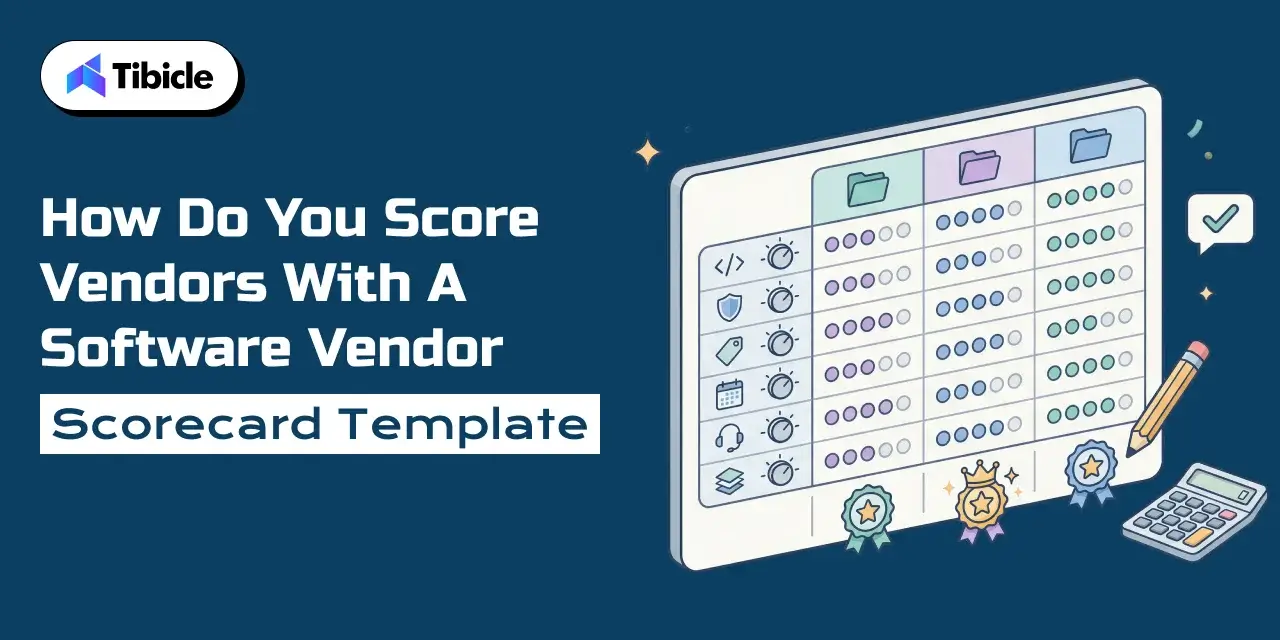
Use this software vendor scorecard template as a starting point, and adjust the weights to your project. Each criterion gets a weight, and each proposal gets a score from 0 to 5 per criterion.
| Criterion | Weight | What a 5 looks like |
| Technical approach | 25% | Architecture answers every stated requirement |
| Team and experience | 20% | Named people with similar past work |
| Security practices | 15% | Mapped to SSDF practices, with evidence |
| Delivery plan | 15% | Milestones with named risk owners |
| Price and terms | 15% | Normalized total within budget |
| References | 10% | Two reachable clients with a similar scope |
Weighted scoring works like this: divide the score by 5, then multiply by the weight. A 4 on technical approach earns 4 ÷ 5 × 25 = 20 points. Add the points across all six criteria for a total out of 100.
Set the rules before you open any proposal:
- Fix the 0 to 5 rubric in advance. A 0 means no answer was given. A 5 means the criterion is fully met with evidence.
- Have two evaluators score independently, then reconcile the differences.
- Publish the weights inside the evaluation criteria section of your software development RFP template, so vendors know how they will be judged.
How Do You Compare Fixed-Price and Hourly Proposals Fairly?
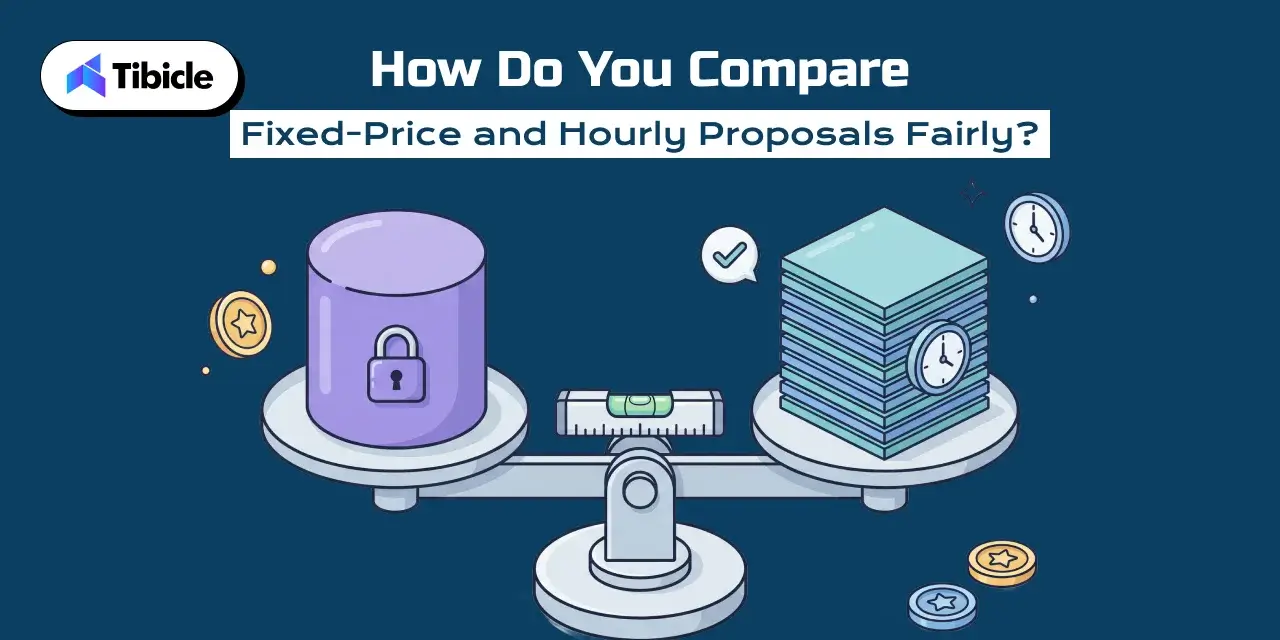
Convert every bid to the same unit: the total cost for the defined scope plus a stated change budget. Your software development RFP template should ask for one pricing format, but bids still arrive as fixed-price and time and materials.
Follow these steps:
- For a fixed-price bid, take the quoted price for the defined scope.
- For a time and materials bid, multiply hours by the blended rate, then add a contingency line.
- Add the same change budget to every bid, such as 10% of the base price.
- Check for exclusions. Low bids often leave out testing, deployment or warranty.
- Sanity check the rates against US labor costs. The median annual wage for US software developers was $135,980 in May 2025 (BLS).
A worked example, with illustrative round numbers:
- Bid A is a fixed price of $100,000 that excludes testing. The vendor quotes $10,000 for testing. Adding 10% for changes gives $121,000.
- Bid B is time and materials: 800 hours at a $100 blended rate is $80,000. Adding 10% for changes gives $88,000.
The raw gap was $20,000. After normalization it is $33,000, so ask Bid B’s vendor how it estimated 800 hours.
What RFP Questions for Software Development Should You Ask?
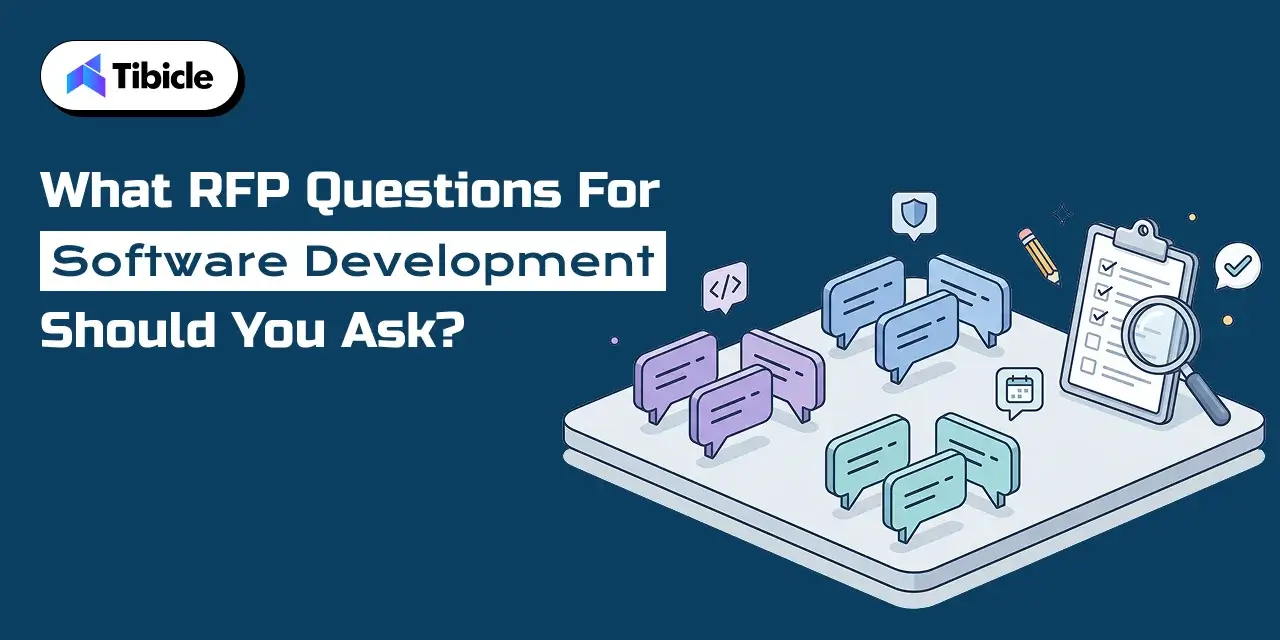
Use these RFP questions for software development as written. They are in the buyer’s voice, grouped into three sets.
Delivery
- Which of our requirements carry the highest risk, and why?
- Who will work on our project, and what did each person build before?
- What is your sprint cadence, and can you share a sample status report?
Quality and security
- Can you share a sample test plan?
- How does your process map to the NIST SSDF practices?
- Which OWASP ASVS level would you build to for our application, and how do you verify it?
Commercial terms
- Who owns source code and IP at each payment milestone?
- What does your service level agreement cover after launch?
- What does your price exclude, such as testing, deployment or warranty?
- How do you price and approve change requests?
What Happens After the RFP Closes?
Follow these steps:
- Shortlist two or three vendors and hold scripted demos. Give each vendor the same script.
- Run a short paid discovery or pilot on one feature.
- Sign a contract that includes a statement of work, acceptance terms, IP assignment and exit terms.
The Consortium for Information and Software Quality (CISQ) estimated the cost of poor software quality in the US at $2.41 trillion in 2022, with technical debt near $1.52 trillion (CISQ). A pilot on one feature tests a vendor’s quality before you commit to a long contract.
Sending Your RFP to Tibicle for software development rfp template
Once your software development RFP template is filled in, you can send it to Tibicle. Tibicle builds web and mobile apps, desktop software and AI tools for startups and enterprises in the USA and Europe, and in India and the Middle East. It takes products from the first wireframe to launch and stays reachable after go-live.
If you are shortlisting custom software developers, Tibicle will review your RFP draft for free before you send it out. Book a free RFP review here.
FAQs
How many vendors should get a software development RFP?
Three to six. Fewer than three limits competition, and more than six makes review slow and shallow. Send the same software development RFP template to every vendor, so each bid answers the same questions.
Should I share a budget in the RFP?
Yes, share a range. A range helps vendors propose the right scope, though it can pull bids toward the top of it. No budget at all gives you quotes that are hard to compare.
What is the difference between an RFP and an RFQ?
An RFQ compares price on a fixed spec. An RFP also weighs the approach and the team behind it. If you know exactly what you want built, send an RFQ. If you want vendors to show how they would build it, send an RFP.
Where can I get a software vendor scorecard template?
Use the table in the scorecard section above. Copy it into a spreadsheet, adjust the weights so they total 100%, and add them to your RFP. A downloadable version is here: [download link].
How long should vendors get to respond?
Two to four weeks for a custom build. Open a Q&A window in week one and close it at the end of that week, so every answer reaches every bidder at the same time.
Conclusion
Publish your scoring weights inside the RFP, then score before you meet vendors. Scoring first keeps demos from swaying the numbers, and fixed weights let two evaluators reconcile their scores without debate. Send your software development RFP template with the scorecard attached, and compare every bid on one scale.
Book a 30-minute RFP review with Tibicle
Schedule A Developer Interview And Get 15 Days Risk-Free Trial
Schedule a Call

Relevant Blog
CMS Migration Checklist: From Content Inventory to Launch QA

Dhairya Dadhania

Dedicated Development Team vs Staff Augmentation Guide

Diya Koradiya
React Native vs Flutter for Startups
Diya Koradiya
Written by
Dhairya Dadhania
Business Development Executive
I'm Dhairya Dadhania, Business Development Executive at Tibicle LLP. I help businesses move beyond their current limitations by defining a clear and ambitious digital vision by focusing on identifying core opportunities and aligning them with purposeful, innovative digital solutions.


Related posts
CMS Migration Checklist: From Content Inventory to Launch QA
What This Guide Covers Who this is for: CMS migration checklist for marketing leads, CTOs, engineering managers, SEO managers and founders who own a live site with traffic to protect and plan to move it to a new CMS. Search intent: Find a practical checklist of what a CMS move needs at each phase, with […]
25 Nov 2026 | Dhairya Dadhania
Dedicated Development Team vs Staff Augmentation Guide
What This Guide Covers Who this is for: CTOs, startup founders, and engineering leaders comparing a dedicated development team vs staff augmentation to choose the right software team engagement model. Search intent: Commercial investigation. Readers want to compare delivery ownership, total cost, hiring speed, management effort, and legal risks before choosing a model. What you […]
23 Nov 2026 | Diya Koradiya
React Native vs Flutter for Startups
What This Guide Covers Who this is for: Startup founders, CTOs, product managers, and technical decision-makers comparing react native vs flutter for startups to choose the right cross-platform framework for their mobile app. It is particularly relevant for early-stage teams evaluating hiring availability, development costs, performance, native hardware integrations, and long-term maintenance with limited budgets […]
20 Nov 2026 | Diya Koradiya
Got an Idea? Get a FREE consultation
We always have room for one more great project

Email
tea@tibicle.com

Phone
+91 9724922880