
React Native vs Flutter for Startups

Nov 20, 2026

Read in 5 Minutes
Table of Contents
- What This Guide Covers
- How Do the Two Ecosystems Compare in 2027?
- Which Framework Is Easier to Hire for in the USA?
- How Do Flutter vs React Native Performance and UI Compare?
- What About Native Modules and Hardware?
- Which Costs More to Maintain After Launch?
- Decision Matrix: React Native vs Flutter for Startups
- Which Should You Choose? Six Startup Scenarios
- Building Your App With Tibicle
- Frequently Asked Questions
- Conclusion
What This Guide Covers
Who this is for:
Startup founders, CTOs, product managers, and technical decision-makers comparing react native vs flutter for startups to choose the right cross-platform framework for their mobile app. It is particularly relevant for early-stage teams evaluating hiring availability, development costs, performance, native hardware integrations, and long-term maintenance with limited budgets and engineering resources.
Search intent:
Commercial investigation and technology comparison. The reader wants to understand which framework is better suited to their startup, how Flutter and React Native differ in hiring, performance, native modules, and ongoing upkeep, and which option offers the best fit for their product and team.
What you will walk away with:
A practical framework comparison, including a decision matrix covering hiring, code reuse, UI performance, hardware integrations, and maintenance, along with six startup-specific scenarios to help you decide between React Native and Flutter based on your team’s skills, product requirements, and available runway.
React Native vs Flutter for Startups: A 2027 Decision Guide
React Native vs Flutter for startups starts with a gap in the hiring data. In the 2024 Stack Overflow survey, 62.3% of developers used JavaScript and 6.0% used Dart.
Yet framework use is almost level among professional developers, with Flutter at 9.4% and React Native at 9.0%.
A seed-stage team has limited runway and one release to get right, so the real question is which choice costs less over the first 18 months. Seed-stage founders, non-technical founders, and startup CTOs each weigh the factors differently, so the guide ends with six startup scenarios. Tibicle’s earlier Flutter vs React Native in 2026: Which One to Choose covers benchmark details, and this cross-platform framework comparison stays on startup trade-offs.
This guide weighs both frameworks on the five factors that decide that cost.
How Do the Two Ecosystems Compare in 2027?
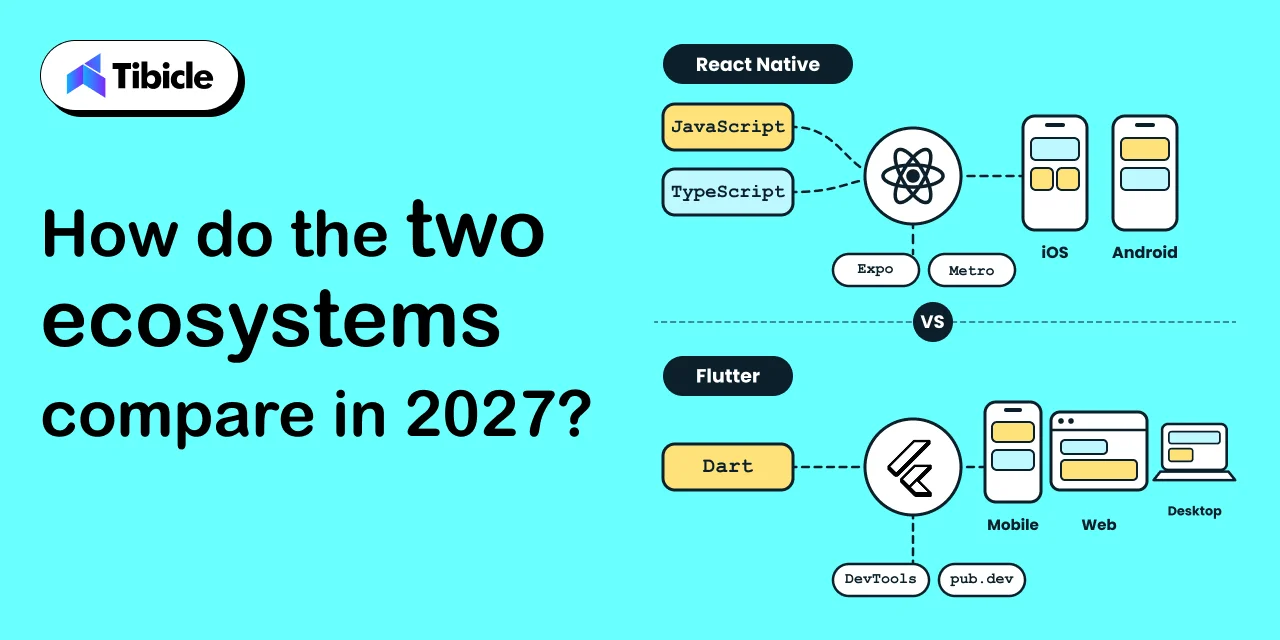
Any cross-platform framework comparison in 2027 starts with what each ecosystem asks of a team on day one.
React Native uses JavaScript or TypeScript. Teams usually build with Expo tooling and draw on a library pool shared with React for the web. Expo covers project setup and builds, which keeps tooling work small for a small team. A startup that already ships a React web app can reuse its language, its state management habits, and part of its component logic.
Flutter uses Dart, a language most web developers have not written before. It ships one widget set for mobile, and the same codebase also targets web and desktop. The trade is a single, consistent toolkit in exchange for a stack that shares little with a React web team.
Two architecture changes reset the baseline for both frameworks. React Native 0.76 shipped the New Architecture by default on October 23, 2024. It replaces the legacy bridge with direct calls between JavaScript and native code. On the Flutter side, Impeller is the default renderer on iOS and on Android API 29 and above, as of Flutter 3.27.
Older tutorials and agency posts often describe versions from before these changes, so check the release numbers in any article before relying on its claims.
For a startup, the practical read is short. React Native favors teams that already work in JavaScript. Flutter favors teams that want one UI toolkit and accept a new language.
Which Framework Is Easier to Hire for in the USA?
React Native is easier to hire for in the USA, judging by the best public proxy for talent supply. Treat the figures below as a signal about supply, never as a headcount.
In the 2024 Stack Overflow survey, 62.3% of all respondents used JavaScript and 6.0% used Dart. React Native runs on JavaScript and TypeScript, so the pool of people who can pick it up quickly is far larger than the Dart pool. Among professional developers, framework use is close: Flutter at 9.4% and React Native at 9.0%. The supply gap lies in adjacent skills, since far more developers already write JavaScript than Dart.
Cost context sharpens the point. The median US software developer wage was $135,980 in May 2025, and BLS projects 10% employment growth from 2025 to 2035. Competition for engineers is not easing, so a startup that can hire from a larger adjacent pool has more room to maneuver.
For React Native vs. Flutter for startups, hiring shows up in three ways:
- React Native lets web hires cross over. A React developer can become productive on mobile without learning a new language.
- Flutter teams are smaller but often specialized. A search for Flutter developers draws on a narrower pool, with candidates who chose the framework on purpose.
- A smaller pool makes it slower to replace someone who leaves.
None of this makes Flutter a poor choice. It means a Flutter plan should name its first two engineers before the framework is final.
How Do Flutter vs React Native Performance and UI Compare?
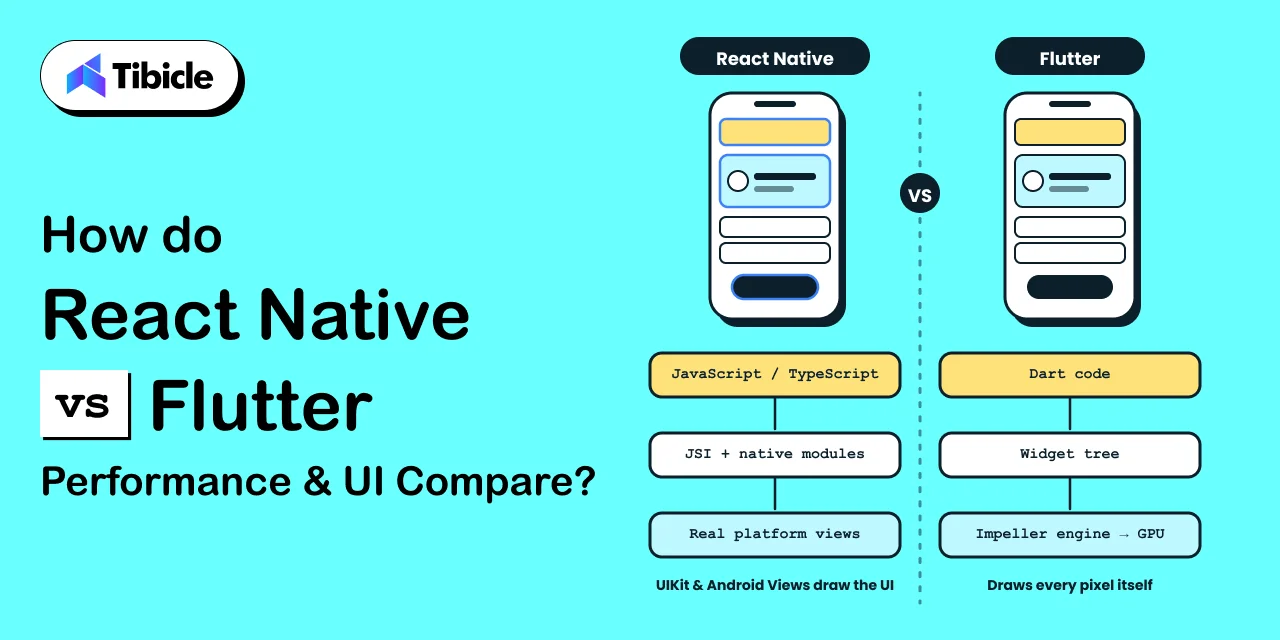
Flutter vs React Native performance differs by mechanism. There is no single speed number. Flutter draws every widget itself: its Impeller renderer paints the interface, so the UI looks the same on every device and the team controls each pixel. React Native takes the other route. It asks the operating system to render platform-native components, while JavaScript runs on the Hermes engine. The interface follows each platform’s own look and behavior.
Platform-native components also pick up OS-level changes, such as new system controls, without extra work from the team. Flutter’s own widgets stay consistent across devices, and the team owns any update needed to match a new OS look.
That mechanism shows where the choice matters for a startup.
Where it matters:
- Animation-heavy consumer apps, such as a social feed with custom motion.
- Brand-specific UI that must look identical on iOS and Android.
Where it rarely matters:
- Forms and onboarding flows.
- Long lists and feeds.
- Dashboards and standard CRUD screens.
A marketplace admin panel or a B2B booking app sits in the second group. Both frameworks handle those screens well, and slow API calls or oversized images usually cost more time than the renderer does.
This post quotes no benchmark figures, because agency benchmarks rarely state the app, device, or version tested. Measured comparisons are in Tibicle’s earlier comparison. A better test for a startup is to build the three hardest screens in each framework and run them on a mid-range Android phone.
What About Native Modules and Hardware?
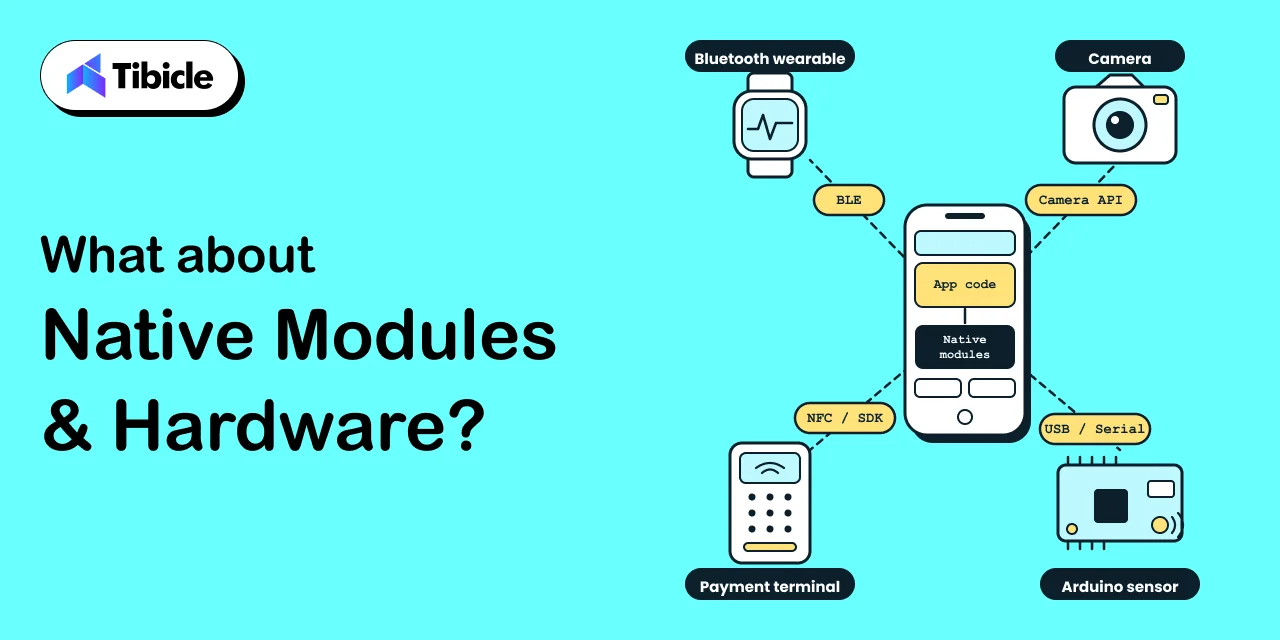
Both frameworks reach into native code when a feature touches hardware. Bluetooth, camera pipelines, and payments often need native modules in React Native and in Flutter, so neither framework removes that work.
React Native handles it with TurboModules under the New Architecture, which lets JavaScript call native code directly. Flutter uses platform channels and plugins, which pass messages between Dart and Kotlin or Swift code. The mechanisms differ, but the staffing need is the same: someone on the team must be able to read and debug native code.
The startup rule is simple. List every device feature the product needs before choosing a framework. Then check the health of the plugin or library behind each one: its last release date, its open issues, and its support for current OS versions.
Tibicle’s Hope case study shows that hardware work is possible in Flutter. The team built a Flutter app paired with an Arduino exercise device, serving patients and physiotherapists from one codebase. The example does not show that the work is easier. A BLE-connected product still needs a plugin audit in either framework, and a missing plugin becomes custom native work on the project plan.
Which Costs More to Maintain After Launch?
Neither framework is cheaper to maintain by default. Both inherit the same yearly store requirements, and those requirements create work every year.
Since April 28, 2026, App Store uploads must be built with Xcode 26 (Apple Developer: upcoming requirements). Google Play requires apps and updates to target Android 16 (API level 36) by August 31, 2026 (Google Play Console Help). Each deadline means the framework must support the new SDK, and then the team upgrades, tests, and resubmits. An app that misses a deadline cannot ship updates for long.
In React Native vs Flutter for startups, upkeep belongs in the budget as a recurring line. Three costs drive it:
- Upgrade effort. Framework major versions and plugin breakage arrive on a schedule the startup does not control, so budget engineering time for each one.
- Release speed. Both frameworks offer hot reload during development. After launch, React Native teams can ship JavaScript-level fixes through Expo EAS Update, which covers over-the-air updates for those changes. Flutter teams that want the same usually add a third-party service.
- Team continuity. The smaller the team, the more a single departure hurts, and a smaller Dart pool makes a replacement slower to find.
The watch items differ. React Native carries library churn, where a popular package loses its maintainer. Flutter carries plugin health, where a native plugin falls behind a new OS release. In both, check release dates before adding a dependency.
Decision Matrix: React Native vs Flutter for Startups
Use this table as the weighted core of a cross-platform framework comparison. The weights reflect limited runway, so hiring speed carries the most.
| Factor | Weight for an early startup | React Native | Flutter |
| Hiring speed in the US | 25% | Larger JavaScript pool | Smaller Dart pool |
| Code sharing with web | 20% | Strong with React web | Flutter web, different stack |
| Custom UI and animation | 20% | Good, platform look | Strong, pixel control |
| Native and hardware needs | 15% | TurboModules | Platform channels |
| Long-term upkeep | 20% | Library churn to watch | Plugin health to watch |
Each row is a trade-off. The table does not declare an overall winner, because the right answer depends on the product.
Founders should change the weights to match their own situation. A team with a live React web app might raise code sharing to 30% and lower custom UI to 10%. A consumer brand built on motion might do the opposite. A hardware startup might move native needs to the top.
To score the options:
- Set your own weight for each factor, so the total is 100%.
- Rate each framework from 1 to 5 on every row, using your team’s skills and your feature list.
- Multiply each rating by its weight and add up the results.
If totals land close together, the decision is a tie on paper. Break it with the question that matters most to a small team: which framework can your first two engineers ship in the next month?
Which Should You Choose? Six Startup Scenarios
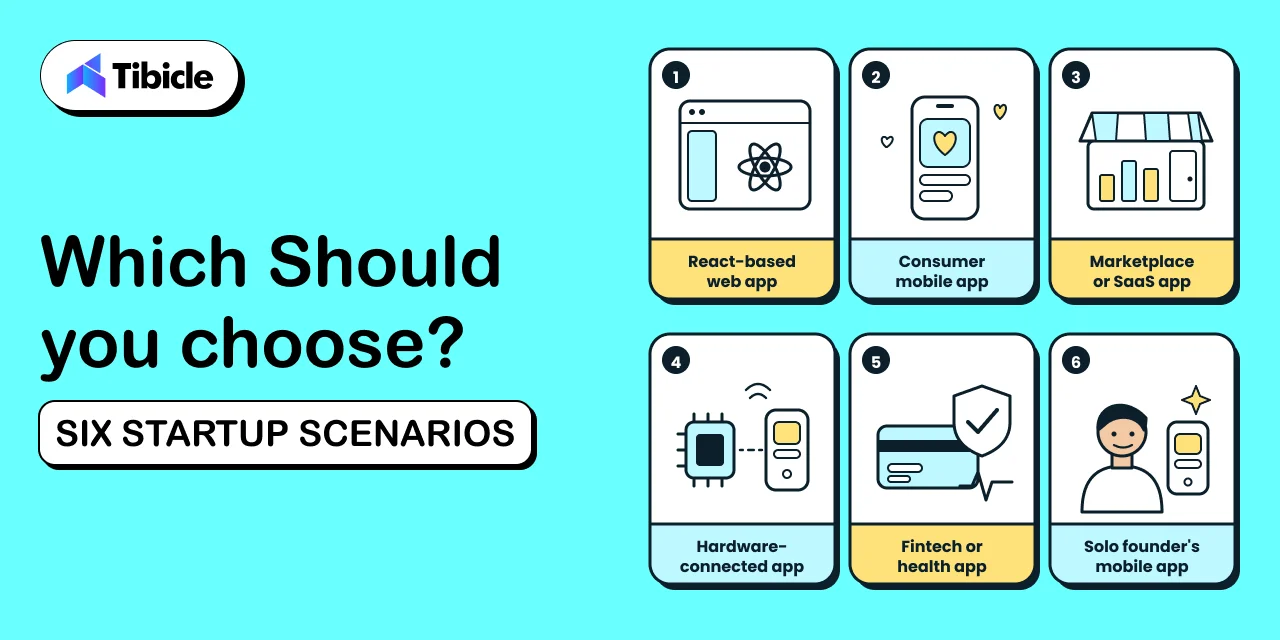
Founders who need to choose React Native or Flutter can match their product to one of six scenarios. Each pick is one line, with the reason attached.
- React web app already live: React Native. The team reuses its language and part of its component logic.
- Brand-heavy consumer app with custom motion: Flutter. Impeller gives pixel-level control over animation and layout.
- Marketplace or SaaS companion app: either works. Pick by team skills, because neither framework has a technical edge on these screens, and both ship standard listing and checkout flows well.
- Hardware or BLE-connected product: check plugins first, then decide. A healthy plugin for each device feature settles most of the question.
- Fintech or health app with strict security reviews: either works, with the native code audited. Reviewers look at the native layer in both frameworks.
- Solo technical founder: the language you already know. Shipping speed matters more than framework theory when one person writes the whole app.
If two scenarios fit, weight the one that affects your first release. Hiring and code reuse usually come before rendering. Revisit the pick if the product changes shape, such as adding hardware or a web app.
Building Your App With Tibicle
Tibicle’s mobile practice covers Flutter and React Native, Ionic, and native Android and iOS. On the React Native side, its work covers the New Architecture (Fabric and TurboModules), Hermes, and Expo EAS. Founders who have settled on React Native and need engineers can hire react native developers through Tibicle, with the framework decision already made from the matrix above. Tibicle also builds Flutter apps, so a Flutter pick does not require a second vendor.
Want a second opinion on your scenario? Book a developer interview with Tibicle.
Frequently Asked Questions
Is Flutter or React Native better for an MVP?
It depends on team skills more than on the framework. A JavaScript team can reach a first release faster in React Native, and a team that already writes Dart can do the same in Flutter. Match the scenario list above to your product, then pick. Either can ship an MVP; who builds it matters most.
Can a startup switch frameworks later?
Yes, but expect to rewrite the UI layer, because Dart and JavaScript code don’t translate. The backend, APIs, data models, design files and product logic carry over, along with lessons from user testing. Plan a switch as a rebuild of the screens, not a port.
Does Flutter vs React Native performance matter for a B2B app?
Rarely. B2B apps are mostly forms, tables and dashboards, which both frameworks render well. Users wait on network calls and data loading more than on the renderer, so team skills and upkeep deserve more weight than raw speed. A game or motion-heavy consumer app is the exception.
How should I choose React Native or Flutter with no in-house developers?
Hire for the framework your first two engineers know best. A contract team or agency can start in either one, but the people who maintain the app after launch should be able to read every line of its code. Ask for code access from day one.
Is react native vs Flutter for startups a long-term commitment?
For the UI layer, yes: screens, widgets, and navigation live in one framework. Backend services, APIs, data, and design assets carry over if you change later, so the commitment is narrower than it looks. Treat the first framework as a two-year decision.
Conclusion
The best starting point for React Native vs Flutter for startups is two questions: who can you hire, and how much code can you reuse from a web app? Settle those first. Then list every hardware feature and check the plugin behind each one, because native requirements decide the exceptions. Add yearly store upkeep to the budget, and the choice is usually clear.
Book a developer interview with Tibicle and start with a 15-day risk-free trial.
Schedule A Developer Interview And Get 15 Days Risk-Free Trial
Schedule a Call

Relevant Blog

SaaS MVP Feature Checklist

Prejin Nadar


Offline Local LLM Desktop App Integration in Electron

Aditya Changlani
Custom AI POS Software Development with Electron & IoT
Aditya Changlani
Written by

Diya Koradiya
Business Development Executive
I'm Diya Koradiya, Business Development Executive at Tibicle LLP. I connect business ideas with the right technology, turning requirements into purposeful digital solutions. With a strong emphasis on clarity and collaboration, I help clients move forward by aligning practical needs with smart innovation.


Related posts
SaaS MVP Feature Checklist
What This Guide Covers Who this is for: B2B SaaS founders, technical co-founders, and seed-stage product managers looking for a SaaS MVP feature checklist to build products that attract and convert their first paying customers. Search intent: Find a practical checklist of what a SaaS MVP needs, and what it doesn’t, before committing engineering time. […]
19 Nov 2026 | Prejin Nadar
Offline Local LLM Desktop App Integration in Electron
What This Guide Covers Who this is for This guide is intended for engineering leads, staff engineers, and technical founders building or maintaining Electron-based desktop applications that must function without a constant connection, particularly teams undertaking offline local LLM desktop app integration to add on-device inference. It is also relevant to product managers scoping offline […]
07 Oct 2026 | Aditya Changlani
Custom AI POS Software Development with Electron & IoT
What This Guide Covers Who this is for: CTOs, retail technology leaders, and product owners at retail chains, grocery and convenience operators, and POS vendors evaluating custom AI POS software development for an AI-enabled checkout or a terminal refresh. Search intent: Understand how custom AI POS software development works, including Electron architecture, IoT integration […]
06 Oct 2026 | Aditya Changlani
Got an Idea? Get a FREE consultation
We always have room for one more great project

Email
tea@tibicle.com

Phone
+91 9724922880