
Dedicated Development Team vs Staff Augmentation Guide

Nov 23, 2026

Read in 5 Minutes
Table of Contents
- What This Guide Covers
- What Is the Difference Between a Dedicated Development Team vs Staff Augmentation?
- Who Is Accountable for What? A Responsibility Matrix
- How Do the Costs Compare?
- Which Model Is Faster to Start and Scale?
- What Are the Governance and Legal Risks?
- When Should You Use a Managed Development Team? A Decision Tree
- Can You Combine Both Dedicated development team vs staff augmentation?
- How Tibicle Staffs Both Models
- Frequently Asked Questions
- Conclusion
What This Guide Covers
Who this is for:
CTOs, startup founders, and engineering leaders comparing a dedicated development team vs staff augmentation to choose the right software team engagement model.
Search intent:
Commercial investigation. Readers want to compare delivery ownership, total cost, hiring speed, management effort, and legal risks before choosing a model.
What you will walk away with:
A practical comparison, responsibility matrix, cost breakdown, and four-step decision tree to help you choose the right model or combine both.
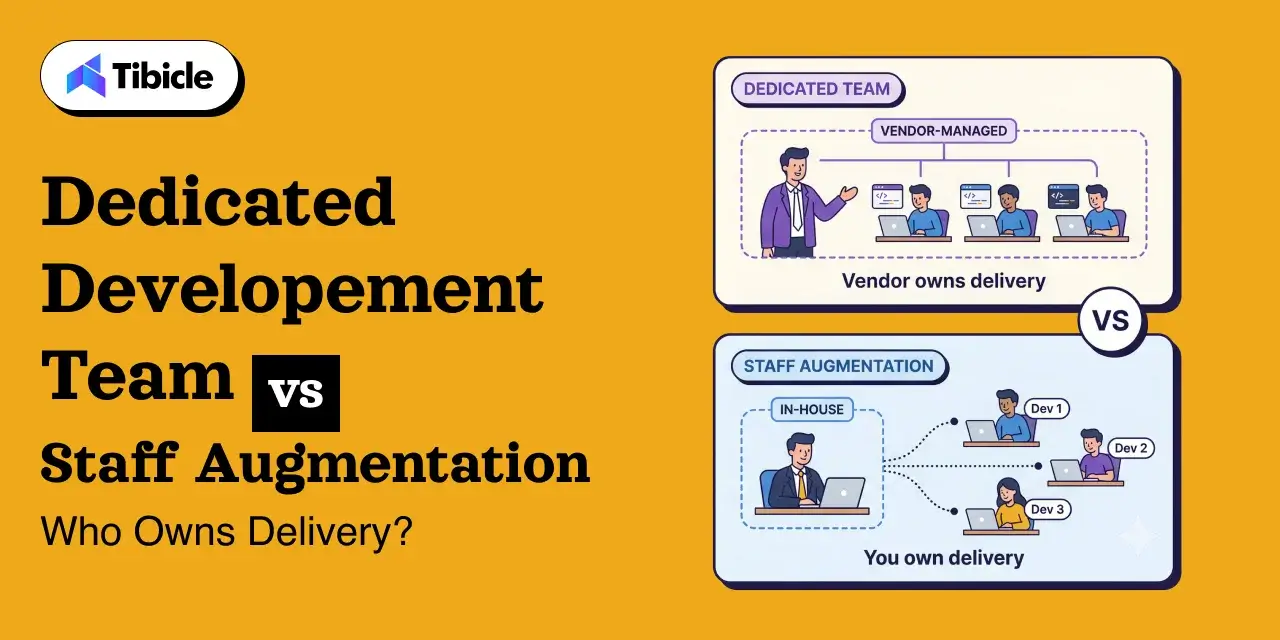
Dedicated Development Team vs Staff Augmentation: Who Owns Delivery?
SHRM benchmarking puts the average US cost per hire at nearly $4,700, before any ramp-up time, and both external models exist to skip that line item.
The choice in a dedicated development team vs staff augmentation comes down to one question: who is accountable when a sprint slips?
Ramp-up, management time, and replacement terms all sit outside that $4,700 figure and show up later in the project. Engineering leaders who already run a team want more output, and each model trades control against management time. Four axes separate the models: responsibility, cost, speed, and risk. A CTO adding capacity, a founder racing a roadmap, and a finance lead reading a contract each need a different answer, so the guide covers all three views.
This guide compares both software team engagement models on those four points, then gives a decision tree.
What Is the Difference Between a Dedicated Development Team vs Staff Augmentation?
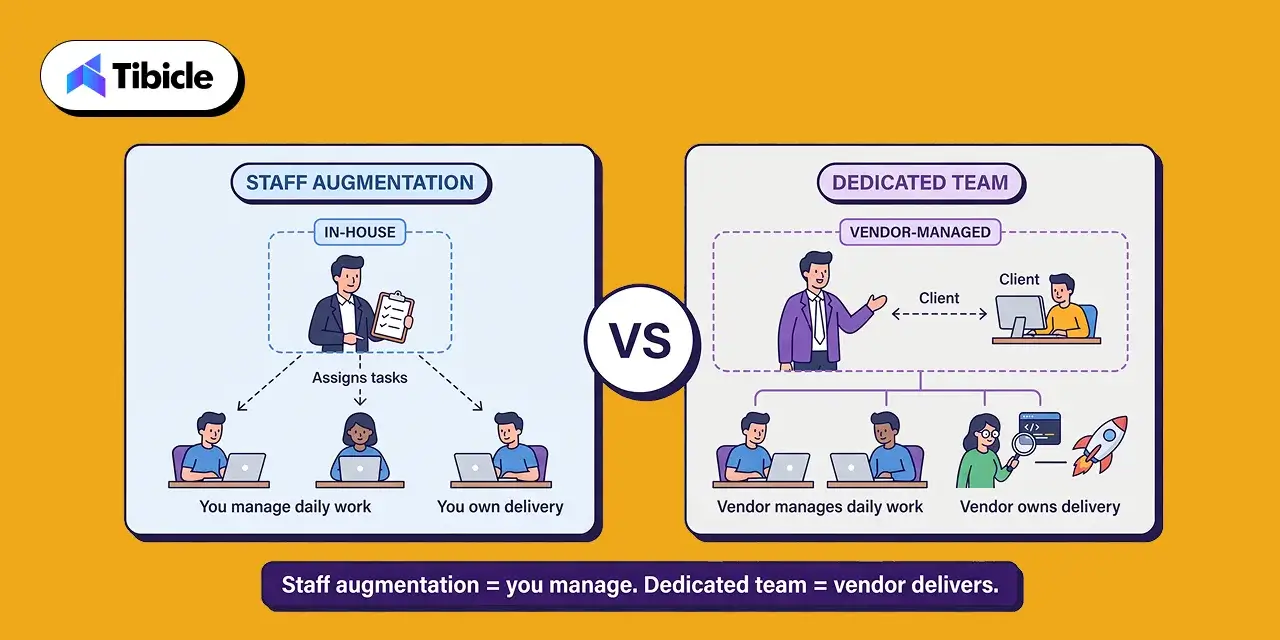
Staff augmentation adds individual engineers who work under your managers, using your process and your tools. A dedicated team is a vendor-run unit that owns a defined scope, with its own lead who manages daily work and reports progress back to you. You still set the priorities in both models.
Managed team vs. staff augmentation, in plain terms, comes down to three questions: who assigns tasks, who reviews code, and who reports progress. In augmentation, your own manager answers all three. In a managed team, the vendor’s lead answers them against the scope you agreed. Augmented engineers report to your manager and join your standups. A dedicated team reports to its own lead, who joins your planning and review sessions.
- Staff augmentation: you choose the individual engineers, the vendor handles contracts and payroll, and your managers direct the work. Accountability for output stays with you.
- Dedicated team: the vendor assembles a team around your scope, a vendor lead manages tasks and quality, and you manage priorities and acceptance.
Team size is a useful limit for both models. The Scrum Guide describes a Scrum Team as typically 10 or fewer people, a cap that works for augmented groups and vendor-led units alike. Beyond that size, coordination takes more of everyone’s time.
Neither model is better in general. Each one fits a different amount of delivery responsibility that you want to keep.
Who Is Accountable for What? A Responsibility Matrix
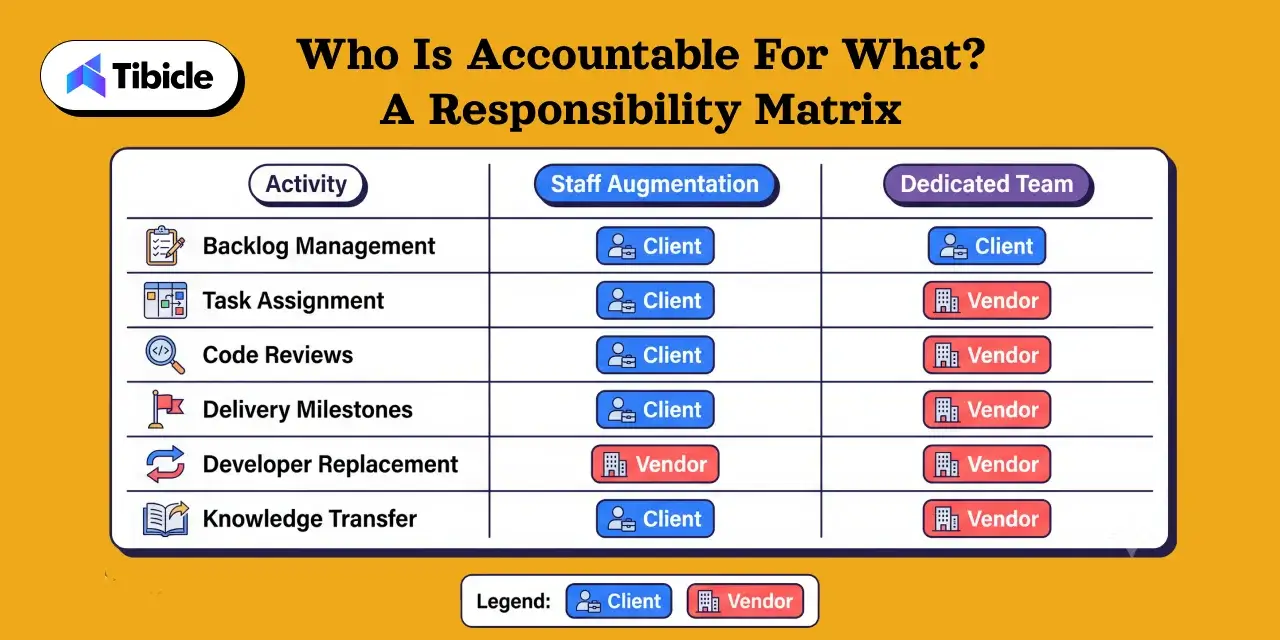
Staff augmentation leaves delivery accountability with the client. A dedicated team moves most of it to the vendor, within the scope and standards you agree. In a dedicated development team vs. staff augmentation, accountability follows daily control.
A RACI view makes this concrete. It separates who is responsible for doing the work, who is accountable for the result, who is consulted, and who is informed. The table names the owner of each activity.
ActivityStaff augmentationDedicated team
| Activity | Staff augmentation | Dedicated team |
| Backlog and priorities | Client | Client, with vendor input |
| Daily task assignment | Client manager | Vendor team lead |
| Code review and quality gates | Client | Vendor, to agreed standards |
| Delivery dates per milestone | Client | Vendor |
| Hiring and replacing engineers | Vendor supplies, client selects | Vendor |
| Knowledge transfer at exit | Client-led | Vendor obligation in the contract |
Two rows decide most disputes: daily task assignment and delivery dates per milestone. In augmentation, both sit with you, so a slipped milestone is yours to explain and fix. In a dedicated team, the contract can name the vendor as accountable for milestone dates, which gives procurement something to enforce.
Two other rows are easy to overlook. Hiring and replacing engineers sits with the vendor in a dedicated team, so a departure becomes the vendor’s problem to solve. The last row, the exit handover, is client-led in augmentation and a vendor obligation in a dedicated team, so write it into the contract before work starts.
Client input never disappears. In both models, you own the backlog and priorities, and what changes is who runs the day.
Use the table in a vendor call. Ask each vendor to confirm every row in writing, and flag any answer that starts with ‘it depends’. Those rows are where delivery disputes begin.
How Do the Costs Compare?
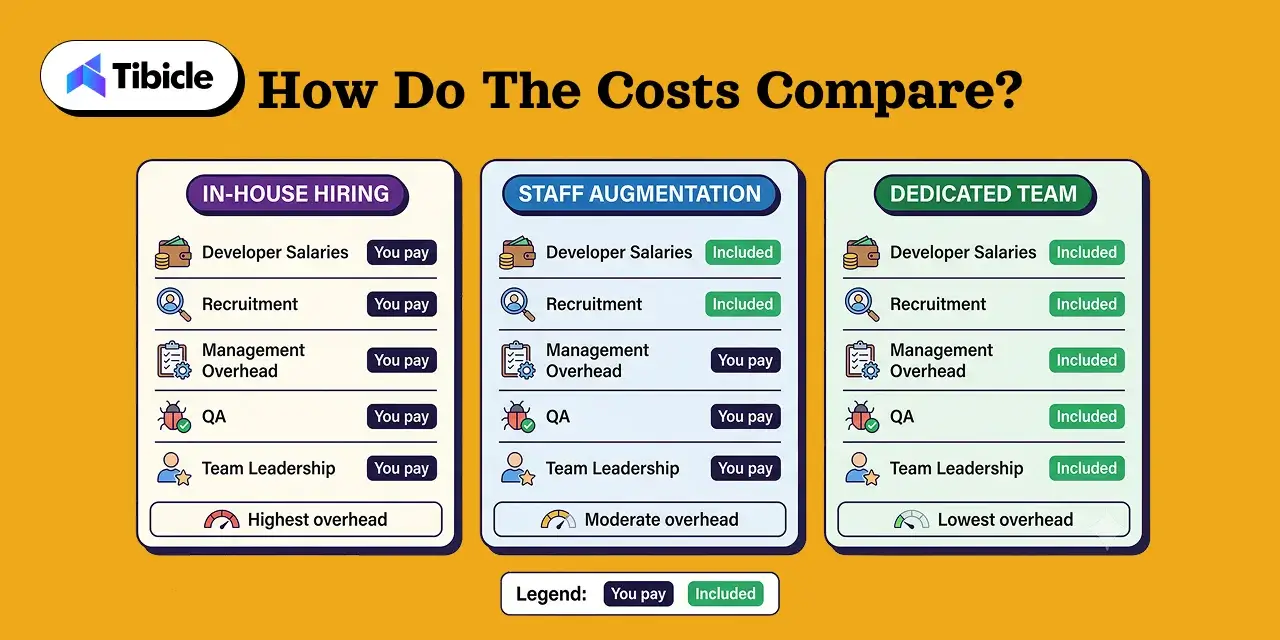
In dedicated development team vs staff augmentation, the hourly rate is the wrong first number. Staff augmentation is often cheaper per hour, while a dedicated team can cost less once management time is counted. A fair outsourcing model comparison builds on fully loaded cost.
Start with the in-house baseline. The median US software developer wage was $135,980 in May 2025, about $65 per hour (BLS Occupational Outlook Handbook). Private-industry employers paid an average of $46.89 per hour worked in June 2026, and benefits made up 30.0% of that total (BLS Employer Costs for Employee Compensation). Because wages are the other 70.0%, a $135,980 wage implies roughly $194,000 in total annual compensation (illustrative calculation), before recruiting or management time.
The table lines up the cost items.
| Cost line | In-house hire | Staff augmentation | Dedicated team |
| Pay | Wage plus benefits | Hourly or monthly rate, often time and materials | Monthly retainer for the team |
| Management | Your managers | Your managers, full load | Vendor lead, lighter client load |
| QA and lead | Hired by you | Hired by you or not included | Included in the retainer |
| Recruiting | Your cost per hire | Vendor’s cost | Vendor’s cost |
| Exit | Severance and notice | Notice period in the contract | Notice period in the contract |
Compare a dedicated team’s retainer against in-house salary plus benefits plus management overhead, since the retainer already includes the lead and QA. For augmentation, add your managers’ time to the engineer’s rate. Ask each vendor for rates in writing and compare totals instead of hourly figures, because rate cards rarely include the management time you carry. Recruiting is the line buyers forget: the SHRM average of nearly $4,700 per hire sits on your books in-house and inside the vendor’s price otherwise.
Which Model Is Faster to Start and Scale?
Augmentation starts faster for one or two engineers. A dedicated team starts slower but scales faster. Speed is easier to compare in three phases than in day counts, because timelines vary by vendor and by stack.
Phase 1, selection: Augmentation is quick when the role is narrow: you interview a few candidates and pick one. A dedicated team takes longer because the vendor assembles a unit and you agree on scope, lead, and working hours. For vendor-side hiring steps, see Tibicle’s guides on how to hire dedicated developers in India and how to hire offshore developers in 7 easy steps.
Phase 2, onboarding: That cost lands on whoever owns the codebase knowledge. In augmentation, that is your own engineers, who spend review and pairing time with each new person. In a dedicated team, the vendor lead absorbs part of the load, but your team still explains the product and architecture once.
Phase 3, full speed: Augmented engineers slot into existing rituals, so they can reach your team’s sprint velocity sooner when the team is stable. A dedicated team needs longer to reach a steady velocity, then scales faster because the vendor manages hiring.
What Are the Governance and Legal Risks?
Three areas need a clause in writing before either model starts. This section is general guidance, not legal advice, so check the details with counsel.
Co-employment risk. When augmented staff take daily direction from your managers, join your meetings, and work like employees, the relationship can start to look like employment. Check worker-classification rules with counsel before you decide how augmented engineers are managed. A vendor-led dedicated team can reduce this exposure because the vendor directs the work.
IP assignment and confidentiality. The statement of work should state that all code and work product belong to your company and that every engineer is bound by confidentiality terms, including any subcontractors. Ask who owns work done before the contract was signed, and who holds repository access during the engagement.
Service level agreement terms. Write down three items:
- Replacement time when an engineer leaves or underperforms.
- Notice period for scaling down or ending the contract.
- Exit terms, including knowledge transfer: documentation, code walkthroughs, and access handover.
Put each term in the contract, not in an email thread. A short review with counsel before signing costs far less than a dispute afterward.
When Should You Use a Managed Development Team? A Decision Tree
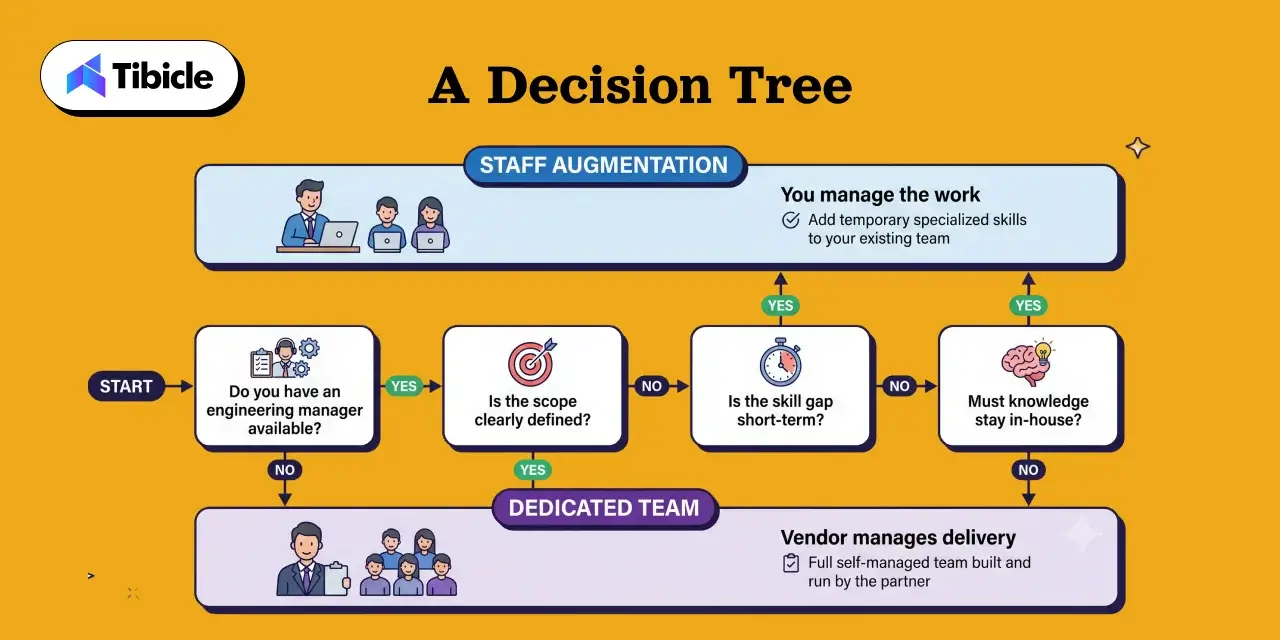
Choosing between a managed team vs. staff augmentation is easier as four yes/no steps. Answer in order and stop at the first step that gives a clear answer. Sketching the path as a flow chart helps.
Step 1: Do you have an engineering manager with spare capacity? If no, choose a dedicated team. Augmented engineers need daily direction, and nobody is free to give it.
Step 2: Is the work a defined product or module? If yes, choose a dedicated team. A vendor-owned scope fits a clear boundary, and a module with its own backlog is the clearest case.
Step 3: Is the gap one skill for under six months? If yes, choose staff augmentation. Setting up a full team for a short gap costs more than it saves.
Step 4: Must the knowledge stay in-house long term? If yes, choose staff augmentation, with documentation rules. Require written design notes, code comments, and recorded walkthroughs from the first week.
If no step stops you, either model works, and cost and speed become the tiebreakers. In dedicated development team vs staff augmentation, steps 1 and 2 favor a vendor-led unit, while steps 3 and 4 favor individual engineers inside your team.
Run the path again whenever the roadmap changes, because a gap that begins as one skill often grows into a module, and a module can outgrow its original model.
Can You Combine Both Dedicated development team vs staff augmentation?
Yes. Mixing software team engagement models is common, and the usual pattern is simple: a dedicated team owns a self-contained module, while augmented engineers join your core team to fill skill gaps. Each group has a clear owner, so accountability stays visible.
Add a handover rule. Name the point where the module moves from the vendor team to your core team, and list what must be ready first: documentation, a code walkthrough and agreed test coverage. Until your team accepts the handover, the vendor stays accountable for the module.
Ask about AI tools in any outsourcing model comparison. Deloitte’s 2024 Global Outsourcing Survey of more than 500 executives found that 83% are already leveraging AI as part of their outsourced services. Ask each vendor how its engineers use AI tools, what code those tools can see and who is accountable for the output.
How Tibicle Staffs Both Models
Tibicle’s dedicated resource service provides developers, QA engineers, DevOps specialists, and support staff who work as an extension of the client’s team. Resources can scale up or down, with priority handling for business-critical tasks. Companies that want a vendor-led dedicated development team can start from that service page. If you are still comparing models, a short call can map your roadmap to the right one.
Want help choosing a model? Book a team-planning call with Tibicle, backed by a 15-day risk-free trial.
Frequently Asked Questions
Dedicated development team vs staff augmentation? Which one is cheaper?
Per hour, often yes. Total cost depends on your management time, because augmented engineers need a manager on your side for daily direction and code review. A dedicated team’s retainer includes the lead and QA, so compare monthly totals, not hourly rates. Ask for both figures side by side.
Who manages the team in a dedicated development team vs staff augmentation model?
The vendor’s lead manages daily work: task assignment, code review and progress reports. You own priorities and milestone acceptance. Agree on a weekly review so scope changes reach the lead in writing, and ask for sprint reports you can compare with your roadmap.
Which outsourcing model comparison factors matter most?
Accountability, then cost, then speed. Across software team engagement models, start with who owns delivery, because it sets how much management time you carry. Then price each option on fully loaded cost, and check speed last. A fast start means little when nobody owns the milestone.
Can staff augmentation turn into a dedicated team later?
Yes, once a scope stabilizes. Name the handover steps: which engineers move into the vendor-led unit, who becomes team lead, and how the backlog and documentation transfer. Convert at a release boundary so no sprint runs under two sets of rules.
Do I need a contract for dedicated development team vs staff augmentation?
Yes. In dedicated development team vs staff augmentation, both models need written terms. An augmentation contract should put IP assignment and confidentiality in writing, and set a replacement window, such as a fixed number of working days, so a departure does not stall your sprint.
Conclusion
The decision in dedicated development team vs staff augmentation starts with who owns delivery. If you want daily control and have the management time for it, staff augmentation adds engineers to your team. If you want a vendor-led unit to own a scope and its milestone dates, a dedicated team fits. Run the four-step decision tree before you request vendor quotes. Then price the choice on fully loaded cost, including management time, recruiting, and exit terms, instead of the hourly rate alone.
Schedule A Developer Interview And Get 15 Days Risk-Free Trial
Schedule a Call

Relevant Blog
React Native vs Flutter for Startups

Diya Koradiya

SaaS MVP Feature Checklist

Prejin Nadar

Written by
Diya Koradiya
Business Development Executive
I'm Diya Koradiya, Business Development Executive at Tibicle LLP. I connect business ideas with the right technology, turning requirements into purposeful digital solutions. With a strong emphasis on clarity and collaboration, I help clients move forward by aligning practical needs with smart innovation.


Related posts
React Native vs Flutter for Startups
What This Guide Covers Who this is for: Startup founders, CTOs, product managers, and technical decision-makers comparing react native vs flutter for startups to choose the right cross-platform framework for their mobile app. It is particularly relevant for early-stage teams evaluating hiring availability, development costs, performance, native hardware integrations, and long-term maintenance with limited budgets […]
20 Nov 2026 | Diya Koradiya
SaaS MVP Feature Checklist
What This Guide Covers Who this is for: B2B SaaS founders, technical co-founders, and seed-stage product managers looking for a SaaS MVP feature checklist to build products that attract and convert their first paying customers. Search intent: Find a practical checklist of what a SaaS MVP needs, and what it doesn’t, before committing engineering time. […]
19 Nov 2026 | Prejin Nadar
Desktop AI App Development Cost Guide: Budgeting On-Device LLMs via Electron in 2026
What This Guide Covers Who this is for: CTOs, product managers, and founders at SaaS and software companies planning a desktop app with local AI features, or adding on-device inference to an existing Electron product for desktop ai app development cost. Search intent: Understand desktop AI app development cost, including on-device LLM integration cost, hardware […]
08 Oct 2026 | Dhairya Dadhania
Got an Idea? Get a FREE consultation
We always have room for one more great project

Email
tea@tibicle.com

Phone
+91 9724922880