What This Guide Covers
Who this is for
CTOs, VPs of engineering, procurement leads, and executives evaluating whether to outsource a business-critical desktop software build. This is especially for buyers who have been burned before by a rate-only vendor comparison for outsource desktop software development.
Search intent
Commercial investigation with an informational lead-in. The searcher already knows they want (or need) to outsource desktop software development. What they are looking for is a framework to avoid a bad vendor decision. That means how to structure contracts, calculate real cost, and vet a partner, not a basic explainer on what outsourcing is.
What you will walk away with:
A risk mitigation framework covering IP assignment, escrow, and audit rights. A total cost of ownership model that goes beyond the hourly rate. A vendor due diligence checklist; and a contract structure (phased milestones, offboarding plan) that keeps the engagement safe past the signing date.
Introduction
Buyers who outsource desktop software development now treat cost and risk as one decision, not two. The global software development outsourcing market is worth $618.38 billion in 2026. It will reach $977.04 billion by 2031, a 9.6% compound annual growth rate (Mordor Intelligence). That growth reflects a shift in buyer behavior, not falling rates. Buyers now price risk into every outsourcing decision. Global ROI on a desktop software engagement depends on risk-adjusted total cost, not the hourly rate on a vendor’s quote. A cheap rate that triggers a security incident wipes out the savings within one bad quarter. So does a rewrite or a stalled release.
This guide covers what actually makes an outsourcing engagement safe. It also covers the risk categories buyers need to plan for, the contract protections that should exist before code changes hands, a true cost model that goes beyond the rate card, a vendor vetting process, and how to structure the engagement itself to stay safe over its full life.
Why “Global ROI” Is the Right Framework for an Outsource desktop software development
Global ROI works as a framework because it forces a buyer to account for everything a rate comparison leaves out. Security exposure, IP protection, rework, and delivery risk. Outsourcing governance has matured across the industry precisely because rate-only comparisons kept producing expensive surprises. Executives now build risk into the sourcing decision from day one instead of treating it as a post-signing concern.
Rate Comparison Alone Hides the Real Cost to Outsource Desktop Software Development
A blended hourly rate tells a buyer nothing about rework hours, missed deadlines, security remediation, or the cost of replacing a vendor mid-project. Two vendors quoting the same rate can produce wildly different outcomes once quality, communication overhead, and risk exposure are factored in. The rate is the starting point of a cost model, not the whole model.
What “Safe” Actually Means in a Desktop Software Engagement
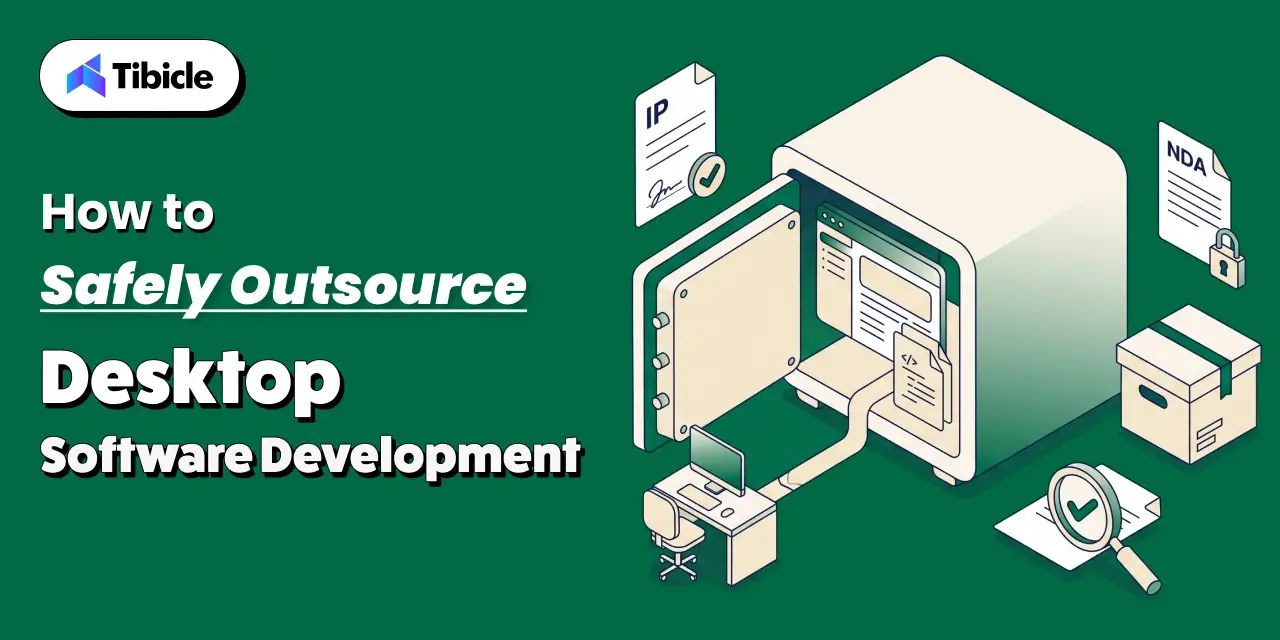
Safe outsourcing means the buyer’s intellectual property, source code, and business continuity are protected. This holds regardless of what happens with the vendor relationship. That includes signed IP assignment before work starts, a documented security posture for the vendor’s development environment, contractual audit rights, and a clear exit path. None of this eliminates outsourcing risk entirely. It converts unknown risk into managed, contracted risk, which is the actual goal of an outsourcing risk. That’s the actual goal of an outsourcing risk strategy: making risk visible and controllable rather than pretending it does not exist.
The Real Risks of Outsourcing Desktop Software Development
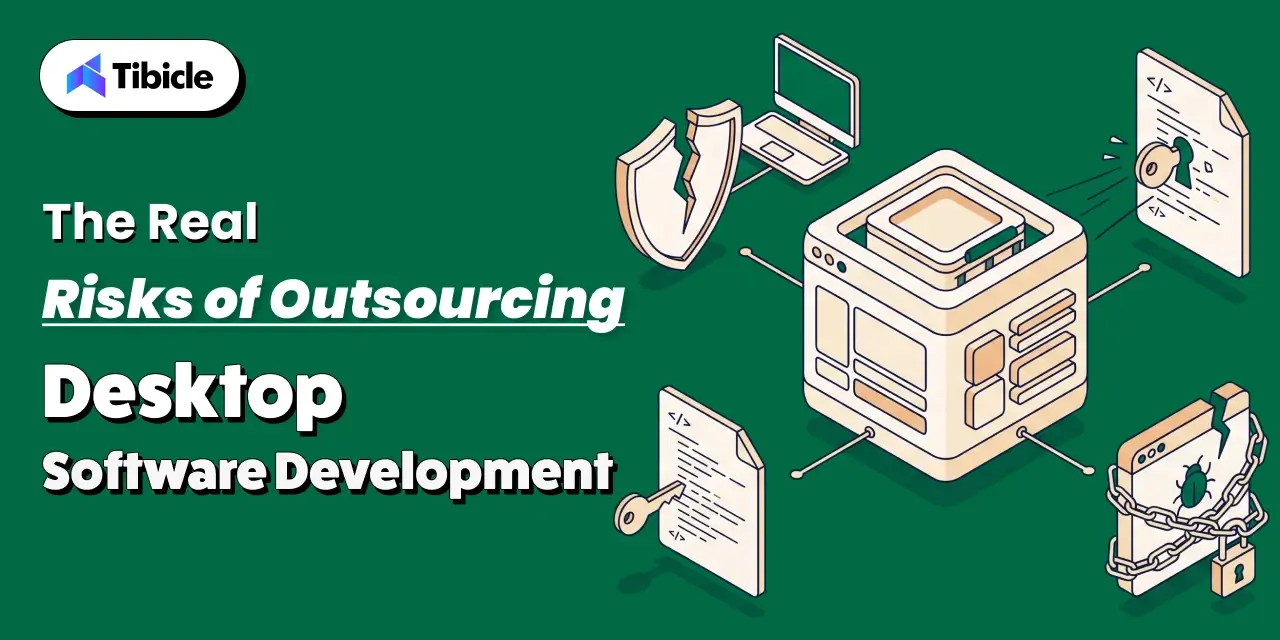
The specific risks a buyer needs to plan for fall into three categories. Security exposure through the vendor, intellectual property loss, and quality or lock-in problems that surface after the contract is signed. Planning for each category before signing is what separates a managed engagement from a gamble.
Security and Third-Party Breach Exposure
Third-party involvement in data breaches reached 48% of all breaches in the latest reporting year, a 60% year-over-year increase. That’s because organizations lean harder on outside vendors for software and services (Verizon 2026 Data Breach Investigations Report). A desktop software vendor with weak access controls, unmanaged credentials, or an unreviewed development environment becomes an extension of the buyer’s own attack surface. This risk needs a security review before the contract, not after an incident.
Intellectual Property and Source Code Risk
Desktop software engagements often involve proprietary algorithms, licensing logic, or business rules that took years to develop internally. Without a signed IP assignment agreement in place before any code or specification is shared, ownership of that work can become disputed later, particularly across jurisdictions with different IP enforcement standards. Source code escrow adds a second layer of protection for long-term, business-critical builds.
Quality, Rework, and Vendor Lock-In Risk
A vendor that under-delivers on quality creates two costs: the rework itself, and the schedule delay while that rework happens. Vendor lock-in compounds this. If the buyer cannot easily move the codebase, credentials, and documentation to another team, a single underperforming vendor can hold an entire product roadmap hostage. Both risks are addressed through contract structure, not hope.
Building a Risk Mitigation Framework Before You Sign a Contract
The contractual and technical protections below should exist before a single line of code or specification changes hands. Retrofitting these protections after the engagement starts is far harder, and in some cases legally impossible.
IP Assignment, NDAs, and Source Code Escrow
BSA’s Global Software Survey put the commercial value of unlicensed and unprotected software worldwide at $46.3 billion, a reminder of how much value leaks out of software that lacks clear ownership and licensing controls (BSA Global Software Survey). A signed IP assignment agreement and an NDA should both be in place before the vendor sees any proprietary code or specification. For long-term, business-critical builds, source code escrow adds a neutral third party holding a current copy of the codebase, released to the buyer if the vendor cannot continue the engagement.
Security Review and Access Control Requirements for the Vendor
Before granting access to repositories or systems, the buyer should require a documented review of the vendor’s own development environment. How credentials are managed, whether multi-factor authentication is enforced, and how the vendor segments client codebases from each other. Access should be scoped to what the engagement actually requires, not granted broadly by default.
Audit Rights and Right-to-Exit Clauses
The contract should give the buyer the right to audit code quality, security practices, and compliance at agreed intervals, not only at the vendor’s discretion. A right-to-exit clause should spell out, in advance, what happens to code, credentials, and documentation if either party ends the engagement, so an exit does not turn into a scramble.
Bullet points worth building directly into the contract:
- A signed IP assignment agreement before any code or specification is shared
- Source code escrow for long-term, business-critical builds
- A documented security review of the vendor’s own development environment
- A clear exit clause defining what happens to code, credentials, and documentation if the engagement ends
Calculating True ROI: Beyond the Hourly Rate for Outsource desktop software development

True ROI on an outsourcing engagement comes from a total cost of ownership model, not a single blended rate. Gartner defines total cost of ownership as a comprehensive assessment of IT or other costs across enterprise boundaries over time (Gartner IT Glossary), which is exactly the lens an outsourcing decision needs.
What a Total Cost of Ownership Model Actually Includes
A TCO model for a desktop software engagement should include the contracted rate, management overhead, ramp-up time, rework, and the opportunity cost of delay. Two vendors with identical rates can produce very different TCO figures once these additional cost lines are added, which is why rate alone is an incomplete comparison.
Pricing In Management Overhead and Ramp-Up Time
Every external team needs internal time to manage: status reviews, code review, and coordination across time zones. A vendor that requires heavy oversight is more expensive than its rate suggests, even if the rate itself is lower than a competitor’s.
Pricing In Rework, Delay, and Opportunity Cost
Delayed releases carry a cost even when no invoice reflects it directly, whether that is lost market position, delayed revenue, or a missed regulatory deadline. Rework hours should be estimated and priced into the comparison from the start, based on the vendor’s track record on similar projects, not assumed away.
Vetting a Desktop Software Development Partner for Safety and Quality
A due diligence process needs to cover technical, financial, and security dimensions at the same time, because a vendor can pass on one dimension and fail on another in ways that only surface mid-engagement.
Technical Portfolio and Architecture Review
Ask for work from a client of comparable size, industry, and project complexity, not a generic portfolio. Review how the vendor structured architecture decisions on a comparable build, and what tradeoffs they made and why.
Financial Stability and Business Continuity Checks
A vendor with a client logo wall is not the same as a vendor with financial stability. Check for signs of business continuity: staff turnover rates, how long the vendor has held key client relationships, and whether the vendor has a documented plan for team continuity if a lead developer leaves mid-project.
Security Posture and Compliance History
Ask directly about past security incidents and how they were handled, not whether any occurred. Every vendor of scale has faced some kind of security event; the useful signal is whether they disclosed it, contained it, and changed their process afterward.
Bullet points worth using as a vetting checklist:
- References from a client of comparable size, industry, and project complexity
- Evidence of financial stability, not just a signed logo wall
- A documented incident history and how past security issues were handled
- A short paid trial engagement before a long-term commitment
Structuring the Engagement for Long-Term Safety for Outsource desktop software development
How the contract and delivery model are structured determines how safe the engagement stays over its full life, not just at signing.
Phased Milestones Instead of a Single Long-Term Contract
Deloitte’s Global Outsourcing Survey found that 70% of executives report their vendor management function is not yet fully mature, and organizations are actively rebalancing sourcing models and expanding governance to manage that gap (Deloitte Global Outsourcing Survey). A phased milestone structure, rather than one long-term contract, gives the buyer a natural checkpoint to evaluate quality and security before committing further budget.
Regular Code and Security Audits Throughout the Engagement
Audits should not stop after the initial vendor review. Recurring code and security audits, built into the milestone schedule, catch drift before it compounds into a larger problem.
A Documented Offboarding Plan From Day One
An offboarding plan should exist from the first day of the engagement, not the last. It should define credential revocation, code and documentation handover, and a knowledge transfer window, regardless of whether the engagement is expected to end soon.
How Tibicle Delivers Safe, High-ROI Desktop Software Outsourcing
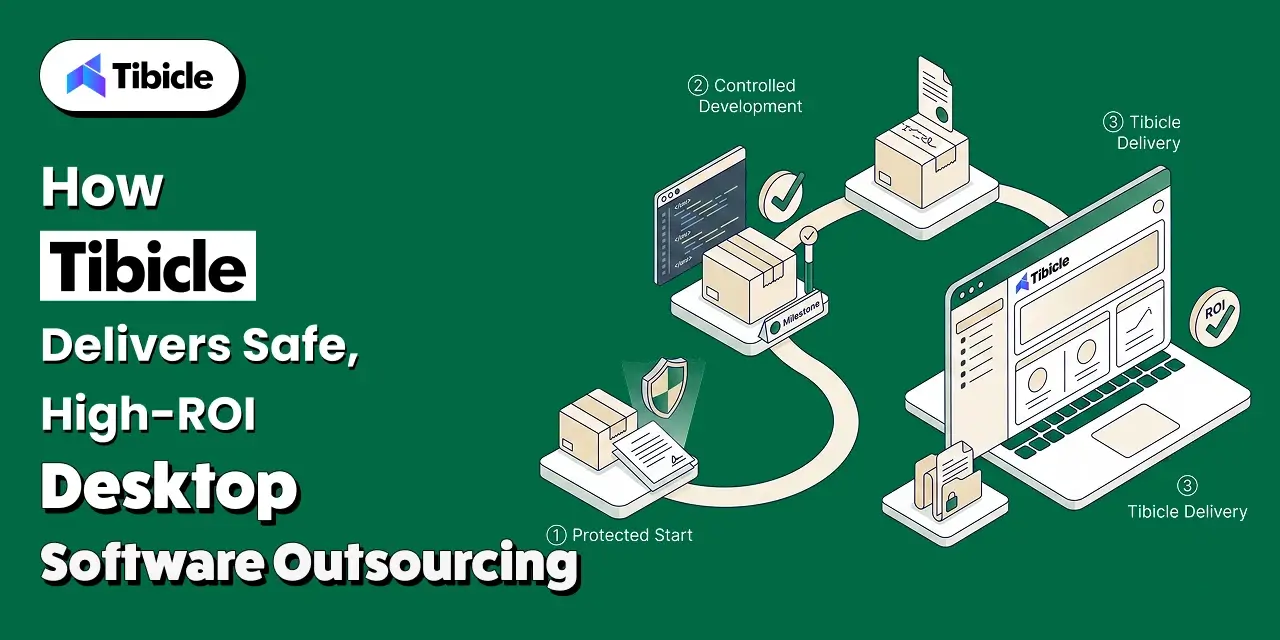
Tibicle applies the risk mitigation framework above directly to every desktop software engagement, rather than treating it as optional add-on scope.
Security and IP Protection Built Into the Engagement Model
Every Tibicle engagement starts with a signed IP assignment agreement and NDA before any code or specification is shared. Access to client systems is scoped by role, and source code escrow is available for long-term, business-critical builds.
Transparent Milestone-Based Delivery and Reporting for Outsource desktop software development
Engagements are structured around phased milestones with scheduled code and security audits, giving clients a documented checkpoint to review quality and security posture before the next phase of budget is committed.
Long-Term Partnership Without Vendor Lock-In for Outsource desktop software development
A documented offboarding plan exists from day one of every engagement. Clients retain full ownership of code, credentials, and documentation, so a long-term partnership stays a choice rather than a dependency.
Key Takeaways for Buyers and Executives for Outsource desktop software development
Global ROI is a function of risk-adjusted total cost, not the lowest hourly rate on the table. Third-party involvement in breaches has grown sharply, and vendor security posture is now a board-level question rather than a technical footnote. IP assignment, escrow, and audit rights should exist before code is shared, not after a problem appears. Phased milestones and a documented offboarding plan reduce risk more than a longer contract term does. Buyers who price these factors into the decision consistently outperform buyers who compare rate cards alone.
Ready to structure a desktop software engagement around these protections? Book a call with Tibicle.
FAQs
What does it actually mean to “safely” outsource desktop software development?
Safe outsourcing means IP assignment, security review, and audit rights are contracted before any code is shared, and an exit plan exists from day one. It does not mean risk is eliminated. It means risk is documented, contracted, and managed.
How do you calculate the true ROI of an outsourcing engagement, not just the hourly rate?
Build a total cost of ownership model that adds management overhead, ramp-up time, rework, and delay costs to the contracted rate, then compare vendors on that total figure rather than the rate alone.
What contract protections should be in place before sharing source code with a vendor for outsource desktop software development?
A signed IP assignment agreement, an NDA, defined access controls, audit rights, and for long-term builds, source code escrow. All of these should be signed before the vendor sees proprietary code.
How much does third-party risk actually factor into outsourcing safety today?
Third-party involvement in breaches reached 48% of all breaches in the latest DBIR, up 60% year over year, which makes vendor security posture a direct extension of a buyer’s own risk exposure.
Should a long-term outsource desktop software contract be one engagement or phased milestones?
Phased milestones give the buyer a documented checkpoint to evaluate quality and security before committing further budget, which reduces risk more than locking into a single long-term contract upfront.
Does Tibicle offer milestone-based, IP-protected outsource desktop software development engagements?
Yes. Every engagement includes a signed IP assignment agreement before code is shared, phased milestones with scheduled audits, and a documented offboarding plan from day one.