Introduction
The global Artificial Intelligence in retail market reached approximately $18.4 billion in 2026, with nearly 89% of retailers actively using or piloting AI technologies across operations. Despite this momentum, most retailers still struggle to move beyond experimentation. Industry studies show that only about one-third of retail organizations have successfully scaled AI deployments across multiple operational functions.
Retail businesses are simultaneously facing growing margin pressure, labor shortages, inventory inefficiencies, compressed profitability, and increasing omnichannel complexity. These operational challenges are forcing leadership teams to evaluate AI investments not as experimental innovation projects, but as measurable business infrastructure decisions tied directly to revenue growth and operational efficiency.
For leadership teams, the challenge is no longer deciding whether artificial intelligence in retail matters; it is identifying which use cases generate measurable business outcomes, realistic implementation timelines, and sustainable ROI.
Businesses evaluating AI investments must balance operational readiness, data maturity, implementation cost, vendor capability, and long-term scalability before expanding deployments across retail systems.
This article explores four high-impact AI retail use cases supported by performance benchmarks, pricing context, ROI insights, and vendor evaluation criteria for retail decision-makers in 2026.
What Is Artificial Intelligence in Retail?
AI in retail refers to the integration of machine learning, natural language processing, computer vision, and predictive analytics into retail operations and customer experiences.
Retailers use AI-powered retail solutions to automate workflows, personalize shopping journeys, optimize inventory management, improve pricing decisions, and strengthen customer engagement across physical and digital channels.
Industry analysts describe 2025–2026 as the “AI pivot years,” where retail adoption shifts from isolated experiments into production-level operational infrastructure. NVIDIA reports that 69% of retailers implementing AI directly increased revenue, while 72% achieved operational cost reductions through automation and optimization initiatives.
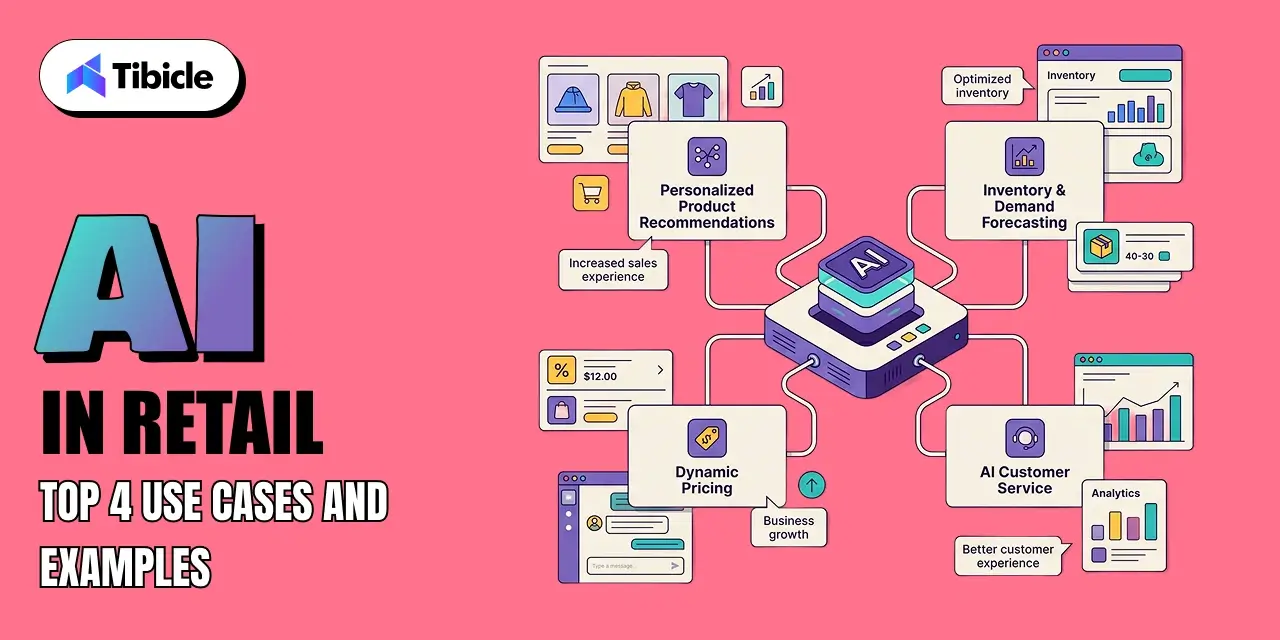
Top 4 Artificial Intelligence Use Cases in Retail
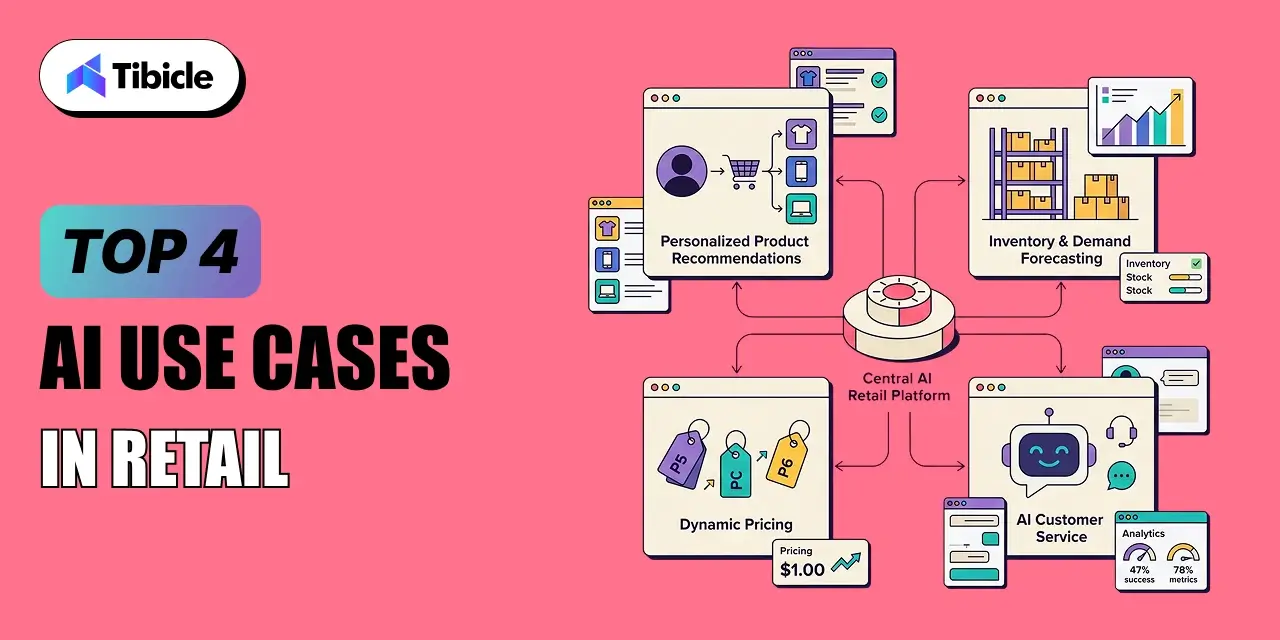
1. Personalized Product Recommendations
Personalization currently represents nearly one-third of total AI retail market revenue because of its direct impact on customer spending and retention.
Studies from McKinsey show AI-driven personalized recommendations increase revenue between 10–15% on average. Highly engaged customers exposed to intelligent recommendation engines can increase average order value by as much as 369%.
Retailers increasingly use AI for retail businesses to reduce cart abandonment, improve retention, and increase customer lifetime value through behavior-based targeting and contextual product discovery.
A well-known example is Macy’s “Ask Macy’s” shopping assistant, where users reportedly spent 400% more than non-users interacting with the platform. Recommendation systems also strengthen omnichannel engagement by synchronizing browsing history, loyalty data, and purchase patterns across devices.
For ecommerce and D2C brands, personalization often becomes the fastest path to measurable AI ROI because implementation complexity remains relatively manageable compared to supply chain or pricing systems.
2. Demand Forecasting and Inventory Optimization
Demand forecasting and inventory optimization account for one of the largest segments of retail AI investment spending globally.
Modern machine learning demand forecasting systems achieve approximately 82–88% SKU-level accuracy compared to traditional statistical forecasting models averaging around 65–75%. These improvements significantly reduce inventory waste and operational inefficiencies.
AI-driven inventory optimization systems also reduce stockouts by nearly 50% while lowering overstocks by approximately 25%. Retailers use these systems to balance procurement, warehouse allocation, and replenishment strategies in real time.
Doe Beauty reportedly saves nearly $30,000 weekly through AI-driven retail automation and inventory management workflows. Businesses implementing forecasting systems typically benefit from:
- Lower carrying costs
- Reduced markdown waste
- Higher sell-through rates
- Faster replenishment decisions
This category delivers particularly strong value for retailers operating across multiple locations or managing seasonal inventory complexity.
3. Dynamic Pricing and Markdown Optimization
Dynamic pricing systems use artificial intelligence in retail to automatically adjust pricing based on demand, competition, inventory levels, seasonality, and customer behavior.
By 2023, nearly 68% of European retailers had adopted AI-driven pricing optimization systems. Retailers implementing dynamic pricing report average margin improvements of approximately 5.1%.
AI pricing engines also improve markdown efficiency by increasing clearance revenue and recovering lost margin on seasonal inventory. Businesses frequently achieve:
- 18% improvement in clearance revenue
- 2–4 percentage point margin recovery
- Faster inventory turnover
Retailers operating in fashion, electronics, and fast-moving seasonal categories benefit especially from real-time pricing optimization because margins shift rapidly during promotional cycles.
4. Artificial Intelligence Powered Customer Service and Conversational Commerce
Conversational AI remains one of the fastest-growing AI retail use cases because of its rapid payback period and operational scalability.
Retail chatbots increase sales by approximately 67%, while companies deploying AI customer service systems generate roughly $3.50 in return for every $1 invested. AI agents can autonomously handle more than 74% of support requests without human intervention.
Retail businesses also dramatically reduce support costs because AI interactions often cost under $1 compared to $6–$14 for traditional human-assisted service interactions.
DRUID’s conversational AI platform reportedly handled more than 110,000 customer conversations and 85,000 users within three months for a retail deployment.
AI customer service systems improve:
- 24/7 support availability
- Order tracking automation
- Customer response speed
- Lead qualification workflows
- Conversational commerce experiences
For many retailers, chatbot deployments become the first production-level AI implementation because they require lower operational complexity than enterprise-wide AI infrastructure.
Artificial Intelligence in Retail Use Case Comparison
| Parameter |
Personalization |
Demand Forecasting |
Dynamic Pricing |
AI Customer Service |
| Avg. Implementation Time |
12–18 weeks |
14–22 weeks |
10–16 weeks |
8–14 weeks |
| Complexity |
Medium |
High |
Medium |
Medium |
| Avg. ROI Timeline |
3–6 months |
6–12 months |
3–6 months |
1–3 months |
| Revenue Impact |
10–15% lift |
20% sales increase |
5.1% margin gain |
67% sales boost |
| Best For |
D2C, ecommerce |
Multi-location retail |
Seasonal inventory |
High-volume support |
Retailers should prioritize AI implementation based on operational maturity, data readiness, and the use case most directly tied to measurable business outcomes. Customer service AI often produces the fastest ROI, while forecasting and personalization deliver stronger long-term operational value.
How Much Does Artificial Intelligence in Retail Cost?
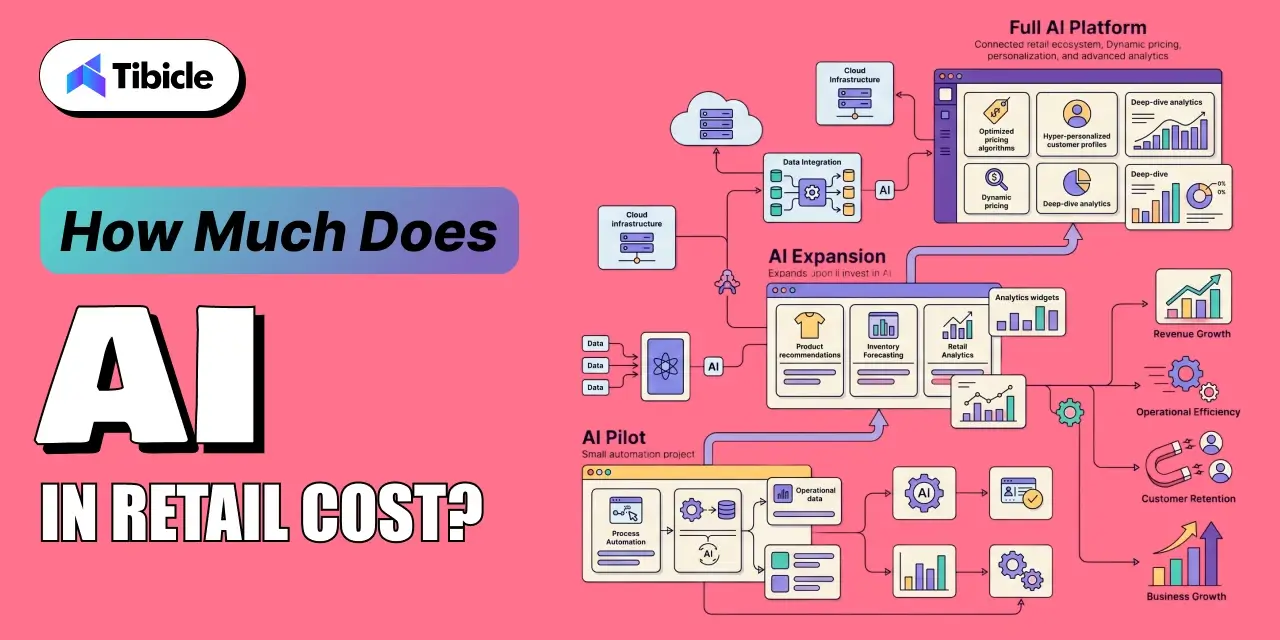
AI implementation cost varies significantly depending on deployment scale, infrastructure complexity, and vendor model.
Large enterprise retailers spend an average of approximately $5.2 million on full-scale AI deployment programs. SMB and mid-market businesses typically rely on SaaS-based AI-powered retail solutions ranging from around $349 monthly for entry-level support systems to more than $10,000 monthly for advanced personalization platforms.
Median payback periods have improved substantially. In 2025, average AI investment payback dropped to approximately 4.2 months compared to 7.8 months in 2024.
Industry analysts increasingly recommend allocating:
- 20–25% of technology budgets toward AI initiatives in 2025
- 30%+ by 2027
Retailers also reduce implementation risk through phased rollouts, funding each expansion stage only after measurable ROI validation.
ROI and Business Impact of Artificial Intelligence in Retail
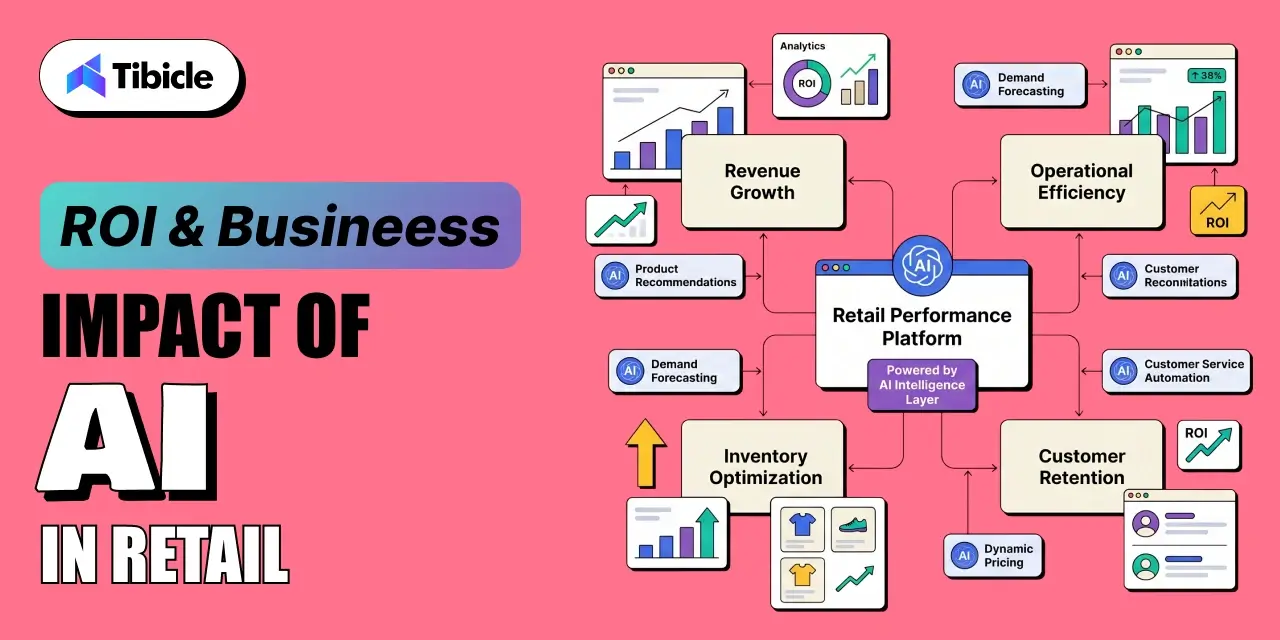
AI in retail now produces measurable operational and financial outcomes rather than experimental benefits.
Research shows:
- 87% of retailers report direct revenue increases from AI
- 94% achieved operational cost reductions
- AI leaders generated 1.7x higher revenue growth
- Top-performing AI organizations delivered 3.6x stronger shareholder returns over three years
Retailers implementing AI across supply chains, finance systems, and customer operations report cost savings between 26–31%.
One of the strongest indicators of success is use case prioritization. High-performing retailers focus on outcome-driven deployments rather than scattered experimentation. Organizations with strong AI ROI typically select projects based on measurable commercial impact instead of trend adoption.
This matters because nearly 46% of AI proof-of-concept projects never reach production environments due to weak ROI planning and unclear implementation priorities.
Key Challenges and Risks of AI in Retail
Data Quality and Integration Gaps
Approximately 67% of AI deployments face challenges integrating with legacy POS, ERP, and e-commerce systems.
Talent Shortage
Around 58% of retailers report AI skill shortages that delay projects by six to twelve months.
Data Privacy and Compliance
Regulatory concerns remain significant, especially across Europe where 72% of retailers cite compliance uncertainty surrounding AI deployment and evolving EU AI Act enforcement.
Bias in Artificial Intelligence Recommendations
Poorly trained recommendation systems affected nearly 30% of personalization initiatives, negatively impacting customer trust and recommendation accuracy.
Businesses must also address ROI measurement carefully because approximately 42% of companies abandoned most AI initiatives in 2025 after failing to establish measurable commercial outcomes.
AI Vendor Selection Checklist for Retail
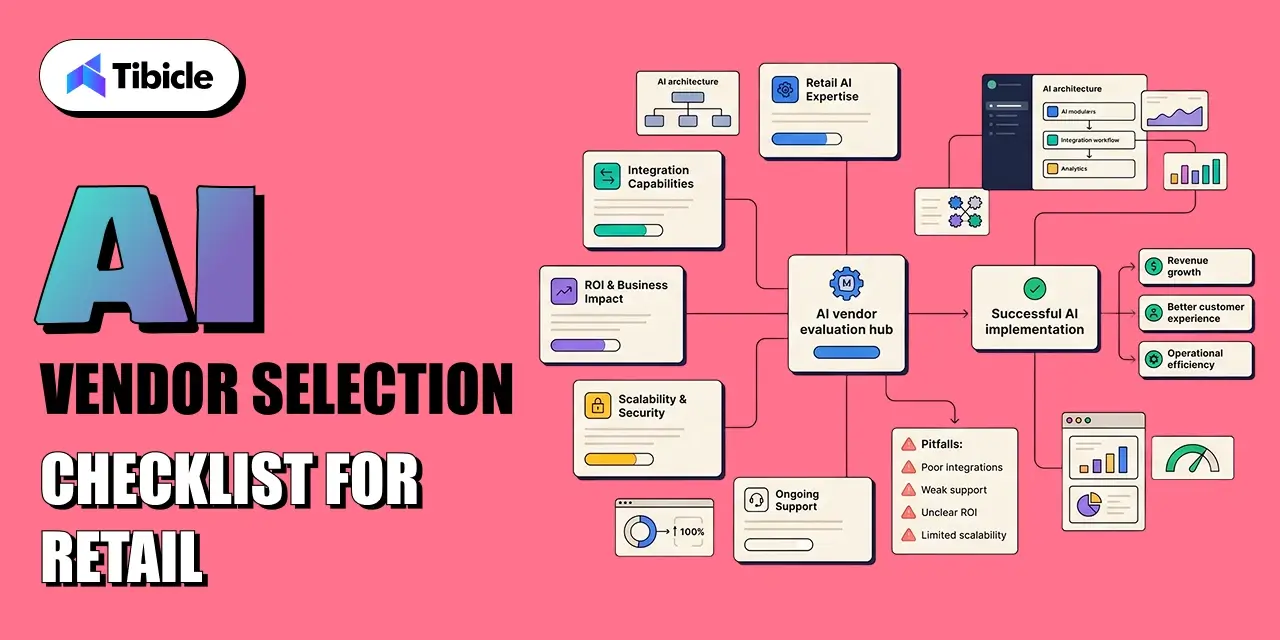
Retailers evaluating AI vendors should assess:
- Retail-specific AI models vs generic tooling
- Integration capabilities across POS, CRM, ERP, and e-commerce systems
- Documented implementation timelines and ROI benchmarks
- Scalability across channels and locations
- Compliance certifications, including GDPR and SOC 2
- Total cost of ownership, including support and retraining
- Pilot-first deployment flexibility
- Ongoing model monitoring and optimization support
Vendor selection should focus on operational fit and measurable outcomes rather than feature volume alone.
Top AI Solutions and Platforms for Retail
Several platforms dominate specific AI retail categories:
The right platform depends on the retailer’s operational priorities, data maturity, implementation budget, and scalability requirements identified earlier in the evaluation process.
Looking to implement AI in your retail operations? Connect with an experienced development partner to scope your first pilot.
Why Tibicle Is a Strong Choice for AI in Retail Implementation
Tibicle operates as an AI consulting and development partner, helping businesses implement practical AI-powered retail solutions rather than selling prepackaged software products.
The company supports organizations through AI consulting, custom AI development, automation systems, semantic search implementation, recommendation engines, and conversational AI deployment strategies.
Tibicle has experience delivering AI systems across retail, healthcare, logistics, and edtech sectors using phased sprint-based implementation models that align with the pilot-first deployment strategy recommended throughout this article.
Their dedicated developer engagement structure also allows businesses to scale AI initiatives cost-effectively while maintaining operational flexibility during rollout phases.
Speak with Tibicle’s AI team to evaluate which retail AI use case fits your business first.
Conclusion
AI in retail has moved beyond experimentation. With nearly 89% retailer adoption and measurable ROI across personalization, forecasting, pricing, and customer service, AI now represents an operational investment rather than an emerging trend.
Retailers should prioritize AI use cases based on data readiness, operational bottlenecks, and projected ROI rather than attempting broad deployments immediately. Phased pilots, measurable KPIs, and strong vendor selection processes remain critical for long-term success.
Get in touch with Tibicle to scope an AI pilot for your retail operations today.
FAQs
What are the most common AI use cases in retail?
Personalized recommendations, demand forecasting, dynamic pricing, and AI-powered customer service remain the highest-impact retail AI use cases based on current adoption and ROI benchmarks.
How much does it cost to implement AI in retail?
Costs range from approximately $349 monthly for SaaS-based AI tools to several million dollars for enterprise-scale AI infrastructure deployments.
What ROI can retailers expect from AI?
Most retailers report measurable revenue growth and operational cost reductions. AI customer service systems alone return approximately $3.50 for every $1 invested.
What are the biggest challenges of AI adoption in retail?
Legacy integration complexity, AI talent shortages, compliance concerns, and poor ROI measurement remain the largest implementation barriers.
How long does it take to see results from AI in retail?
Customer service AI often shows results within 1–3 months, while forecasting and personalization systems typically require 6–12 months for full operational impact.
How do I choose the right AI vendor for retail?
Retailers should evaluate vendors based on retail-specific expertise, integration capabilities, compliance readiness, documented ROI timelines, scalability, and long-term support structure.