
Mobile AI App Development Company Guide

Sep 24, 2026

Read in 9 Minutes
Table of Contents
- What This Guide Covers
- Introduction
- Why On-Device Inference Is Reshaping Mobile AI App Development Company
- Flutter vs React Native for Mobile AI App Development Company
- On-Device AI Architecture for Mobile AI App Development Company
- Quantization and Model Selection for Mobile Constraints for mobile ai app development company
- Battery, Latency, and Privacy: The Case for On-Device Mobile AI app development company
- Building and Shipping a Cross-Platform Mobile AI App Development Company
- How Tibicle Builds Cross-Platform Mobile AI App Development Company
- Key Takeaways for Product Teams
- Frequently Asked Questions
What This Guide Covers
Who this is for:
Mobile AI App Development company for B2B SaaS targeting founders, CTOs, product leaders, and technology decision-makers. It is particularly relevant for teams deciding between an offshore vs nearshore AI engineering team, assessing whether an external partner has the technical capability to take an AI feature from proof of concept to production, or looking to expand their AI roadmap without building an entire specialist AI engineering team in-house.
Search intent:
Commercial investigation and vendor evaluation. The reader is not looking for a basic explanation of AI integration or software outsourcing. They are evaluating how to choose an AI integration company for B2B SaaS and whether an offshore vs nearshore AI engineering team or another engagement model best fits their product requirements. The key decision factors are engineering capability, AI project experience, time-zone overlap, communication speed, cost, proof-of-concept validation, IP protection, data security, compliance, and the structure of the long-term engagement.
What you will walk away with:
A practical framework for evaluating an AI integration company for B2B SaaS, including the real differences between offshore and nearshore AI engineering teams; the technical questions to ask when vetting past AI integration work; how to structure a scoped proof of concept before committing to a larger engagement; and what to verify around data access, IP ownership, security, and compliance. You will also have a clearer basis for choosing between staff augmentation, a dedicated AI engineering team, and fixed-scope development, identifying vendor red flags, and selecting an offshore vs nearshore AI engineering team based on your product’s collaboration requirements, technical complexity, budget, and long-term AI roadmap.
Introduction
Mobile AI app development company is now making an architecture decision that didn’t exist two years ago: whether AI features run inside the app, on the device, or whether they depend on a cloud API call for every inference request. The global mobile application market was valued at $228.98 billion in 2023 and is projected to grow at a compound annual growth rate of 14.3% through 2030, according to Grand View Research’s Mobile Application Market press release. A growing share of that investment is flowing toward AI-powered features, and the framework and inference stack decisions made at project start determine whether those features perform in production or fail under real device constraints.
Flutter and React Native are both capable of supporting on-device AI inference. The question is not which framework can do it; it is which one fits the project’s existing team skill set, the model’s hardware requirements, and the product’s specific latency, privacy, and battery constraints.
This guide covers the framework decision, the inference runtime selection, quantization requirements, and the build and release process that a mobile AI app development company needs to get on-device AI from proof of concept to a production-grade app store release.
Why On-Device Inference Is Reshaping Mobile AI App Development Company
The architecture shift from cloud-only AI to on-device AI inference for mobile apps is not driven by engineering preference. It is driven by product quality requirements that cloud round trips cannot meet at scale: sub-100ms response times, offline functionality, and privacy constraints that prevent user data from leaving the device.
From Cloud-Only AI Features to On-Device Inference
Cloud-only AI mobile features have a predictable failure mode: they degrade exactly when users need them most. Network latency spikes under poor connectivity. Inference costs scale with usage in ways that damage unit economics at the growth stage. API dependencies create single points of failure that a native app should not carry. On-device inference removes all three dependencies: the model runs on the phone’s own hardware, inference completes without a network call, and the cost structure is fixed rather than usage-based.
The engineering trade-off is model size and hardware compatibility. On-device inference requires a model that fits inside the phone’s memory budget and runs fast enough on its NPU or CPU to be useful. That trade-off is becoming more favorable every product cycle as mobile NPU inference capability grows across the mid-tier device segment.
The Hardware Catching Up: NPUs in Mainstream Phones
IDC’s forecast on GenAI smartphone shipments, cited from IDC’s forecast on GenAI smartphone shipments, projects that over 1 billion GenAI-capable smartphones will be in active use globally by 2028. The shift is already visible in the mid-tier segment: Qualcomm’s Snapdragon 7-series and MediaTek’s Dimensity 7000-series chips both include dedicated NPU cores capable of running quantized small language models at acceptable latency on devices that retail well below the flagship price point.
For a mobile AI app development company scoping a new project, this hardware trajectory has a direct implication: designing exclusively for flagship NPU performance in 2024 means excluding a significant share of the addressable install base. Building for mid-tier NPU capability in 2026 means the inference architecture works for the mainstream market today, not just two product cycles from now.
Flutter vs React Native for Mobile AI App Development Company
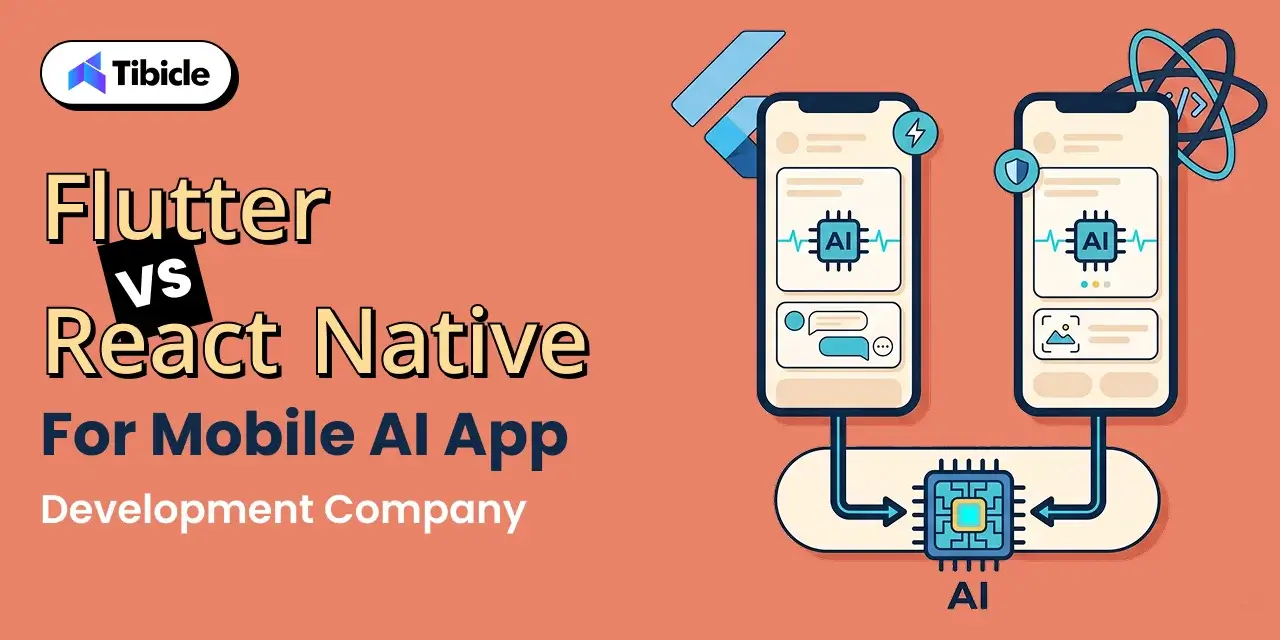
The Flutter on-device LLM versus React Native AI integration comparison resolves differently depending on what the project actually needs from the inference layer. Both frameworks support on-device AI through native bridges; the differences are in ecosystem maturity, team familiarity, and the rendering model’s implications for AI-powered UI components.
Framework Adoption: What Developers Actually Use
According to the 2024 Stack Overflow Developer Survey (Other frameworks and libraries section, all respondents), React Native is used by approximately 9.17% of professional developers and Flutter by 9.16%, effectively matching adoption at the global level. That statistical parity means framework selection for a cross-platform AI project cannot be made on ecosystem size grounds alone. It has to be made on the specific capabilities and trade-offs each framework presents for an inference-heavy project, and on the existing skill profile of the team doing the build.
Native Module Access for On-Device Inference in Each Framework
Both Flutter and React Native access on-device inference runtimes, TensorFlow Lite, Core ML, and ONNX Runtime Mobile, through native bridge layers rather than through the cross-platform framework itself. In Flutter, platform channels invoke native Kotlin or Swift code that calls the inference library directly. In React Native, native modules or the newer Turbo Modules architecture provide the same pathway. The bridge is not a performance bottleneck for inference: the compute-intensive work happens in native code on the NPU or CPU, and the cross-platform layer handles only session management and result passing.
The native module bridge for AI design pattern is consistent across both frameworks: write the inference logic once in native Kotlin/Swift, expose it through the bridge, and call it from the cross-platform UI layer. The framework choice affects how you structure and maintain that bridge, not whether you can build it.
Where Each Framework’s AI Tooling Ecosystem Is Stronger
Flutter’s cross-platform AI SDK ecosystem on pub.dev is smaller but more curated packages that exist for TensorFlow Lite and Core ML integration tend to be maintained by developers who have actually shipped inference in production. React Native’s npm ecosystem is larger and includes more community-built AI wrappers, with more variation in maintenance quality and production readiness. For a mobile AI app development company evaluating both, the practical question is whether a relevant, actively maintained package exists for the specific inference task, not which ecosystem is larger in total package count.
Use the table below to compare both frameworks on factors specific to on-device AI work:
| Factor | Flutter | React Native |
| Native inference
bridge |
Platform channels to native
TensorFlow Lite / Core ML code |
Native modules or Turbo Modules to the same native libraries |
| Existing AI
package ecosystem |
Smaller, more curated pub.dev packages | Larger npm ecosystem, more community AI wrappers |
| Rendering consistency across devices | Own rendering engine, more consistent AI UI overlays | Renders through native components, more platform-authentic feel |
On-Device AI Architecture for Mobile AI App Development Company
The runtime and hardware stack decisions that determine whether on-device AI inference for mobile apps actually performs well sit below the cross-platform framework layer. Choosing the wrong inference runtime, or targeting the wrong hardware unit, produces an app that performs acceptably in development and fails under real device conditions at production scale.
Choosing a Mobile Inference Runtime
TensorFlow Lite is the broadest-compatibility option: it runs on Android, iOS, and Linux-based embedded targets, supports GPU and NPU delegation on both major platforms, and has the widest model format ecosystem through the TFLITE converter. Core ML is Apple-only but produces the best iOS performance on Apple Silicon, with native integration into the OS-level Neural Engine that outperforms third-party runtimes on Apple hardware. ONNX Runtime Mobile provides a framework-agnostic pathway: models converted to ONNX format run across Android and iOS without a platform-specific export step, which reduces toolchain complexity for teams maintaining a unified cross-platform model pipeline.
Runtime selection should follow the deployment target: Core ML for iOS-first products where Apple Silicon performance is the priority, TensorFlow Lite for Android-first or truly cross-platform deployments, and ONNX Runtime Mobile for teams that need to swap inference backends without rearchitecting the bridge layer.
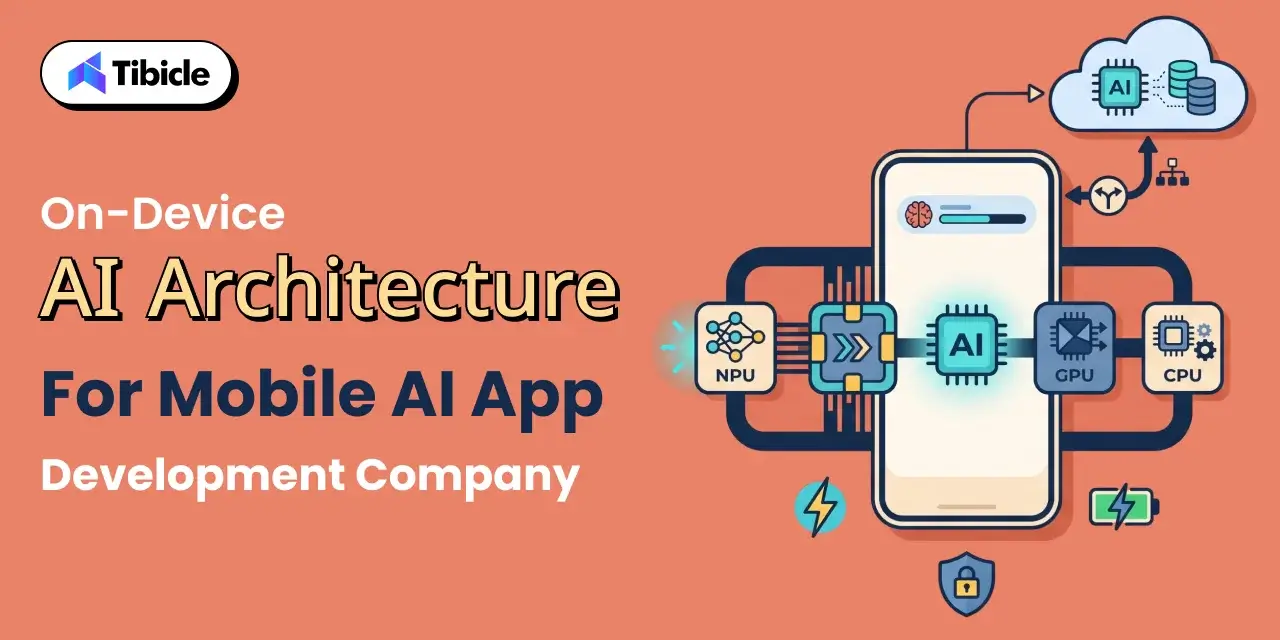
Where On-Device AI Actually Runs in the Mobile Hardware Stack
Smartphones accounted for a majority share of the on-device AI market in 2024, according to Coherent Market Insights’ On-Device AI Market report. Within a phone, inference can run on the CPU, GPU, or NPU, and the hardware target directly affects latency, battery draw, and model compatibility.
Mobile NPU inference on the dedicated neural processing unit delivers the best latency-per-watt for supported model architectures, but not every model operator maps cleanly to every NPU’s supported layer types. GPU delegation is the fallback for models that the NPU cannot accelerate: it runs on the graphics processor and delivers faster inference than CPU at higher power draw. CPU inference is the compatibility floor: it runs any model regardless of operator support, at the cost of higher latency and battery consumption.
Falling Back to Cloud When On-Device Isn’t Enough
A hybrid inference architecture offline AI mobile app for supported query types, cloud API for queries that exceed on-device capability is the production reality for most AI-powered apps. The design decision is which queries go on-device by default and which escalate to the cloud. On-device handles: offline queries, latency-sensitive interactions, and tasks where user data must not leave the device. Cloud handles: queries requiring a larger model than fits in device memory, tasks with accuracy requirements the quantized model cannot meet, and context windows that exceed what the phone’s NPU can process in real time.
The fallback logic must be explicit in the app architecture from the start, not a retrofit added when on-device performance disappoints. Build the cloud pathway in parallel with the on-device implementation and expose the routing decision as a configuration parameter the product team can tune based on production latency and accuracy data.
Quantization and Model Selection for Mobile Constraints for mobile ai app development company
Mobile devices impose memory, compute, and thermal constraints that server-side inference does not. Running a model on a phone that was trained and evaluated on a GPU cluster without adapting it to mobile hardware limits produces an app that works in development and fails in field conditions. Quantized mobile models are the standard response, but not all quantization strategies produce the same accuracy and latency trade-off.
Why Mobile Devices Need More Aggressive Quantization Than Desktop
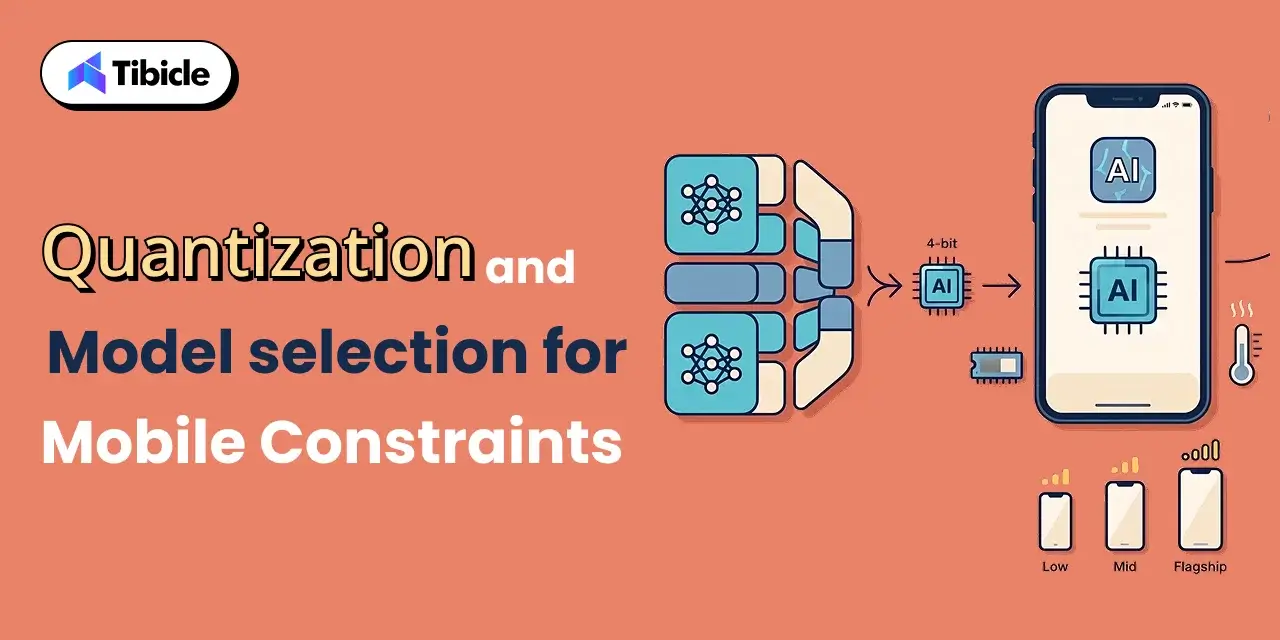
Research published in “A Systematic Evaluation of On-Device LLMs” (arXiv 2505.15030, 2025) found that heavily quantized larger models consistently outperform smaller high-precision models down to an effective threshold of approximately 3 bits per weight. Below that threshold, accuracy degrades faster than model size shrinks, and a smaller, higher-precision model becomes the better trade-off. Above 3 bits per weight, more aggressive quantization of a larger model produces better task accuracy than a smaller model running at full precision. That finding directly shapes how a mobile AI app development company should approach model selection: start with the largest model the device memory budget can hold after quantization, not with the smallest model that
Picking a Model Size That Fits Phone Memory and Thermal Limits
A practical memory budget for a Flutter on-device LLM or React Native AI feature on a mid-tier device is 1.5 to 2.5 GB of RAM allocated to the inference session, accounting for OS overhead and the rest of the app’s memory footprint. A 7-billion parameter model quantized to 4-bit requires approximately 3.5 GB in active inference, over the mid-tier budget. A 3B model at 4-bit quantization fits within 1.8 GB and runs within thermal limits on most Snapdragon 7-series and Apple A16-class devices without triggering aggressive throttling.
Thermal limits are the constraint that benchmarks on a cold device miss. Sustained inference at high NPU load raises chip temperature and triggers thermal throttling within 2 to 5 minutes on most mid-tier devices, reducing effective inference throughput by 30 to 60% compared to the cold-device benchmark. Test sustained inference scenarios, not just single-query latency.
Testing Across Low, Mid, and Flagship Device Tiers
A battery and latency mobile inference test suite needs to cover at minimum three hardware tiers: a low-end Android device (Snapdragon 4-series or equivalent, 3 to 4 GB RAM), a mid-tier device (Snapdragon 7-series, Dimensity 7000-series, or equivalent, 6 to 8 GB RAM), and a flagship device (Snapdragon 8 Gen 3, Apple A17 or equivalent). The performance gap between tiers on the same quantized model is typically 3x to 5x in latency and 2x to 3x in sustained throughput before thermal throttling.
Low-end device testing is the constraint that produces the architecture decision: if the model cannot run on a low-end device within acceptable latency and battery parameters, that workload belongs in the cloud fallback path, not in the on-device inference layer. Discovering that after launch is significantly more expensive than building the cloud fallback before release.
Battery, Latency, and Privacy: The Case for On-Device Mobile AI app development company
The product case for on-device AI inference for mobile apps is not just an engineering argument. It resolves into three user-facing product quality dimensions that directly affect retention, trust, and the competitive positioning of the app in its category.
Latency Gains From Skipping the Network Round Trip
A cloud inference call on a mobile network adds a minimum of 80 to 200 milliseconds of network round-trip latency before the model begins processing. On-device inference on a mid-tier NPU completes a typical language task in 50 to 300 milliseconds total with no network dependency and no degradation under congested network conditions. For any AI feature where response speed is part of the user experience autocomplete, real-time translation, voice transcription, camera-based analysis the latency gap between on-device AI inference for mobile apps and cloud API calls is a product quality difference, not just a technical preference.
Battery and Thermal Trade-offs of Local Inference
On-device inference draws more power than idle CPU states and more than a lightweight cloud API call from the network radio perspective. A sustained inference session on the NPU draws 2 to 4 watts comparable to video playback versus sub-100 milliwatt network API calls. For battery and latency mobile inference design, this means on-device AI is appropriate for short, session-bounded interactions: a 2 to 5 second inference completion, not a background process running continuously. Features that require sustained inference real-time camera AI, continuous voice processing need duty cycling and NPU sleep management to avoid visible battery drain within a typical usage session.
Privacy as a Product Differentiator, Not Just a Compliance Box
An offline AI mobile app that processes user data entirely on-device without sending input text, images, or audio to an external server carries a privacy story that is increasingly a purchase and trust driver, not just a legal compliance requirement. In healthcare, legal, and enterprise productivity categories, user data that never leaves the device is a feature that enterprise procurement teams actively evaluate before approving app distribution.
Document the data residency architecture explicitly: which inference tasks run on-device, which fall back to cloud, and what data is transmitted in each case. That documentation belongs in the privacy policy, the app store listing, and the enterprise security review response, not just in the engineering spec.
Building and Shipping a Cross-Platform Mobile AI App Development Company
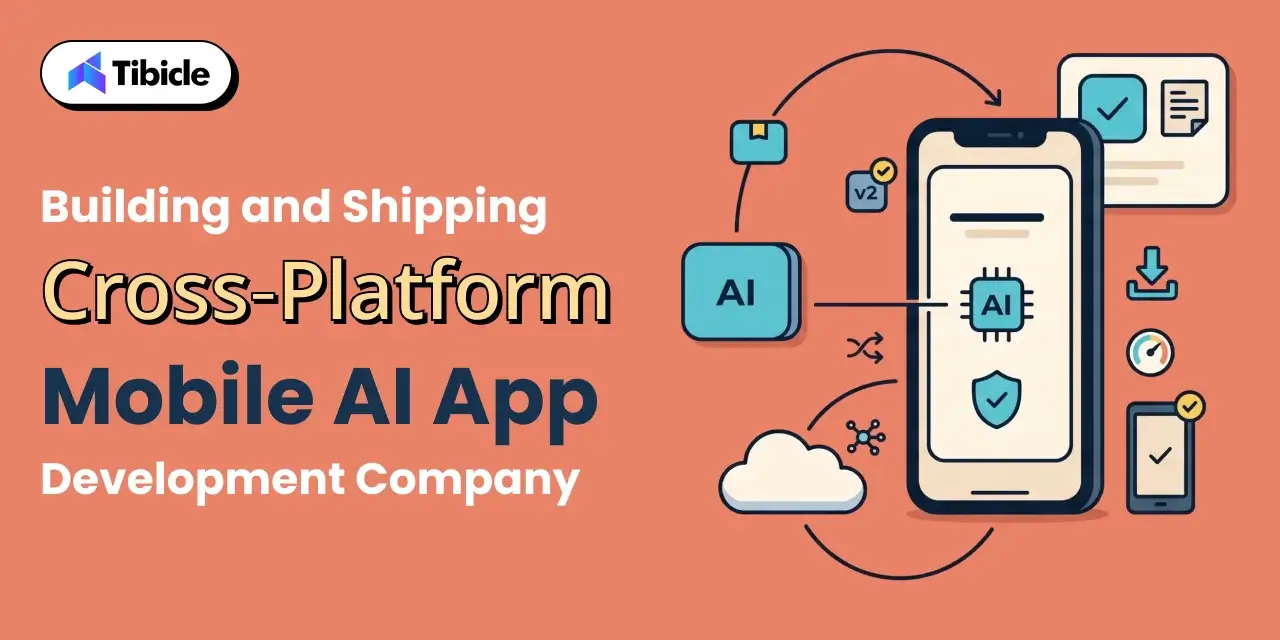
The build and release process for an AI-powered mobile app has several decision points that don’t exist in a non-AI project: which features run on-device, how the model gets distributed to the device, how app store review handles a bundled model file, and how model updates are managed independently of app version updates.
Scoping Which Features Run On-Device vs in the Cloud
The scoping decision is driven by three variables: the model size the device budget can support, the latency requirement the feature needs to meet, and the data privacy constraint that determines whether user input can leave the device at all. A mobile AI app development company scoping this for a client should produce a feature-by-feature inference location decision before the architecture is finalised, not a blanket on-device or cloud-first decision applied uniformly across every AI feature in the product.
Start with the features where latency or privacy make on-device the correct answer. Build the on-device AI inference architecture for mobile apps for those first. Add cloud fallback paths for the features where the on-device model does not meet accuracy or context window requirements. The hybrid model is the production reality for most apps the scoping exercise determines where the boundary sits.
App Store Review Considerations for On-Device Models
Apple App Store and Google Play both permit bundled model files and over-the-air model downloads, but each has specific review requirements that affect how models are distributed and updated. Executable code delivered post-install is prohibited under both review policies, but model weights are data files, not executable code, and are treated differently. The review risk is not the model file itself; it is undisclosed data collection or processing that the app review notes don’t cover.
A React Native AI integration or Flutter app that downloads a model on first launch must disclose that download in the app description and handle the case where the download fails, or the device lacks storage. Document exactly what the model does, what data it processes, and whether any data leaves the device in the app review notes, not just the privacy policy.
Testing, Monitoring, and Updating Models Post-Launch
Post-launch model management is the operational discipline that determines whether on-device AI quality holds or degrades over time as the app’s user base and use case distribution evolve.
- Bundle only the model size a phone’s storage budget can absorb across both platforms
- Test cold-start inference time on a low-end device, not just the developer’s flagship phone
- Version models separately from app releases so a bad model can be rolled back without a store update
- Document exactly which data stays on-device and which is sent to the cloud, for both app store review and the privacy policy
How Tibicle Builds Cross-Platform Mobile AI App Development Company
Tibicle operates as a mobile AI app development company for product teams at the stage where the AI feature scope has been defined, and the framework decision needs to be made against real inference requirements, not the stage where the team is still evaluating whether on-device AI is feasible. The delivery structure covers three phases: framework and architecture assessment, implementation with on-device inference built in from the start, and post-launch support across iOS and Android.
Framework and Architecture Assessment for Mobile AI app development company
The assessment phase maps the product’s AI feature list against the specific inference requirements of each feature: latency target, model size constraint, privacy requirement, and offline availability expectation. That mapping determines the inference runtime selection TensorFlow Lite, Core ML, or ONNX Runtime Mobile and the quantization strategy for each model in scope. The output is a written architecture specification that covers the on-device and cloud fallback boundaries, the hardware tier targets for testing, and the model distribution approach before any implementation starts.
For teams that have not yet chosen between Flutter and React Native, the assessment includes a framework recommendation grounded in the team’s existing skill profile and the inference bridge architecture required for the specific models in scope not a generic Flutter versus React Native preference.
Implementation With On-Device Inference Built In
Tibicle’s implementation approach treats on-device AI inference for mobile apps as a first-class architecture requirement from sprint one, not a feature added after the UI is built. The native inference bridge Platform Channels in Flutter and native modules in React Native is built and tested on real device hardware at the start of the project, not at the end. Model quantization is validated against the target device tier before the inference layer is integrated into the app UI.
The cross-platform AI SDK integration follows the same pattern on both platforms: native inference code written once in Kotlin and Swift, exposed through the bridge, consumed by the cross-platform UI layer. That architecture keeps inference logic maintainable independently of UI framework updates and allows model updates to be tested in isolation before app release.
Ongoing Support Across iOS and Android in mobile ai app development company
Post-launch support for a mobile AI app development company engagement covers model version management, inference runtime updates as TensorFlow Lite, Core ML, and ONNX Runtime release new versions, and OS-level changes to NPU driver behaviour that can affect inference latency and accuracy on specific device tiers.
The support model includes quarterly inference quality reviews testing the production model against the current device tier distribution of the app’s actual install base, not the device tier distribution at launch. As mid-tier NPU capability grows and the install base shifts, models quantized for today’s hardware constraints may have room to run larger and more accurate variants. Identifying those opportunities is part of the ongoing support cadence, not a separate engagement.
Key Takeaways for Product Teams
Choosing a mobile AI app development company for an on-device inference project now requires asking specifically about the team’s experience with inference runtimes, quantization, and native bridge architecture, not just Flutter or React Native UI development experience. A team that has shipped React Native screens but has no production inference deployment is not a mobile AI team.
- Flutter and React Native both support on-device AI inference for mobile apps through native bridges; the real difference is ecosystem maturity and the team’s familiarity with the bridge architecture
- Mobile devices need more aggressive quantization than desktop, and testing must happen on real low- and mid-tier hardware, not just the developer’s flagship phone
- On-device inference is a genuine product differentiator on latency, battery, and privacy, not just an engineering constraint to work around
Ready to scope a cross-platform mobile AI app with on-device inference? Book a discovery call with Tibicle’s team. The session maps your model requirements, device tier targets, and framework options before any architecture decisions are made.
Frequently Asked Questions
What should I look for in a mobile AI app development company for an on-device inference project?
Look for demonstrated experience with the specific inference runtimes the project requires TensorFlow Lite, Core ML, or ONNX Runtime Mobile and with native bridge architecture in the framework the project is using. Ask for reference deployments where on-device inference shipped to production on both iOS and Android. A company with strong Flutter or React Native UI experience but no production inference deployments is not a mobile AI app development company in the relevant sense.
Should I build my Mobile AI app development company for Flutter or React Native?
Both frameworks support on-device inference through native bridges at comparable performance the inference compute happens in native code on the device’s NPU or CPU regardless of which framework manages the UI layer. The decision should be based on the team’s existing skill profile, the availability of maintained packages for the specific inference task on pub.dev versus npm, and the rendering model’s implications for AI-powered UI components.
Can Flutter and React Native both run quantized LLMs on-device?
Yes. Both frameworks access native inference libraries TensorFlow Lite on Android, Core ML on iOS through bridge layers that call native Kotlin or Swift code. The cross-platform framework handles UI and session management; the inference library runs in native code on the device’s NPU or CPU. The model size that fits depends on the device’s available RAM after OS overhead, not on the framework choice.
How much phone storage and memory does an on-device AI feature realistically need?
A 3B parameter model quantized to 4-bit requires approximately 1.8 GB in active inference within the memory budget of most mid-tier Android and Apple A16-class iOS devices. Storage for the model file on disk runs 1.5 to 2 GB for the same size class. Quantized mobile models at the 1B parameter range fit within 800 MB to 1 GB of RAM, making them compatible with low-tier devices in the 3 to 4 GB total RAM category.
Will app stores flag an app that bundles or downloads an AI model?
Neither the Apple App Store nor Google Play prohibits bundled model files or over-the-air model downloads. Model weights are data files, not executable code, and are not subject to the executable code delivery restrictions. The review risk is undisclosed data collection or processing — not the model file itself. Document the model’s data processing behaviour explicitly in the app review notes and privacy policy.
Does Tibicle build cross-platform mobile AI app development company with on-device AI inference?
Yes. Tibicle’s mobile AI app development company practice covers the full delivery scope for on-device inference projects: framework and architecture assessment, native inference bridge implementation in Flutter and React Native, model quantization and device tier testing, app store release, and post-launch model version management across iOS and Android. Every engagement starts with an architecture assessment that maps the AI feature scope to specific inference runtime and quantization requirements before implementation begins.
Schedule A Developer Interview And Get 15 Days Risk-Free Trial
Schedule a Call

Relevant Blog

AI Integration Company for B2B SaaS Guide

Diya Koradiya

Custom AI Chatbot Development Services
Diya Koradiya
GraphRAG Implementation Services

Arjun Shinojiya
Written by
Recent Blogs
Mobile AI App Development Company Guide
What This Guide Covers Who this is for: Mobile AI App Development company for B2B SaaS targeting founders, CTOs, product leaders, and technology decision-makers. It is particularly relevant for teams deciding between an offshore vs nearshore AI engineering team, assessing whether an external partner has the technical capability to take an AI feature from proof […]
AI Integration Company for B2B SaaS Guide
What This Guide Covers This guide examines how to choose an AI integration company for B2B SaaS when comparing offshore and nearshore engineering teams. It covers the factors that go beyond hourly rates, including talent access, time zone overlap, communication speed, and collaboration requirements for iterative AI projects. You will learn how to compare offshore […]
Custom AI Chatbot Development Services
What This Guide Covers Who this is for: CIOs, CTOs, AI leaders, operations executives, customer support teams, and enterprise technology decision-makers evaluating custom AI chatbot development services for internal knowledge access, customer support, helpdesk automation, or other business-critical use cases. It is particularly relevant for organisations with proprietary knowledge bases, sensitive data, complex access controls, […]
Got an Idea? Get FREE Consultation
In our world, there's no such thing as having too many clients

