
AI Integration Company for B2B SaaS Guide

Sep 23, 2026

Read in 6 Minutes
Table of Contents
- What This Guide Covers
- Introduction
- Why Companies Are Rethinking How They Choose an AI Integration Company for B2B SaaS
- Offshore vs Nearshore: What Actually Changes for an AI Integration Company for B2B SaaS Project
- Vetting an AI Integration Company for B2B SaaS Regardless of Location
- Security, IP, and Compliance Considerations Across Borders
- Engagement Models: Staff Augmentation vs Dedicated AI Integration Company for B2B SaaS Team
- Red Flags When Evaluating an AI Integration Company for B2B SaaS
- How Tibicle Works as a Nearshore-Friendly AI Integration Company for B2B SaaS
- Key Takeaways for B2B SaaS Teams
- FAQ Section
What This Guide Covers
This guide examines how to choose an AI integration company for B2B SaaS when comparing offshore and nearshore engineering teams. It covers the factors that go beyond hourly rates, including talent access, time zone overlap, communication speed, and collaboration requirements for iterative AI projects.
You will learn how to compare offshore and nearshore AI engineering teams. You will also learn how to evaluate technical experience and structure a proof of concept. The guide covers data security, IP ownership, compliance, and access control. The guide also explains when staff augmentation, dedicated teams, or fixed-scope engagements make the most sense, along with the red flags that can indicate a weak AI integration partner.
By the end, you will have a practical framework for evaluating whether an offshore, nearshore, or another engineering model best fits your B2B SaaS product and AI roadmap.
Introduction
The global IT services outsourcing market was valued at $744.6 billion in 2024 and is expected to reach $1,219.31 billion by 2030, growing at an 8.6% CAGR, according to Grand View Research’s IT Services Outsourcing Market Report. That growth is being driven by something more specific than general cost savings.
Choosing an AI integration company for B2B SaaS has become a talent-access decision as much as a budget decision. AI engineering skills are scarce enough right now that most product teams cannot simply hire their way to a production-ready integration in-house on a reasonable timeline. That scarcity shapes the choice between offshore and nearshore engineering, not just the hourly rate on a proposal.
This guide breaks down what actually changes between offshore and nearshore AI engineering teams, how to vet an AI integration company regardless of where it’s based, and the security, IP, and engagement-model questions that determine whether a partnership reaches production or stalls in pilot.
Why Companies Are Rethinking How They Choose an AI Integration Company for B2B SaaS
From Cost Arbitrage to Talent Access
Outsourcing decisions used to start with a rate card. A company compared hourly costs across regions, picked the cheapest viable option, and treated engineering talent as broadly interchangeable within a given price tier. That model breaks down for AI integration work, where the pool of engineers who can actually take a retrieval-augmented generation system or a fine-tuned model from prototype to production is small relative to demand. The question has shifted from “where is this cheapest” to “where can I actually find and retain the specific skill set this project needs.”
The AI Skills Shortage Behind the Offshore vs Nearshore Decision
An ai integration company for B2B SaaS is competing for talent in one of the tightest hiring markets on record. Seventy-two percent of employers globally report difficulty filling open roles, and for the first time, AI skills have overtaken traditional engineering and IT capabilities as the hardest to find, according to ManpowerGroup’s 2026 Global Talent Shortage Survey.
That shortage doesn’t disappear because a company decides to look offshore or nearshore instead of hiring locally. It just changes shape. Offshore markets in South and Southeast Asia have deep benches of AI engineering talent but limited overlap with US working hours. Nearshore markets in Latin America have smaller but growing AI talent pools with far more schedule overlap. Neither location magically solves the underlying scarcity, which is exactly why vetting matters more than geography, a point this guide returns to in the next section.
Offshore vs Nearshore: What Actually Changes for an AI Integration Company for B2B SaaS Project
Time Zone Overlap and Its Effect on AI Project Velocity
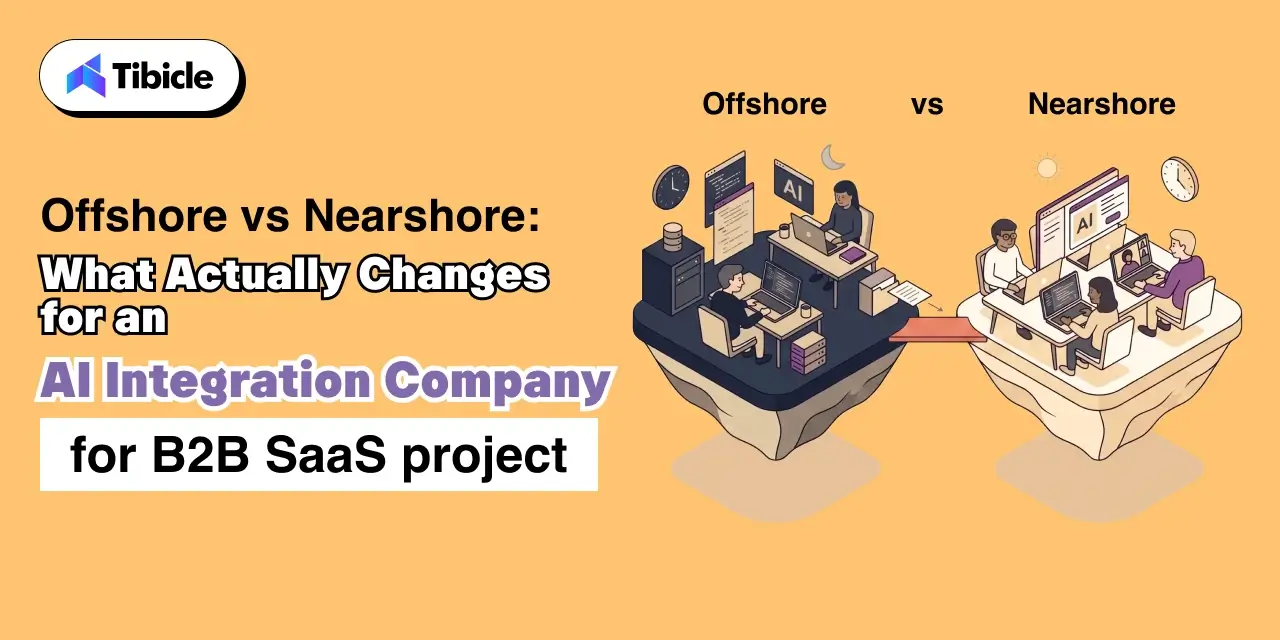
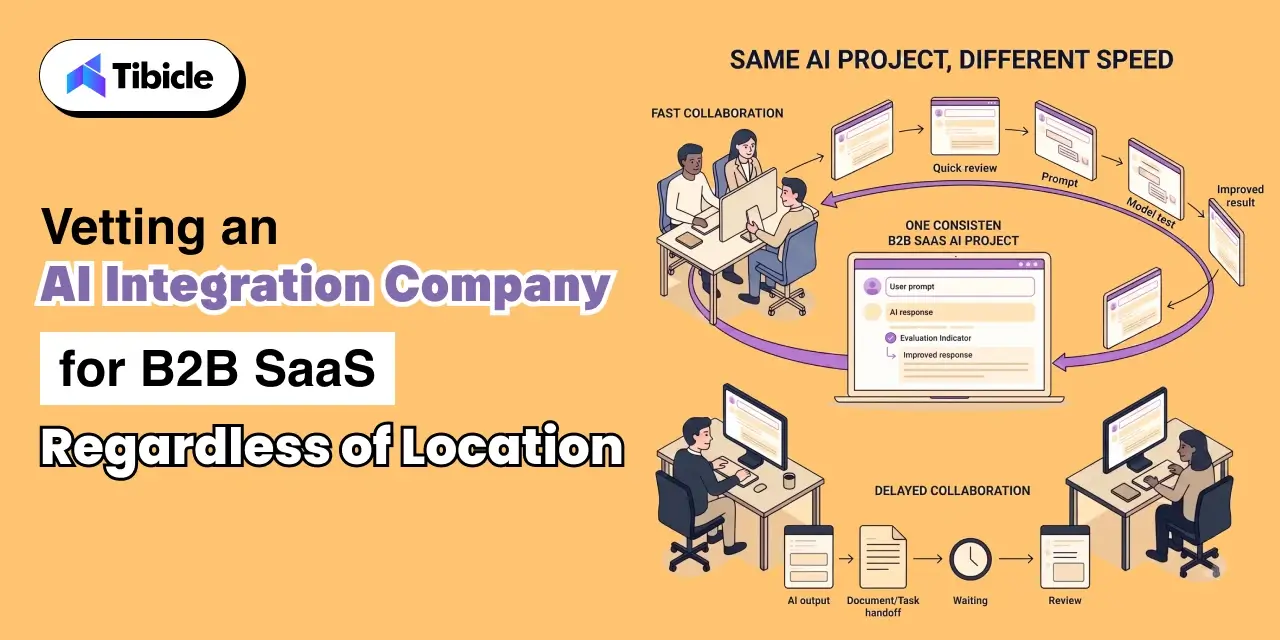
AI integration work is iterative in a way that a lot of traditional software development isn’t. Prompt behavior, retrieval quality, and model output all need to be reviewed against real examples, and those reviews are faster live than over an asynchronous ticket thread. Offshore teams in South or Southeast Asia typically offer limited same-day overlap with US business hours, which pushes review cycles onto a next-day cadence. Nearshore teams in Latin America generally overlap 4 to 8 hours with US working hours, which keeps daily standups, live debugging sessions, and rapid prompt-iteration cycles inside a single working day instead of stretching them across two.
Cost Differences Between Offshore and Nearshore AI Engineering Teams
Cost still matters, and the gap between offshore and nearshore rates is real, just smaller than it used to be as nearshore markets mature. The Latin America IT services outsourcing market generated $70.85 billion in revenue in 2024 and is projected to reach $126.32 billion by 2030 at a 10.1% CAGR, according to Grand View Research’s Latin America IT Services Outsourcing Outlook. That growth reflects rising demand for exactly this kind of nearshore engineering capacity, even at rates that sit above traditional offshore pricing.
In practical terms, offshore engagements still deliver the largest cost reduction against US in-house rates. Nearshore delivers a moderate reduction, positioned between offshore and onshore pricing, in exchange for the overlap advantage described above.
Communication and Cultural Alignment on Technical Reviews
Time zone overlap is only part of what makes a technical review effective. Nearshore teams working closely with US product organizations tend to develop closer alignment on how feedback gets delivered, how urgency gets communicated, and how much context gets assumed versus spelled out in a written brief. None of this is impossible to build with an offshore team, but it usually takes longer to establish and depends heavily on which specific people are assigned to the account, not just which country they’re in.
| Model | Typical Overlap and Cost | Best Fit |
| Offshore(e.g. South/Southeast Asia) | Limited same-day overlap, largest cost reduction | Well-scoped, well-documented work with less need for live collaboration |
| Nearshore(e.g. Latin America) | 4-8 hours of overlap with US business hours, moderate cost reduction | AI integration work needing frequent live review and iteration |
| Onshore | Full overlap, highest cost | Leadership roles or highly regulated in-person work |
Vetting an AI Integration Company for B2B SaaS Regardless of Location
Why Most AI Integration Company for B2B SaaS Projects Never Reach Production
Location is a smaller factor in project success than most procurement checklists suggest. About 95% of enterprise generative AI pilots deliver no measurable profit-and-loss impact, according to MIT NANDA’s “The GenAI Divide” report. That failure rate holds across offshore, nearshore, and onshore engagements alike, which means the
offshore-versus-nearshore decision matters less than most vendor evaluations assume. What separates the projects that reach production is scoping discipline, realistic evaluation criteria, and an engineering team that has actually shipped something similar before, not the time zone the team sits in.
Questions to Ask About Past AI Integration Work
Ask for the specific system architecture behind a past project, not just the outcome. What retrieval strategy did they use, and why that one over the alternatives? How did they handle hallucination or low-confidence outputs in production? What did the evaluation pipeline look like before the feature shipped? An AI integration company that has genuinely done this work will answer in specifics. One that hasn’t will drift back toward marketing language about “cutting-edge AI solutions” within a question or two.
Requesting a Scoped Proof of Concept Before Committing
A short, clearly scoped proof of concept, typically two to four weeks against a single well-defined use case, tells you more than any reference call. It shows how the team actually communicates, how quickly they surface problems instead of hiding them until the next milestone, and whether their estimate of effort was close to reality. Any vendor unwilling to structure a paid proof of concept before a longer commitment is asking you to skip the one step that would validate everything else in their pitch.
Security, IP, and Compliance Considerations Across Borders
Data Residency and Access Control With a Distributed Team
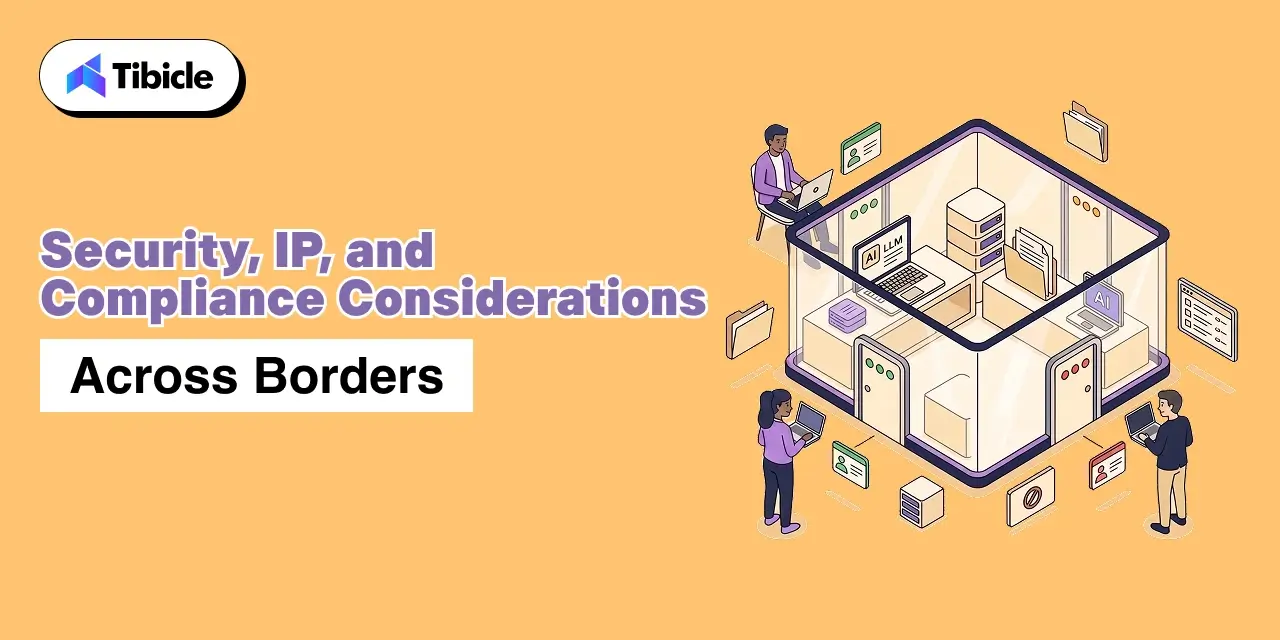
Governance gaps around AI access are common and expensive. Shadow AI now accounts for 43% of security incidents, more than double the prior year, and 92% of organizations that experienced an AI-related breach lacked proper AI access controls at the time, according to IBM’s Cost of a Data Breach Report 2026. A distributed engineering team, whether offshore or nearshore, adds another layer to this problem unless access is explicitly scoped and logged. Before any engineer touches production data, confirm exactly which systems they can reach, whether that access is role-based or blanket, and how it gets revoked when the engagement ends.
IP Assignment and Confidentiality Across Jurisdictions
A contract governed by US law doesn’t automatically mean the IP assignment clause is enforceable wherever the engineer actually lives and works. IP law varies by jurisdiction, and some countries require additional local documentation for a work-for-hire or assignment clause to hold up. This is worth confirming directly with the vendor rather than assuming the contract’s governing law clause covers it, particularly for any AI integration work that touches proprietary training data, prompts, or model configurations.
SOC 2 and Compliance Alignment With Your AI Integration Company for B2B SaaS Partner
SOC 2 compliance, or an equivalent framework, signals that a vendor has documented security practices rather than informal ones. But a claim of compliance and verified compliance are different things. Ask for the actual audit report or attestation, not just a badge on a website, and confirm it covers the specific team or subsidiary that will be working on your project rather than a parent company that carries the certification on paper only.
Confirm IP assignment terms are enforceable in the engineer’s home jurisdiction, not just in the contract’s governing law clause
Require a signed data processing agreement before any production access is granted
Ask which specific individuals will have access to production systems, not just which company
Verify SOC 2 or equivalent compliance status directly rather than accepting a claim at face value
Engagement Models: Staff Augmentation vs Dedicated AI Integration Company for B2B SaaS Team
Staff Augmentation for a Single AI Feature
Staff augmentation works well when your product team already has AI architecture decisions in place and needs additional engineering hands to implement a specific, well-defined feature. You retain ownership of design decisions; the augmented engineers execute against your existing roadmap and codebase conventions.
A Dedicated Team for Ongoing AI Roadmap Work
A dedicated team fits when AI integration isn’t a one-off feature but an ongoing part of the product roadmap: new model capabilities, expanding use cases, and continuous evaluation work that never really finishes. This structure gives the team context that compounds over time, since the same engineers carry institutional knowledge from one iteration to the next instead of relearning your system with every new project.
Fixed-Scope Projects and Where They Fall Short
Fixed-scope contracts work when requirements are genuinely stable, but AI integration work rarely stays that stable once real evaluation data starts coming in. Model behavior in production frequently reveals gaps that weren’t visible in the original scope, and a fixed-price contract without a change-order process either forces the vendor to cut corners to hit the original budget, or forces you into a slow renegotiation right when momentum matters most. Treat fixed-scope as a fit for narrow, well-understood integrations, not for exploratory AI roadmap work.
Red Flags When Evaluating an AI Integration Company for B2B SaaS
Vague Case Studies and No Named Technical References
Case studies that describe outcomes in general terms, “improved efficiency” or “streamlined operations”, without naming the client, the specific system built, or the engineer who led it, are a warning sign. Credible vendors can usually offer at least one reference call with an engineer who worked the project directly, not just an account manager summarizing it secondhand.
No Clear Answer on Data Handling or Model Training
Ask directly whether your data or prompts will be used to train or fine-tune any model, including models used for other clients. A vendor that hedges or gives an inconsistent answer across two different people on the same call hasn’t actually settled this internally, which means you’re the one absorbing that risk later.
Pricing That Doesn’t Map to a Defined Scope
A single lump-sum number with no breakdown by role, hours, or milestone makes it impossible to tell what you’re actually paying for, or to catch scope creep before it becomes a budget problem. A credible quote maps cost to defined deliverables and shows who is doing the work at each stage.
No engineer on the call can speak to a specific past RAG or LLM integration in technical detail
Vague answers about whether client data or prompts are used to train or fine-tune any model
A quote with no breakdown by role, hours, or milestone
No proposed proof-of-concept phase before a long-term contract is signed
How Tibicle Works as a Nearshore-Friendly AI Integration Company for B2B SaaS
Time Zone and Communication Fit for US Product Teams
Tibicle structures engagements around direct, senior-engineer access rather than routing every technical question through an account manager. That structure matters more for AI integration work than for standard feature development, since prompt tuning and evaluation review benefit from short, frequent feedback loops rather than long async threads. For B2B SaaS teams weighing an offshore vs nearshore AI engineering team decision, this kind of direct communication structure is what actually determines whether daily overlap translates into faster iteration.
AI Integration Process From Scoping to Production
Tibicle starts with a scoping phase. The team maps the AI capability to your existing architecture before coding begins. Next, the team runs a bounded proof of concept using real data. Only after that validation does the engagement move into full build, with evaluation criteria and success metrics defined upfront so both sides know what “production-ready” actually means before the sprint clock starts.
Ongoing Support and Team Scaling
Once an AI feature reaches production, the work doesn’t stop. Model behavior drifts, new use cases surface, and evaluation pipelines need maintenance. Tibicle keeps the same engineers on an account for ongoing roadmap work. The team can also scale as your AI roadmap expands. This avoids restarting the vetting process for each phase.
Key Takeaways for B2B SaaS Teams
Choosing an AI integration company for B2B SaaS is now a talent-access decision as much as a cost decision, given how scarce AI engineering skills are
Nearshore teams trade some cost savings for meaningfully more overlap with US working hours, which matters most on fast-iterating AI work
Vetting quality matters more than location. Most AI integration projects fail from weak scoping, not from where the engineers sit
IP assignment, data access, and compliance terms need to be settled before production access is granted, not after
Ready to talk through your AI roadmap? Book a call with Tibicle.
FAQ Section
What should a company look for in an AI Integration Company for B2B SaaS?
Look for engineers with specific AI integration experience. Ask how your data will be used. Review IP assignment terms in the engineer’s jurisdiction. Also, consider starting with a scoped proof of concept.
Is nearshore or offshore better for an ongoing AI Integration Company for B2B SaaS project?
Nearshore generally fits ongoing AI integration work better because of the daily overlap it provides for live review and iteration. Offshore can still work well for well-documented, well-scoped work that needs less real-time collaboration. Neither location guarantees success on its own; vetting quality matters more than the choice between the two.
How much time zone overlap do I actually need for AI engineering work?
Four to eight hours of overlap, the typical range for nearshore teams in Latin America, is usually enough to run daily standups and live technical reviews within a single working day. Less overlap pushes most feedback onto a next-day cycle, which slows iteration on prompt tuning and evaluation work specifically.
What questions should I ask about IP ownership and data handling before signing a contract?
Ask whether IP assignment is enforceable in the engineer’s home jurisdiction, not just under the contract’s governing law. Ask directly whether your data or prompts will be used to train or fine-tune any model. And require a signed data processing agreement before any production access is granted, not after the engagement starts.
Should I start with staff augmentation or a dedicated AI Integration Company for B2B SaaS team?
Staff augmentation fits a single, well-defined AI feature where your team already owns the architecture decisions. A dedicated team fits ongoing AI roadmap work where context and institutional knowledge need to compound across multiple projects over time.
Does Tibicle offer a nearshore-friendly AI Integration Company for B2B SaaS?
Yes. Tibicle works with B2B SaaS teams on AI integration projects with a structure built around direct senior-engineer access and daily overlap with US working hours, from initial scoping through a bounded proof of concept and into ongoing production support. Book a call to discuss a specific project.
Schedule A Developer Interview And Get 15 Days Risk-Free Trial
Schedule a Call

Relevant Blog
Custom AI Chatbot Development Services

Diya Koradiya

GraphRAG Implementation Services

Arjun Shinojiya
Enterprise AI Automation Development Agency
Arjun Shinojiya
Written by
Recent Blogs
AI Integration Company for B2B SaaS Guide
What This Guide Covers This guide examines how to choose an AI integration company for B2B SaaS when comparing offshore and nearshore engineering teams. It covers the factors that go beyond hourly rates, including talent access, time zone overlap, communication speed, and collaboration requirements for iterative AI projects. You will learn how to compare offshore […]
Custom AI Chatbot Development Services
What This Guide Covers Who this is for: CIOs, CTOs, AI leaders, operations executives, customer support teams, and enterprise technology decision-makers evaluating custom AI chatbot development services for internal knowledge access, customer support, helpdesk automation, or other business-critical use cases. It is particularly relevant for organisations with proprietary knowledge bases, sensitive data, complex access controls, […]
GraphRAG Implementation Services
Who this is for: Engineering leads and product owners at enterprise SaaS companies evaluating GraphRAG implementation services for a knowledge base or retrieval system that vector search alone is not answering well. Search intent: Commercial evaluation with a technical backbone. The reader has moved past “what is GraphRAG” and wants to know when a knowledge […]
Got an Idea? Get FREE Consultation
In our world, there's no such thing as having too many clients

