
Electron js development services: Offshore vs Nearshore Guide

Aug 25, 2026

Read in 5 Minutes
Table of Contents
- What This Guide Covers
- Introduction
- Why CTOs Choose Electron js Development Services
- Offshore vs Nearshore Electron js Development Services: Key Differences
- Cost of Offshore vs Nearshore Electron js Development Services
- Talent Availability for Electron js Development services and JavaScript Development
- Communication and Delivery Speed Across Time Zones
- How to Vet an Electron js Development Services Partner
- How Tibicle Delivers Electron js Development Services for US and EU Teams
- FAQ
What This Guide Covers
Who this is for: CTOs, SaaS founders, engineering leaders, product managers, and business owners evaluating Electron.js development services and deciding between offshore, nearshore, or blended development teams. It is especially useful for teams planning cross-platform desktop applications and looking to balance development cost, technical talent, communication, and delivery speed.
Search intent: Vendor evaluation and project planning. This guide is designed for teams that already understand the need for Electron.js development and want to determine which outsourcing model is the right fit. Rather than comparing vendors based only on hourly rates, it examines the broader factors that influence the real cost and success of an engagement, including time zone overlap, management overhead, talent availability, team structure, communication, IP protection, code quality, and vendor due diligence.
What you will walk away with: A practical comparison of offshore vs nearshore Electron.js development services, including regional hourly-rate benchmarks, total cost of ownership considerations, Electron-specific talent requirements, dedicated teams vs staff augmentation, communication models across time zones, and a structured vendor-vetting process. You will also learn how paid trial sprints, IP agreements, code reviews, and references can reduce outsourcing risk, along with how Tibicle supports US and EU teams through dedicated Electron teams, staff augmentation, structured communication, onboarding, and long-term support.
Introduction
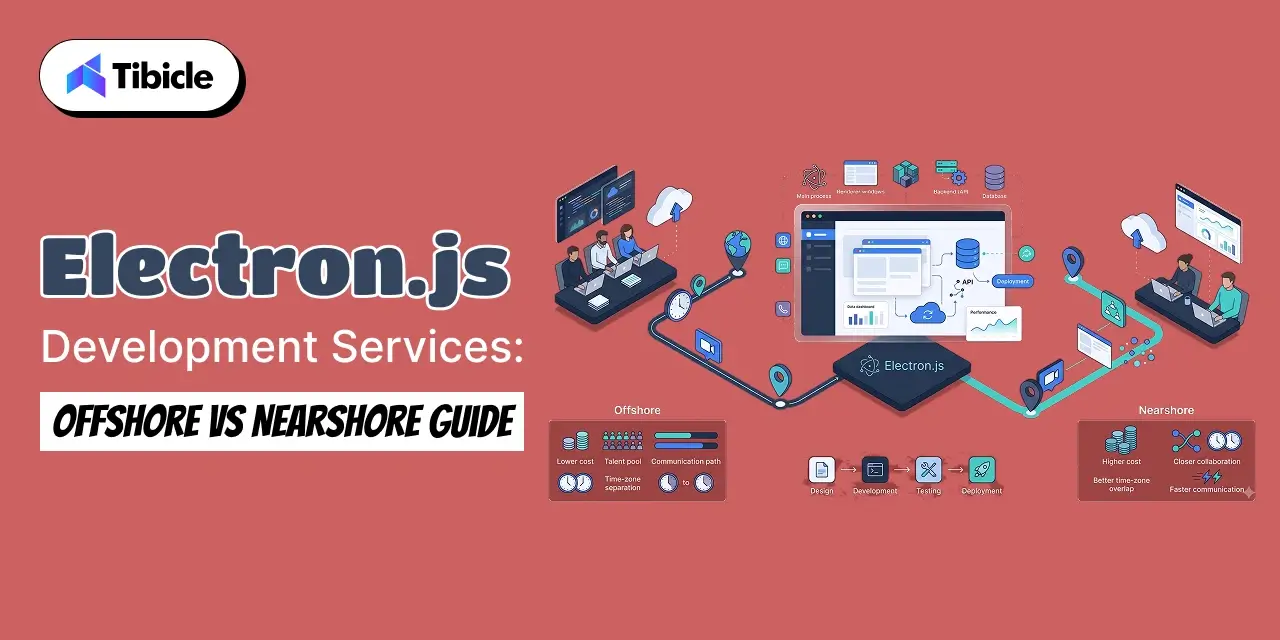
The global software development outsourcing market is worth roughly $618 billion in 2026. It is on track to reach $977 billion by 2031. The market is growing at a 9.6% annual rate. Meanwhile, Electron.js is a popular option for SaaS companies that need desktop apps. It lets teams build for Windows, macOS, and Linux from one codebase. As a result, companies can avoid maintaining separate native codebases.
For a CTO, the offshore versus nearshore decision on Electron.js development services rarely comes down to the hourly rate on a proposal. It comes down to total cost of ownership the rate, plus the management overhead, the ramp-up time, the review-cycle delays, and the risk of the wrong team touching your codebase. A cheaper rate that costs you three extra sprints in oversight isn’t actually cheaper.
This guide breaks down how offshore and nearshore Electron.js development services differ structurally, what they actually cost once the full picture is accounted for, how to evaluate talent depth, and what a vetting process should look like before you sign anything.
Electron.js has quietly become one of the more common outsourcing targets for SaaS companies that need a desktop presence. Building and maintaining native apps across three operating systems is expensive in a way that rarely shows up on a roadmap until a team is already behind. Electron collapses that into a single JavaScript, HTML, and CSS codebase that ships to all three platforms, which makes the required skill set look deceptively close to the web development skills most teams already have — while the actual engineering (native module bridging, code signing, auto-update pipelines, memory management) is a distinct discipline.
The Talent Gap Behind the Build vs Outsource Decision
The build-vs-outsource conversation is downstream of a talent problem that isn’t specific to Electron. 72% of employers globally reported difficulty finding the skilled talent they need in ManpowerGroup’s 2026 Talent Shortage Survey, a figure drawn from nearly 40,000 employers across 41 countries. Engineering and IT roles remain among the hardest to fill even as AI-specific skills have overtaken them at the very top of the list. For a CTO who needs a desktop app shipped on a fixed timeline, waiting on a domestic hire to materialize is often the more expensive option, even before comparing rates.
What Electron js Development Services Actually Cover
The label covers a wider range of engagements than most CTOs assume when they first start scoping a vendor:
- Cross-platform desktop app builds on a single Electron codebase
- Migration of an existing native app to Electron
- Ongoing maintenance, patching, and version upgrades
- Staff augmentation to extend an in-house team
Knowing which of these you actually need changes the sourcing conversation. A one-time migration project suits a fixed-scope offshore engagement. An ongoing product with a roadmap that changes every sprint suits nearshore staff augmentation or a blended model.
Rate is the number every proposal leads with, but it’s not the variable that determines whether the engagement actually works. Three structural differences matter more day to day: how much of the workday overlaps, how the team is managed, and how the contract is structured.
Time Zone Overlap and Daily Collaboration
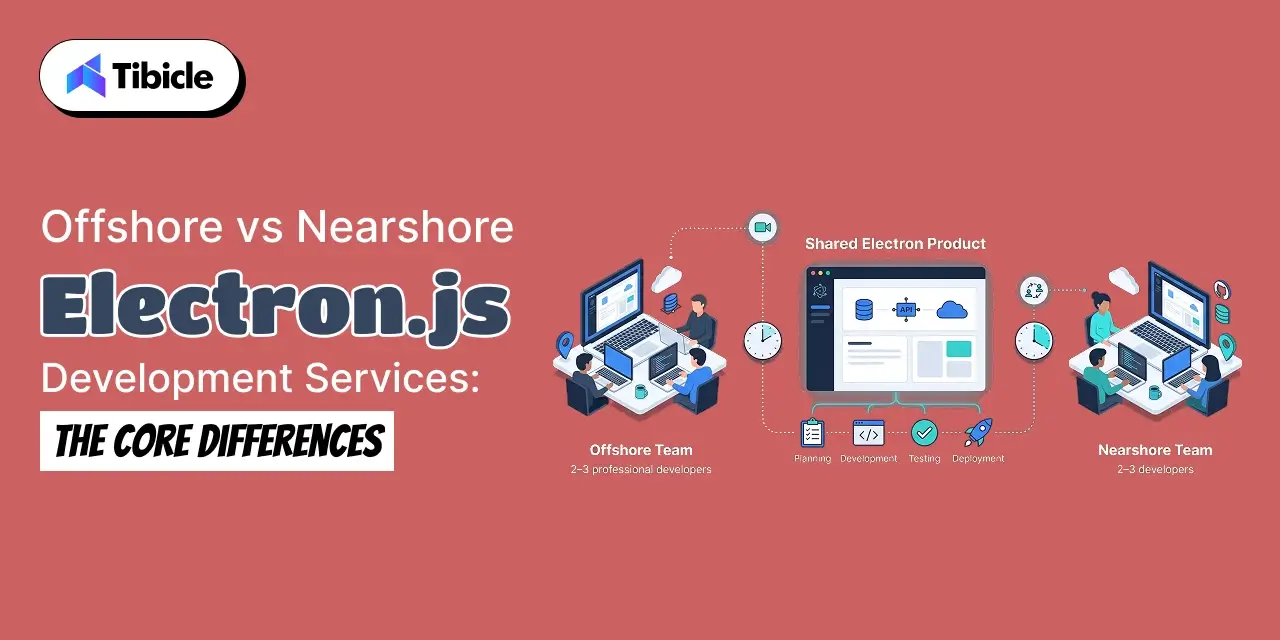
Nearshore teams, typically two to four time zones away, can usually join a live standup and overlap for most of a working day. Offshore teams, often eight to twelve time zones out, may share only an hour or two of live overlap, or none at all. That doesn’t make offshore unworkable; it changes how work gets handed off. A well-run offshore team operates on detailed written specs and asynchronous check-ins rather than live pairing.
Oversight, Reporting Lines, and Contract Structure
Nearshore engagements more often run as an extension of the in-house team, with the same daily rituals, the same sprint cadence, and a developer who effectively sits inside your existing reporting structure. Offshore engagements more commonly run through a vendor’s own project manager, with your side reviewing at milestone checkpoints rather than daily. Neither is inherently better oversight, it’s a different oversight model, and it should match how hands-on your own team wants to be.
Where Each Model Tends to Fit Best
- Offshore for a defined scope with a mature specification and less need for daily sync
- Nearshore for active product work that needs daily standups in a shared time window
- A blended model with a nearshore lead and an offshore delivery team for cost control
Cost of Offshore vs Nearshore Electron js Development Services
The hourly rate on a proposal is the easiest number to compare and the least useful one on its own. It’s a starting point for a total-cost-of-ownership calculation, not the calculation itself.
Regional averages vary widely, and even within a region, rates shift with seniority, tech stack, and how specialized the work is. Accelerance’s 2026 Global Software Development Rates & Trends Guide puts current bands roughly as follows:
| Region | Typical Hourly Rate Range | Common Fit |
| South Asia (including India) | $15 to $45 | Long-term dedicated teams, cost-sensitive builds |
| Eastern Europe | $35 to $70 | Senior engineering depth, EU time zone overlap |
| Latin America | $25 to $60 | US time zone overlap, active daily collaboration |
| Western Europe or North America | $65 to $150+ | Onshore oversight, highly regulated projects |
These bands are for context when comparing proposals, not a quote for any specific engagement; actual rates depend on seniority, specialization, and engagement length.
What the Hourly Rate Does Not Include
A quoted rate almost never covers the full cost of getting an Electron.js build shipped:
- Project management and account oversight time
- Onboarding, ramp-up, and knowledge transfer
- Time zone-driven delays on review cycles
- Turnover and backfill risk on longer engagements
Calculating True Total Cost of Ownership
A useful way to stress-test a proposal is to add a management overhead line (typically 10–20% of the engineering spend for offshore, less for nearshore where oversight is lighter), a one-time ramp-up cost for the first four to six weeks, and a contingency line for backfill if a developer rotates off the project. Once those are added, a $25/hour offshore rate and a $50/hour nearshore rate can land closer together than the headline numbers suggest, which is the point of running the math before comparing quotes.
Talent Availability for Electron js Development services and JavaScript Development
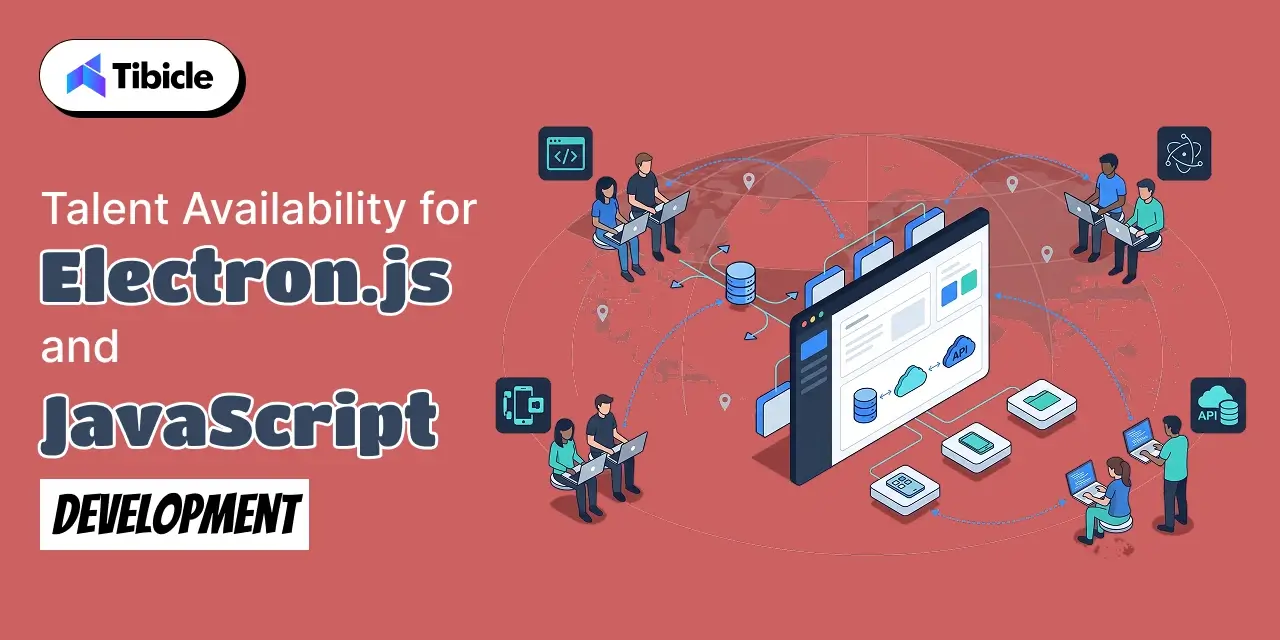
Electron sits on top of a very large JavaScript talent pool, but the pool of engineers who have actually shipped a production Electron app is much smaller than the pool of engineers who list JavaScript on a resume.
The Size of the JavaScript Talent Pool by Region
India illustrates the scale available in a single hub: the country’s technology industry workforce reached nearly 6 million employees in FY26, according to Nasscom’s Annual Strategic Review 2026, with the industry adding roughly 135,000 net new jobs during the year. That scale is what allows offshore vendors in hubs like India to staff dedicated Electron teams without pulling engineers off other client work, a depth that’s harder to replicate in smaller nearshore markets.
Vetting for Electron-Specific Experience, Not Just JavaScript
A general JavaScript developer and an Electron developer are not the same hire. Before engaging any vendor, check for:
- Portfolio proof of shipped desktop apps, not only web apps
- Familiarity with native module integration in C++ or Rust
- Experience with code signing and auto-update pipelines
- Comfort working across Windows, macOS, and Linux builds
Team Structure: Dedicated Team vs Staff Augmentation
A dedicated team works best when the Electron build is a distinct, ongoing product line with its own roadmap, the vendor owns architecture decisions within agreed guardrails. Staff augmentation works best when you already have technical leadership in-house and simply need hands to execute against a spec your own architects have set. Offshore vendors more commonly propose dedicated teams by default; nearshore engagements slot more naturally into staff augmentation.
Communication and Delivery Speed Across Time Zones
Cost and talent depth get most of the attention in vendor comparisons, but time zone mismatch is what actually slows delivery down week to week.
Daily Standups and Live Pairing Windows
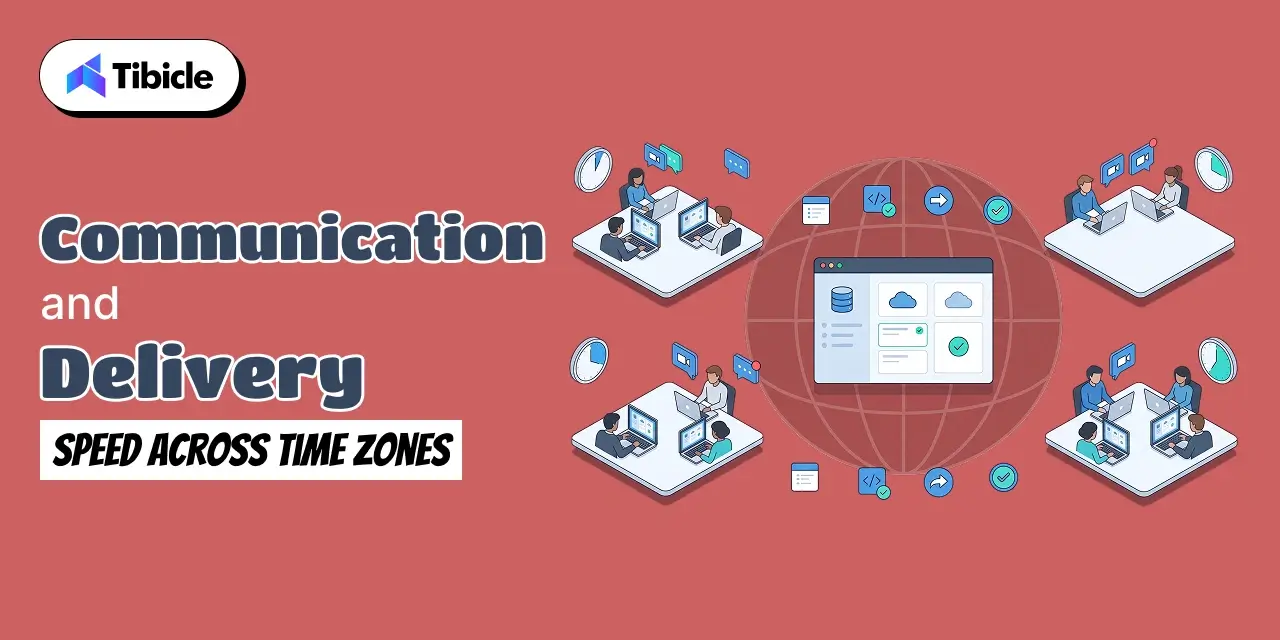
With four or more hours of overlap, a live daily standup and same-day code review are realistic. That’s typically achievable with nearshore teams in Latin America for US-based CTOs, or Eastern Europe for EU-based CTOs.
Asynchronous Handoff Models for Wider Time Gaps
With little or no overlap, the model shifts to a handoff: your team ends the day with a written brief, the offshore team works through their day, and you review what’s ready when you’re back online. This works well for well-specified, self-contained tickets and poorly for ambiguous, fast-changing scope.
Language, Documentation, and Communication Norms
English proficiency is generally strong across the major outsourcing hubs, but written documentation quality varies more than spoken fluency does. For asynchronous models especially, ask a prospective vendor for a sample of how they document a handoff — it’s a better signal than a call.
The location decision and the vendor decision are separate. A strong nearshore vendor can be a poor fit, and a strong offshore vendor can be an excellent one, due diligence is what tells them apart.
Code Quality and Architecture Review
Ask for a sample of recent Electron code, not just a portfolio site. Look specifically at how the main and renderer processes are separated, how IPC is handled, and whether the app follows current Electron security recommendations around context isolation.
IP Protection, Contracts, and Data Handling
Get a signed NDA and IP assignment agreement in place before any proprietary code or specs are shared, and confirm in writing where code and data are stored during development, not just after handover.
References and a Paid Trial Sprint
This is where sourcing diversification data becomes relevant: organizations aren’t just picking a single vendor and staying put. Deloitte’s Global Outsourcing Survey found 67% of surveyed executives are already moving toward outcome-based outsourcing relationships rather than simple time-and-materials contracts, reflecting a broader shift toward proving value before committing long-term. A paid trial sprint applies that same logic at the vendor level:
- A signed IP assignment and NDA before any code is shared
- A short paid trial sprint before a long-term commitment
- References from a client of comparable size and industry
- A clear escalation path if delivery slips
How Tibicle Delivers Electron js Development Services for US and EU Teams
Dedicated Team and Staff Augmentation Models
Tibicle works with CTOs under both models: a dedicated Electron team that owns a build end to end, or staff augmentation that slots experienced Electron developers into an existing engineering team without disrupting how that team already runs sprints.
Communication Cadence Across US and EU Time Zones
Engagements are structured around a live overlap window with US and EU teams for standups and reviews, backed by written handoff documentation for anything that falls outside that window, so delivery doesn’t stall on a missed call.
Onboarding, Code Handover, and Long-Term Support
Every engagement starts with a defined onboarding period covering codebase walkthroughs, access provisioning, and a documented architecture review, and continues into long-term support and version maintenance after launch, so the relationship doesn’t end at handover.
Key Takeaways for CTOs
Offshore and nearshore aren’t a single cost decision; oversight model and time zone overlap matter as much as the hourly rate on the table. The quoted rate is rarely the full cost once management time, ramp-up, and review-cycle delays are factored in. A large JavaScript talent pool narrows fast once you filter for actual shipped Electron experience, native module work, and code-signing familiarity. Before any long-term commitment, get a signed IP agreement in place and run a short paid trial sprint to see how the team actually works, not just how the proposal reads.
Ready to scope your Electron.js build? Book a call with Tibicle.
FAQ
What is the difference between offshore and nearshore Electron js development services?
Nearshore teams sit two to four time zones away and typically overlap for most of a working day, which supports live standups and same-day reviews. Offshore teams sit further out, often eight or more time zones away, with limited or no live overlap, which shifts collaboration toward written specs and asynchronous handoffs.
How much do Electron js development services cost offshore versus nearshore?
Offshore rates in South Asia typically run $15–$45 per hour, while nearshore rates in Latin America run closer to $25–$60 per hour, according to Accelerance’s 2026 rate benchmarks. The gap narrows once management overhead, ramp-up time, and review delays are added to each option’s total cost.
How do I vet an offshore team for Electron js development services experience specifically?
Ask for portfolio proof of shipped desktop apps rather than web apps alone, and probe for experience with native module integration, code signing, and auto-update pipelines. General JavaScript fluency doesn’t guarantee Electron-specific competence.
Does nearshore always mean better communication than offshore?
Not automatically. Nearshore gives you more live overlap, but communication quality still depends on the vendor’s documentation habits and English proficiency. A well-run offshore team with strong written handoffs can outperform a poorly managed nearshore one.
Can a CTO combine offshore and nearshore teams on the same Electron js development services project?
Yes. A common blended model uses a nearshore lead for daily collaboration and architecture decisions, paired with an offshore delivery team for cost-efficient execution on well-specified tickets.
Does Tibicle offer both dedicated team and staff augmentation models for Electron js development services projects?
Yes. Tibicle supports both a fully dedicated Electron team that owns the build end-to-end, and staff augmentation that adds experienced Electron developers into an existing in-house team.
Schedule A Developer Interview And Get 15 Days Risk-Free Trial
Schedule a Call

Relevant Blog


Offline Local LLM Desktop App Integration in Electron

Aditya Changlani

Custom AI POS Software Development with Electron & IoT
Aditya Changlani
Written by

Diya Koradiya
Business Development Executive
I'm Diya Koradiya, Business Development Executive at Tibicle LLP. I connect business ideas with the right technology, turning requirements into purposeful digital solutions. With a strong emphasis on clarity and collaboration, I help clients move forward by aligning practical needs with smart innovation.
Related posts
Desktop AI App Development Cost Guide: Budgeting On-Device LLMs via Electron in 2026
What This Guide Covers Who this is for: CTOs, product managers, and founders at SaaS and software companies planning a desktop app with local AI features, or adding on-device inference to an existing Electron product for desktop ai app development cost. Search intent: Understand desktop AI app development cost, including on-device LLM integration cost, hardware […]
08 Oct 2026 | Dhairya Dadhania
Offline Local LLM Desktop App Integration in Electron
What This Guide Covers Who this is for This guide is intended for engineering leads, staff engineers, and technical founders building or maintaining Electron-based desktop applications that must function without a constant connection, particularly teams undertaking offline local LLM desktop app integration to add on-device inference. It is also relevant to product managers scoping offline […]
07 Oct 2026 | Aditya Changlani
Custom AI POS Software Development with Electron & IoT
What This Guide Covers Who this is for: CTOs, retail technology leaders, and product owners at retail chains, grocery and convenience operators, and POS vendors evaluating custom AI POS software development for an AI-enabled checkout or a terminal refresh. Search intent: Understand how custom AI POS software development works, including Electron architecture, IoT integration […]
06 Oct 2026 | Aditya Changlani
Got an Idea? Get FREE Consultation
In our world, there's no such thing as having too many clients

Email
tea@tibicle.com

Phone
+91 9724922880