
HubSpot vs Salesforce: Which CRM Is Best in 2026?

May 18, 2026

Read in 4 Minutes
Table of Contents
- Introduction
- HubSpot vs Salesforce CRM Architecture Comparison
- HubSpot vs Salesforce: Feature Comparison
- HubSpot vs Salesforce – Head-to-Head Comparison
- CRM Pricing Comparison: HubSpot vs Salesforce (2026)
- HubSpot vs Salesforce ROI Comparison
- HubSpot vs Salesforce Risks and Hidden Costs
- Best CRM for Business Growth: HubSpot vs Salesforce
- CRM Vendor Evaluation Checklist
- Why Tibicle LLP Helps You Get the Most Out of Either Platform
- Conclusion
- FAQs
Introduction
The global CRM market is projected to exceed $80 billion in 2026, with HubSpot vs Salesforce consistently ranking as the two most evaluated platforms across mid-market and enterprise CRM shortlists. For revenue leaders, CXOs, and operations teams, this decision is not simply a software subscription change – it is a long-term infrastructure commitment that directly impacts revenue operations, customer acquisition, reporting architecture, marketing efficiency, and organizational scalability.
Choosing between these platforms requires evaluating more than brand recognition. Businesses must assess platform architecture, pricing structures, implementation demands, AI capabilities, and long-term operational fit. While HubSpot often appeals to speed-focused organizations seeking usability and integrated marketing, Salesforce remains dominant for enterprises prioritizing deep customization and large-scale process control.
Evaluating CRM comparison 2026 factors, such as pricing, AI capabilities, implementation complexity, and total cost of ownership, is critical for selecting the right platform for your current business stage and projected growth over the next 18 months.
HubSpot vs Salesforce CRM Architecture Comparison
CRM Platform Structure and Business Benefits of HubSpot
HubSpot operates on a unified platform architecture where Marketing, Sales, Service, and Operations Hubs all share the same contact database. This structure eliminates middleware dependency during marketing-to-sales handoffs and simplifies operational visibility across departments. HubSpot works especially well for businesses that want centralized workflows without hiring dedicated CRM administrators.
Its integrated structure also reduces implementation friction and simplifies reporting consistency across customer acquisition, retention, and support teams. Organizations prioritizing fast onboarding and operational simplicity often prefer HubSpot for this reason.
CRM Platform Architecture and Enterprise Scalability of Salesforce
Salesforce follows a modular architecture built around separate cloud products, including Sales Cloud, Service Cloud, and Marketing Cloud. This structure allows significantly deeper customization but also increases operational complexity. Most enterprise Salesforce environments require certified administrators, implementation consultants, or external partners to maintain workflows and integrations effectively.
Salesforce is best suited for organizations with complex sales structures, compliance-heavy processes, multi-entity operations, and advanced reporting requirements that demand high CRM scalability.
HubSpot vs Salesforce: Feature Comparison
Sales Pipeline and Forecasting
HubSpot provides visual drag-and-drop pipeline management that works effectively for standard B2B sales cycles out of the box. Teams can quickly configure stages, automate deal tracking, and enable sales pipeline automation without extensive technical setup.
Salesforce offers more advanced territory management, enterprise forecasting, and multi-stakeholder deal tracking capabilities. Its flexibility is significantly deeper, making it suitable for organizations managing layered sales hierarchies and complex revenue operations.
Marketing Automation
HubSpot positions itself as an integrated marketing automation platform, including email marketing, landing pages, SEO tools, workflows, blog management, and advertising integrations across paid tiers. Businesses benefit from having marketing and CRM operations connected natively.
Salesforce requires a separate Marketing Cloud or Pardot purchase for advanced marketing capabilities. Pricing starts at approximately $1,250 per month, which significantly increases operational spend for teams needing enterprise automation.
Customer Service and Support
HubSpot Service Hub includes ticketing, knowledge bases, shared inboxes, and customer support workflows unified directly within CRM records. This structure simplifies collaboration between sales and support teams.
Salesforce Service Cloud focuses more heavily on enterprise support environments with omnichannel routing, SLA management, and advanced case escalation systems for high-volume operations.
AI – Breeze vs Agentforce
The comparison between Breeze AI vs Agentforce reflects accessibility versus enterprise depth. HubSpot Breeze deploys rapidly with native CRM integration and claims productivity improvements of up to 76% across sales teams.
Salesforce Agentforce supports billions of enterprise workflows monthly and serves over 18,500 organizations, but implementation often requires AI specialists, engineering support, and multi-month deployment cycles.
HubSpot vs Salesforce – Head-to-Head Comparison
| Criteria | HubSpot | Salesforce |
| Best for | SMB to mid-market | Enterprise |
| Marketing included | Yes – all tiers | No – separate purchase |
| Implementation time | Days to weeks | 1–6 months |
| Dedicated admin required | No | Yes |
| AI tool | Breeze | Agentforce |
| Free tier | Yes | Limited |
| Gartner rating | 4.4 / 5 | 4.2 / 5 |
| Customization ceiling | High | Very high |
| CRM market share | ~15% | ~21.8% |
Not sure which column fits your team? Book a 30-minute CRM fit call with Tibicle.
CRM Pricing Comparison: HubSpot vs Salesforce (2026)
HubSpot Pricing Structure 2026
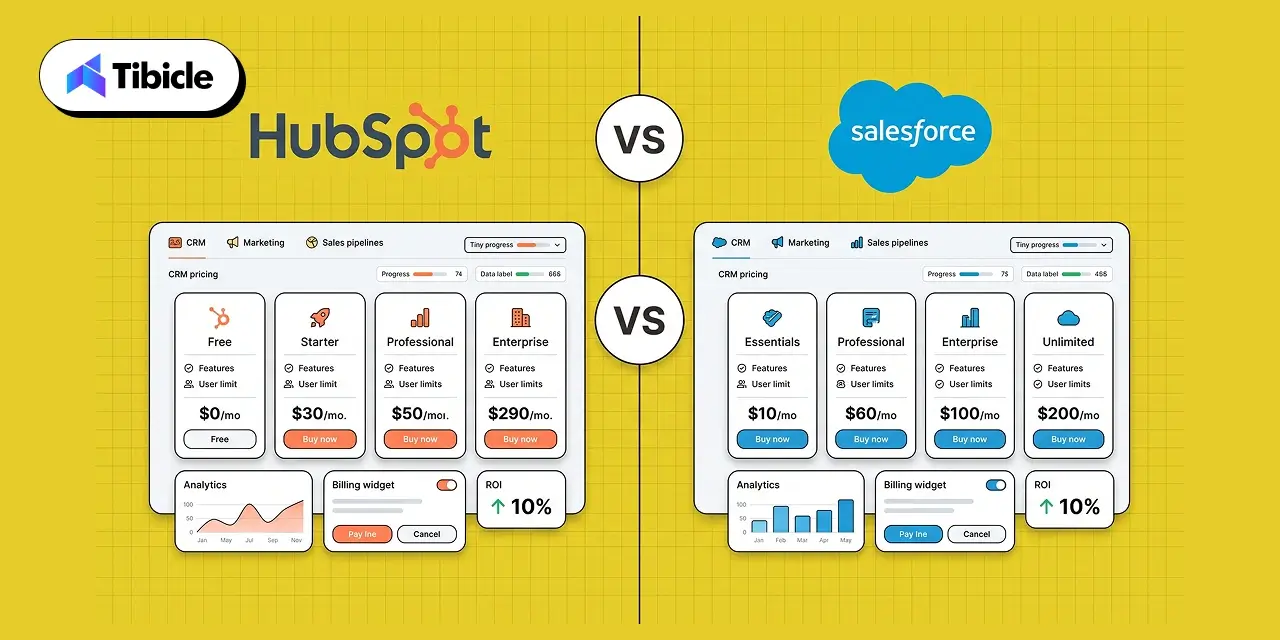
HubSpot pricing 2026 follows a hub-based structure with Starter, Professional, and Enterprise tiers across Marketing, Sales, Service, and Operations products. Marketing Hub Professional begins around $800 per month with three included seats, while Sales Hub Enterprise uses predictable contact-based pricing.
HubSpot’s pricing model is generally easier to forecast because most tools are bundled directly into the platform instead of being sold as separate cloud products.
Salesforce Pricing Structure 2026
Salesforce pricing 2026 starts at approximately $25 per user monthly for Starter Suite plans, though automation and reporting capabilities remain limited at lower tiers. Enterprise plans range between $100–$175 per user monthly.
Marketing Cloud (Pardot) costs an additional $1,250–$4,200 monthly, while Agentforce AI uses consumption-based pricing starting around $2 per conversation.
HubSpot vs Salesforce Total Cost of Ownership
For a 25-user mid-market team, estimated crm total cost of ownership reaches approximately $123K for HubSpot versus roughly $375K for Salesforce across three years. Salesforce environments also frequently require dedicated administrators costing $70K–$250K annually.
Nearly 86% of HubSpot customers manage the platform internally without dedicated admins. By comparison, a 50-person Salesforce Enterprise deployment often costs nearly three times more than the HubSpot equivalent before marketing add-ons and implementation services are included.
HubSpot vs Salesforce ROI Comparison
Where HubSpot Delivers ROI
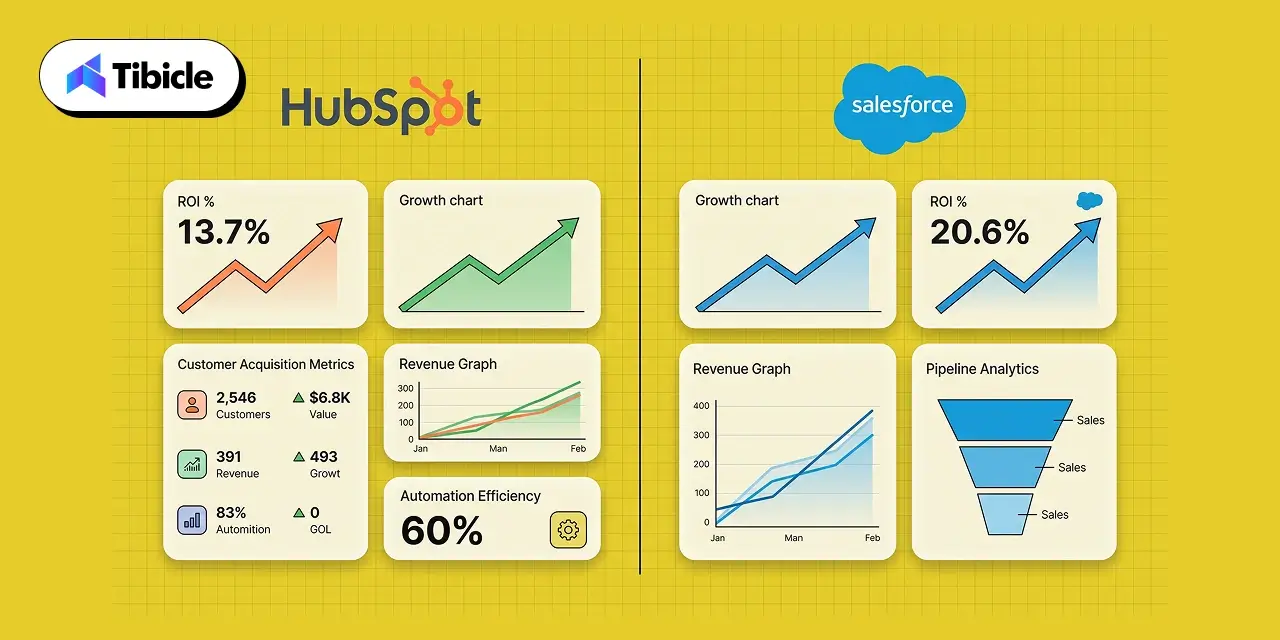
HubSpot typically delivers the strongest ROI for organizations prioritizing speed, usability, and connected operational workflows. Companies using unified customer data report up to four times better ROI from sales and marketing alignment initiatives. Sales teams using HubSpot Sales Hub also report significantly higher win rates and faster onboarding cycles.
Several organizations have reduced operational cost substantially after shifting away from Salesforce toward simplified HubSpot environments with lower admin overhead and faster reporting visibility.
Where Salesforce Delivers ROI
Salesforce delivers stronger ROI in highly regulated industries, multi-cloud enterprise environments, and organizations with complex operational hierarchies. Agentforce AI supports enterprise-scale workflow orchestration across billions of monthly automated interactions.
However, Salesforce ROI depends heavily on implementation quality. Poor architecture, weak adoption planning, or over-customization often turn deployments into expensive operational burdens instead of revenue accelerators.
ROI Decision Matrix
- Under 200 users with marketing-led growth → HubSpot
- Over 500 users with complex sales operations → Salesforce
- Regulated industries like fintech and healthcare → Salesforce industry clouds
- Organizations prioritizing fast deployment and usability → HubSpot
HubSpot vs Salesforce Risks and Hidden Costs
HubSpot Risks
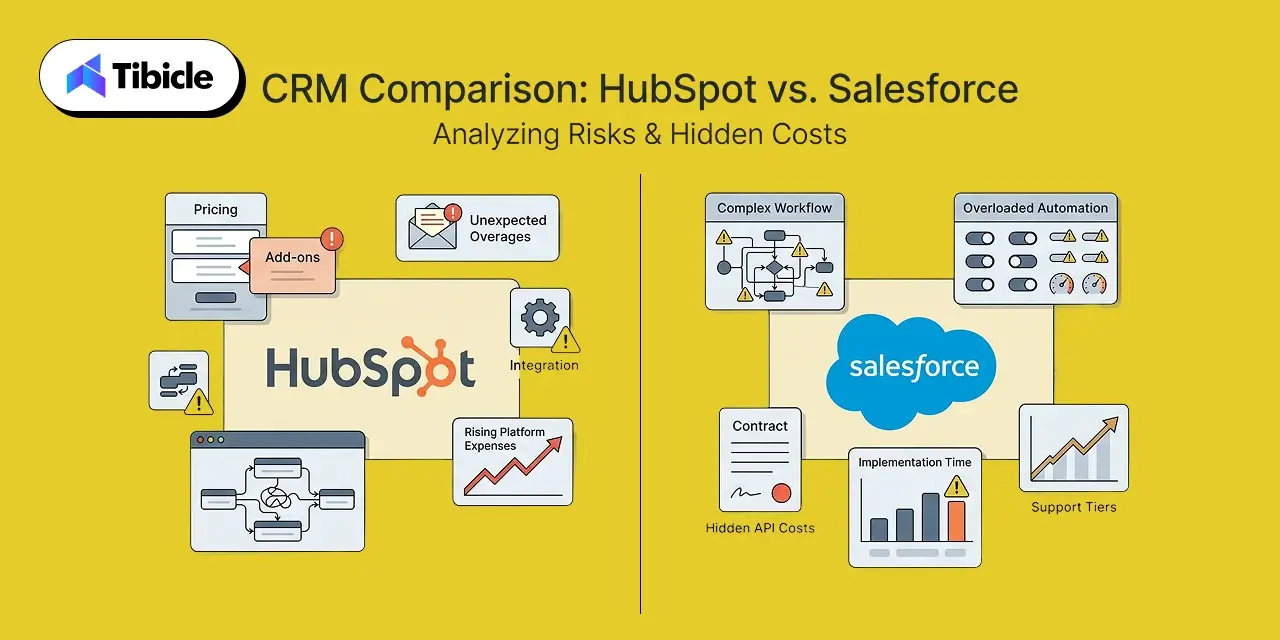
HubSpot’s biggest limitation appears at very large operational scale. Organizations managing over one million records may encounter customization and performance constraints. Pricing also rises significantly as contact databases and seat counts expand.
Salesforce Risks
Salesforce environments frequently introduce hidden operational expenses including storage overages, annual pricing escalators, implementation consulting fees, and high CRM implementation cost structures tied to customization complexity. Poor deployment planning often creates data silos and low platform adoption.
Switching away from Salesforce can also become expensive because CRM migration complexity increases significantly once large-scale custom workflows and integrations are deeply embedded into operations.
Best CRM for Business Growth: HubSpot vs Salesforce
The best CRM depends on your business size, operational complexity, and long-term growth strategy.
- Startups → HubSpot
HubSpot offers faster implementation, lower upfront costs, integrated marketing tools, and easier adoption for early-stage growth. - SMBs → HubSpot
Small and mid-sized businesses benefit from HubSpot’s usability, predictable pricing, and lower administrative overhead. - Enterprises → Salesforce
Salesforce is better suited for large organizations needing deep customization, advanced workflows, enterprise compliance, and large-scale CRM scalability. - Hybrid Growth Models → Both
Many scaling businesses use HubSpot for marketing automation and customer acquisition, while Salesforce manages enterprise sales operations and complex revenue processes.
HubSpot is typically stronger for speed, simplicity, and lower total cost of ownership, while Salesforce is ideal for enterprise-grade customization and large-scale operational control.
CRM Vendor Evaluation Checklist
Before selecting the best CRM for business growth, organizations should evaluate both platforms against operational and financial requirements rather than feature lists alone.
- Current team size vs projected 24-month growth
- Marketing capabilities included vs sold separately
- Implementation timeline operations teams can realistically absorb
- Internal or outsourced admin availability
- AI activation speed vs enterprise orchestration needs
- ERP, finance, and billing integration requirements
- Migration complexity from existing systems
- Contract escalation clauses and storage limitations
- Support tiers included vs paid upgrades
- Compliance requirements, including GDPR, SOC 2, HIPAA, and FINRA
The right CRM decision depends on operational fit, long-term maintainability, and scalability – not just vendor reputation.
Why Tibicle LLP Helps You Get the Most Out of Either Platform
Tibicle works across both HubSpot and Salesforce implementations without platform bias in recommendations. Their approach focuses on selecting CRM architecture that aligns with operational workflows, reporting needs, and long-term business scalability rather than pushing a specific vendor ecosystem.
Services include CRM selection advisory, implementation planning, workflow optimization, migration support, integration setup, and ongoing operational management. Tibicle supports both first-time CRM adopters and organizations consolidating fragmented systems into unified customer operations.
Their consulting process also emphasizes cost visibility, implementation practicality, and adoption planning to reduce operational disruption during rollout phases.
Talk to Tibicle’s CRM team before you sign. One hour now can save 12 months of re-architecture later.
Conclusion
The core difference in the crm comparison 2026 conversation remains straightforward: HubSpot prioritizes usability, faster onboarding, and lower operational overhead, while Salesforce delivers deeper customization, enterprise scalability, and advanced workflow control. Neither platform is universally correct for every business.
The right decision depends on organization size, reporting complexity, compliance requirements, internal operational maturity, and long-term growth expectations. Businesses should evaluate total platform ownership across at least 36 months rather than focusing only on entry-level subscription pricing.
The dual-platform strategy – HubSpot for marketing operations and Salesforce for enterprise sales workflows – is becoming increasingly common among scaling organizations moving beyond 200 users.
Ready to match the right CRM to your growth stage? Connect with Tibicle’s implementation team for a no-obligation fit assessment.
FAQs
Is HubSpot or Salesforce better for small businesses?
HubSpot is generally the stronger option for businesses under 200 employees because it offers faster setup, lower admin dependency, integrated marketing tools, and a free CRM tier.
What is the real cost difference between HubSpot and Salesforce?
A 25-user mid-market deployment typically costs around $123K with HubSpot versus approximately $375K with Salesforce across three years after implementation, admin, and marketing add-on expenses are included.
Can HubSpot handle enterprise-level CRM requirements in 2026?
Yes. HubSpot Enterprise supports advanced reporting, custom objects, predictive lead scoring, and scalable operations for organizations with hundreds or thousands of users.
What is the difference between Breeze AI and Agentforce?
HubSpot Breeze deploys quickly with native CRM integration, while Salesforce Agentforce provides deeper enterprise AI orchestration but requires longer implementation and specialized technical resources.
Is it possible to use both HubSpot and Salesforce together?
Yes. Many organizations use HubSpot for marketing automation and top-of-funnel engagement while Salesforce manages enterprise sales operations and compliance-heavy workflows.
How long does a CRM migration from Salesforce to HubSpot take?
Most migrations for organizations with 20–100 users take between four and twelve weeks, depending on integration complexity, workflow mapping, and historical data cleanup requirements.
Schedule A Developer Interview And Get 15 Days Risk-Free Trial
Schedule a Call

Relevant Blog
Enterprise AI Automation Development Agency

Arjun Shinojiya

Legacy Application AI Modernization Services
Arjun Shinojiya
Custom Computer Vision Software Development Company
Arjun Shinojiya
Written by

Recent Blogs
Enterprise AI Automation Development Agency
Who this is for: Operations leads, CTOs, and process owners evaluating an enterprise AI automation development agency for a full business process rather than a single bolted-on bot. Search intent: Commercial evaluation with a technical backbone. The reader has moved past “what is workflow automation” and wants to know why point-solution RPA plateaus, what end-to-end […]
Legacy Application AI Modernization Services
Who this is for: Engineering leads, CTOs, and IT decision-makers responsible for a legacy web or desktop application who are evaluating AI modernization services for legacy applications rather than a full ground-up rebuild. Search intent: Commercial evaluation with a technical backbone. The reader has moved past “what is legacy modernization” and wants to know where […]
Custom Computer Vision Software Development Company
Who this is for: Engineering leads, product owners, and operations heads at B2B enterprises evaluating a custom computer vision software development company for a real visual-data workflow rather than a demo. Search intent: Commercial evaluation with a technical backbone. The reader has moved past “what is computer vision” and wants architecture choices, accuracy data, and […]
Got an Idea? Get FREE Consultation
In our world, there's no such thing as having too many clients

