
Restaurant POS Systems Explained: Types, Features, and How to Choose One

Jul 22, 2026

Read in 4 Minutes
Table of Contents
Introduction
The point of sale is the operational hub of a modern restaurant. The market for restaurant POS systems reflects it. The global restaurant POS systems market was valued at $15.38 billion in 2024. It is projected to reach $27.8 billion by 2033, growing at a 6.8% CAGR. Yet most operators choose among restaurant POS systems on the headline monthly price. They discover the real cost and the real limitations months later.
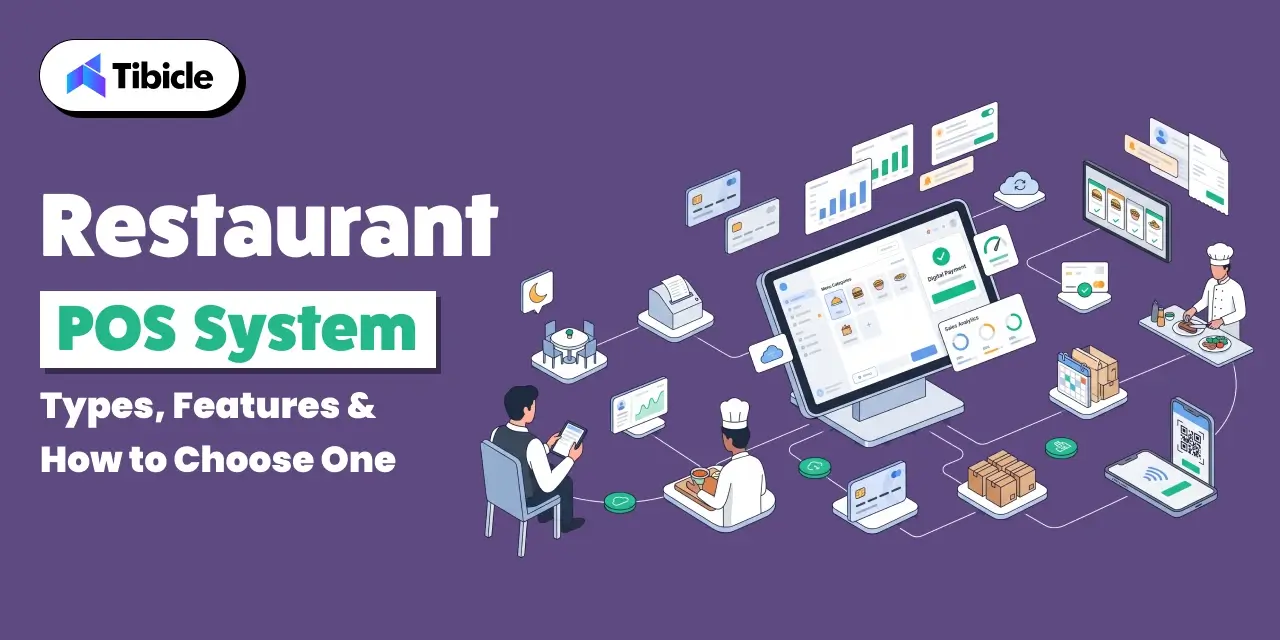
Restaurant POS systems have moved well beyond ringing up orders. They now route tickets to the kitchen, track inventory, manage labor. They also pull every sales channel into one place, most often through a cloud-based POS system. Choosing well means understanding the types, the features that actually move the P&L. The cost layers vendors do not advertise. This guide explains restaurant POS systems end to end: what they are, the main types, the features to prioritize. It also coverts what they cost in 2026, and a framework for choosing one.
What a Restaurant POS System Actually Is
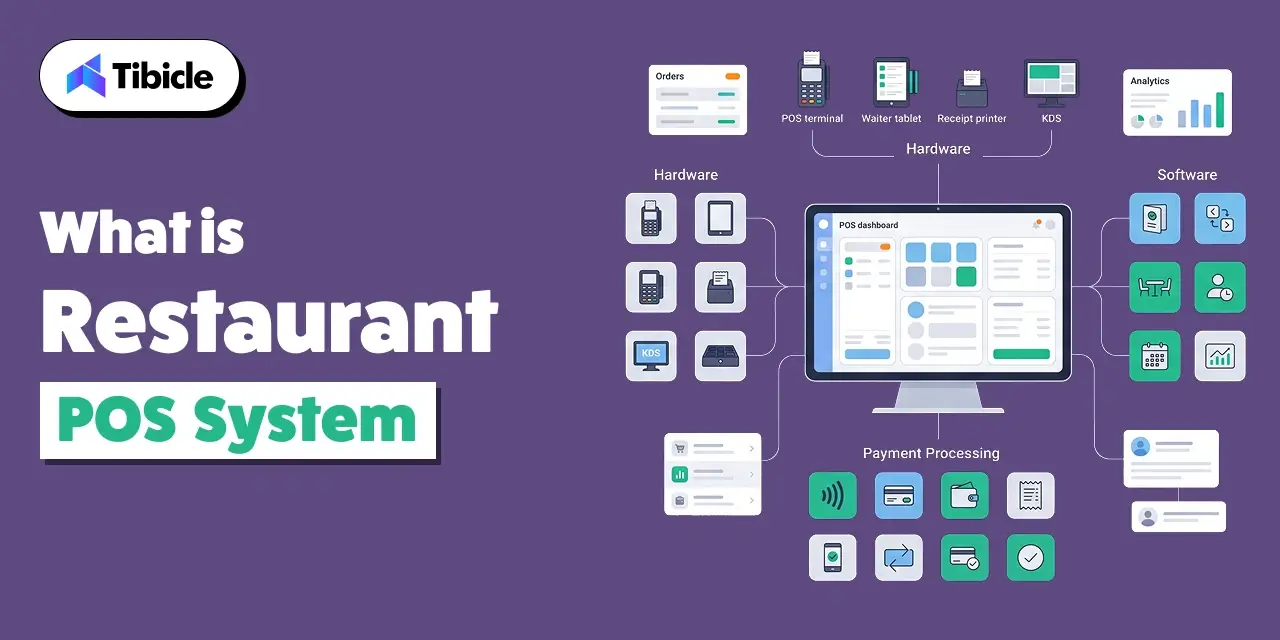
A restaurant POS system is the combination of hardware and software that processes orders and payments. It tracks what happens across the restaurant. The hardware is what staff touch during service: terminals, tablets, card readers, and kitchen screens. The restaurant POS software is the brain: it handles menus, order routing, payments, and reporting. Understanding that split is the first step to comparing restaurant POS systems fairly.
The distinction matters because restaurant POS systems are sold as bundles, and the pieces do not carry equal weight. Hardware is a one-time or financed cost. The restaurant POS software is where daily workflow lives. Payment processing, discussed later, is where most of the money actually goes. A clear-eyed buyer separates the three before comparing quotes.
The Main Types of Restaurant POS Systems
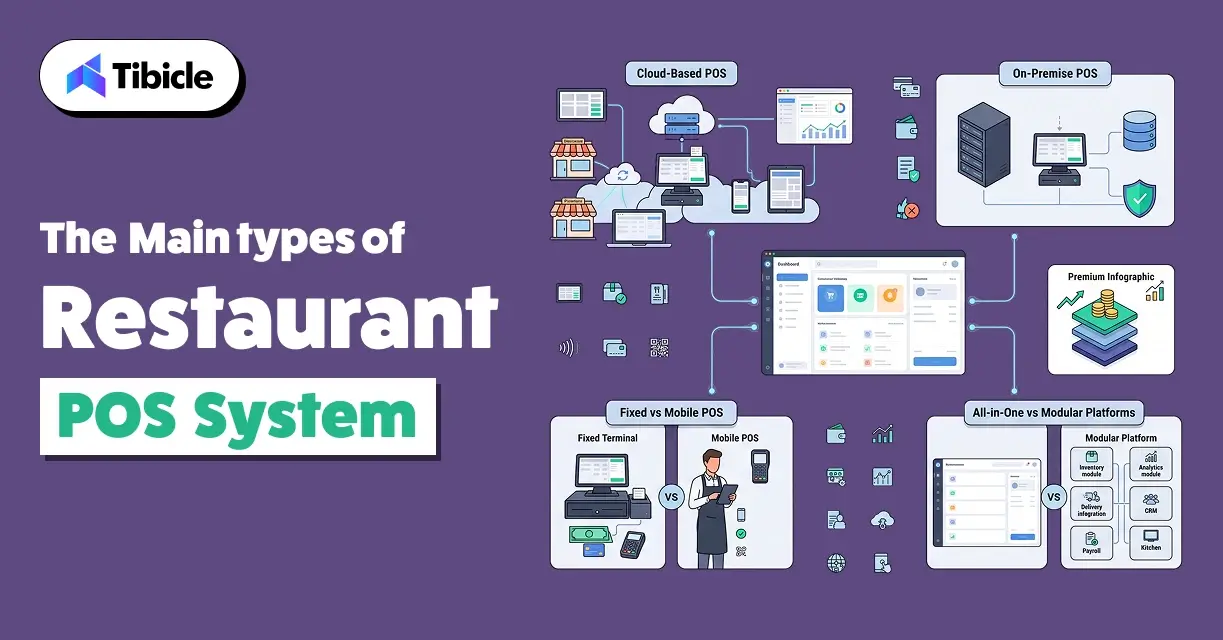
Restaurant POS systems split along two axes: how they are deployed, and what form the hardware takes. Both shape cost, flexibility, and fit, and both matter when you compare them side by side.
Cloud-Based POS Systems
A cloud-based POS system stores data on remote servers and runs as a subscription. A cloud-based POS system updates automatically, syncs across locations in real time, and lets an operator check performance from any device, anywhere. This is the direction the market is moving: the cloud segment is growing faster than on-premise, at above 9% CAGR, because a cloud-based POS system lowers upfront cost and shifts hardware-maintenance risk to the provider. For most restaurants opening today, a cloud-based POS system is the default choice among restaurant POS systems.
On-Premise POS Systems
On-premise systems keep data on local servers inside the restaurant. They appeal to large operators who want tight control, work offline reliably, and keep data behind their own firewall. The trade-off versus a cloud-based POS system is higher upfront cost, manual updates, and harder multi-location reporting. On-premise still has a place, but a cloud-based POS system is the rule rather than the exception in 2026.
Fixed vs Mobile Terminals
Independent of deployment, restaurant POS systems come as fixed stations or mobile terminals, and both can run on a cloud-based POS system. Fixed terminals anchor a counter or checkout. Mobile POS, handhelds and tablets, let servers take orders and payment tableside, cut ticket errors, and speed up table turns. Mobile is the fastest-growing hardware form among restaurant POS systems because it fits the way service actually flows.
All-in-One vs Modular Platforms
Some restaurant POS systems bundle everything- ordering, payments, loyalty- into one platform; others let you assemble modules. Independent restaurants and small cafes usually prefer all-in-one platforms for their ease of use, often a cloud-based POS system, while franchises and chains invest in scalable, enterprise-grade restaurant POS systems with multi-location sync.
Core Features to Look For
Feature lists across restaurant POS systems are long; the ones that decide day-to-day value are short. These are the capabilities worth weighting most.
- Order routing and kitchen display: orders should flow straight from the restaurant POS software to a kitchen display, reducing errors and improving ticket times. This is a baseline test of good restaurant POS software.
- Payment flexibility: the restaurant POS software should accept credit, debit, mobile wallets, and contactless, plus split checks by seat, item, or percentage.
- Inventory tracking: stock that depletes against sales in real time, so food cost stays visible before month-end; a cloud-based POS system handles this best.
- Menu management: update items, pricing, and specials once in the restaurant POS software and have it sync across every terminal and online channel.
- Reporting and analytics: the restaurant POS software should surface daily sales, labor, and menu-performance data, ideally by location, available from any device.
- Delivery and online-order integration: the restaurant POS software should connect directly to delivery aggregators, with orders routed into the same system instead of a separate tablet.
- Loyalty and CRM: built-in rewards and customer data in the restaurant POS software that turn first-time visitors into regulars.
The strongest restaurant POS systems tie these together on one data source. A kitchen display disconnected from inventory, or loyalty that does not read the restaurant POS software, recreates the silos POS systems were meant to remove.
What Restaurant POS Systems Cost in 2026
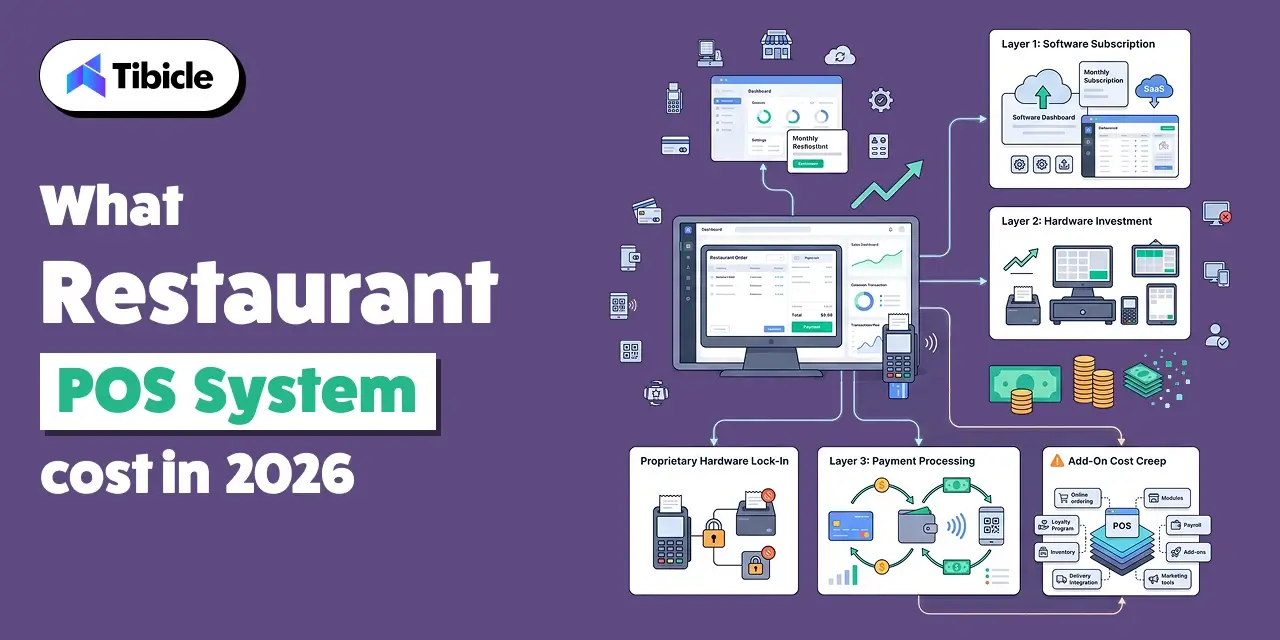
Every restaurant POS system bill has three layers, and vendors compete hardest on the one you notice least. Understanding all three is the difference between a budget that holds and one that doubles by invoice three, and it is the single most useful skill when comparing POS systems.
| Cost Layer | Typical Range (2026) | Notes |
| Software (monthly) | $0 to ~$399 / month | The advertised number, and the smallest layer; free tiers exist |
| Hardware (per terminal) | $600 to $2,000; full setup $2,000 to $4,000 | Some vendors lock you to proprietary hardware |
| Processing (per swipe) | ~2.3% to 2.99% + $0.10 to $0.15 | Usually the highest cost by far; see below |
The layer that dominates is processing. On $50,000 a month in card volume, processing runs roughly $12,000 to $18,000 a year, far more than software and hardware combined, per a 2026 cost breakdown. A restaurant POS system with a low headline price on its restaurant POS software but a higher processing rate can cost more overall than a pricier one with a lower rate. All in, a single-location restaurant typically spends $1,200 to $5,000 a month on its full stack, most of it processing, according to a vendor-neutral pricing analysis.
Two traps hide in the fine print: proprietary-hardware lock-in, where leaving a vendor turns $1,500 to $3,000 of terminals into paperweights, and add-on creep, where a $69 base plan reaches $150 to $500 a month once online ordering, loyalty, and payroll modules are added.
How to Choose the Right One
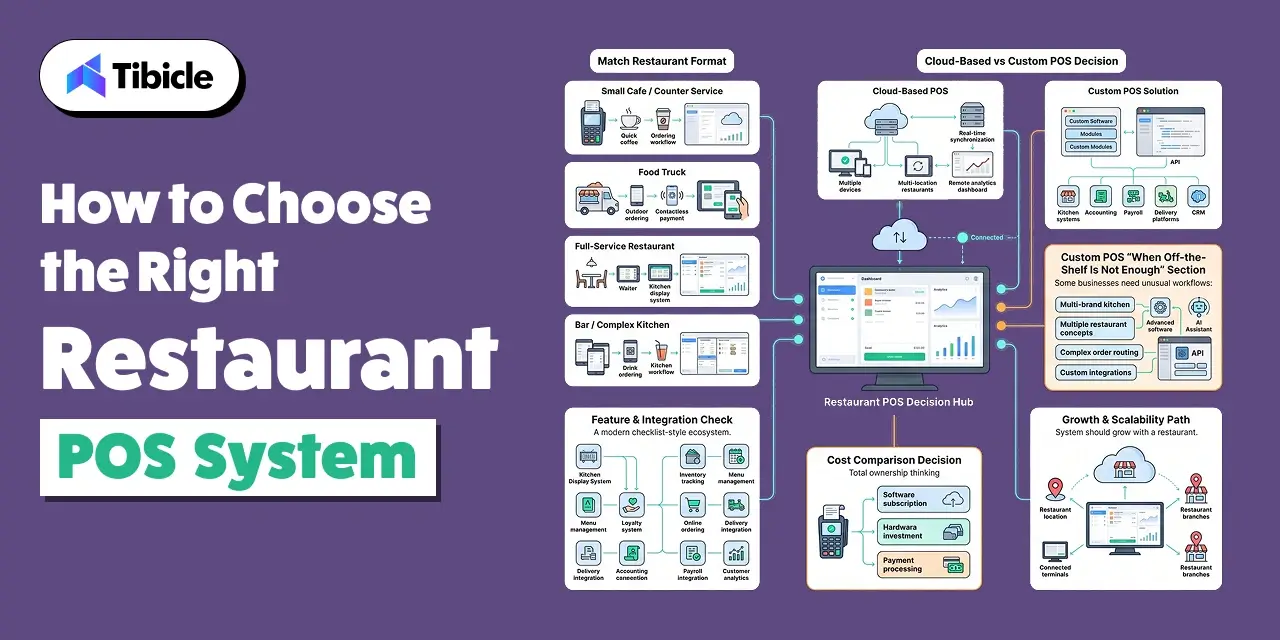
The right restaurant POS system depends on your format, your volume, and your growth plan. Use this short framework to narrow the field of POS systems:
- Match the type to your model: counter-service and food trucks lean toward a simple cloud-based POS system; full-service and bars need deeper table management and coursing. The type of restaurant POS system matters as much as the brand.
- Compare the all-in monthly total: add restaurant POS software, hardware amortization, and processing. Never compare headline software prices alone.
- Check the contract and hardware terms: month-to-month with standard hardware protects flexibility; some restaurant POS systems use multi-year terms with proprietary hardware that raise switching costs.
- Verify integrations: confirm the restaurant POS software connects to your delivery apps, accounting, and payroll without custom work, since weak integration is the most common restaurant POS software complaint.
- Plan for scale: choose restaurant POS systems that price predictably as you add locations, not ones that penalize each new terminal. A cloud-based POS system usually scales more cleanly here.
For a small cafe, an affordable all-in-one cloud-based POS system is usually the right call. For a full-service restaurant with bar and kitchen complexity, a feature-rich platform earns its higher cost. The mistake is choosing the demo that looked best in the room instead of the restaurant POS system that fits how your kitchen actually runs.
When Off-the-Shelf Is Not Enough
Off-the-shelf POS systems cover most operations well. They fall short for businesses with non-standard workflows: multi-brand dark kitchens routing orders across concepts, franchises needing custom procurement logic, or operators whose existing systems will not integrate with any mainstream restaurant POS software. Forcing a packaged platform to fit those cases often costs more in workarounds than a purpose-built system would, which is where custom restaurant POS systems come in.
Tibicle LLP builds custom POS software, connected kitchen systems, and AI-driven restaurant applications for operators in that category. Its restaurant tech and custom POS services run from a scoped MVP to a full restaurant POS software build shaped around how a specific operation works. For operators who have outgrown packaged restaurant POS systems, or need one that connects cleanly to the rest of their stack, a custom build is worth costing out against the alternative.
Conclusion
Restaurant POS systems are no longer just cash registers; they are the data hub every other system reads from. Choosing among the systems comes down to three things: picking the type that fits your format, weighting the features that move the P&L, and comparing the all-in cost, especially processing, rather than the headline restaurant POS software price.
Most operators are well served by a mainstream cloud-based POS system. Those with complex, multi-brand, or integration-heavy operations should weigh a custom build before signing a multi-year contract on packaged POS systems.
Comparing restaurant POS systems, or scoping a custom build? Talk to the Tibicle team, or see their guide to the best restaurant accounting software in 2026.
Frequently Asked Questions
What are restaurant POS systems?
These are the hardware-and-software setups that process orders and payments while tracking sales, inventory, and labor. The restaurant POS software handles menus, routing, and reporting; the hardware is what staff use during service.
How much do restaurant POS systems cost in 2026?
Across restaurant POS systems, software runs $0 to about $399 a month, hardware $600 to $2,000 per terminal, and processing roughly 2.3% to 2.99% per swipe. All in, a single location typically spends $1,200 to $5,000 a month, most of it processing fees.
What is a cloud-based POS system?
A cloud-based POS system stores data on remote servers and runs as a subscription, so it updates automatically, syncs across locations in real time, and can be managed from any device. Among restaurant POS systems, a cloud-based POS system is the fastest-growing and most common choice for new restaurants.
Which POS type is best for a small restaurant?
A cloud-based, all-in-one platform is usually best for small or counter-service restaurants: low upfront cost, easy setup, and predictable pricing. Full-service restaurants with bars and complex kitchens need restaurant POS software with deeper table management and coursing.
When should a restaurant use a custom POS instead?
When workflows are non-standard, multi-brand dark kitchens, custom procurement, or systems that will not integrate, customizing a packaged restaurant POS system costs as much as building a purpose-fit one. That is when custom restaurant POS systems make sense.
Schedule A Developer Interview And Get 15 Days Risk-Free Trial
Schedule a Call

Relevant Blog
Enterprise LLM Integration Services

Prejin Nadar

Building Private local AI Desktop App Development
Prejin Nadar
Written by

Recent Blogs
Enterprise LLM Integration Services
What This Guide Covers Who this is for Enterprise LLM integration services help engineering leaders, platform teams, and technology executives turn existing model access into working production workflows. This guide is for organisations connecting OpenAI, Claude, or both to systems that support real business processes, including CRM platforms, ticketing systems, document pipelines, and internal tools. […]
When to Hire an AI Software Development Consulting Firm.
What This Guide Covers Who this is for Engineering leaders, technology executives, and AI teams often struggle to turn completed initiatives into measurable results. This guide helps organisations address stalled pilots, failed AI implementations, rising costs, poor data quality, and workflows that function technically but fail to deliver measurable business value. An AI software development […]
Building Private local AI Desktop App Development
What This Guide Covers Who this is for: US tech firms, SaaS companies, startups, CTOs, engineering managers, and product teams looking for experienced Electron.js developers for ongoing private local AI desktop app development and custom desktop application development. Search intent: Hiring and decision. This guide covers where to find Electron.js developers, how to evaluate their […]
Got an Idea? Get FREE Consultation
In our world, there's no such thing as having too many clients

