
Top AI Integration Services Companies for Enterprise in 2026

Apr 02, 2026

Read in 4 Minutes
Table of Contents
- Introduction
- How AI Integration Actually Works
- 1. Tibicle: End-to-End AI Integration Services Built for Production-Grade GenAI Deployment
- 2. LeewayHertz: AI Integration Company Specializing in LLM-Powered Business Workflows
- 3. Accenture: End-to-End AI Integration Solutions From Strategy to Secure Deployment
- 4. Algoscale: Custom AI Integration Services for Full-Cycle GenAI Deployment
- 5. Hexaware Technologies: AI Integration Company With a Structured Use-Case Evaluation Framework
- Comparison Table: Top 5 AI Integration Services
- Why Tibicle Earns Its Spot Among Production-Ready AI Integration Services
- Conclusion
- FAQs
Introduction
According to McKinsey (2024), 72% of organizations now use AI. However, most GenAI projects never reach production. The gap isn’t ambition – it’s execution. In many cases, businesses lack the right AI integration services to turn experiments into working systems. While 65% of companies report regular GenAI usage, fewer than one in three achieve measurable ROI at scale.
With the global GenAI market growing at a 36.99% CAGR through 2031, choosing the right AI integration services is a strategic make-or-break decision. What separates a functional GenAI deployment from a failed pilot comes down to architecture, data readiness, and the right integration partner.
This guide covers the top 5 AI integration services helping enterprises move from experiments to production systems that deliver results.
How AI Integration Actually Works
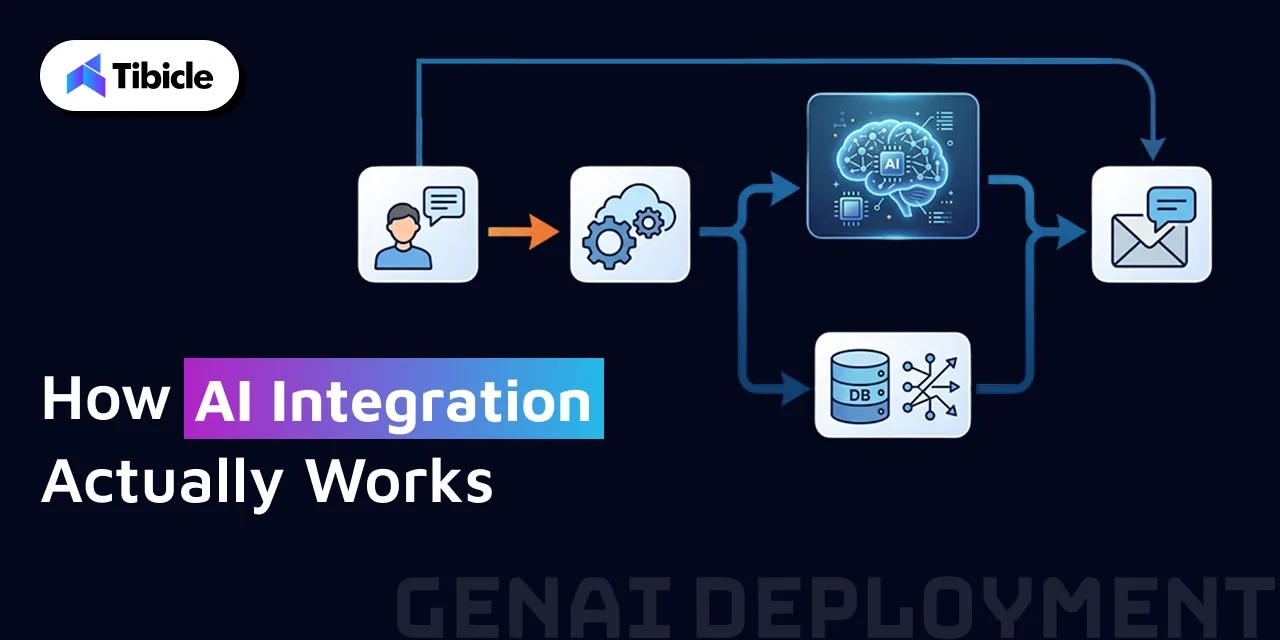
AI integration is not just about plugging in a model; it’s about making that model work smoothly with your existing systems and data.
Here’s how it usually works in practice:
- API Integration:
AI models (such as LLMs) are integrated with your app via APIs. This allows your system to send data to the model and get responses in real time. - RAG Pipelines (Retrieval-Augmented Generation):
Instead of relying only on pre-trained data, the AI pulls relevant information from your own database or documents before generating a response. This improves accuracy and reduces wrong outputs. - Vector Databases:
Your data (documents, FAQs, etc.) is converted into embeddings and stored in a vector database. This helps the AI quickly find the most relevant information when needed. - Workflow Integration:
AI is integrated with tools like CRM, ERP, and internal dashboards, so it becomes part of your daily operations, not a separate tool. - Model Deployment & Monitoring:
Once everything is live, the system is monitored regularly to track performance, fix issues, and improve responses over time.
In simple terms, good AI integration services make sure your AI doesn’t just exist—it actually works inside your business.
1. Tibicle: End-to-End AI Integration Services Built for Production-Grade GenAI Deployment
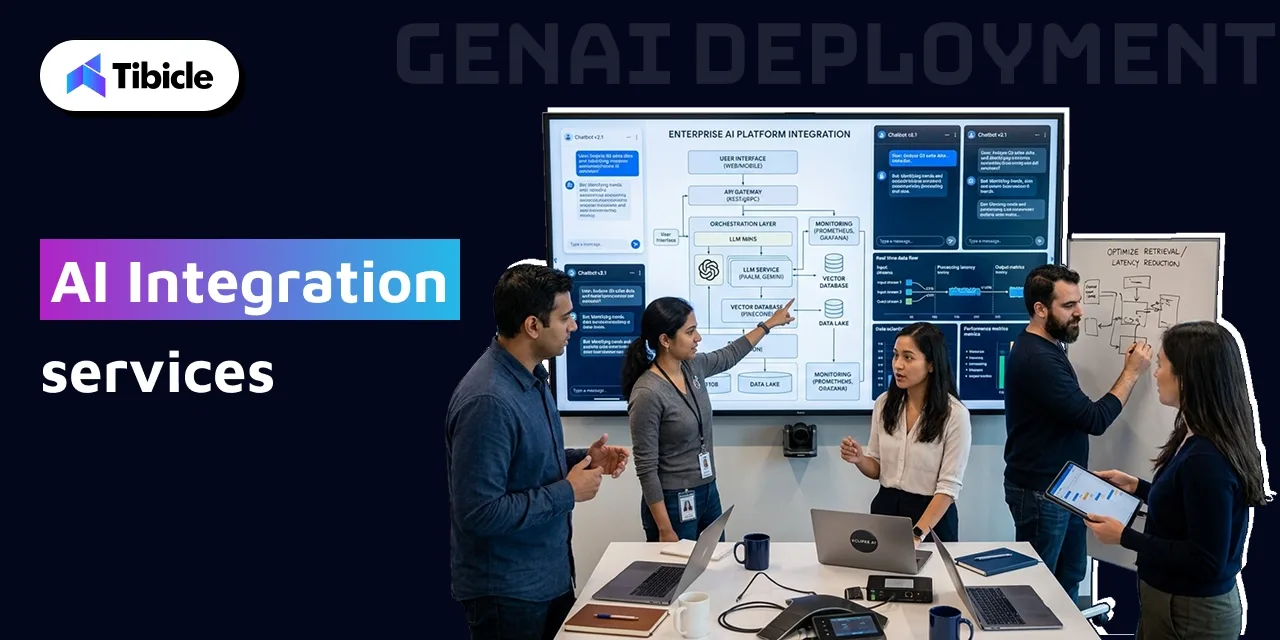
When it comes to AI integration services that actually ship to production, Tibicle stands out for the right reasons. Tibicle builds and deploys full-cycle AI solutions, multilingual chatbots, semantic search systems, recommendation engines, and AI-powered LMS platforms across both web and mobile environments. Their approach is not proof-of-concept-first. It is production-first.
What makes Tibicle operationally distinct is its sprint-based delivery model. Weekly client reviews, clear milestone documentation, and scope-change protocols are baked into every engagement from day one. This makes GenAI rollouts auditable, transparent, and far less likely to drift off-track mid-project.
Tibicle serves startups, SMBs, and enterprises across edtech, healthcare, e-commerce, and SaaS verticals, bringing the same production rigor to a 10-person team as it does to a scaling enterprise.
What Sets Tibicle Apart from Larger AI Integration Vendors
The results speak directly to execution quality. A deployed AI chatbot handled 75% of customer queries within the first month of going live and reduced manual ticket creation by 60%, results independently verified on Clutch.
Equally important is accessibility. Tibicle’s flexible engagement model starts at $25–$49/hr with a $1,000 minimum project threshold. That means production-grade GenAI integration is within reach without the budget overhead of enterprise-scale vendors.
2. LeewayHertz: AI Integration Company Specializing in LLM-Powered Business Workflows
LeewayHertz has built a strong reputation for embedding large language models directly into enterprise business workflows without forcing organizations to rebuild existing infrastructure. Their core offering centers on custom AI Copilots and autonomous Agents designed to plug into the systems enterprises already rely on.
Beyond the initial build, LeewayHertz covers the full MLOps lifecycle, model deployment, real-time monitoring, and governance controls that keep AI systems stable and compliant in production. Their cross-industry capability spans NLP, computer vision, and predictive modeling, making them a strong choice for organizations with complex, multi-function AI requirements.
How LeewayHertz Handles AI System Integration Without Workflow Breaks
LeewayHertz uses middleware connectors to link LLMs with CRM and ERP platforms without requiring organizations to reengineer core infrastructure. This keeps integration timelines tighter and operational disruption minimal.
On the accuracy side, their production-grade RAG (Retrieval-Augmented Generation) pipelines are specifically designed to reduce hallucination risk, a critical factor for domain-specific deployments in legal, financial, and healthcare environments where output reliability is non-negotiable.
3. Accenture: End-to-End AI Integration Solutions From Strategy to Secure Deployment
Accenture approaches AI integration at the enterprise transformation level. Their process takes organizations from initial AI strategy development through to a fully secured, AI-enabled digital core, covering every layer in between, including data architecture, compliance frameworks, and change management.
A key differentiator is their structured proof-of-concept validation process. Before any GenAI capability scales across business units, Accenture builds roadmaps that stress-test feasibility against real organizational data and infrastructure. This dramatically reduces the risk of expensive failures at scale.
Accenture is particularly well-positioned for large multimodal GenAI systems that require alignment across departments, data sources, legal jurisdictions, and governance structures simultaneously.
Where Accenture’s AI Integration Services Add the Most Value
Accenture’s strongest contribution sits at the intersection of compliance, scale, and deployment speed. Their frameworks are designed for organizations where a single misstep in data governance or security can carry regulatory consequences.
According to IDC research, companies with strong AI integration achieve an average 3.7x ROI from AI, with top AI leaders reaching as high as 10.3x returns. Accenture is built for organizations operating at that upper tier of complexity and investment, particularly Fortune 500 companies navigating multi-stakeholder GenAI transformations with strict data governance requirements.
4. Algoscale: Custom AI Integration Services for Full-Cycle GenAI Deployment
Algoscale delivers end-to-end GenAI integration across the full development and deployment spectrum, from LLM fine-tuning and RAG implementation to text, image, and speech-based application development. They do not hand off at the model stage. Their involvement runs from ideation through model training, deployment, systems integration, and ongoing optimization.
This full-cycle commitment matters more than it might appear. Research indicates that companies using comprehensive GenAI integration solutions report 3.7x returns once they successfully exit the pilot phase. Getting through that transition, from pilot to production, requires exactly the kind of sustained, end-to-end support that Algoscale provides.
Algoscale’s Approach at Enterprise Scale
Algoscale integrates vector databases alongside retrieval-augmented generation architectures to improve output precision at scale. This combination addresses one of the most common production failures in enterprise GenAI: degraded accuracy as data volume and query complexity increase.
Their domain-tuned models are particularly effective in high-stakes sectors. In fintech and healthcare, where error rates carry direct compliance and safety implications, domain-specific fine-tuning meaningfully reduces failure rates compared to general-purpose model deployments.
5. Hexaware Technologies: AI Integration Company With a Structured Use-Case Evaluation Framework
Hexaware Technologies brings a methodical, framework-driven approach to AI integration services that addresses one of the most common early-stage failure points: choosing the wrong use cases to build on. Their proprietary Decode and Encode frameworks divide the integration journey into two disciplined phases.
Decode is the discovery phase, identifying which GenAI use cases are technically feasible, data-ready, and high-impact within the client’s specific operating environment. Encode is the execution phase, bringing validated use cases to production with built-in speed, governance controls, and multilingual workflow support. Delivery runs through Hexaware’s Service Experience Accelerator, which incorporates state-transition logic to manage complex, multi-step AI workflows reliably.
Hexaware’s structured approach has earned it recognition as one of only 13 providers acknowledged as a leader in both GenAI strategy and deployment services.
Why the Decode Framework Changes How AI System Integration Gets Prioritized
Most enterprise AI integration projects do not fail during execution. They fail because the wrong use cases were prioritized in the first place, cases that lacked sufficient data quality, organizational readiness, or clear business value.
Decode forces feasibility-first thinking. Before a single line of integration code is written, use cases are evaluated against the client’s actual data environment, infrastructure constraints, and measurable business outcomes. This front-loaded rigor is what separates integrations that survive production from those that stall at staging.
Comparison Table: Top 5 AI Integration Services
| Provider | Best For | Core Strengths |
| Tibicle | Startups, SMBs, Enterprises | Full-cycle GenAI, sprint delivery, chatbots, semantic search |
| LeewayHertz | LLM workflow automation | AI Copilots, MLOps lifecycle, RAG pipelines |
| Accenture | Large-scale transformation | Strategy to deployment, compliance, multimodal GenAI |
| Algoscale | Full-cycle GenAI deployment | LLM fine-tuning, RAG, vector DB, domain-tuned models |
| Hexaware | Use-case prioritization | Decode/Encode framework, governance, multilingual workflows |
Why Tibicle Earns Its Spot Among Production-Ready AI Integration Services
Among the five providers in this guide, Tibicle stands out for making production-grade AI integration services genuinely accessible not just to enterprise organizations with seven-figure technology budgets, but to startups, SMBs, and growth-stage companies with real business problems to solve.
Their deployed portfolio includes multilingual chatbots, semantic search systems, and recommendation engines across edtech and SaaS clients, not prototype demos, but live production systems delivering verified outcomes. One deployed chatbot resolved 75% of customer queries in its first month of operation and cut manual ticket creation by 60%.
Conclusion
GenAI implementation is not fundamentally a technology problem. It is an architecture problem and a data problem. Organizations that treat it as a software procurement exercise consistently find themselves stuck in a cycle of failed pilots and delayed ROI.
When properly integrated, GenAI can automate 60–70% of repetitive employee tasks, but only when the underlying data infrastructure, system connectors, and governance controls are correctly built. Poor AI integration solutions do not just underdeliver. They create active governance gaps, open security vulnerabilities, and drain resources without producing measurable returns.
Choosing the right AI integration services means evaluating providers against your actual production requirements, your existing tech stack, your compliance obligations, your data quality, and your timeline, not their feature lists.
Ready to move from experimentation to production? Schedule a consultation with an AI integration company that fits your tech stack and compliance requirements today.
FAQs
What do AI integration services include?
They include things like LLM deployment, RAG systems, API integrations, model monitoring, and ongoing improvements.
How is an AI integration company different from an AI development firm?
Development focuses on building models, while integration is about connecting those models with your existing systems and making them usable.
What does smooth AI system integration look like?
It means no downtime, proper connection with your tools (like CRM/ERP), and testing alongside your current system before full rollout.
How long does AI integration take?
Usually between 3 to 12 months, depending on how complex your systems and data are.
What are the risks of poor AI integration?
You can face wrong outputs, security risks, inefficiencies, and compliance issues.
Which industries benefit the most from AI integration?
Healthcare, fintech, e-commerce, manufacturing, and HR tech, basically any industry dealing with large data or repetitive processes.
Schedule A Developer Interview And Get 15 Days Risk-Free Trial
Schedule a Call

Relevant Blog
HubSpot vs Salesforce: Which CRM Is Best in 2026?

Avni Kanabar

Risk Management In IT Projects
Avni Kanabar
Written by

Recent Blogs
HubSpot vs Salesforce: Which CRM Is Best in 2026?
Introduction The global CRM market is projected to exceed $80 billion in 2026, with HubSpot vs Salesforce consistently ranking as the two most evaluated platforms across mid-market and enterprise CRM shortlists. For revenue leaders, CXOs, and operations teams, this decision is not simply a software subscription change – it is a long-term infrastructure commitment that […]
What Is IT Outsourcing? A Decision-Maker’s Guide for (2026)
Introduction The global IT Outsourcing market is estimated at $662 billion in 2026 and is projected to reach $1.345 trillion by 2034 at an 8.2% CAGR. At the same time, 77% of employers report difficulty finding skilled technology talent, pushing companies toward global outsourcing partners for delivery support and specialized expertise. Modern outsourcing is no […]
Risk Management In IT Projects
Introduction According to PMI’s 2025 Pulse Report, only 58% of IT projects finish within budget, and just 52% are delivered on schedule. These figures show that risk management in IT projects is not just a compliance activity but a financial protection mechanism. Organizations that implement structured IT project risk assessment and project risk mitigation strategies […]
Got an Idea? Get FREE Consultation
In our world, there's no such thing as having too many clients

